
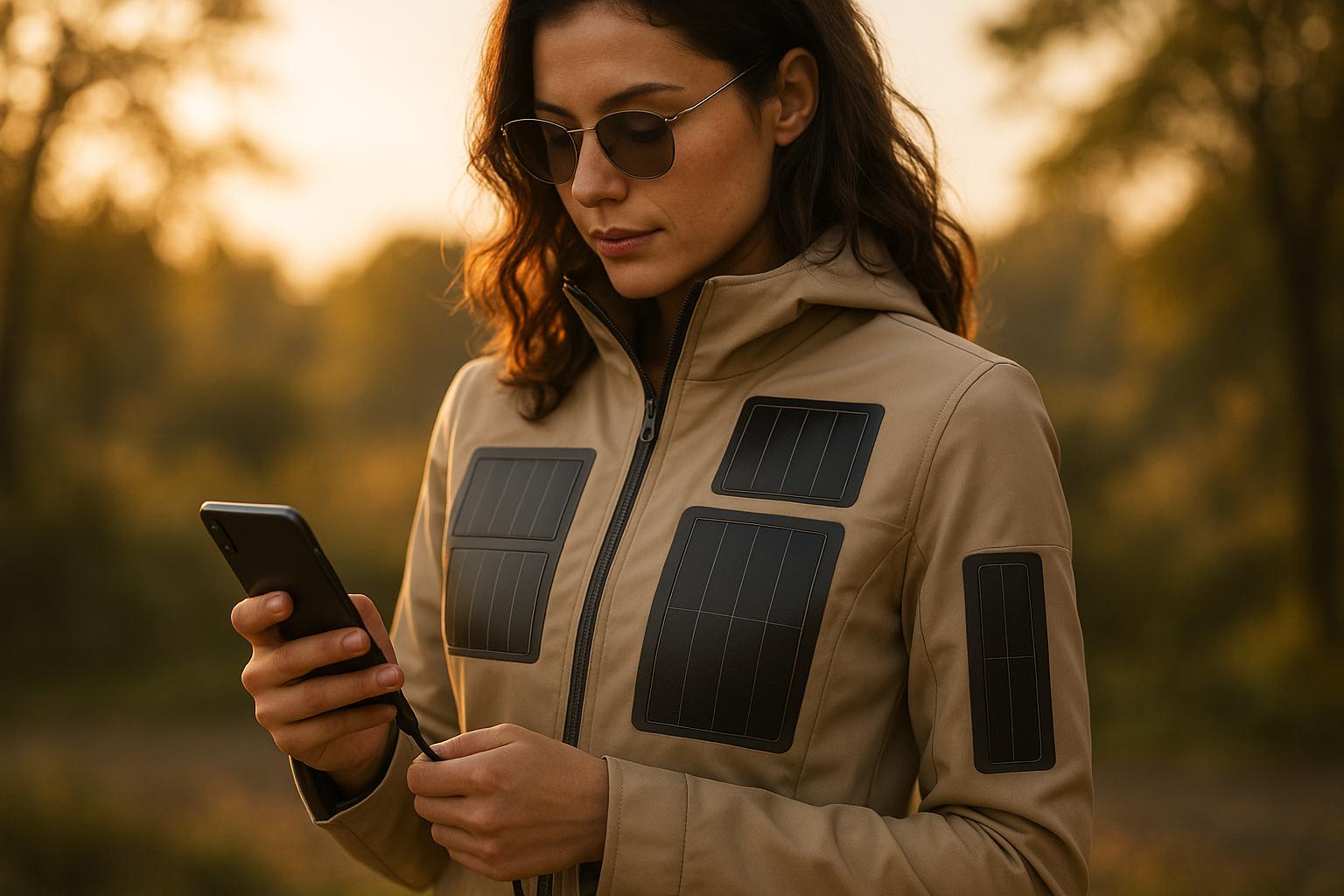
Solar-powered wearables combine style and energy functionality, turning everyday items like jackets, backpacks, and jewelry into portable power sources. These innovations allow users to charge devices, power LEDs, or even regulate temperature – all while reducing electricity costs and carbon emissions. Here’s a quick breakdown:
- How It Works: Wearables use sunlight to generate electricity, with some backpacks charging smartphones in 2–3 hours of sunlight.
- Environmental Impact: Each wearable can save $30–$50 annually on energy bills and prevent 50–75 pounds of CO2 emissions.
- Popular Items: Solar-powered backpacks, jackets, shirts, and jewelry are gaining traction, offering both practicality and eco-conscious design.
- Market Growth: The solar backpack market alone is projected to hit $104.07 million by 2027, reflecting growing interest in these products.
These wearables are reshaping how we think about clothing, blending energy efficiency with modern design. Below, we dive into the key features, durability, and challenges of solar-powered fashion.
Make It Wearable | Solar-Powered Fashion That Charges Your Phone
1. Solar-powered bags and backpacks
Solar-powered bags and backpacks offer a practical and stylish way to explore wearable solar technology. By combining energy generation with everyday functionality, they’re perfect for students, commuters, and outdoor enthusiasts who need a reliable power source while on the move.
Design aesthetics
Striking the right balance between function and style is key for designers. Modern solar backpacks often feature sleek, minimalist designs paired with tech-inspired details like clean lines, metallic finishes, and integrated LED lights. Some even incorporate subtle vintage elements for added character. A great example is the Fil & Fog backpack line from the Paris-based studio Fritsch-Durisotti, which uses water-resistant TPU coatings and high-frequency welding to create durable yet refined designs. Customization is another growing trend, allowing users to showcase their personal style while embracing sustainable technology. Lightweight, water-resistant materials are also being prioritized to meet both practical needs and visual appeal.
Energy efficiency
The efficiency of solar backpacks hinges on factors like the quality of the solar panels, battery capacity, and MPPT (Maximum Power Point Tracking) technology. Solar panels generally perform best in temperatures between 59°F and 95°F (15°C to 35°C), though higher temperatures can decrease output by 10% to 25%. Proper panel positioning is also crucial for maximizing energy collection. Here’s a look at some current market options:
| Brand | Solar Panel Power | Battery Capacity | Key Features |
|---|---|---|---|
| Voltaic Systems Array | 10 watts | 19,800 mAh | Can charge laptops |
| Kingsons Solar Backpack | 15 watts | 10,000 mAh | Highest wattage output |
| ECEEN Solar Backpack | 7 watts | 10,000 mAh | Mid-range performance |
| XD Design Solar Backpack | 6 watts | 10,000 mAh | Compact design focus |
For instance, the Voltaic Systems Array stands out for its ability to charge laptops, while other brands focus more on powering smaller devices like smartphones and tablets.
Durability and maintenance
Solar backpacks are built to endure daily use while safeguarding their solar components. Most models come with warranties guaranteeing at least 90% performance for the first 10 years and 80% for the following 15–20 years. Over a 25-year span, overall performance typically degrades by 8–14%. Wool & Oak’s Carry-On Backpack is a great example of durability, featuring a modular system with five separate bags that can be individually replaced as needed. To keep your backpack running efficiently, regularly clean the solar panels and ensure they’re well-ventilated.
Eco-friendliness
These backpacks don’t just power devices – they also contribute to reducing carbon emissions. Each unit can offset approximately 50–75 pounds of CO2 annually while generating 5 to 10 watts of power. This makes them a practical choice for recharging devices during daily commutes. One inspiring example is the Soma Bags initiative in Tanzania, led by social entrepreneur Innocent James. These backpacks, made from recycled cement bags and traditional fabrics, absorb sunlight during the day to provide up to 8 hours of light at night, helping children in areas without electricity study after dark. Additionally, many manufacturers are now incorporating recycled plastics and adopting sustainable production methods to further minimize environmental impact.
Price range
In 2021, the solar backpack market was valued at $61.59 million and is expected to grow at an annual rate of 9.14%, reaching $104.07 million by 2027. Prices vary widely depending on factors like solar panel efficiency, battery capacity, build quality, and brand reputation. As the technology advances and production scales up, these products are likely to become more affordable for everyday consumers. This progress is paving the way for other solar-powered wearables, including smart jackets and outerwear, which will be explored in the next section.
2. Smart Jackets and Outerwear
Solar-powered jackets bring together fashion and technology by incorporating solar elements into clothing.
Energy Efficiency
While solar textiles aren’t as efficient as traditional solar panels at converting sunlight into energy, they offer a unique advantage: they can adapt to different shapes and still generate power while keeping you warm. This dual functionality makes them an intriguing option for wearable tech, even if their energy output isn’t as high.
Durability and Maintenance
Caring for these high-tech garments requires extra attention. The longevity of the electronics inside depends on how flexible and well-protected the solar cells and wiring are. Here are some tips to keep your solar-powered jacket in good shape:
- Always disconnect the power source before washing.
- Use detergents designed for technical fabrics and waterproof coatings.
- Air-dry the garment instead of using a dryer.
- Regularly check for any loose wires or damage.
- Store the jacket in a cool, dry place, away from direct sunlight.
With proper care, these innovative garments can remain functional and stylish for a long time.
3. Solar Dresses and Shirts
Solar dresses and shirts combine cutting-edge design with renewable energy, blending style and practicality. These garments incorporate flexible solar panels, enabling them to power LEDs or charge small devices.
Design Aesthetics
Today’s designers are finding clever ways to integrate solar cells into clothing without compromising style. For instance, Dutch designer Pauline van Dongen has created the Solar Shirt, which incorporates ultra-thin, flexible solar panels directly into the fabric. The result? A garment that’s not just energy-efficient but also sleek and comfortable to wear. This seamless integration ensures the clothing remains fashionable while maximizing energy collection.
Energy Efficiency
The energy performance of solar clothing depends on the type of solar technology used. Perovskite solar cells, for example, are making waves in wearable tech. These lightweight, crystal-based materials can capture a wider spectrum of light, even in low-light conditions like cloudy weather or shaded areas. Flexible perovskite cells now boast efficiency rates nearing 25%. A practical example is the Guilin solar-power dress by Art by Physicist, which uses lotus-shaped organic photovoltaic modules. This dress can charge a phone battery by about 30% in just five hours, and it even works under indoor lighting.
Durability and Maintenance
One of the biggest challenges with solar-powered clothing is ensuring the solar cells can withstand daily wear and washing. Impressively, solar fabrics maintain 90% of their energy output after 15 machine washes and endure 6,000 abrasion cycles with only a 5.6% drop in performance. Advanced encapsulation techniques, like SiO₂-polymer composites, offer additional protection, making these garments more durable and practical for everyday use.
Eco-Friendliness
Solar dresses and shirts are gaining popularity at events that emphasize sustainability, appealing to environmentally conscious consumers. By cutting down on traditional charging methods, these garments help reduce overall energy consumption from the grid. Researchers are also working on transparent solar cells, which could lead to clothing that looks and feels like regular apparel but generates energy. Additionally, fabrics that can convert body heat into electricity are on the horizon, promising even more sustainable options. Up next, solar-powered jewelry continues this exciting mix of fashion and green energy.
sbb-itb-593149b
4. Solar-powered Jewelry
Solar-powered jewelry takes the concept of wearable technology to a new level, combining traditional accessories with functional solar energy capabilities. These pieces can power small LED displays or even charge connected devices, making them both stylish and practical.
Design Aesthetics
Modern solar jewelry balances sleek design with cutting-edge technology. Many pieces feature minimalist styles that discreetly integrate solar components, allowing for a seamless look. Customization options are abundant, letting users choose metals, colors, and even specific functionalities. Designers often draw inspiration from natural forms, giving these accessories an organic and elegant appearance.
One standout example is the Tago Arc smart bracelet by Liber 8 Technology. Originally launched in 2015 and updated in 2024, this bracelet uses a flexible e-paper display that can be customized via nine different applications or with user-uploaded designs. What sets it apart is its energy source – it uses a phone’s NFC reader to power its display, eliminating the need for traditional charging. Davin Chi, the creator of the Momento collection, describes his smart jewelry as:
"a digital locket for the 21st century".
This fusion of fashion and functionality highlights the potential of solar-powered jewelry to provide energy solutions in compact, wearable forms.
Energy Efficiency
Harvesting energy efficiently is a challenge for solar jewelry due to its small surface area and the constant movement of the wearer. The placement of solar panels is crucial, as factors like shading, deformation, and shifting angles of light can significantly impact performance. Interestingly, the angle of light hitting the panel often has a greater effect on energy output than the curvature of the accessory itself.
Flexible polymer solar panels are commonly used in these designs, each offering different levels of efficiency. For instance:
- CIGS panels achieve up to 20.4% efficiency.
- CdTe panels operate around 13.8%.
- Amorphous silicon panels offer about 7.1% efficiency.
While amorphous silicon panels are less efficient, their flexibility makes them ideal for wearables. Panels that contour to the body can provide more consistent energy generation under varying lighting conditions. Additionally, connecting smaller panels in parallel can improve power output, especially in environments with uneven lighting.
Durability and Maintenance
Solar jewelry is relatively low-maintenance, requiring just a few hours of sunlight every few weeks to stay charged. However, exposure to extreme temperatures – like leaving the jewelry on a car dashboard or in direct sunlight for long periods – can damage its internal components. Materials like leather or urethane bands are particularly susceptible to discoloration when exposed to the sun for extended periods.
To keep solar jewelry in good condition, it’s best to store it in a cool, dry place away from direct sunlight when not in use. Cleaning the surface with a soft, lint-free cloth helps maintain the efficiency of the solar cells. Avoid harsh cleaning agents, as they can damage the materials. For long-term care, professional servicing every three to four years can ensure the jewelry continues to perform well.
Pros and Cons
Solar-powered wearables, from backpacks to jewelry, combine functionality with eco-conscious design. However, each type comes with its own set of advantages and drawbacks. Here’s a closer look at the trade-offs across these categories.
Solar backpacks are dependable for charging multiple devices, making them ideal for outdoor activities or travel. But their added bulk and weight compared to traditional backpacks can make them less comfortable for extended use.
Smart jackets and outerwear bring technology into everyday wear effortlessly. High-end models, however, come with a steeper price tag and require extra care to protect the built-in electronics.
Solar dresses and shirts showcase a stylish way to integrate solar technology into daily life. For instance, the Solar Shirt demonstrates how clothing can generate renewable energy. Yet, these garments often face durability issues and limited energy output due to their smaller solar panel surfaces.
Solar-powered jewelry offers a discreet and elegant approach to wearable solar tech. These accessories can power small devices or LED displays while doubling as fashion statements. Still, their energy output remains minimal, and miniaturization presents ongoing challenges.
Cost is a common hurdle for all these categories. As Erin Lawrence, a former contributor to Digital Trends, points out:
"You’re no doubt reading this and thinking this sounds great, but the downside of this technology may already be obvious: It’s more expensive."
Take the Garmin Fenix 7 Solar Edition, for example – it costs $799, a $100 premium over the standard version priced at $699, reflecting the added expense of solar capabilities.
Energy efficiency also varies widely. Solar wearables typically generate tens to hundreds of milliwatts of power. While monocrystalline silicon cells can reach efficiencies of up to 26.7%, flexible amorphous silicon cells lag behind at around 12%.
Durability is another concern. Traditional photovoltaic systems can last up to 30 years, but wearable designs face unique stresses like constant movement, weather exposure, and daily wear. Designers must strike a balance between flexibility and protecting delicate electronics.
Although solar wearables reduce dependence on the power grid, their production has environmental costs. They can generate enough energy to offset their manufacturing footprint within one to four years. However, creating these devices involves energy-intensive materials like metals and glass, along with the use of hazardous chemicals that require careful handling.
Market growth reflects increasing interest in wearable solar tech. The global market is projected to reach $158 million by 2026, with an annual growth rate of 15.1% from 2021 to 2026. Notably, North America accounted for over 40% of the market in 2024, valued at approximately $49.84 million .
One undeniable advantage of solar wearables is their convenience. As Wave Case notes:
"Solar chargers provide a level of convenience that’s especially useful in outdoor or remote settings. Whether you’re camping, hiking, or travelling, as long as the sun is shining, you can keep your devices charged."
That said, solar charging is slower than traditional mains-powered options, requiring users to plan their energy needs ahead of time. While these wearables merge eco-friendly technology with style, each design must navigate its own unique challenges.
Conclusion
Solar fashion is reshaping the way we think about style and sustainability, blending energy efficiency with wearable design. Our exploration highlights how different categories of solar-powered clothing and accessories bring their own strengths to this evolving industry.
From backpacks that can recharge a smartphone in just 2–3 hours of sunlight to high-tech outerwear and garments that generate electricity as they’re worn, the possibilities are both practical and stylish. Even smaller items, like accessories, are proving that energy-harvesting technology can be seamlessly integrated into everyday wear.
The environmental benefits are impressive. A single wearable solar panel can prevent 50–75 pounds of carbon dioxide emissions each year while offsetting 2–3 kilowatt-hours of energy consumption monthly. Solar panels have also become far more efficient, now paying off their energy debt in just one year – a vast improvement from the five-year payback period seen in 1992.
Looking ahead, emerging technologies like transparent solar cells, graphene-based materials, self-cleaning textiles, and energy-storing fabrics could make solar-powered clothing as functional and durable as traditional garments. These advancements promise to boost efficiency and address current challenges, bringing us closer to a future where solar fashion is indistinguishable from conventional clothing.
Consumer interest, especially among Gen Z and millennials who value ethical and tech-forward fashion, is driving this transformation. With recyclability rates as high as 95–99% and decreasing costs, solar wearables are on track to enter the mainstream. Soon, solar-powered clothing won’t just be a novelty – it’ll be a practical, everyday way to integrate renewable energy into our lives.
FAQs
How do solar-powered wearables benefit the environment compared to traditional fashion items?
Solar-powered wearables bring a fresh approach to reducing our dependence on fossil fuels and cutting down carbon emissions. Unlike conventional clothing and accessories that often require resource-intensive manufacturing and contribute to waste, these devices tap into renewable energy, encouraging a shift toward more eco-conscious living.
On average, a single solar-powered wearable can offset about 50–75 pounds of CO2 emissions each year. That’s a meaningful step toward lowering our carbon footprint. However, it’s also worth noting the potential environmental challenges posed by electronic waste from these devices. By blending sustainable design with practical functionality, solar-powered wearables are setting the stage for a cleaner and greener future in both fashion and technology.
What should I look for in a solar-powered backpack to ensure maximum energy efficiency?
When picking a solar-powered backpack, several factors can influence how effectively it charges your devices. Start with the solar panel efficiency – the better the panels, the more sunlight they can convert into power. Next, check the battery capacity. A larger battery means you’ll have enough stored energy to keep your gadgets powered all day long. Pay attention to the orientation and placement of the solar panels too; they should be positioned to soak up as much sunlight as possible.
Your local weather conditions also play a role. If you live in a sunny area, you’ll get the best results. Finally, look for a backpack with a dependable power management system. This ensures energy is stored and distributed effectively, so your devices are ready to go when you need them.
How do solar-powered clothes compare to regular clothing in terms of durability and care?
Clothing with built-in solar power needs a bit more care than your everyday outfits to keep the solar cells working properly. This means cutting back on frequent washes and steering clear of rough handling. While these garments aren’t as tough as traditional clothing just yet, newer developments in flexible and washable solar textiles are making them sturdier and simpler to care for.
With ongoing technological advancements, solar-powered clothing is steadily becoming a viable choice for environmentally conscious shoppers who want to blend sustainability with cutting-edge fashion.
