
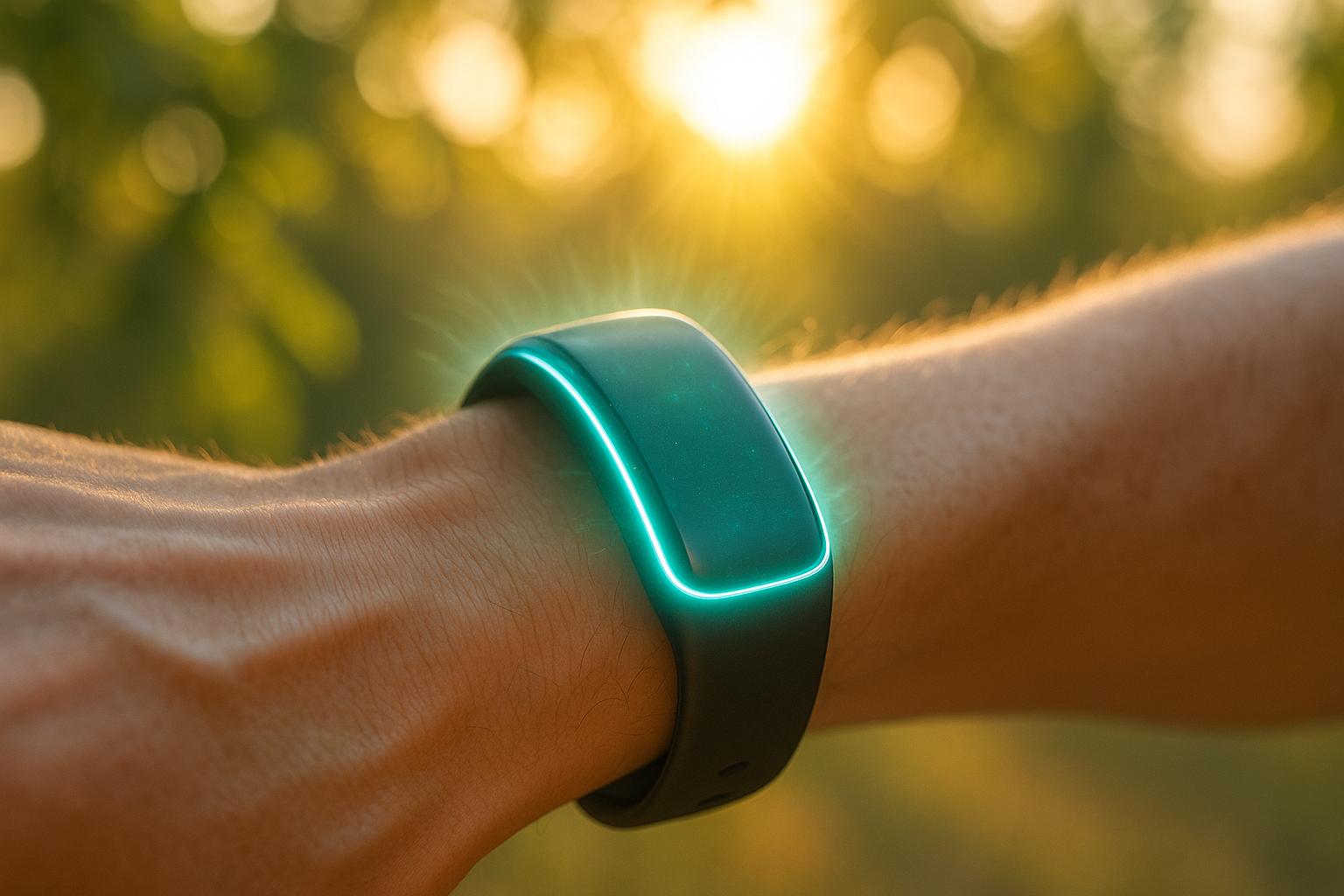
Self-charging wearables eliminate the hassle of frequent recharging by generating power from your body and surroundings. These devices use energy from motion, heat, light, or sweat to continuously monitor health metrics like heart rate, activity levels, and temperature. This technology not only ensures uninterrupted operation but also reduces electronic waste by minimizing battery reliance.
Key Points:
- Energy Sources: Body movements (piezoelectric), friction (triboelectric), body heat (thermoelectric), and light (photovoltaic cells).
- Advantages: Continuous monitoring, lightweight designs, reduced waste, and better comfort for users.
- Energy Storage: Micro-batteries for steady power and supercapacitors for quick bursts of energy.
- Applications: Health tracking, chronic disease management, and remote patient monitoring.
Self-charging wearables are reshaping healthcare by offering uninterrupted, reliable health monitoring while addressing environmental concerns. Below, we explore how these devices work, the energy harvesting methods involved, and their integration with health systems.
Wearable devices: Powering your own wellness | Veena Misra | TEDxRaleigh

Energy Harvesting Methods in Wearables
Self-charging wearables draw energy from the human body and their surroundings using a variety of techniques. These methods eliminate the need for traditional charging, providing a steady power source for continuous monitoring and other functionalities. Let’s dive into the core principles and practical applications of these energy harvesting methods.
Piezoelectric Generators
Piezoelectric generators (PEGs) transform mechanical energy from body movements – like walking, running, or even simple gestures – into electricity through the piezoelectric effect. This occurs when specific materials generate an electric field in response to mechanical stress. Walking, for instance, can produce over 1 watt of power if an individual takes around 10,000 steps daily.
The efficiency of these generators hinges on how stress is applied relative to the material’s polar axis. Research highlights that the 33-mode offers higher voltage outputs, while the 31-mode provides more current. Materials play a crucial role as well: PZT ceramics are known for their high piezoelectric coefficients, ZnO is lightweight and can be woven into textiles, and PVDF films are flexible, making them ideal for wearables. In controlled environments, PEGs have achieved power densities up to 343 mW/cm³, while real-world scenarios yield about 19 mW/cm³ at a walking pace of 1 Hz.
Triboelectric Nanogenerators (TENGs)
Triboelectric nanogenerators convert mechanical energy into electricity through friction between materials, using contact electrification and electrostatic induction. They can harness energy from body movements, vibrations, and even environmental factors like wind. Their effectiveness depends on factors such as contact area, applied force, and environmental conditions. For example, reduced humidity can boost charge generation by up to 20%.
Recent advancements have led to an impressive charge density of 3.53 mC/m², enhancing their potential for wearable applications. TENGs are lightweight and flexible, making them easy to integrate into fabrics or insoles, further broadening their usability.
Thermoelectric Generators
Thermoelectric generators (TEGs) tap into body heat, converting temperature differences between the skin (around 98.6°F or 37°C) and the surrounding environment into electrical energy via the Seebeck effect. The key advantage of TEGs is their ability to generate power continuously, whether the user is active or at rest. They are also quiet and require little to no maintenance.
However, TEGs face challenges such as lower power output, the need to maintain a sufficient thermal gradient, and integration difficulties due to their bulkier designs. Additionally, parasitic heat losses can affect their efficiency, especially when used with soft, deformable tissues.
Photovoltaic Cells
Photovoltaic cells in wearables use flexible solar panels to capture ambient light, converting it into electricity. These cells can draw power from both natural sunlight and indoor lighting. However, their efficiency depends on light intensity, spectrum, temperature, and the angle of incidence.
Modern flexible solar cells can be seamlessly integrated into clothing or device surfaces. Despite their potential, their performance indoors or in low-light conditions is limited, making them better suited as a supplementary power source rather than a primary one.
Comparison of Energy Harvesting Methods
The table below summarizes the strengths and limitations of each method, along with their ideal applications:
| Method | Advantages | Disadvantages | Best Use Cases |
|---|---|---|---|
| Piezoelectric | High power density, works with various movements, lightweight, cost-effective | Requires continuous motion; efficiency depends on stress orientation | Activity trackers, fitness monitors |
| Triboelectric | Operates with minimal movement, integrates well into fabrics | Sensitive to humidity and temperature, still under development | Smart clothing, insoles, low-power devices |
| Thermoelectric | Continuous energy generation, no moving parts, long lifespan | Lower power output, requires temperature gradient, higher manufacturing costs | Medical monitors, devices needing constant power |
| Photovoltaic | Captures ambient light, flexible integration | Highly dependent on lighting conditions, less effective indoors | Outdoor wearables, devices with large surfaces |
Energy Storage Solutions for Wearables
Once energy is harvested from sources like body movements, heat, or light, the next step is storing it efficiently. Wearable devices rely on energy storage systems to ensure a steady power supply, even when energy isn’t actively being harvested. These systems collect energy when available and release it as needed, keeping devices functional. Two key technologies dominate this space: micro-batteries and supercapacitors. Each comes with its own strengths, making them suitable for different applications. Let’s take a closer look at how these technologies meet the unique demands of wearables.
Micro-Batteries
Micro-batteries store energy through chemical reactions, specifically redox processes at their electrodes, which give them a high energy density. This makes them ideal for wearables that require consistent, long-term power. These tiny energy storage units are manufactured using well-established processes, such as roll-to-roll production of electrodes. Their compact design allows them to hold a significant amount of energy in a small space. For example, micro-batteries with a capacity above 1 µWh can power low-energy devices for over a month.
For medical wearables, this capability is crucial. A neural recording device, for instance, typically consumes about 100 µW for continuous data collection and transmission. However, micro-batteries do face challenges in wearables. They need to be stretchable to work seamlessly with on-skin devices, ensuring they don’t hinder natural body movements. This is where supercapacitors come into play as a complementary option.
Supercapacitors
Supercapacitors offer a different approach to energy storage, focusing on speed and durability. Instead of relying on chemical storage, they use charge separation to store energy, which allows for rapid charging and discharging. This makes them particularly well-suited for applications that demand quick bursts of power.
Supercapacitors can be divided into three main types:
- Electric double-layer capacitors (EDLCs): These store charge at the interface between the electrode and electrolyte surfaces.
- Pseudocapacitors: These rely on reversible Faradic redox reactions at the electrode-electrolyte interface.
- Hybrid capacitors: These combine both mechanisms to enhance performance.
One of their standout features is durability. Supercapacitors can endure far more charge-discharge cycles compared to traditional rechargeable batteries. While batteries are designed for extended energy release, supercapacitors excel in delivering energy in short, powerful bursts.
Advances in Small-Scale Storage
Recent progress in miniaturized energy storage is reshaping the possibilities for wearables. Flexible micro-supercapacitors (FMSCs) are at the forefront, offering a blend of high energy and power density, flexibility, and long lifespans. These devices are incredibly small, with dimensions ranging from a few micrometers to millimeters, and are less than a millimeter thick.
The performance improvements are striking. FMSCs can endure thousands to millions of charge-discharge cycles. Materials like MXene-based microelectrodes are pushing boundaries even further. For example, a wavy-like MXene micro-supercapacitor achieves an areal capacity of 185 mF/cm² and can stretch up to 800% without losing functionality.
Using an island-bridge design to connect cells, micro-supercapacitor arrays have achieved greater stretchability and adjustable voltage outputs. These systems can be stretched up to 100% and still function as intended.
Advances in manufacturing are also making these technologies more accessible. Techniques like advanced printing, laser patterning, and lithography have enabled the development of miniaturized energy storage devices with footprints smaller than 1 cm². Despite their small size, these devices maintain the power density and reliability required for medical-grade applications.
The materials driving these breakthroughs include 2D materials such as Phosphorene and MXenes, as well as organic materials, nanocomposites, quantum dots, MOFs, biomaterials, and self-healing materials. These innovations are tackling one of the biggest challenges in wearable energy storage: balancing high electrochemical performance with mechanical flexibility.
As the demand for portable and flexible electronics grows, the development of advanced energy storage solutions is accelerating. With improvements in energy harvesting and storage, self-charging wearables are edging closer to becoming maintenance-free devices.
sbb-itb-593149b
Integration with Health Monitoring Systems
Self-charging wearables bring together energy harvesting, medical sensing, and secure data transmission to enable continuous health monitoring. These devices create a seamless system where power generation, health data collection, and secure communication work in harmony to deliver real-time health insights.
This integration relies on three key components. First, energy harvesting technologies convert body movements, heat, and ambient light into usable energy. This powers medical-grade sensors that track vital signs and other physiological metrics. Finally, advanced data processing and secure transmission systems analyze the collected information and deliver it to healthcare providers or personal devices. Together, these elements form a powerful tool for tracking and managing health.
Medical-Grade Sensors
Modern self-charging wearables are equipped with sensors that monitor heart rate, blood oxygen levels, physical activity, and body temperature. For example, optical sensors using photoplethysmography (PPG) technology measure heart rate, blood oxygen, and even blood pressure by detecting changes in blood volume through light absorption. Accelerometers and gyroscopes track movement, sleep quality, and physical activity, while also identifying falls or subtle changes that might signal early health concerns. Temperature sensors add another layer of monitoring by detecting fluctuations in body heat.
A notable innovation comes from W. Gao’s research group, which developed a flexible, perspiration-powered electronic skin. This device generates electricity from human sweat, achieving a power density of 3.5 mW/cm² for biofuel cells in untreated body fluids. It enables simultaneous metabolic sensing and wireless data transmission via Bluetooth.
Biochemical sensors represent the next frontier in wearable technology. These sensors analyze sweat, interstitial fluid, and other body fluids to monitor biomarkers like glucose levels and electrolyte balance. Such capabilities are particularly useful for managing chronic conditions like diabetes.
Data Processing and Transmission
Powered by harvested energy, these wearables handle real-time data analysis and communication. Sensors collect raw measurements, which are then processed using AI algorithms and edge computing to provide actionable health insights. This rapid analysis can detect abnormalities and send timely alerts. Bluetooth Low Energy (BLE) ensures efficient data syncing with minimal power consumption, connecting wearables to smartphones, tablets, or medical systems.
Despite these advancements, challenges remain. For instance, 46% of American patients report that their physicians do not incorporate wearable-collected data into treatment plans. Real-time monitoring could enable quicker responses to emergencies, such as detecting early signs of heart attacks or strokes and alerting caregivers or emergency services.
Cybersecurity and Privacy
Once data is processed and transmitted, ensuring its security becomes critical. Given the sensitive nature of health data, robust cybersecurity measures are essential. Data encryption is a fundamental safeguard. As Charles Cinert, Chief Services Officer at ClearDATA, explains, "Strong encryption should be a baseline requirement to protect data transmitted between the wearable device and the healthcare provider’s system".
A 2024 report by the Ponemon Institute revealed that over 60% of healthcare data breaches involve data in transit, emphasizing the importance of secure transmission protocols. Multi-factor authentication (MFA), combining biometric identifiers with passwords or PINs, adds another layer of protection. Regular firmware updates are also vital, as demonstrated in 2023 when ESET researchers showed how attackers could manipulate popular fitness trackers to alter data such as step counts and heart rate. The healthcare sector remains vulnerable, with 70% of hospitals experiencing major ransomware attacks last year.
Privacy protection goes beyond preventing unauthorized access. It also involves transparency – ensuring users understand what data is collected, how it’s used, and who has access to it. For instance, while 81% of Americans assume their health data collected by wearables is secure, this isn’t always the case.
"To protect patient health and privacy, stakeholders across the healthcare ecosystem must collaborate. Healthcare providers, wearable manufacturers, regulatory bodies, and cybersecurity experts all have a role to play."
- Charles Cinert, Chief Services Officer, ClearDATA
Emerging technologies like blockchain offer promising solutions by creating immutable records of data transactions. This enhances data integrity and gives users greater control over who can access their information.
The integration of self-charging wearables with health monitoring systems represents a major step forward in personalized healthcare. However, the success of these technologies will depend on maintaining strong security and privacy measures to build trust and encourage widespread use.
Future Trends and Sustainability in Wearables
Wearable technology is on the brink of becoming smarter and more environmentally friendly, thanks to progress in energy harvesting, storage, and AI-driven power management. The wearable sensors market is projected to hit $7.2 billion by 2035, underscoring the intense competition among manufacturers to create devices that balance performance with environmental responsibility. These advancements are reshaping how wearables are designed, produced, and used. From materials that break down naturally to AI systems that fine-tune energy use, the future of self-charging wearables promises devices that are cleaner, smarter, and more efficient. This evolution opens doors to breakthroughs in materials and smarter energy management.
Biodegradable and Eco-Friendly Materials
The electronics industry generates a staggering amount of waste, and wearables are no exception. Many devices rely on metals, plastics, and other materials that take decades – or even centuries – to decompose. Enter biodegradable materials, which offer a more sustainable path forward.
Take SWEET (Smart, Wearable and Eco-friendly Electronic Textiles), for example. Developed by researchers at the University of Southampton and UWE Bristol, this biodegradable e-textile combines renewable Tencel with graphene-based electrodes, cutting environmental impact by up to 40% compared to traditional metals. When buried in soil, these fabrics showed noticeable degradation within just four months.
"Achieving reliable, industry-standard monitoring with eco-friendly materials is a significant milestone. It demonstrates that sustainability doesn’t have to come at the cost of functionality, especially in critical applications like healthcare."
- Dr. Shaila Afroj
Manufacturing processes are also evolving. Techniques like inkjet printing allow precise material application on textiles, minimizing waste while consuming less water and energy than traditional methods like screen printing. Biodegradable e-textiles address recycling challenges posed by metallic components in traditional wearables, offering safer disposal options. Beyond textiles, materials science is making strides in reducing environmental impact. For instance, recycling aluminum saves 9 tons of CO₂ emissions per metric ton, proving that sustainable materials can compete with – and even outperform – conventional ones.
AI for Power Optimization
Artificial intelligence is transforming how self-charging wearables manage energy. By analyzing user behavior, environmental conditions, and sensor data, AI adjusts power consumption dynamically, ensuring efficient energy use. For instance, wearables can lower sensor activity during sleep and ramp it up when the user is active.
Edge computing further enhances this capability by processing data directly on the wearable device. This reduces latency, improves privacy, and optimizes bandwidth.
"By employing ML at the edge, wearables can make intelligent and autonomous power management decisions, maximizing the utilization of energy from energy harvesters. This optimization leads to longer battery life between recharges, enhancing the overall usability and convenience of the wearable device for users."
Predictive analytics is another game-changer. AI can foresee energy demands based on user habits, allowing devices to allocate power more effectively. For example, during periods of expected high activity, devices can prioritize energy reserves, while low-activity times can focus on energy harvesting. This is particularly impactful in healthcare, where AI-driven wearables can reduce hospital readmissions. The Centers for Medicare and Medicaid Services impose fines of $350 million to $535 million on 40–49% of U.S. hospitals annually for readmissions. Reinforcement learning further optimizes network pathways, ensuring efficient energy use.
While AI significantly improves power management, challenges in usability and design persist.
Challenges and Future Developments
Despite advancements, hurdles remain in creating sustainable, self-charging wearables. Usability is a key issue – 1 in 5 patients finds wearables difficult to use. Additionally, 87% of patients using devices that require manual data entry report inaccuracies, which can limit their clinical value.
Data security is another pressing concern. In 2021, a breach at GetHealth exposed 61 million records from devices like Apple and Fitbit, including identifiable information. Such incidents deepen consumer mistrust, with 40% of healthcare users expressing concerns about data security. Adoption is also uneven; while 42% of Americans with or at risk for cardiovascular disease use wearables, high costs and complexity deter broader use.
On the technical front, improving energy conversion efficiency, stability, and material durability remains a challenge. Current energy harvesting methods struggle to deliver consistent power across different activities and conditions. To address these issues, future devices are likely to focus on flexibility, seamless integration, and smarter functionality. Manufacturers are also experimenting with new business models, like subscriptions or "hardware as a service", to lower upfront costs and boost accessibility. Enhancing accuracy through better sensors, advanced algorithms, and refined calibration methods will be crucial for reliable healthcare monitoring.
Looking ahead, the combination of sustainable materials, AI-driven power management, and user-friendly designs will shape the next wave of self-charging wearables. Overcoming current limitations will be key to making these devices more secure, accessible, and environmentally friendly.
Conclusion
Self-charging wearables are changing the game in healthcare by solving the problem of battery limitations. These devices tap into ambient energy sources like light, heat, motion, and even biofluids, eliminating the hassle of frequent charging or battery replacements. This innovation allows for uninterrupted health monitoring, making it easier to track vital data continuously.
For instance, a system just 90 µm thick can achieve over 16% efficiency, delivering power outputs exceeding 10 mW cm⁻². Abbott Diabetes Care showcased a glucose monitoring sensor powered entirely by body heat. Using a thermoelectric generator, it produced 378 µW of power – far more than the 64 µW required to run the sensor. This breakthrough removes the need for external batteries while ensuring stable, reliable operation. These advancements are paving the way for durable, low-maintenance devices.
The environmental benefits are also worth noting. As the wearable electronics market is expected to hit $138.5 billion by 2029, reducing battery waste becomes a critical advantage. The human body itself provides an abundant energy source, generating up to 2,000 Kcal daily through regular activities. Harnessing this renewable energy could significantly cut down on electronic waste.
AI-powered energy optimization is further enhancing these systems, ensuring consistent performance. For example, WePower Technologies has developed a system that delivers 30 times more energy than current kinetic harvesting technologies. Meanwhile, the global energy harvesting system market is projected to exceed $2.5 billion by 2030.
The clinical benefits of self-charging wearables are already evident. The HERB-DH1 study showed that continuous monitoring through digital therapeutics led to lasting reductions in blood pressure. This success earned the technology approval as a first-line treatment for hypertension in Japan, complete with medical insurance coverage.
As these technologies continue to evolve, they hold the potential to revolutionize healthcare. By making monitoring more efficient, accessible, and eco-friendly, self-charging wearables are set to transform preventive medicine and personalized care, all while reducing battery waste and supporting a healthier planet.
FAQs
How do self-charging wearables generate and store their own power?
Self-charging wearables draw power from their surroundings using energy harvesting methods. These include techniques like piezoelectric systems (which turn motion or pressure into electricity), triboelectric systems (relying on friction or contact), and thermoelectric systems (using heat differences). Some devices even combine energy sources, like body heat and movement, to generate more power.
The energy collected is stored in specially designed batteries or capacitors, allowing these devices to run continuously without frequent external charging. This approach enhances convenience and makes wearables a practical choice, particularly for medical and fitness purposes.
What are the environmental advantages of self-charging wearables compared to traditional battery-powered devices?
Self-charging wearables offer a clear eco-friendly advantage by reducing the dependence on disposable batteries. Since these batteries are tough to recycle and often end up contributing to pollution, cutting them out of the equation makes a big difference. Instead, these devices tap into ambient energy sources like body heat, light, or motion, which helps lower electronic waste and reduces the demand for producing batteries that harm the environment.
What’s more, self-charging systems tend to outlast traditional batteries, meaning less waste over time and a smaller environmental impact overall. By choosing this technology, users not only get to enjoy efficient and innovative wearables but also play a part in supporting sustainability.
How do self-charging medical wearables protect sensitive health data and ensure user privacy?
Self-charging medical wearables take data security and privacy seriously by using strong encryption methods to protect information during both transmission and storage. This ensures that sensitive health data stays secure and out of reach from unauthorized parties.
To add another layer of protection, these devices often include strict access controls and anonymization techniques, making it harder to link the data to specific individuals. On top of that, they adhere to regulations like HIPAA, which set rigorous standards for privacy and security. These efforts not only safeguard personal health information but also help users feel confident that their data is being handled responsibly.
