
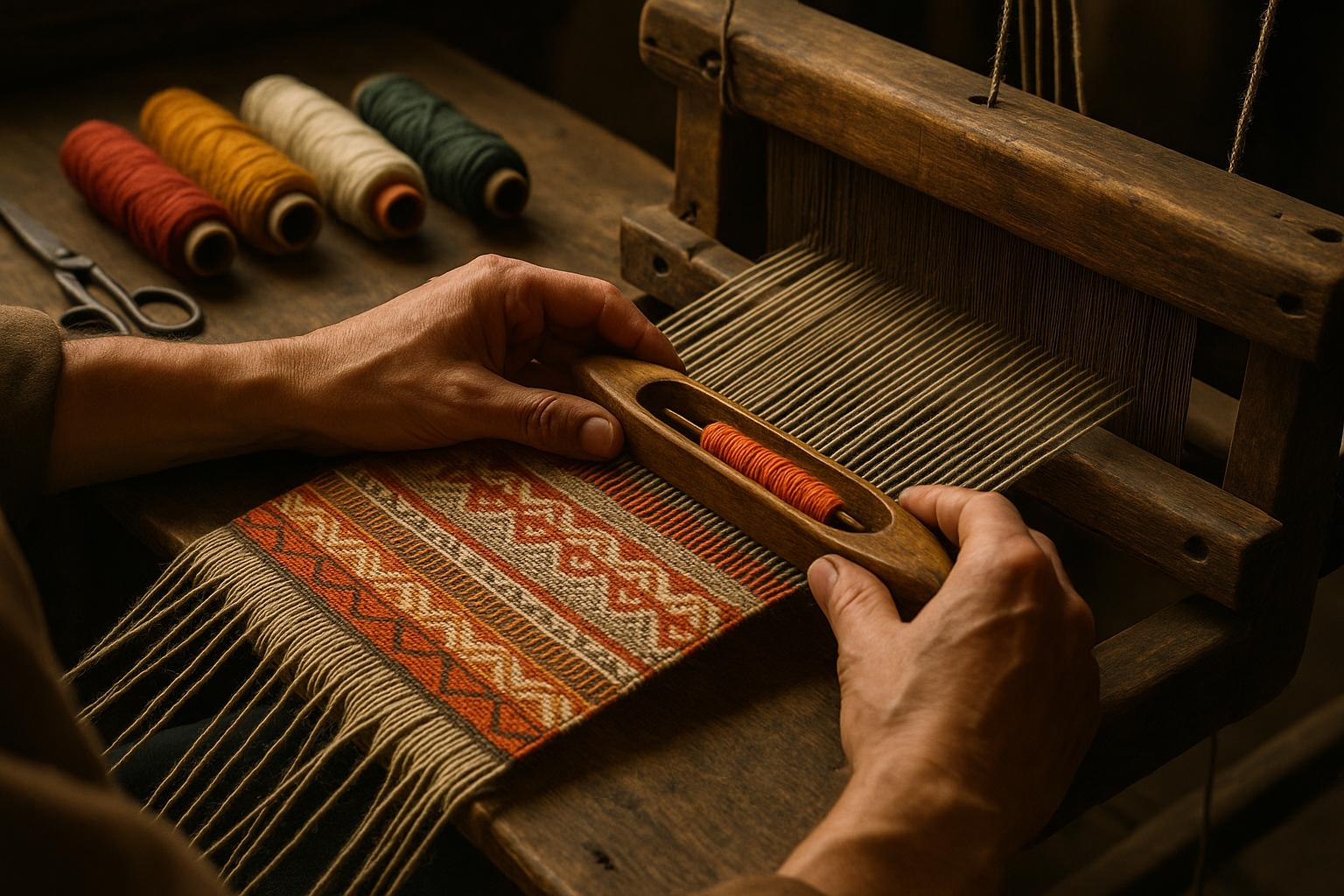
Forgotten crafts are disappearing fast, taking generations of knowledge with them. Digital archiving is the key to preserving these skills for future generations. This process involves creating high-quality digital records of materials, techniques, and stories to ensure they remain accessible and secure. Here’s a quick breakdown:
- Why it matters: Crafts like mouth-blown glass and goldbeating are vanishing due to modernization, aging artisans, and shrinking demand.
- How it helps: Digital archives protect these crafts from loss, making them accessible for research, education, and global sharing.
- Tools needed: High-quality cameras, microphones, 3D scanners, and software for organization and storage.
- Steps to archive: Plan your project, digitize items, organize files with metadata, store securely, and share responsibly.
Archives and Museum Digitization Projects
Tools and Platforms for Digital Archiving
Preserving forgotten crafts requires the right digital tools to ensure every detail is captured, organized, and securely stored. A successful digital archive hinges on a thoughtful mix of recording equipment, organization software, and storage solutions.
Digital Recording Tools
To document the intricate details of crafts, high-quality cameras are a must. Mirrorless cameras like the Fujifilm X-T5, with its 40.2-megapixel sensor, are excellent for capturing fine details.
For video, professional-grade cameras such as the Canon EOS R5 (8K, 12-bit RAW) and Nikon Z9 (up to 120 fps) are ideal for recording dynamic crafting processes.
Pairing your video setup with professional microphones like the Rode NTG4+ or Sennheiser MKE 600 (around $400) ensures clear audio. For monitoring, headphones like the Sony MDR-7506 (approximately $100) are reliable options.
Even smartphone photography can look professional with a proper three-point lighting setup, making it a budget-friendly alternative for capturing high-quality visuals.
Once you’ve captured your materials, organizing them efficiently is the next step.
File Organization Tools
As your archive grows, managing your digital assets becomes increasingly important. This is where Digital Asset Management (DAM) software comes in, helping you centralize storage, manage metadata, and maintain version control. Popular options include Adobe Bridge, Eagle, and Filecamp, each offering tools to streamline organization and tagging.
- Eagle: A budget-friendly option with a one-time payment of $29.95, supporting a wide range of formats like images, raw files, fonts, icons, 3D models, videos, and audio.
- Filecamp: Designed for mid-range needs, its pricing starts at $29/month for Basic, $59/month for Advanced, and $89/month for Pro.
- Air: Affordable for team use, with plans at $10 per user/month for Plus and $25 per user/month for Pro.
Testing demos of these tools can help you find a solution that integrates seamlessly into your workflow.
Storage and Sharing Platforms
Reliable cloud storage is critical for long-term preservation. Leading providers like AWS, Microsoft Azure, and Google Cloud Platform offer robust solutions for large-scale needs.
For smaller or collaborative projects, Google Drive is a practical choice with its 15GB free tier and affordable upgrades: $1.99/month for 100GB, $2.99/month for 200GB, and $9.99/month for 2TB. It also integrates seamlessly with Google Workspace for real-time collaboration.
For those requiring extensive storage, IDrive is a strong contender. It offers 10TB for $4.98 in the first year, with subsequent plans like 5TB for $69.65 annually. Benedict Collins of TechRadar describes it as a "fantastic all-rounder" offering a balance of security, ease of use, and performance.
If privacy is a priority, platforms like Sync.com and MEGA stand out. Sync.com starts with 5GB free and paid plans at $5/month for 200GB, while MEGA offers end-to-end encryption for added security. For a one-time payment option, pCloud provides lifetime plans, such as 2TB for $399.
To avoid reliance on a single provider, consider a multi-cloud strategy. This approach not only reduces the risk of vendor lock-in but also boosts resilience. Many platforms offer free tiers – test these before committing to paid plans. Look for features like versioning, encryption, and seamless workflow integration to ensure your archive remains scalable and secure over time.
Step-by-Step Guide to Digital Craft Archiving
Preserving traditional crafts through digital archiving can ensure they endure for future generations. A well-organized approach is key to creating a reliable and secure archive. Here’s how to get started.
Step 1: Planning and Preparation
Start by laying a solid foundation for your project. Carefully assess the crafts you want to document, and define the scope, budget, and timeline. These initial decisions will guide the tools you choose, the team you assemble, and the workflow you design.
Clarify your project’s purpose. Is the archive the end goal, or part of a larger initiative like an exhibition or educational program? This will help shape your approach and resource allocation.
Understanding your audience is equally important. Knowing who will use the archive helps you decide what details to emphasize and how to present the material effectively.
Before digitization, secure copyright permissions to avoid legal complications. Additionally, consult a conservation professional to evaluate the condition of the items. They can recommend handling precautions, repairs, or special treatments to protect the materials during the digitization process.
Step 2: Creating Digital Copies
Capturing high-quality digital representations is essential to preserving the intricate details of each craft. Non-contact 3D scanning is a safe and effective method, especially for fragile artifacts.
Choose the right scanner for the job. For small, detailed items, devices like the Artec Spider II (capable of capturing details as fine as 0.05 mm) work well. Medium-sized objects are often best scanned with the Artec Eva, which offers accuracy up to 0.1 mm. For larger installations, consider the Artec Ray II, designed for precise scanning of sizable objects.
To enhance realism, combine 3D scanning with photogrammetry. Software like Artec Studio can integrate multiple scans and improve color accuracy. Beyond static models, consider creating video content – such as technique demonstrations or interviews with artisans – to capture the living knowledge behind the crafts.
Step 3: Organizing and Labeling Files
A well-organized archive ensures easy access and long-term usability. Begin by creating a main folder, then sort files into subfolders based on craft type, geographic origin, or time period.
Adopt clear and consistent file naming practices. For example, instead of generic names like "IMG_001.jpg", use descriptive titles such as "Navajo_Rug_Weaving_2025-07-15.jpg" to provide context at a glance.
Don’t forget metadata! Embed important details like the creator’s name, creation date, materials used, and copyright information. This helps preserve the historical and cultural context of each piece.
Save files in widely supported formats to ensure future accessibility. For images, use formats like PNG or TIFF; for videos, stick with standard file types.
Step 4: Storing and Backing Up Archives
Your archive’s reliability depends on a strong storage and backup strategy. Follow the 3-2-1 rule: keep three copies of your data, store them on two different types of media, and ensure one is stored offsite. This approach minimizes risks from hardware failures, natural disasters, or human errors.
Use local storage for quick access and cloud storage for redundancy. Automate backups to ensure consistency. For sensitive data, restrict access and use encryption to protect it.
Maintain an up-to-date inventory of storage locations and regularly test your recovery plan to ensure your data remains secure.
Step 5: Sharing and Making Archives Accessible
The final step is to make your archive a resource for others. Decide on access policies based on your audience and any cultural sensitivities related to the crafts.
Choose platforms that suit your audience, whether academic repositories, community websites, or other digital spaces. Provide clear instructions for accessing and citing the materials, and include contact details for inquiries.
Set retention policies to define how long materials will be preserved and under what conditions they might be removed. This helps maintain the archive’s integrity while respecting the rights and traditions of the craft communities involved.
Regularly update your archive to keep it secure, accessible, and in step with technological advancements and user needs.
sbb-itb-593149b
Common Challenges in Digital Archiving
Digital archiving of forgotten crafts comes with its own set of hurdles. Understanding these challenges is key to building accurate and meaningful archives.
Verifying Origin and History
One of the toughest parts of digital archiving is confirming the authenticity and origin of traditional crafts. Without proper verification, archives risk including fake items or spreading incorrect information.
Forgeries make up nearly 10% of the global art market. This makes authentication a critical step.
Start by collecting any historical documentation you can find, such as receipts, invoices, gallery records, or certificates that trace the item’s journey. Ownership history can often be pieced together using public and private records, like sales receipts or estate documents. If gaps remain in the historical trail, you may need to consult experts or conduct further research.
For high-value items, scientific methods like microscopy or X-ray analysis can help confirm authenticity. Expert input is invaluable when documentation is incomplete or questionable.
Crafts without proper certification can lose up to 30% of their potential market value. To avoid this, create detailed certificates of authenticity for each archived item. These should include information like the creator’s name, the date of creation, materials used, dimensions, and photographic evidence. If the provenance is incomplete, clearly document what is known and highlight any gaps to prevent misleading future researchers.
While verifying authenticity is crucial, keeping up with technological advancements is another significant challenge.
Keeping Up with Technology Changes
Technology moves quickly, and today’s standard file formats may become obsolete in just a few years. The formats you choose now will determine whether future generations can access your archive. Formats like PNG for images or MP4 for videos are popular today but might require specialized software down the line.
To avoid losing access to your files, develop a migration strategy early. Review your archive every three to five years and update files to newer formats as needed. It’s also a good idea to store multiple versions of each file – keep high-resolution master files in preservation-quality formats alongside more accessible copies. This redundancy ensures you have options if one format becomes problematic.
Stay updated on industry standards and new technologies by following digital preservation groups and attending workshops or webinars. Keep local copies of your files to guard against potential issues with cloud storage. Document your technical decisions carefully so future archivists understand your choices regarding formats, software, and storage methods.
But technology isn’t the only concern – preserving the craft’s deeper story is just as important.
Saving Both Appearance and Knowledge
Beyond the technical challenges, it’s essential to capture the cultural essence of these crafts. While documenting the visual aspects is important, preserving the knowledge behind the craft – such as techniques, stories, and its significance – is equally critical. Digital archives should aim to preserve both the physical and cultural dimensions of these crafts.
Work directly with artisans and community leaders to record not just the crafts themselves, but also the methods and narratives that bring them to life. These interviews and stories are vital for preserving traditional techniques and passing them on to future generations.
Provide historical context by including detailed explanations of when, where, and why specific crafts emerged. By linking digital assets with their broader historical and cultural background, you help users not only see the craft but also understand its importance.
Collaborate with cultural institutions and community organizations to ensure your documentation is respectful and accurate. In some cases, sharing certain traditional knowledge may require permission from community leaders. Additionally, preserve original language terms alongside translations to maintain linguistic integrity, especially when working with indigenous or minority craft traditions.
Conclusion: Saving Heritage Through Action
The moment to take action is here. This guide has highlighted how digital archiving not only protects artifacts but also preserves the heart of our shared heritage. With every passing day, more traditional crafts fade into history, taking with them centuries of knowledge and artistry. Digital archiving offers a way to safeguard these treasures for future generations while making them accessible to people around the world.
The process doesn’t have to be overwhelming. As Laura Kells, Senior Archivist at the Library of Congress, advises: "Just start out by saying, ‘I want to improve the organization.’" Begin with what you already have – whether it’s your grandmother’s quilting designs, old woodworking tools, or snapshots of traditional pottery techniques. Sort these items into broad categories, digitize them, and label your files with clear names and helpful metadata.
These efforts go far beyond personal collections. They open doors to cultural exchange and education on a global level, helping displaced communities reconnect with their roots and inspiring younger generations to explore traditional skills.
Consider the success of initiatives like The British Library’s Endangered Archives Programme, which has digitized over 13 million images and 35,000 soundtracks since 2004. Additionally, 96% of survey participants have recognized digital platforms as an effective way to promote and share cultural heritage.
Your role in this is crucial. Community archives give underrepresented groups the chance to preserve and share their histories, perspectives, and experiences in their own voice. By documenting forgotten crafts, you’re not just saving objects – you’re capturing stories, techniques, and identities that might otherwise disappear.
So, start today. Gather your materials, outline your plan, and take that first step – whether it’s snapping a photo or scanning a document. Don’t forget to back up your files to keep them safe and accessible. Your efforts will create lasting value for educators, researchers, and communities everywhere.
The heritage we protect today will serve as the foundation for tomorrow’s creativity and understanding. Your actions are the final piece in the journey from planning to preserving. Don’t wait – these crafts need you to ensure their survival.
FAQs
What are the advantages of using digital tools to preserve traditional crafts instead of traditional methods?
Preserving traditional crafts through digital tools brings several standout advantages compared to older methods. Digital archiving makes these crafts accessible to anyone with an internet connection, no matter where they are in the world. This approach also safeguards the content from physical wear and tear, keeping both the details and visuals intact for years to come.
Another perk? Digital archives are simple to update and refine. Adding fresh insights or improving existing documentation is straightforward. Plus, sharing this information becomes effortless, allowing a broader audience to discover and appreciate these crafts. By using digital tools, we not only protect cultural heritage for future generations but also make it easier for people today to connect with these traditions.
How can I make sure the crafts I archive digitally are authentic and historically accurate?
To maintain the integrity and historical accuracy of the crafts you’re archiving digitally, start by sourcing information from trustworthy references like historical documents, museums, or academic studies. Partnering with specialists or skilled artisans in the craft can help confirm details and provide valuable context.
Include comprehensive metadata to capture key details such as the craft’s origin, materials used, techniques employed, and its broader cultural importance. Consider leveraging technology like blockchain to establish a secure and tamper-proof record of authenticity. Periodically review and update your archives to reflect the latest research or findings, keeping them both accurate and current.
How can I share my digital archives while respecting cultural sensitivities?
When sharing digital archives, it’s important to begin by engaging with the communities tied to the crafts or traditions you’re documenting. Use respectful language that aligns with their cultural norms, and include detailed metadata to explain the background and significance of the materials. Exercise caution with sacred or private content – never share such materials without clear, explicit consent.
Strive to make your archives accessible to a broad audience while safeguarding sensitive details. Always adhere to ethical standards and any applicable legal requirements to respect cultural heritage and prevent harm.