
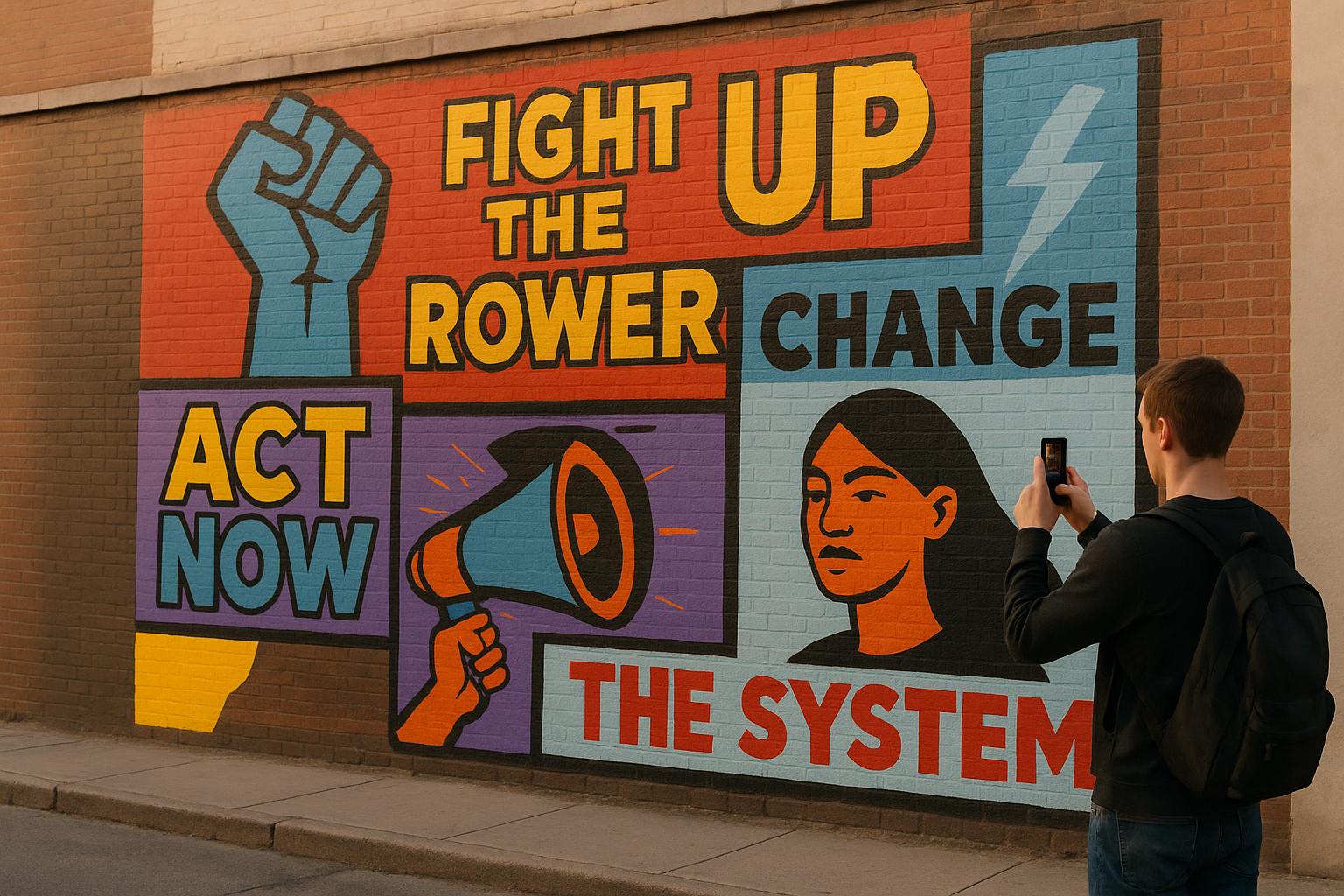
Social media has transformed political graffiti from a local act of defiance into a global tool for activism. Platforms like Instagram and Twitter allow street art to reach millions, turning temporary visuals into lasting political statements.
Key highlights:
- Global Reach: A mural in one city can gain international attention within hours.
- Hashtags and Geotags: Tools like #streetart and geotagging preserve and amplify graffiti messages.
- Case Studies: Movements like the Arab Spring and Hong Kong protests used graffiti and social media to mobilize and spread awareness.
- Challenges: Artists face legal risks, censorship, and the pressure to create shareable content while maintaining their message.
Social media bridges physical graffiti with digital platforms, reshaping how political messages are shared, preserved, and discussed worldwide.
Listening Post – Feature: The power of street art
From Walls to Screens: How Political Graffiti Has Changed
Political graffiti has evolved from being solely a local, physical form of expression to thriving on digital platforms, marking a shift in how modern protests communicate. Messages that once lived exclusively on neighborhood walls now travel across global networks, transforming how they reach and influence audiences.
Dual Existence: Physical and Digital
Today, political graffiti operates in two realms: the physical and the digital. This dual presence extends the reach and longevity of these messages. While physical graffiti often leaves a strong, immediate impression in specific communities, digital platforms immortalize these works, keeping them accessible long after the paint fades or the walls are cleaned.
On the streets, graffiti maintains its traditional role as a local marker of resistance and identity. Its presence can make an immediate impact, resonating with those who encounter it in person. However, when shared online, it takes on a new life. A piece of graffiti spotted in a Hong Kong alley can appear on Instagram feeds in New York within minutes, spreading its message far beyond its original context.
This digital exposure invites a broader audience to engage. A single piece of graffiti can spark layered interpretations as it circulates online, with viewers adding their own commentary and perspectives. Social media doesn’t just amplify these messages – it archives them. Platforms like Instagram and Twitter preserve graffiti that might otherwise vanish, turning fleeting acts of protest into enduring conversations. Artists can also interact directly with their audience, explaining their work and engaging in discussions that transform graffiti into an ongoing dialogue.
This interplay between physical and digital graffiti has fueled real-world movements, showing how these two mediums work together to amplify political messages.
Case Studies: Movements Powered by Graffiti
Several political movements highlight how graffiti, combined with social media, has transformed local acts of defiance into global symbols of resistance.
During the Arab Spring, graffiti played a pivotal role alongside Facebook campaigns in mobilizing protests. For example, the "We Are All Khaled Said" Facebook page, organized by the April 6 Youth Movement, helped spread calls for action. Graffiti and street art from these protests were photographed and widely shared online, turning local visuals into international symbols. Surveys revealed that nine out of ten Egyptians and Tunisians used Facebook to organize protests and raise awareness. In this period, Facebook usage surged across many Arab nations, except in Libya, where limited internet access posed a challenge.
"Egypt’s huge protest was located in a well-known, central place: Tahrir Square. Cutting off communication between the people at home and the people at Tahrir Square was an ineffective form of censorship because there was little to keep secret about the protest’s existence or location. However, the drastic act of censorship sent a strong signal to the country and alerted people who may not have been aware of the extent of the threat posed to the government." – Zeynep Tufekci
The 2019 anti-ELAB protests in Hong Kong showcased an even more sophisticated integration of physical graffiti and digital tools. Graffiti wasn’t just symbolic – it served practical purposes, guiding protesters to supplies like food, water, and medical aid. The movement’s leaderless structure relied heavily on social media for coordination. Telegram, for example, saw explosive growth during this time, with 110,000 new users joining in July 2019 compared to 26,000 the previous year – a staggering 323% increase.
One of the most iconic symbols of the Hong Kong protests was a graffiti image of a young woman wearing a gas mask, helmet, and goggles. This image appeared on walls across the city and was widely shared online, spreading its message internationally. Beyond graffiti, other digital forms of protest emerged. Facebook profiles turned into black rectangles with yellow ribbons, symbolizing the pro-democracy movement, while YouTube became a hub for protest-related videos and footage.
Protesters also used platforms like LIHKG, a Reddit-like forum, to share strategies and schedules. Telegram hosted massive group chats to coordinate actions in real time. This multi-platform approach ensured that both physical graffiti and its digital counterparts reached vast audiences, even in the face of censorship.
These examples show how graffiti, when amplified by social media, can sustain movements without centralized leadership. By blending physical expression with digital tools, activists create resilient communication networks that thrive even under restrictive conditions. This evolving relationship between graffiti and social media continues to reshape how political messages are shared and preserved.
How Social Media Spreads Political Graffiti
Social media has taken the localized nature of political graffiti and turned it into a global phenomenon. With just a few clicks, street art that once spoke to a single neighborhood can now reach audiences worldwide in a matter of hours, amplifying its political message far beyond its original context.
Main Platforms for Sharing
Instagram serves as a virtual gallery for political graffiti, where artists and activists can showcase their work to audiences across the globe. Its emphasis on high-quality visuals makes it perfect for highlighting the artistic details and symbolism of street art. Artists often use Instagram to document their creations, grow their audience, and even attract sponsors or gallery opportunities.
Twitter, on the other hand, is all about speed. It allows activists to share images of new graffiti almost instantly, providing real-time updates and coordination during political movements. This immediacy ensures that political graffiti often becomes part of breaking news, reaching thousands within minutes.
TikTok has quickly become a favorite among younger activists. The platform’s short video format and powerful algorithm can turn a local piece of graffiti into a viral sensation. Artists frequently share time-lapse videos of their work or offer commentary, connecting with audiences far beyond their immediate surroundings.
Meanwhile, Facebook processes a staggering 300 million new photos daily, and 6,000 tweets are posted every second. This sheer volume creates endless opportunities for political graffiti to gain traction. Social media platforms don’t just host content – they organize it through tools like hashtags and geotags, making it easier for users to find and share relevant material.
How Hashtags and Geotagging Work
Hashtags transform scattered images of political graffiti into cohesive, searchable collections. When artists and activists use consistent hashtags, they create virtual galleries that group street art by themes, locations, or movements.
For example, during the 2010 Arab Spring, hashtags like #25jan became rallying points for protests and brought attention to the revolution. Hashtags don’t just organize content – they link physical graffiti to larger digital conversations about political change.
Geotagging takes this a step further by mapping political activity. Users can tag the locations of graffiti, creating digital maps that reveal patterns of resistance. A notable example occurred during the 2016 Standing Rock protests, where over 1.4 million people checked in to the Standing Rock Indian Reservation between October 30 and early November. This use of location tags not only showed solidarity but also complicated law enforcement’s efforts to monitor activists.
Influencers and Activists as Spreaders
Social media’s power goes beyond its technical features, thanks to the involvement of high-profile figures who can amplify messages to massive audiences. When celebrities, politicians, or prominent activists share images of political graffiti, they expose it to people who might not otherwise encounter it. For instance, when Taylor Swift encouraged her 284 million followers to vote, it led to approximately 350,000 visits to the voter registration website vote.gov within just 24 hours.
St. Louis artist Damon Davis has witnessed firsthand how social media strengthens grassroots movements. He remarked:
"Social media has allowed for an unprecedented availability of information and decentralized organizing abilities in this movement".
Artists like Davis often use their platforms not only to share their own work but also to amplify the voices of others. Community activists play a similar role, bridging the gap between local street art and global audiences. They document neighborhood graffiti, provide context about local political struggles, and help interpret the art’s deeper meanings.
This dynamic creates a feedback loop: as influential figures share street art, its visibility grows, inspiring more artists to create politically charged pieces. A single well-timed post by an activist can spark significant change, demonstrating how social media democratizes the spread of political messages. The viral nature of these platforms ensures that street art transcends its geographic origins, becoming a symbol of global movements. Together with the amplification provided by influencers and activists, social media solidifies its role as a powerful tool for spreading political dissent.
sbb-itb-593149b
Impact on Political Movements and Public Discussion
Street art has evolved from local murals to a global phenomenon, largely thanks to social media. This shift has not only expanded its audience but also transformed how it influences political conversations and public engagement. Recent studies highlight how street art, amplified through digital platforms, fuels political participation.
Research on Graffiti’s Influence
Political graffiti has become a dynamic tool for sparking public involvement. By turning ordinary public spaces into arenas for dissent, artists challenge established power structures and express their views. The visual nature of graffiti simplifies complex political ideas, making them accessible and encouraging civic action.
One notable example is the #ChalkedUnarmed project, which demonstrated graffiti’s role in activism. Similarly, in early 2024, political graffiti in Georgia became a rallying point against a controversial "foreign agents" law. Slogans like "Down with Georgian Dream", "Say No to System!", "Say No to Russian Law!," and "No Justice, No Peace!" appeared on walls and quickly circulated across social media. These messages countered dominant media narratives, illustrating how street art shapes political discussions.
Moreover, research shows that street art transcends local boundaries, fostering global solidarity among artists and activists. It also provides a platform for marginalized voices, enabling them to participate in political dialogue on a broader scale.
Benefits and Drawbacks of Social Media Sharing
Social media has amplified the reach of graffiti, but it comes with its own set of challenges. Here’s a closer look at the pros and cons:
| Benefits | Drawbacks |
|---|---|
| Global Reach: Graffiti can reach international audiences almost instantly. | Censorship: Platforms can remove posts, deactivate accounts, and limit content visibility. |
| Lightning Speed: A mural can gain thousands of shares and likes within hours. | Government Surveillance: Authorities may use social media to monitor and suppress dissent. |
| Community Building: Artists can connect with supporters worldwide, creating networks around their work. | Loss of Context: Online images often fail to convey the full impact of the original artwork. |
| Activism Platform: Social media helps raise awareness about political and social issues on a global scale. | Pressure to Conform: Artists may feel compelled to create more "Instagram-friendly" pieces, compromising their artistic vision. |
| Democratized Access: A single post can bring an artist’s work to millions. | Spread of Disinformation: Algorithms can amplify false narratives just as quickly as accurate ones. |
While social media enhances graffiti’s visibility, it also creates economic and social ripple effects. The cost of cleaning graffiti can run into millions annually, straining local government budgets and prompting stricter anti-vandalism laws. Additionally, the rapid spread of graffiti online can influence public perceptions of political figures, blurring the line between genuine grassroots movements and misinformation.
For artists, digital platforms offer unprecedented exposure but also bring challenges. The constant demand for new content and the pressure to engage audiences online can make it difficult to maintain artistic integrity. Despite these obstacles, social media remains a powerful tool for amplifying political graffiti, enabling artists to respond swiftly to global events and inspire public action.
Legal, Ethical, and Social Challenges
As social media turns graffiti into a global political tool, it brings with it a host of legal, ethical, and social challenges. The intersection of political graffiti and digital platforms amplifies artistic voices but also exposes creators to risks that go beyond traditional street art. These challenges demand careful navigation by artists, activists, and society at large.
Legal Risks and Surveillance
Sharing political graffiti on social media can carry serious legal consequences, which vary depending on the jurisdiction. Because graffiti often involves defacing property without consent, it seldom qualifies for First Amendment protection, even when it carries political messages .
Posting graffiti online can be seen as promoting or distributing illegal activities, potentially leading to charges like aiding and abetting or conspiracy. Legal interpretations differ widely across states – some require proof of malicious intent, while others impose strict liability. Financial penalties also range significantly, with some states doubling fines or adding restitution based on the extent of the damage.
Law enforcement agencies actively monitor social media to identify individuals or groups they perceive as threats, including those involved in creating or sharing political graffiti . This surveillance can discourage artists from sharing their work online, fearing legal repercussions. For example, in 2020, police in Wichita, Kansas, arrested a teenager due to a misunderstanding of a Snapchat post, suspecting him of inciting a riot. Similarly, a Palestinian student was denied entry into the U.S. to study at Harvard because of his friends’ social media activity.
"Actual intent to carry out violence can be difficult to discern from the angry, hyperbolic – and constitutionally protected – speech and information commonly found on social media." – Former acting chief of DHS I&A
Beyond these legal risks, the digital realm raises pressing ethical concerns for creators.
Ethical Issues for Artists and Activists
Social media’s ability to amplify political graffiti also introduces ethical dilemmas, particularly around anonymity and safety. Artists and activists may find themselves targets of harassment, doxxing, or other threats due to the personal information that can be exposed online . Maintaining anonymity is critical, as the rapid spread of content can shift public perceptions of political figures and lead to severe consequences for creators. A 2021 review by DHS’s Office of Intelligence & Analysis noted the difficulty of distinguishing genuine threats from exaggerated online content.
To protect their identities, artists can take practical steps like using strong passwords, enabling two-factor authentication, employing VPNs, and disabling geolocation data .
The broader societal impact of political graffiti’s digital reach is also significant. According to a Pew Research study, 18% of U.S. adults primarily get their political news from social media, with nearly half of those users aged between 18 and 29. The rapid spread of information online can shape public opinion quickly, placing an ethical responsibility on both creators and those who share their work. Media scholar Ronald Deibert highlights this dynamic:
"The world of social media is more conducive to extreme, emotionally charged, and divisive types of content than it is to calm, principled considerations of competing or complex narratives"
In response to these challenges, some artists are exploring new methods to balance creativity with legal and ethical considerations. Techniques like chalk art, light projections, and washable paint allow them to express themselves while staying within legal boundaries. Others are rethinking the shift from physical graffiti to digital platforms, considering how this transition affects their message and its impact.
The combination of legal, ethical, and social pressures creates a complex landscape for those using social media to amplify political graffiti. As these platforms continue to evolve, so will the challenges and opportunities for artists and activists navigating this space.
Conclusion: Social Media’s Changing Role in Political Graffiti
Social media has reshaped political graffiti, turning it from a local form of street expression into a global force that influences activism and public conversations. Movements like the Arab Spring highlight how social platforms became essential tools for organizing and amplifying messages.
One of the most striking shifts is the way artistic expression has become more accessible. Hashtags now connect artists and audiences across the globe, creating a virtual gallery where ideas and creativity flow freely. Take Kelsey Montague, for example. Her "What Lifts You" wings murals invite people to interact with her work by posing for photos and sharing them online. This approach transforms casual viewers into active participants, blending street art with digital engagement. While this accessibility opens up new opportunities, it also brings challenges.
On one hand, the rise of digital tools provides artists with new ways to monetize their work, like selling prints, merchandise, or NFTs. On the other hand, the need to create highly shareable content can sometimes dilute the political message behind their art. These pressures don’t just affect individuals – they influence entire movements. Campaigns like #ChalkedUnarmed in 2014 and Mexico’s #YaMeCanse show how social media helps transform political graffiti into organized activism, amplifying voices and connecting communities. During Turkey’s Gezi Park protests, for instance, over 20% of tweets included images, proving how visual expression has become a core part of digital activism.
As this relationship between social media and political graffiti continues to grow, artists face the challenge of balancing creativity with legal and ethical concerns. The real test lies in preserving the raw, rebellious essence of political graffiti while leveraging social media to drive meaningful change.
Today, political graffiti thrives in both physical spaces and digital platforms, each fueling the other. By merging street-level defiance with online reach, it remains a powerful tool for activism and dialogue, proving its ability to inspire and unite across boundaries.
FAQs
How do platforms like Instagram and X (formerly Twitter) amplify the influence of political graffiti?
Social media platforms like Instagram and X (formerly Twitter) have become key players in spreading the influence of political graffiti. They give artists and activists the ability to share their work instantly, extending its reach far beyond their immediate surroundings.
These platforms create opportunities for images and messages to gain widespread attention, sparking global awareness about various social and political issues. They also serve as hubs for discussion, helping to build movements and connect individuals who share similar values and support the causes represented in the graffiti. This online visibility often elevates local street art into a potent force for activism on a global stage.
What challenges do artists face when sharing political graffiti on social media?
Artists who post political graffiti on social media face a mix of legal and ethical hurdles. On the legal side, graffiti is often viewed as vandalism or property damage, which can lead to accusations or even legal action due to its unauthorized nature on public or private property.
Ethically, the challenges are more nuanced. Artists must consider how their work aligns with community values, avoid creating imagery that could be seen as offensive, and take care not to misuse sensitive political or social issues in their art.
These obstacles underscore the delicate balance between expressing oneself creatively and being mindful of the broader social impact, especially in an age where social media can amplify their message worldwide.
How have political movements like the Arab Spring and Hong Kong protests used graffiti and social media to spread their messages?
Political movements like the Arab Spring and the Hong Kong protests have shown how graffiti and social media can work hand in hand to amplify their causes. Graffiti became a striking way to express dissent and solidarity, cutting through traditional media barriers to deliver messages directly to the public.
Social media took this further by sharing graffiti images globally, organizing protests, and building a sense of connection among activists. In Hong Kong, platforms like AirDrop and Telegram were especially important for quietly sharing protest art and coordinating actions. This combination of physical graffiti and digital tools created a dynamic approach to activism, spreading messages and inspiring action far beyond local borders.
