
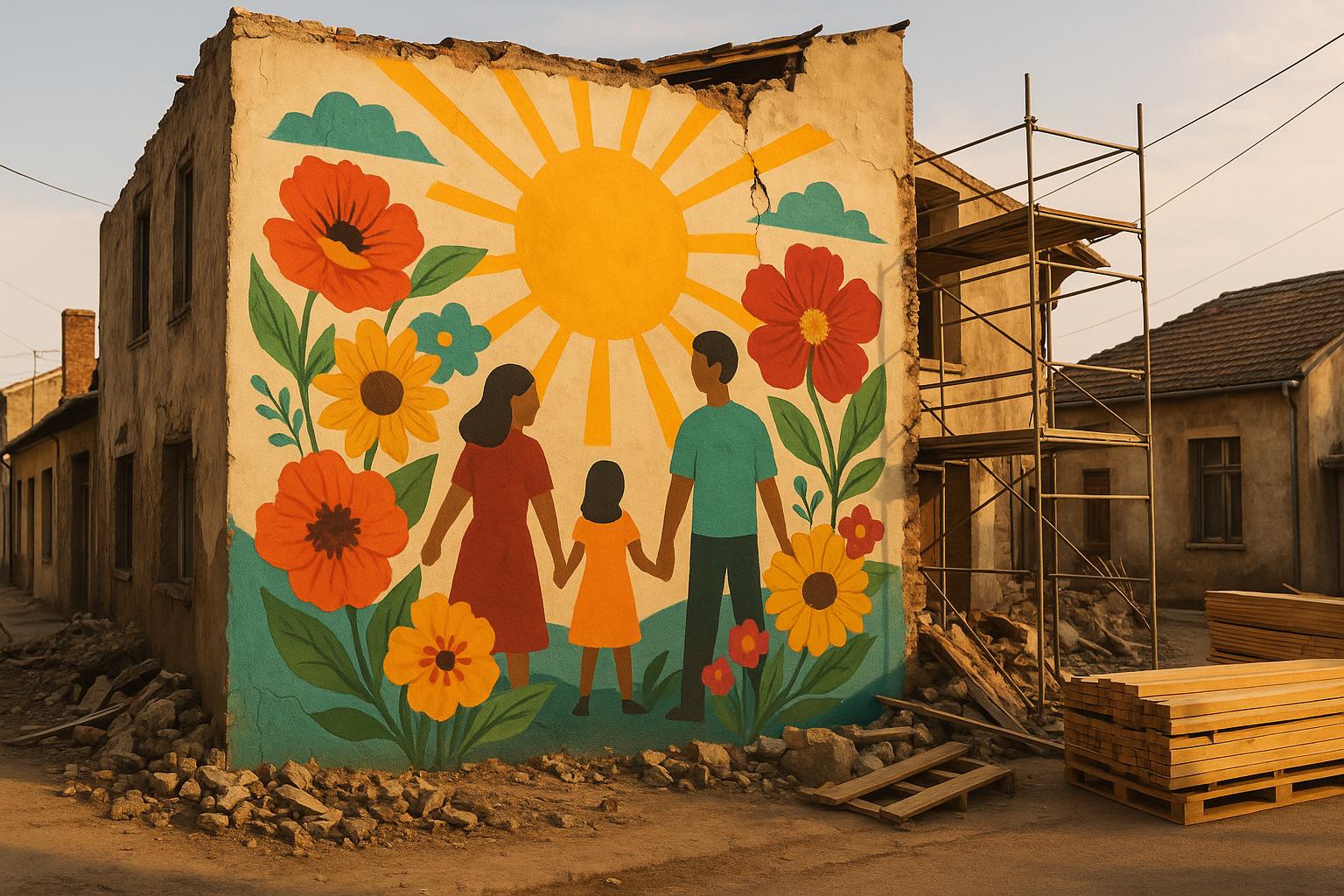
Street art has emerged as an unexpected yet powerful way to help communities recover after natural disasters. It transforms damaged spaces into symbols of hope and resilience, offering emotional relief and fostering social connections. Here’s how it makes a difference:
- Emotional Healing: Art allows survivors to process trauma and grief in a non-intimidating way, reducing feelings of isolation.
- Rebuilding Social Bonds: Collaborative projects bring people together, strengthening community ties and creating shared experiences.
- Reclaiming Spaces: Public art turns areas of destruction into vibrant, meaningful landmarks, helping communities regain a sense of ownership.
- Mental Health Support: In places where traditional mental health resources fall short, art provides an alternative path to recovery.
Examples from cities like Christchurch, Puerto Rico, and Joplin show how murals, sculptures, and community-driven projects have helped rebuild not just physical spaces but also the spirit of the people. Street art isn’t just decoration – it’s a tool for healing and renewal.
Disaster Recovery Through Placemaking
How Natural Disasters Affect Communities Emotionally
Natural disasters leave more than just visible destruction; they carve deep emotional scars that often linger long after the physical damage is repaired. While responders work to clear debris and restore utilities, the psychological toll on survivors can be profound. Studies show that nearly one-third of people affected by disasters experience mental health struggles, including post-traumatic stress disorder (PTSD), anxiety, and depression. Among these, PTSD is the most common, impacting 34.4% of survivors, followed by depression at 25%.
"Natural disasters affect people in different ways. A person’s reaction depends on many factors, including their past experiences, what is happening in their life at that moment, the nature of their exposure, and the support available to them as they rebuild. The sudden loss of control and uncertainty can be overwhelming, making it harder to cope in both the short and long term." – Nomi Levy-Carrick, MD, MPhil
Children often bear the heaviest emotional burden. They are more vulnerable to the psychological effects of disasters than adults, with trauma often lingering well into their developmental years. Disruptions to their sense of safety and routine can reshape their emotional well-being for years.
These challenges highlight the importance of addressing emotional recovery alongside physical rebuilding.
Why Emotional Recovery Matters as Much as Physical Rebuilding
Communities tend to focus heavily on rebuilding infrastructure – homes, roads, and businesses – while the emotional scars of disasters often go unaddressed. Yet, when mental health struggles become widespread, the ripple effects can weaken the entire community. Trust in institutions erodes, social connections fray, and collective recovery slows down.
The aftermath of Hurricane Katrina serves as a stark example. A survey revealed that 50% of respondents showed symptoms of PTSD. The mental health crisis became as paralyzing as the physical destruction, stalling recovery efforts and fracturing community bonds for years.
Despite these challenges, there is hope. Research on Hurricane Katrina survivors found that over 60% displayed resilience a few years after the storm. Those who thrived often had strong social support systems and maintained a sense of optimism, even amid loss. This highlights the critical role emotional recovery plays in long-term community outcomes.
Social cohesion, in particular, proves vital during recovery. A study of the 2011 Tohoku earthquake and tsunami in Iwanuma, Japan, found that communities with stronger social ties before the disaster experienced fewer severe PTSD cases afterward. Social cohesion reduced PTSD risk by 13% at the individual level and 25% at the community level.
"Community-level social cohesion is theorized to promote population health by strengthening both individual and community resilience in the aftermath of disaster." – Nakagawa and Shaw
This is where art steps in as a powerful tool for healing and reconnection.
How Art Helps People Process Trauma and Find Hope
In the wake of major disasters, traditional mental health services often become overwhelmed, leaving many survivors without adequate support. Art provides an alternative path to healing, offering a shared experience that validates collective grief while inspiring hope. Creating art together helps break the isolation that many feel after disasters. Transforming destruction into something meaningful shifts the narrative from one of loss to one of renewal.
Art also tackles the stigma that can prevent people from seeking mental health support. For many, participating in creative projects feels less intimidating than formal therapy, offering a safe space to process emotions.
"When emotions become overwhelming and get in the way of functioning and relationships, it’s important to seek out support. Shame and guilt can get in the way of that. It’s important disaster survivors understand that they shouldn’t worry alone and they can seek help if they are feeling stuck or in a dark place emotionally." – Nomi Levy-Carrick, MD, MPhil
Community art projects, in particular, help rebuild the social networks that disasters often disrupt. Research shows that social support tends to weaken over time after disasters, but creative initiatives can reverse this trend. By bringing people together to work on shared goals, art fosters reconnection and strengthens communal ties.
For displaced communities or those with weakened social bonds, art becomes a way to rebuild a sense of belonging. These projects create new gathering spaces, foster shared purpose, and help people redefine their identity beyond the trauma they’ve endured.
This emotional rebuilding is essential for overall recovery. Without addressing psychological wounds, communities can struggle to sustain momentum in physical reconstruction. Art not only heals individuals – it mends the social fabric, making collective recovery possible.
How Street Art Supports Community Recovery
Street art plays a powerful role in helping communities heal after disasters, turning ordinary spaces into symbols of hope and renewal. Unlike traditional art locked away in galleries, street art lives where people do – on walls, streets, and public spaces. It transforms damaged areas into reminders of resilience and turns empty spaces into proof that recovery is possible. This shift in the physical environment often sparks a psychological shift, replacing despair with a renewed sense of possibility.
"Artists are often anchors in their neighborhoods…they can help restore the color, liveliness, and balance of everyday life." – Jessica Cusick, Cultural Affairs Manager for the City of Santa Monica
Let’s dive into how public art helps reclaim spaces, involves residents in recovery efforts, and creates lasting symbols of strength for survivors.
How Public Art Helps Communities Reclaim Their Spaces
After a disaster, communities often feel disconnected and powerless in their own neighborhoods. Public art offers a way to reverse this by giving residents the chance to redefine their surroundings. Through murals, sculptures, and other creative projects, people can reclaim spaces that were once symbols of destruction.
Take Christchurch, New Zealand, for example. After the devastating 2011 earthquake, the seaside suburb of New Brighton launched a community-driven initiative called Mural Madness. This project transformed bare walls and empty lots into vibrant, colorful spaces. Not only did it beautify the neighborhood, but it also gave residents a sense of ownership in their recovery efforts.
British sculptor Antony Gormley, who contributed to post-earthquake Christchurch, spoke about the healing power of art:
"I believe in the therapeutic potential of art…In objectifying a moment of pleasure or pain it can release us from the pull or continued return, whether of addiction or depression. The challenge (in the case of Christchurch) was to find both a location and a language to carry this potential. I wanted to make something that was in recognition of a traumatic change, but which could also take some part in its healing".
Street art doesn’t just address emotional recovery – it also tackles the practical issue of abandoned or damaged spaces. When a community sees creativity replacing destruction, it changes how they relate to their environment. Instead of constant reminders of loss, these spaces become symbols of strength and renewal.
Getting Residents Involved in Art Projects
Street art is most impactful when it actively involves the people it’s meant to serve. Recovery projects thrive when they are done with communities, not just for them. By participating in the creation of public art, residents form deeper connections with the work and with each other. This shared experience turns personal healing into collective recovery.
A great example comes from Puerto Rico after hurricanes Irma and Maria in 2017. The San Juan-based theater company Y No Había Luz engaged communities through workshops that used recycled materials to create masks, puppets, and plays. One of their productions, "El Centinela de Mangó" ("The Mango Sentinel"), was inspired by a beloved tree that fell during Hurricane Maria in the town of Orocovis.
"For us, it’s very important that Puerto Ricans know that the possibility of making society better exists." – Yussef Soto Villarini, Founding Member of Y No Había Luz
This approach empowers residents to take an active role in their recovery. Instead of passively receiving aid, they become collaborators in rebuilding their community. The process of creating art together also helps restore social connections that disasters often sever, giving people a way to process trauma through creativity.
Artist Don Rimx, who painted murals featuring local boxers outside the Monterey Boxing Club in Bayamón, Puerto Rico, highlights the importance of these connections:
"For me, art is something everybody carries. It’s good to spread love and civility…I’m interacting with the people. I’m sharing knowledge. I learn something from them, too."
This kind of collaboration ensures that the final artwork reflects the community’s values and experiences. It also creates opportunities for everyone to contribute, even those who might not feel comfortable painting. Whether it’s helping to design concepts, preparing surfaces, or organizing events, there’s a role for everyone in these projects.
How Art Creates Shared Symbols for Survivors
Street art has a unique ability to unite people by creating shared symbols that speak to their collective experience. Disasters often leave individuals feeling isolated in their trauma, but public art provides a way to validate those feelings while fostering solidarity.
These shared symbols give communities a common language to express their journey. For example, a mural featuring landmarks destroyed in a hurricane acknowledges loss, while a sculpture celebrating resilience becomes a beacon of hope. Together, they tell a story that honors both the challenges and the strength of recovery.
In La Perla, San Juan, Puerto Rico, local efforts to revitalize the neighborhood with art after Hurricane Maria included work by art student Dalila Pinci. Her reflections capture the transformative power of shared symbols:
"Art can breathe new life into an island still recovering from natural disasters…At the end of the day, we are the ones who are learning, innovating. That can help with the world in this darkness."
Artist Samuel Lind explains how public art can also affirm cultural identity, which is especially important when disasters threaten to erase it:
"In my art expression, I send a message of what I believe our nation is and how beautiful our culture is. Our expression of identity as Puerto Ricans is important."
By reflecting a community’s heritage, street art reinforces a sense of identity and belonging. These shared symbols often emerge from conversations within the community, ensuring they resonate deeply with the people who see them every day.
Beyond their symbolic value, these artworks also serve practical purposes. A mural might become the backdrop for a neighborhood gathering, while a sculpture could act as a meeting point. In this way, street art doesn’t just represent recovery – it actively supports it by creating spaces for connection and collaboration, helping communities continue to grow stronger together.
Real Examples: Street Art in Disaster Recovery
Joplin, Missouri: Art From Tornado Debris
On May 22, 2011, an EF-5 tornado tore through Joplin, Missouri, leaving behind a devastating path. It claimed 161 lives, destroyed thousands of buildings, and generated a staggering 3 million cubic yards of debris. Amid this destruction, residents and artists came together to turn the remnants of the storm into symbols of hope and renewal.
One standout effort was The Reclamation Project, led by artist Matthew Dehaemers. This initiative brought together artists from Joplin and Kansas City to create sculptures and paintings using tornado debris. Dehaemers explained the project’s purpose:
"All these objects and materials have a story behind them, and that story’s only made through the people that own them. So what I thought was in between us and them is this material that has a choice of being put in this giant landfill or it has an opportunity to be reborn in a new, positive way."
This project created personal connections between artists and survivors, offering a way to process grief and rebuild community ties. For example, Joplin resident Ann Leach, who lost her home, collaborated with artist Luis Garcia to transform her grandmother’s music box, decorative aluminum dishes, and even pages from her Bible into a meaningful art piece. These artworks were later auctioned, with proceeds supporting local artists in rebuilding their studios and hosting art therapy sessions.
Another initiative, an exhibition at the Spiva Center for the Arts titled "On the Other Side", showcased works by both professional and amateur artists responding to the tornado. One contributor, Evelyn Duvall, used items salvaged from her destroyed childhood home – like Monopoly houses and an old 45 record – to create a sculpture. Reflecting on the experience, she shared:
"It helped me cope with what had happened. And I think that that’s important. And we all have to find our own way to deal with it."
Meanwhile, Art Feeds took a more hands-on approach with their "Rebuild Joplin" project, engaging students in imagining their community’s future. Kids sketched new building designs and constructed 3D scale models using large boxes. Their ideas included a revamped Mercy Hospital with a waterslide for discharged patients and a skyscraper offering free housing for displaced families.
These initiatives in Joplin highlight how art can transform devastation into community-driven healing and creativity.
St. Petersburg, Florida: Community Mural Festivals
In St. Petersburg, public art has played a key role in reclaiming shared spaces. Since 2015, the SHINE Mural Festival has been an annual event that has brought nearly 170 murals to the city’s downtown and arts districts. Organized by the St. Petersburg Arts Alliance, this October festival has become a vibrant celebration of creativity and collaboration.
The festival is about more than beautifying walls – it’s about bringing people together. Local, national, and international artists work side by side to create an outdoor gallery that the whole community can enjoy. The festival also incorporates technology through PixelStix, allowing viewers to connect with online content for a deeper understanding of the murals.
By turning neighborhoods into gathering spaces, the SHINE Mural Festival fosters dialogue, strengthens bonds, and reflects the shared values of the community. This annual tradition has become a lasting symbol of pride and connection for St. Petersburg.
New Orleans: Evacuspots as Public Art
While mural festivals focus on revitalizing urban spaces, New Orleans has taken a different approach by integrating art into its emergency infrastructure. The city’s Evacuspots – 17 fourteen-foot steel sculptures – serve as evacuation pickup points, blending functionality with creativity. Installed in 2013 by Evacuteer.org in partnership with the Arts Council of New Orleans and the Office of Homeland Security and Emergency Preparedness, each sculpture cost approximately $8,850.
Designed by artist Douglas Kornfeld, these sculptures address a critical need in a city frequently impacted by hurricanes – 28 tropical storm and hurricane events since 2000 alone. Built to withstand Category 5 winds, the sculptures mark locations for the City Assisted Evacuation (CAE) plan, which can transport up to 30,000 residents.
The Evacuspots also tackle communication challenges in a city where traditional signage may not reach everyone, especially with adult literacy rates at 44 percent. David Morris, Executive Director of Evacuteer, highlighted the universal appeal of art:
"That’s the beauty of art. Art is universal. Art is something that can be appreciated by people of every race, religion, creed, people that speak every language, it crosses all barriers, all boundaries. So it only makes sense that in a time of emergency, we would want something so universal."
Kornfeld intentionally designed the sculptures to be non-threatening:
"I didn’t want to create something threatening or anxiety producing. I wanted something that would not alarm people, but would be very recognizable."
Beyond their practical purpose, the Evacuspots have become symbols of resilience. The term "Evacuspot" is now embedded in emergency planning, and the sculptures’ imagery has appeared on Mardi Gras floats and transit worker uniforms. Morris envisions their broader impact:
"We want this symbol that we have in New Orleans to become a nationally and internationally recognizable icon of refuge and resilience."
sbb-itb-593149b
Benefits and Challenges of Using Street Art for Recovery
How Street Art Benefits Community Healing
Street art plays a powerful role in fostering emotional and social recovery, often filling gaps that traditional methods leave behind. When neighborhoods are transformed with vibrant, meaningful artwork, residents experience a renewed sense of pride and connection. These public displays become lasting symbols of resilience, reminding communities of their strength long after the initial trauma has passed. Beyond beautifying spaces, street art rebuilds the collective spirit of a community.
Research backs this up. A 2015 study in Talca, Chile, following a major earthquake, found that both creating and viewing art helped people cope with trauma and facilitated healing. Street art also strengthens community bonds. By creating spaces where people can gather and connect, it fosters shared experiences and unity. For instance, in Christchurch, New Zealand, following the 2010 and 2011 earthquakes, artists led a public health campaign that reached 70% of the affected population. An impressive 93% of participants reported a positive impact on their wellbeing, and 85% engaged in the recommended activities. The ongoing visibility of street art serves as a constant reminder of hope and recovery, reinforcing these messages throughout the healing journey.
However, while the benefits are clear, these projects also come with practical challenges that need careful consideration.
Common Problems with Street Art Recovery Projects
Despite its many advantages, street art recovery projects face a range of obstacles. One of the biggest hurdles is funding. Communities often need to balance the costs of art initiatives with pressing necessities like housing and healthcare. Securing materials and financial support usually requires tapping into multiple sources, which can be a time-consuming process.
Accessibility is another issue. Not everyone in the community can participate equally. Physical limitations, work commitments, or family responsibilities can prevent some residents from being involved, unintentionally excluding their voices from the healing process. Additionally, maintaining these artworks over time presents challenges. Long-term care involves collaboration among artists, conservators, local governments, and suppliers, making it a complex and ongoing effort.
Cultural sensitivity can also pose problems. Designs that fail to reflect local traditions or values may alienate residents rather than unite them. Pre-existing power dynamics within the community can further complicate collaborative efforts, potentially undermining the inclusiveness of the project.
Weighing the Benefits Against the Challenges
The evidence is clear: street art offers emotional relief, strengthens community ties, and preserves cultural identity. Studies show that traumatic events often disrupt a community’s emotional balance, and art has the potential to help restore it.
| Benefits | Challenges | Solutions |
|---|---|---|
| Boosts community pride and unity | Funding constraints | Seek diverse funding sources; balance art projects with urgent community needs |
| Provides an outlet for emotions | Limited accessibility | Implement inclusive participation methods and flexible involvement options |
| Establishes symbols of recovery | High maintenance demands | Plan for upkeep; train locals in preservation techniques |
| Spreads messages of hope and healing | Cultural insensitivity risks | Engage the community; collaborate with local leaders to ensure relevance |
A trauma-informed approach is essential to ensure these projects provide psychological support without causing further harm. Honest discussions about resource allocation and community priorities are also key. Jessica Cusick, Cultural Affairs Manager for the City of Santa Monica, captured this beautifully:
"Artists are often anchors in their neighborhoods. They’re the kind of people who remember the quirky little restaurant or shop that was destroyed; they have a feel for what makes neighborhoods vital and individual, and they can help restore the color, liveliness, and balance of everyday life."
The most effective street art recovery projects tackle challenges head-on. They involve the community from the beginning, honor local traditions, and plan for sustainability. When done well, street art can spark meaningful cultural shifts, leaving a lasting positive impact. As conservators emphasize, the goal is to preserve the artwork’s integrity and message for as long as possible.
How Organizations and Government Can Support Art-Based Recovery
When it comes to helping communities recover through street art, support from government bodies and arts organizations plays a crucial role. These institutions provide the funding, planning, and policies needed to transform art into a tool for healing in the wake of disasters. Their involvement complements grassroots efforts, which often spark the initial wave of recovery in affected areas.
Finding Money and Support for Recovery Art Projects
Securing funding is a cornerstone of any disaster recovery art initiative. Federal programs, like those offered by the Federal Emergency Management Agency (FEMA), are a major source of financial support. FEMA provides both Public Assistance, which covers emergency measures and debris removal, and Individual Assistance, now more accessible to self-employed individuals, including artists and small business owners.
The National Endowment for the Arts (NEA) also plays a significant role by offering grants through its Grants for Arts Projects (GAP) program. These grants range from $10,000 to $100,000, with Local Arts Agencies able to request even larger sums – up to $150,000 – for subgranting programs.
"The Arts . . . belong to all the people of the United States."
In addition to federal funding, organizations like the Red Cross and United Way provide immediate relief, while groups such as the Heritage Emergency National Task Force (HENTF) focus on cultural recovery. Communities can also check FEMA’s disaster declarations to confirm their eligibility for assistance programs. While navigating the application process can be complex, the financial support provided can turn ambitious ideas into reality. Equally important is ensuring that local perspectives shape these projects from the start.
Including Artists and Residents in Planning Projects
For street art to effectively aid recovery, collaboration between artists and local residents is essential. Artists contribute their creative expertise, while community members bring insights into the neighborhood’s identity and values. Together, they create works that resonate deeply with the people they’re meant to serve.
This synergy fosters a sense of belonging and pride. For example, in Santa Monica, Evan Meyer, CEO of Beautify, partnered with city officials to create 40–50 murals along Lincoln Boulevard. The project didn’t just beautify the area – it also boosted local business revenues by 5–10%, with some businesses reporting increases as high as 50%. Beyond economic benefits, such initiatives often reduce vandalism, as residents feel a stronger connection to their surroundings.
Adding Art to Government Recovery Plans
Embedding art into government recovery plans ensures consistent and long-term support for art-based healing. By integrating art projects into emergency preparedness strategies, agencies can proactively address community needs rather than reacting after a disaster strikes.
Planning ahead proves far more effective than scrambling to respond. For instance, pre-disaster engagement with communities can lower rebuilding costs and help preserve local culture. Governments can collaborate with arts organizations to develop strategies that incorporate art into mitigation and recovery efforts.
Several examples highlight how this approach works in practice. After Hurricane Maria in 2017, Puerto Rico’s Instituto de Cultura Puertorriqueña (ICP) launched the Cultura Rodante (Culture on Wheels) program, quickly mobilizing funds and resources to bring art back to affected communities. In Miami, the Arts Resilient 305 program connects artists, museums, and cultural organizations with emergency responders to build resilience well before disasters occur.
Eastern Kentucky’s response to the 2022 floods also showcased the power of coordinated efforts. The Heritage Emergency National Task Force (HENTF) and the Smithsonian Cultural Rescue Initiative (SCRI) worked together to support institutions like Appalshop and the Appalachian Artisan Center, ensuring that cultural landmarks were part of the recovery process.
"Community recovery in the aftermath of such disasters is a crucial challenge, and the arts have a strong role to play."
- Americans for the Arts
To make these efforts even more effective, policy frameworks should address regulatory gaps that hinder cultural recovery. By prioritizing cultural resources alongside physical infrastructure, governments can ensure that creative workers and organizations have the tools they need to rebuild and continue serving their communities.
Conclusion: Art as a Tool for Community Recovery
Street art has shown itself to be much more than colorful murals or decorative pieces – it’s a powerful medium for helping communities heal after natural disasters. Hurricanes, floods, and other catastrophes often leave behind more than just physical destruction; they also leave deep emotional scars that can linger for years. Traditional therapy and medical interventions are essential, but they don’t always address the collective grief and trauma that entire neighborhoods experience. This is where street art steps in.
By offering a way to express shared emotions, street art becomes a bridge to recovery. Initiatives like Y No Había Luz in Puerto Rico have helped survivors turn recycled materials into masks and puppets, creating art that reflects both their struggles and their hopes. Yari Helfeld, the organization’s Executive Director, explains their approach:
"We never try to tell them what is right, what is wrong. We always try to highlight the beauty and the possibilities, the desires and the dreams. We never try to make them remember the bad and feel the pain again."
This philosophy underscores the healing power of art. It allows individuals to channel their personal stories into creations that resonate with the entire community. In doing so, it complements earlier recovery efforts and reinforces the role of creativity in rebuilding lives and neighborhoods.
The impact of street art extends far beyond the immediate aftermath of a disaster. It transforms abandoned or neglected spaces into vibrant areas where people can connect, share, and rebuild a sense of belonging. Take the HeART Wall project in Gainesville, Florida, for example. This initiative brought together more than 2,500 people to create a massive mosaic, turning a shared artistic effort into a symbol of unity and resilience.
Street art also gives communities the chance to reclaim their narratives. Instead of letting outsiders define what disaster-stricken areas should look like, residents use art to tell their own stories. It addresses specific areas of urban neglect, sparking social renewal and helping communities rise stronger.
Moving forward, collaboration is key. When artists, residents, local governments, and organizations work together, the transformative potential of art becomes even greater. These partnerships don’t just rebuild what was lost – they create communities with a deeper sense of connection and resilience. Street art is not just about beautifying walls; it’s about building bonds, fostering hope, and creating a foundation for lasting strength through shared creativity and determination.
FAQs
How does street art support children’s emotional recovery after natural disasters?
Street art serves as a powerful tool for helping children navigate the emotional aftermath of natural disasters. Activities like drawing, painting, and creating murals give kids a way to express complex emotions that they may struggle to articulate. Through this creative process, they can work through their trauma in a safe, supportive environment.
Collaborative art projects within communities also play a key role in fostering connection and hope. When children take part in these group efforts, they not only strengthen their emotional resilience but also regain a sense of belonging and optimism. These shared creative experiences can be a meaningful step toward healing and rebuilding after difficult times.
What challenges do communities face when using street art for disaster recovery, and how can they address them?
Street art projects aimed at disaster recovery often face hurdles like tight budgets, differing cultural perspectives, and the challenges posed by local environmental conditions. These factors can complicate the process of creating and preserving art that resonates with the community.
Addressing these challenges starts with securing sufficient funding, whether through grants, sponsorships, or other financial support. Involving local residents and artists is also crucial to ensure the artwork genuinely reflects the community’s identity and values. To protect these creations from wear and tear, applying preservation methods like protective coatings can make a big difference. Ultimately, thoughtful collaboration with stakeholders and careful planning are essential for producing street art that not only lasts but also fosters emotional connection and social recovery.
How can local governments and organizations support street art to aid communities after natural disasters?
Local governments and organizations have an opportunity to use street art as a powerful tool for recovery after natural disasters. By incorporating arts initiatives into disaster recovery plans and dedicating funding to community art projects, they can help bring people together and support emotional healing.
Collaborating with local artists, nonprofits, and arts organizations can make these efforts even more impactful. Offering grants or resources for murals and public art installations gives communities a way to reflect on their experiences, rebuild their sense of identity, and find strength in unity. Beyond transforming affected areas visually, these projects inspire a shared sense of hope and renewal.
