
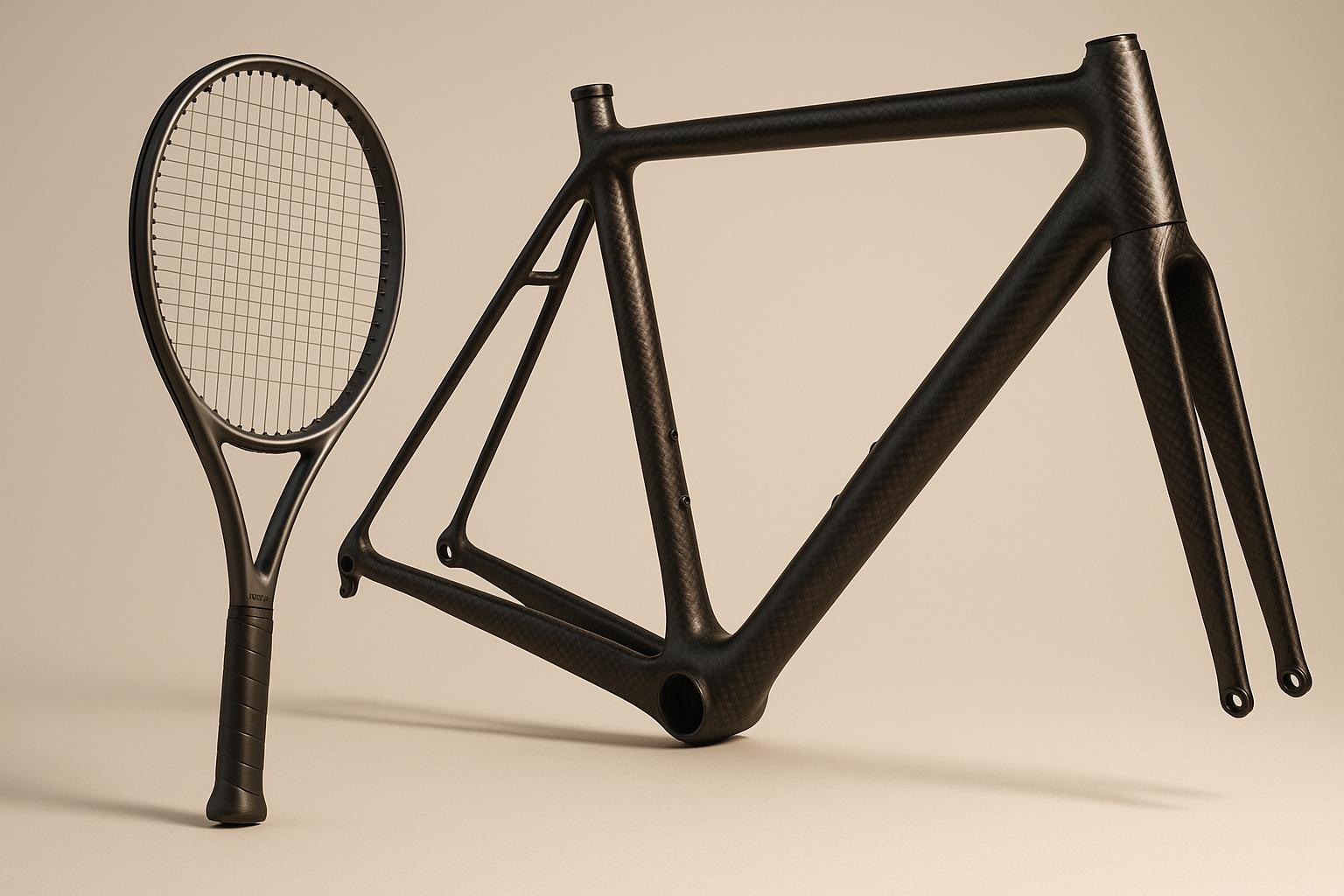
Graphene and carbon fiber are two cutting-edge materials transforming sports gear. Both offer impressive strength and lightweight properties, but they differ in structure, performance, and applications.
- Graphene: Known for being 200x stronger than steel, incredibly lightweight, and highly conductive. It’s used in tennis rackets, bike frames, and footwear to improve durability, weight reduction, and thermal management.
- Carbon Fiber: Highly reliable with a strength-to-weight ratio five times that of steel. It’s a staple in bikes, golf clubs, and helmets for its stiffness and durability.
Quick Comparison
| Aspect | Graphene | Carbon Fiber |
|---|---|---|
| Strength | 200x stronger than steel | 5x strength-to-weight ratio of steel |
| Weight | Extremely lightweight | Lightweight but heavier than graphene |
| Applications | Tennis rackets, shoes, bike frames | Bikes, golf clubs, helmets, skis |
| Conductivity | Highly conductive | Limited conductivity |
| Durability | Stronger and more impact-resistant | Durable but prone to impact damage |
| Cost | Expensive due to manufacturing challenges | High production cost but mature processes |
Graphene excels in advanced applications where conductivity and extreme strength are needed, while carbon fiber remains a dependable choice for structural integrity and scalability. Hybrid materials combining both may define the future of sports equipment.
Is Graphene Lighter Than Carbon Fiber? – Chemistry For Everyone
Material Properties and Structure
While both graphene and carbon fiber are primarily made of carbon, their atomic structures and production methods set them apart. These differences are what give each material its unique performance characteristics, especially in sports equipment. Let’s break down how these structural and manufacturing distinctions impact their use.
Composition and Manufacturing
Graphene is a single layer of carbon atoms arranged in a hexagonal honeycomb pattern, making it just one atom thick. Carbon fiber, on the other hand, is thicker, with a diameter of 5–10 micrometers, and consists of carbon atoms structured in small, graphite-like ribbons. These ribbons align along the fiber’s axis but lack the long-range crystalline order of graphene, giving carbon fiber a more amorphous structure. This amorphous nature allows the ribbons to bend and interlock, which contributes to the material’s mechanical strength.
The manufacturing processes also differ. Graphene is ideally pure carbon, while carbon fiber can include elements like oxygen and nitrogen to adjust its properties for specific applications.
Strength-to-Weight Ratio and Stiffness
Both materials excel in strength, but their structural differences lead to distinct performance metrics. Graphene boasts a tensile strength of about 130 GPa and an elastic modulus of 1.1 TPa. In comparison, carbon fiber typically has a tensile strength of around 3.5 GPa and a modulus of 228 GPa (33 msi) .
Carbon fiber particularly stands out for its stiffness-to-weight ratio. A plain-weave carbon fiber laminate has a ratio of 160 × 10^6, outperforming aluminum and steel, which measure around 100 × 10^6 – a 60% improvement. Interestingly, adding just 0.075% graphene by weight to carbon fiber can enhance its strength by 225% and its stiffness by 184%, according to research from Penn State. Professor Adri van Duin from Penn State highlights the potential of this combination:
"Even though carbon fibers have really nice features, they would make a car far more expensive with the way carbon fibers are manufactured now. If you can get these properties easier to manufacture then you can make cars significantly lighter, lower the cost of them and make them safer."
Toughness and Electrical Conductivity
Beyond strength and stiffness, graphene and carbon fiber offer unique properties in toughness and electrical conductivity. Graphene’s ability to conduct electricity is unmatched, with conductivity levels up to 70% higher than copper. As RP Deshpande from IIT Bombay explains:
"Graphene is the best conducting material known so far. Its one atom thickness gives many benefits for supercapacitor, batteries and many other applications."
Carbon fiber, while not as conductive as graphene, can have its electrical properties enhanced with treatments like silver nanoparticle coatings. Mechanically, carbon fiber offers up to four times the tensile strength of high-grade steel. However, graphene is both lighter and stronger than carbon fiber and Kevlar, making it ideal for weight-sensitive applications.
The way these materials are processed and combined with other components is crucial for their performance in sports equipment. Carbon fiber is often used in composites with materials like epoxy resin, metals, or ceramics, allowing manufacturers to fine-tune its properties for specific needs. Similarly, graphene’s high tensile strength, large surface area, and excellent thermal and electrical conductivity make it a valuable addition to composite designs. This is why graphene is increasingly being incorporated into sports gear – enhancing items like tennis rackets and running shoes – often as a complement to carbon fiber rather than a complete replacement.
Performance in Sports Equipment
Graphene and carbon fiber have revolutionized sports equipment by leveraging their unique material properties. Their strength, lightness, and conductivity have opened up new possibilities for performance improvements across various sports.
Sports Equipment Applications
One of the most notable uses of graphene in sports began with tennis rackets. In 2013, Head incorporated graphene into their designs, significantly enhancing racket maneuverability and control. Meanwhile, carbon fiber remains a staple in racket construction, valued for its durability and consistent performance.
In cycling, brands like Guerciotti have adopted graphene to create lighter and stronger bike frames. Carbon fiber, with its impressive strength-to-weight ratio – five times greater than steel – continues to dominate professional racing bikes, ensuring speed and reliability.
Graphene has also made its mark on footwear. British brand Inov-8 introduced sports shoes with graphene-enhanced outsoles, improving both durability and grip. This advancement is especially beneficial for activities like trail running, where traction and longevity are critical.
Winter sports have also embraced graphene, with lighter skis now offering improved rebound and rigidity. Trevor Brown, CEO of Rosbert International Pty Limited, explains:
"Graphene is a stronger and lighter material and Head has a patent for 10 years on using this technology in their skis. They are graphene sheets which go all the way along the length of the ski."
In golf, carbon fiber is a key material in club shafts, contributing to power and precision. Its ability to efficiently store and release energy enhances swing performance, making it a favorite among golfers.
Protective gear has benefited from both materials. Carbon fiber’s lightweight strength is ideal for helmets, while graphene adds impact resistance for extra safety. Patrick Varas, Product Manager at Apollo Bikes, notes:
"In the Mixino we are using aramid as well as graphene nanofibres in the reinforcing roll cage. Graphene is much stronger and lighter than the polycarbonate roll cages used in previous helmets, and helps to keep the helmet together in case of an impact."
These innovations showcase how graphene and carbon fiber excel in different areas, as summarized in the comparison below.
Pros and Cons Comparison
| Aspect | Graphene Advantages | Graphene Disadvantages | Carbon Fiber Advantages | Carbon Fiber Disadvantages |
|---|---|---|---|---|
| Weight | Reduces equipment weight by nearly 20% | 5X greater strength-to-weight ratio compared to steel | ||
| Durability | 200 times stronger than steel; 50% more durable grip in footwear | Excellent resistance to corrosion and wear | Vulnerable to impact damage | |
| Applications | Used in tennis rackets, skis, bikes, and footwear | Widely used in tennis rackets, golf clubs, bicycles, and helmets | Complex repair processes | |
| Performance | Enhances thermal management and impact dissipation | Consistent and predictable performance |
The data highlights some fascinating contrasts. For instance, graphene’s tensile strength of 130 GPa far outmatches even the strongest carbon fiber (Toray T1000) at 6.3 GPa. To put this into perspective, a one-square-meter sheet of graphene weighing just 0.77 mg could support a four-kilogram cat without breaking.
Both materials continue to push boundaries in sports. Graphene’s ability to improve comfort through better thermal management and impact dissipation makes it ideal for wearable equipment. On the other hand, carbon fiber’s proven reliability in products like tennis rackets, golf clubs, skis, bicycles, and hockey sticks ensures its place in structural applications where performance and dependability are key.
sbb-itb-593149b
Strengths, Weaknesses, and Design Suitability
To design cutting-edge sports equipment, it’s essential to understand the strengths and challenges of materials like graphene and carbon fiber. Both materials bring impressive benefits to the table but also come with unique hurdles that can influence how they’re used in real-world applications.
Material Strengths
What Makes Graphene Stand Out
Graphene is a powerhouse of material science. It’s the lightest and strongest material known, while also being highly conductive and flexible. This rare combination allows manufacturers to create sports gear that is not only durable but also highly responsive to an athlete’s movements.
Graphene’s versatility shines in specialized uses, such as sports shoes with improved outsoles or thermal management systems. A great example is the Vollebak reversible graphene jacket, which weighs just 197 grams and leverages graphene’s ability to store and redistribute heat effectively. Its conductivity opens doors to innovative designs that other materials simply can’t match.
Carbon Fiber’s Trusted Reputation
Carbon fiber has been a go-to material in sports equipment for decades, and for good reason. Its strength-to-weight ratio is five times greater than steel, making it invaluable for gear that demands both durability and lightweight performance. Its reliability and predictability make it a favorite among professional athletes.
What also sets carbon fiber apart is its mature manufacturing process. Engineers can precisely control fiber orientation and layering, enabling them to fine-tune the material’s performance for specific applications. This level of customization has cemented carbon fiber as a staple in high-performance sports equipment.
Limitations and Challenges
As impressive as these materials are, they’re not without their drawbacks. Each presents unique challenges in production and performance.
Graphene’s Manufacturing Obstacles
Graphene’s incredible properties come with a hefty price tag – literally. Producing high-quality graphene at scale is both difficult and expensive. Techniques like mechanical exfoliation or chemical vapor deposition struggle to meet large-scale demands, limiting its availability and driving up costs.
Another issue is consistency. Current production methods often result in variations in graphene’s size, layer count, and defect levels. Its single-atom thickness also makes it tricky to handle during manufacturing, as it tends to clump together and become unstable. These challenges complicate its integration into existing production workflows and add to the overall cost. On top of that, some production methods raise environmental and health concerns, and the lack of standardized quality controls makes it hard to achieve consistent performance across suppliers.
Carbon Fiber’s Vulnerabilities
While carbon fiber is a proven performer, it’s not invincible. One of its key weaknesses is its sensitivity to impact damage. A sharp object or sudden impact can cause delamination or breakage, compromising the material’s integrity. Repairs are often not an option; damaged carbon fiber components typically need to be replaced entirely, which can be both costly and time-consuming for athletes and teams.
Another limitation is its lack of electrical conductivity, an area where graphene clearly outshines it. Additionally, graphene offers the potential for a nearly 20% weight reduction in comparable applications, something carbon fiber can’t achieve.
Design Suitability Considerations
Choosing the right material ultimately depends on the specific demands of the sport and the equipment being designed. Carbon fiber remains the top choice for applications where reliability and well-established manufacturing processes are critical. Decades of development have created a mature supply chain and well-understood design principles, making it a dependable option.
On the other hand, graphene holds promise for next-generation innovations. Its unique properties can justify the added complexity and cost in situations where its advantages – like conductivity and extreme lightweight – are game-changers.
Looking ahead, hybrid designs could offer the best of both worlds. By combining the two materials, manufacturers can tap into graphene’s strengths in targeted areas while relying on carbon fiber for structural integrity. Research has already shown that adding just 0.075% graphene by weight to carbon fiber can boost its strength by 225% and its stiffness by 184%. This approach could pave the way for groundbreaking advancements in sports equipment design.
Future Trends in Sports Materials
The world of sports materials is on the brink of transformation. With advancements in graphene and carbon fiber, the industry is pushing beyond traditional boundaries. Projections show the global sporting goods market could hit $1.5 billion by 2030, growing at an impressive annual rate of 10%.
Hybrid Materials: A Game-Changer
Hybrid composites are emerging as a major innovation, combining graphene with carbon nanotubes (CNTs) to overcome the limitations of using each material individually. These hybrids prevent issues like CNT clumping and graphene restacking, unlocking their full potential.
The results from these combinations are striking. For instance, adding just 0.075% of functionalized graphene oxide to an epoxy matrix can boost tensile strength by 30.3%. Similarly, introducing 0.25% graphene filler to carbon fiber reinforced polymers increases bending strength by 5%. These breakthroughs hint at a future filled with cutting-edge manufacturing possibilities.
Advances in Manufacturing Techniques
Companies like Lyten Motorsports are leading the charge with revolutionary manufacturing methods. Their proprietary 3D Graphene technology uses advanced 3D printing and adhesives to create ultra-lightweight, durable components. After rigorous testing with INDYCAR Experience‘s 2-seater cars, Lyten is now scaling up production with autoclave manufacturing.
Dan Cook, CEO of Lyten, captures the excitement, stating:
"Material science is creating a future that is lighter, stronger and safer, while reducing our impact on the planet. The introduction of carbon fiber revolutionized the sport, and we believe Lyten 3D Graphene can be the next materials revolution in motorsports".
Smart Design and Additive Manufacturing
The industry is also embracing advanced computational tools like finite element analysis (FEA) and machine learning to refine composite designs. These tools allow for the creation of complex shapes and optimized fiber alignments, pushing performance limits.
Additive manufacturing, or 3D printing, is reshaping production processes by enabling the creation of intricate, customized structures that traditional methods can’t achieve. This market is poised for tremendous growth, with projections estimating it will reach $65.148 billion at an annual growth rate of 29.86%.
Real-World Applications Taking Shape
Major brands are already applying these advanced materials. HO Sports, in collaboration with Checkerspot, developed the Sabre water ski, featuring a bio-based foam core tailored for water sports.
Another example is the partnership between Reinforce 3D and Bauer Hockey. Blanca Garro, CEO of Reinforce 3D, emphasizes the impact of their technology:
"Our mission at Reinforce 3D has always been to take any part to a new level of performance. Partnering with Bauer Hockey allows us to demonstrate the true potential of our CFIP technology and 360-degree solution in high-performance applications".
Market Growth and Sustainability
The carbon fiber market in sports equipment is expected to grow to $542.8 million by 2033. While glass-fiber composites currently dominate with 96% of the market share, carbon fiber products are set to grow at nearly 9.87% annually through 2030. Sustainability is becoming a key focus, with an emphasis on eco-friendly production methods and recycled carbon fiber.
Multiscale Reinforcement: The Next Frontier
Researchers are investigating multiscale reinforcement strategies that combine fibers with graphene nanoplatelets (GNPs). These techniques aim to improve the interface between carbon fibers and epoxy matrices, addressing a common weakness in traditional composites.
The broader materials market is also seeing rapid growth. The global carbon nanomaterials market is projected to reach $5.7 billion by 2030, growing at a 17.2% annual rate, while the advanced polymer composites market could hit $12.478 billion by 2025.
These advancements signal a future where sports equipment will be lighter, stronger, and more responsive, driven by a combination of cutting-edge materials, smarter manufacturing processes, and a growing commitment to sustainability. The possibilities ahead are as exciting as they are transformative.
Conclusion
Graphene brings incredible lightweight strength to the table, cutting equipment weight by nearly 20% in practical use. Meanwhile, carbon fiber stands out with its proven structural reliability, boasting a density almost twice as low as aluminum and five times lower than steel. With graphene being about 200 times stronger than steel, it shines in applications where weight reduction, flexibility, and advanced features like thermoregulation are key. On the other hand, carbon fiber remains the go-to choice for scenarios requiring maximum stiffness, long-term durability, and scalable production costs.
That said, both materials have their hurdles. Graphene struggles with manufacturing complexities and potential toxicity issues, while carbon fiber’s high production costs and time-intensive processes can be limiting. These challenges, however, are driving innovation, particularly in hybrid solutions that blend the best of both materials.
The numbers speak volumes: the graphene composite market is expected to leap from $567.2 million in 2023 to a staggering $2.8 billion by 2033, reflecting growing confidence in its possibilities. At the same time, carbon fiber’s steady annual growth rate of 4.55% demonstrates its ongoing relevance and demand. Together, these advancements in material science are reshaping sports equipment, combining strength, lightness, and functionality in ways that elevate performance.
Ultimately, whether to use graphene or carbon fiber depends on the specific needs of the application. As manufacturing technologies improve and hybrid materials become more common, athletes can anticipate gear that’s lighter, tougher, and more responsive than ever. The future of sports materials isn’t about choosing one over the other – it’s about harnessing the strengths of both to push the limits of what’s possible in performance.
FAQs
How do the manufacturing processes of graphene and carbon fiber differ, and what does this mean for their use in sports equipment?
The way graphene and carbon fiber are made sets them apart and influences how they’re used in sports gear. Graphene, a super-thin nanomaterial, is created from graphite through techniques like chemical vapor deposition (CVD) or exfoliation. The result? A lightweight yet incredibly strong material that can be seamlessly added to composites, boosting both durability and performance.
Carbon fiber, however, is produced differently. It starts with materials like polyacrylonitrile (PAN) or pitch, which are spun into fibers and then heated to high temperatures to carbonize them. This process creates strong, rigid fibers on a microscopic scale, making them ideal for structural parts in sports equipment. While graphene shines in enhancing lightweight materials, carbon fiber continues to dominate in high-strength applications, thanks to its well-established production methods and trusted performance.
What are the environmental impacts of using graphene and carbon fiber in sports equipment?
Graphene is gaining attention as a greener option for sports equipment. Its lightweight yet strong structure means manufacturers can use less material and energy during production, which helps cut down on carbon emissions. Plus, because it’s so durable, sports gear made with graphene tends to last longer, reducing waste over time.
In contrast, carbon fiber poses more environmental challenges. Its production process is energy-intensive, and a significant portion of discarded carbon fiber often ends up in landfills. While it’s valued for boosting performance, its environmental downsides make graphene a more sustainable alternative.
How could combining graphene and carbon fiber improve the performance of sports equipment?
Combining graphene with carbon fiber in sports equipment opens the door to exciting possibilities. This hybrid material could lead to gear that’s stronger, lighter, and more durable, giving athletes a noticeable edge in performance and reliability.
Graphene’s unmatched strength and conductivity, paired with the lightweight and stiffness of carbon fiber, offer manufacturers the chance to create equipment with improved mechanical strength, stiffness, and electrical conductivity. Imagine ultra-light tennis rackets that swing effortlessly, bike frames built for both speed and durability, or skis that offer superior control and efficiency on the slopes.
This blend of advanced materials is shaping the future of sports gear, setting new standards for what athletes can achieve with the help of cutting-edge technology.
