
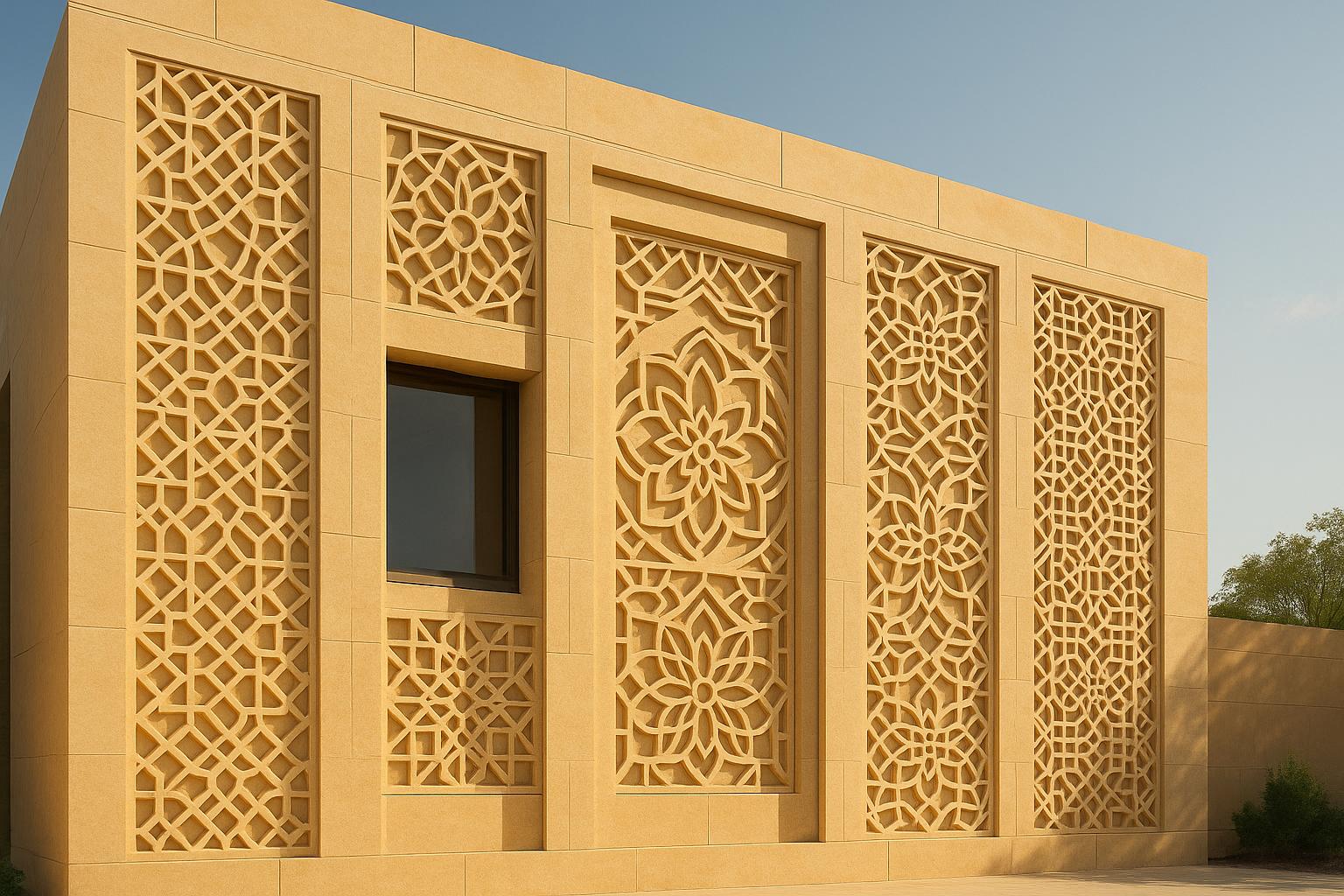
Geometric patterns have shaped architectural designs across history, linking mathematics, spirituality, and cultural values. From Islamic tessellations symbolizing infinity to Gothic cathedrals emphasizing light and verticality, these patterns reflect the harmony between structure and meaning.
Key points:
- Islamic Architecture: Focuses on repetitive patterns like stars and tessellations, symbolizing divine unity and infinity. Examples include the Dome of the Rock and the Taj Mahal.
- Gothic Architecture: Uses shapes like circles and triangles to symbolize eternity and the Holy Trinity. Features like rose windows and flying buttresses enhance light and structural stability.
- Asian Temples: Designs incorporate cosmic principles like mandalas and Feng Shui, reflecting unity with nature. Examples include the Shwedagon Pagoda and Temple of Heaven.
- Indigenous Structures: Patterns like spirals and quadripartite designs represent cosmic cycles and harmony. Examples include the Maya Pyramid of Kukulcán and Machu Picchu.
These patterns aren’t just decorative – they serve structural and symbolic purposes, influencing modern architecture through principles like the Golden Ratio and sustainable design practices.
Sacred Geometry: Things an Architect Should Know
1. Islamic Architecture
Islamic geometric patterns represent a rich tradition deeply tied to mathematical precision and spiritual expression. Originating during the Islamic Golden Age, these intricate designs have evolved over centuries, leaving their mark on iconic architectural works worldwide.
Symbolic Meaning
In Islamic architecture, geometric patterns are far more than decorative elements – they carry profound spiritual significance. These patterns visually express tawhid (the oneness of God), with their repetitive shapes symbolizing the infinite nature of both the universe and the divine. As David Wade aptly describes:
"The decorated pages of a Qur’an can become windows onto the infinite".
The symmetry and intricate complexity of these patterns reflect a cosmic harmony, emphasizing spiritual qualities over physical representation.
Historical and Cultural Influence
The evolution of Islamic geometric patterns was closely tied to Islamic religious and cultural principles. The prohibition of figurative imagery (aniconism) encouraged artists to focus on abstract and mathematical designs. Drawing inspiration from Greek, Roman, and Sasanian traditions, early Islamic artists refined simple geometric shapes into elaborate patterns.
For example, one of the earliest appearances of geometric designs, such as 8-pointed stars and lozenges, can be seen in the Great Mosque of Kairouan in Tunisia, dating back to 836 CE. By the 9th century, polygonal tessellation had become a hallmark of Islamic art. Regional influences and the patronage of various dynasties contributed to unique styles across the Islamic world. This diversity is evident in structures like the Dome of the Rock (691 CE), the Great Mosque of Damascus (661–750 CE), the Süleymaniye Mosque in Istanbul (1550–1557 CE), and the Taj Mahal in Agra (1632–1653 CE).
Practical Applications
Islamic geometric designs are not just visually striking – they also serve functional purposes in architecture. For instance:
- Jali screens: These intricately carved panels feature repeating geometric patterns that allow airflow, diffuse sunlight, and ensure privacy in hot climates.
- Muqarnas: These honeycomb-like domes add an ornamental touch while distributing structural loads and reflecting mathematical and cosmological principles.
- Stained glass windows: Geometric patterns in these windows create stunning light effects while enhancing the ambiance of worship spaces.
Decorative Elements
Geometric motifs are prominently featured in domes, arches, courtyards, and other architectural spaces, often paired with calligraphy for a cohesive design. Over time, these patterns grew in complexity. Early Islamic designs, like simple stars and lozenges, evolved into intricate 14- and 16-point stars by the 16th century. The girih style, which gained popularity between the 15th and 20th centuries, is a prime example. It features interlaced strapwork patterns based on repeated squares, circles, and arabesques.
Regional preferences also influenced decorative choices. For instance, Ottoman architects often integrated floral and vegetal motifs while reserving geometric patterns for elements like door panels and minbars.
Today, geometric patterns continue to dominate Islamic art, appearing in over 80% of Islamic artworks. Their enduring presence highlights their role in reflecting the artistic and spiritual values of Islamic culture. Next, we’ll examine how geometric patterns convey spiritual themes in Gothic and Christian architecture.
2. Gothic and Christian Architecture
Gothic and Christian architecture took geometric designs to a whole new level, turning them into spiritual tools that connected worshippers to the divine. Unlike the mathematical precision seen in Islamic patterns, Gothic geometry emphasized verticality and light, aiming to guide the soul toward transcendence through its shapes and proportions.
Symbolic Meaning
Medieval builders believed that geometric patterns could bridge the earthly and the divine. Every shape carried a profound spiritual meaning, turning cathedrals into sacred gateways.
| Shape | Symbolism |
|---|---|
| Circle | Eternity, infinity, unity with the divine |
| Triangle | Holy Trinity, harmony, balance, connection between heaven, earth, and humanity |
| Square and Rectangle | Physical existence, earthly stability, material world |
| Cross | Christ’s sacrifice, unity of material and spiritual realms |
One of the best examples of circular symbolism is the rose window, which represented God’s infinite nature while allowing divine light to flow into sacred spaces. In Notre-Dame de Paris, the rose window specifically honors the Virgin Mary – known as the Mystical Rose – symbolizing purity and divine grace.
The Golden Ratio (approximately 1.618) frequently appeared in cathedral designs, aligning human craftsmanship with a sense of divine order.
Cultural Context
The deep religious devotion of the medieval period shaped every aspect of Gothic architecture. Sacred geometry became a way to express divine order, with builders believing they could physically construct pathways to heaven.
This cultural backdrop led to iconic architectural masterpieces. For instance, Chartres Cathedral (1194–1250) features rose windows designed using the Golden Ratio and Fibonacci sequences, visually reflecting cosmic harmony. Notre-Dame Cathedral in Paris incorporates symbolism into every detail, from its three doors representing the Trinity to its cruciform layout, which places worshippers symbolically at the foot of Christ’s sacrifice.
Functional Use
Gothic geometric patterns weren’t just symbolic – they were practical too. Builders used geometry to enhance divine illumination and structural stability. For example, the east-west orientation of cathedrals, with apses facing east, symbolized Christ’s resurrection while maximizing the morning light for ceremonies. Stained glass windows used geometric designs to filter sunlight, creating a glowing, otherworldly atmosphere that evoked a divine presence.
A great example of functional geometry is St. Joseph’s Cathedral in Hanoi, Vietnam (1886), where equilateral triangle-based arches provide both structural stability and a nod to the Trinity.
Decorative Application
Gothic decoration seamlessly wove geometric patterns into architectural elements, creating unified spiritual experiences. Cruciform plans were standard, with many cathedrals designed as Latin or Greek crosses to remind visitors of Christ’s sacrifice . Proportional systems, often based on the Golden Ratio, influenced the design of facades, windows, and arches, ensuring a sense of harmony that reflected divine perfection.
Gothic decoration differed significantly from Islamic patterns. While Islamic geometry focused on infinite repetition, Gothic designs emphasized a hierarchical progression, drawing the eye upward toward heaven. This vertical focus aligned with the cultural goal of spiritual ascension.
Triangular motifs were common in Gothic decoration, symbolizing the Trinity through details like window tracery and sculptural elements. These patterns created visual rhythms that reinforced theological ideas through repetition.
The interplay of geometry and light in Gothic architecture was transformative. Builders used geometric designs to optimize divine illumination, reinforcing the medieval belief that light symbolized God’s presence. Up next, we’ll explore how sacred geometry found expression in Asian temple designs, offering another fascinating cultural perspective.
3. Asian Temples
Asian temples stand out for their intricate designs that reflect cosmic harmony. Their architecture is deeply tied to ancient philosophies, using geometric patterns to create spaces that symbolize the universe. These sacred designs are not only visually striking but also carry profound spiritual meaning, as explored in the sections below.
Symbolic Meaning
The geometry of Asian temples is steeped in symbolism, aiming to mirror the cosmic order. Various shapes and patterns hold specific meanings: circles represent unity and infinity, squares signify stability and the cardinal directions, and triangles highlight the connection between heaven and earth. Hexagons, known as Kikkō, are associated with protection and longevity, while overlapping circles (Shippō) symbolize spiritual treasures. Lattice patterns (Kagome) are believed to ward off negative energies, and rising wave motifs (Takewaku) convey resilience and the ability to overcome challenges. The dome, a central feature in many temples, represents Mount Meru, the sacred mountain central to Hindu and Buddhist cosmology.
Cultural Context
The symbolic elements in temple architecture are deeply rooted in philosophical systems that shape their design. Mandalas, Vastu Shastra, and Feng Shui all play significant roles in aligning these structures with universal principles.
- Mandalas are intricate spiritual diagrams used in meditation and rituals, emphasizing mathematical precision to represent the cosmos.
- Vastu Shastra, an ancient Indian architectural guide, focuses on symmetry, proportion, and orientation to harmonize buildings with natural forces.
- Feng Shui directs the arrangement of architectural elements to enhance the flow of Chi, creating a balance with natural elements.
In Japan, geometric patterns inspired by ancestral beliefs and a deep connection with nature are thought to bring good fortune, longevity, and protection.
Functional Use
Geometry in Asian temples isn’t just symbolic – it serves practical spiritual purposes too. For example, the Shwedagon Pagoda in Myanmar (6th century) incorporates Mandala, Vastu Shastra, and Feng Shui principles. Its design centers on a stupa surrounded by smaller stupas and shrines, with its placement optimized to channel positive energy (Chi).
Similarly, the Temple of Heaven in China (built 1406–1420) reflects directional hierarchy through Feng Shui. Its circular structures symbolize heaven, while square elements represent earth, creating harmony between people and their surroundings. In India, the Hoysaleshwara Temple in Karnataka (12th century) exemplifies Vastu Shastra with its precise alignment to cardinal directions, proportional design based on Ayadi Sutras, and energy-balancing features like Ratna Bhandara.
Decorative Application
The decorative aspects of Asian temples seamlessly blend geometry with spiritual symbolism. The Borobudur Temple in Indonesia (9th century) is a striking example, built as a three-dimensional mandala. Its design takes visitors on a symbolic journey from the earthly realm to spiritual enlightenment.
In Chinese temple design, colors also play a role: yellow signifies imperial power, red represents good fortune, and green stands for wealth and growth. The Temple of Heaven’s Hall of Prayer for Good Harvests showcases intricate geometry in its construction. This circular structure, set on a marble base and built without nails, features gold and green decorative elements and triple eaves, combining functional design with symbolic meaning.
sbb-itb-593149b
4. Indigenous and Pre-Columbian Structures
Indigenous and Pre-Columbian architecture across the Americas showcases intricate geometric designs that reflect advanced mathematical knowledge, deep astronomical understanding, and spiritual beliefs. These patterns weren’t just decorative; they served as visual representations of complex cultural ideas, shaping the identity and structure of entire civilizations.
Symbolic Meaning
Geometric patterns in Indigenous and Pre-Columbian architecture often carried profound cosmological significance. For instance, the stepped fret motif, common in Mesoamerican and Andean cultures, symbolized mountains, clouds, and the connection between earth and sky. This design wasn’t limited to architecture – it also appeared in textiles, representing ideas like cyclical time and movement, particularly in Mixtec and Aztec art.
Other patterns, like spirals and concentric circles, symbolized cosmic energy, spiritual journeys, and cyclical time. These motifs, frequently found in petroglyphs and ceramics across North and South America, were often tied to water symbolism, such as whirlpools. In Hohokam and Mimbres pottery, spirals conveyed themes of growth and transformation.
The quadripartite design, representing the four cardinal directions and cosmic balance, was another key element. This pattern was integrated into city layouts, ritual spaces, and artistic works, reflecting harmony between opposing forces in nature.
Cultural Context
These geometric patterns weren’t just artistic – they embodied a sophisticated blend of mathematics, astronomy, and cultural beliefs. Pre-Columbian societies used abstract designs to communicate complex cosmological and philosophical ideas. These motifs acted as a shared symbolic language, reinforcing social structures and religious ideologies. They also tied into concepts of sacred geography and divine order, with mathematical precision underpinning both cultural beliefs and the practical brilliance of their architecture.
Functional Use
Geometric designs in Indigenous and Pre-Columbian structures also served practical purposes. Many buildings were aligned with celestial bodies, showcasing the builders’ astronomical expertise. For example, the Maya Pyramid of Kukulcán at Chichén Itzá has 91 steps on each of its four sides. Including the top platform, this totals 365 steps – the exact number of days in a solar year.
Pyramids were more than just ceremonial centers; they were integral to city layouts. Natural materials like stone, wood, and clay were used to create structures that harmonized with their environment. The Inca observatory at Machu Picchu, for instance, aligns perfectly with the sun during solstices, while Tikal’s network of pyramids and public buildings incorporated advanced water management systems. At the feathered serpent pyramid of Kukulcán, clapping at its base produces echoes resembling a native bird’s chirp, demonstrating a blend of acoustics and symbolism.
Decorative Application
Decoration in Indigenous architecture merged geometric motifs with functionality. In Machu Picchu, for example, the Inca used precisely cut granite blocks to ensure both structural stability and aesthetic appeal.
Unlike Islamic art, which uses geometric designs to evoke the infinite, Indigenous American art tied geometric patterns to nature and spirituality. This approach highlighted the relationship between human creation and natural forces. Beyond ceremonial structures, these principles extended to practical designs, such as terraced fields engineered to prevent erosion and maximize agricultural output. This seamless integration of art, utility, and nature reflects a cultural philosophy where science, spirituality, and design were deeply interconnected. While parallels can be drawn with Islamic and Gothic traditions, Indigenous designs stand apart in their unique expression of harmony with the natural world.
Comparison of Strengths and Limitations
By examining the distinct qualities of these architectural traditions, we can better understand their strengths and the challenges they face. Their symbolic, structural, and aesthetic elements reveal how each tradition applies geometry to timeless principles while adapting to modern contexts.
Symbolic Depth and Spiritual Expression
Islamic architecture stands out for its precise geometric patterns that symbolize divine unity and infinity. This mathematical clarity carries deep spiritual meaning. However, its strict avoidance of figurative imagery, while significant in its spiritual context, limits its ability to tell stories visually compared to traditions that incorporate human or animal forms.
Gothic architecture conveys powerful emotional and spiritual messages through its soaring verticality and interplay of light. Features like pointed arches and ribbed vaults guide the eye upward, evoking a sense of spiritual ascension. Yet, this focus on dramatic height and light can sometimes overshadow the intricate mathematical relationships found in other traditions.
Asian temple architecture merges symbolic meaning with a sense of harmony, often reflecting cosmic principles like balance and cyclical time in its layouts. While this approach creates a unique connection between philosophy and form, the diversity of regional styles can make it challenging to maintain a consistent interpretation.
Indigenous and Pre-Columbian structures integrate astronomy, mathematics, and spirituality seamlessly. A striking example is the Maya Pyramid of Kukulcán, with its 365 steps symbolizing the solar year. However, the loss of traditional techniques over time has hindered a full understanding of their symbolic systems.
Practical Application and Structural Benefits
Modern research underscores the structural stability of triangles, a principle extensively used in Islamic architecture through intricate triangular subdivisions in star patterns. These designs combine visual appeal with structural soundness. Meanwhile, Gothic architecture introduced groundbreaking engineering solutions like flying buttresses, which efficiently distribute weight but add complexity and cost to construction.
Indigenous and Pre-Columbian architecture demonstrates exceptional environmental adaptation. For instance, Machu Picchu’s granite blocks fit together so precisely that they ensure stability while blending with the landscape. These structures also incorporate advanced water management and astronomical alignments, showcasing thoughtful planning. On the other hand, Asian temple design often prioritizes harmony with natural surroundings over pure structural efficiency, resulting in buildings that age gracefully and integrate seamlessly with their environment.
The practical choices in each tradition not only ensure stability but also shape their distinct visual and cultural identities.
Visual Appeal and Aesthetic Impact
The visual strengths of these traditions reflect their cultural values and technical expertise. Islamic designs create mesmerizing, infinite patterns that evoke introspection. As Carlos Avendano describes:
“…the effect… is a state of abstract contemplation which brings man to the profound condition needed to reach that internal well-being which puts him closer to God… aesthetic sensitivity is by no means denied in the search for spiritual growth: on the contrary it is a way of enhancing the whole human being.”
While these patterns inspire reflection, the absence of figurative imagery may feel less relatable to some viewers.
Gothic architecture captivates with dramatic contrasts of light and shadow, intricate stonework, and vibrant stained glass. Christopher Wren acknowledged the sophistication of pointed arches and their connection to earlier Islamic innovations. However, the style’s strong ties to specific religious contexts can limit its universal appeal.
Indigenous designs often draw inspiration from natural forms and cosmic cycles. At Kukulcán, the pyramid’s unique echo effects combine visual and auditory experiences. While this holistic approach creates memorable encounters, its cultural specificity can make interpretation difficult for outsiders.
| Aspect | Islamic | Gothic | Asian | Indigenous |
|---|---|---|---|---|
| Symbolic Complexity | Mathematical precision | Vertical spirituality | Cosmic balance | Astronomy and nature integration |
| Structural Innovation | Efficient geometric patterns | Flying buttresses | Environmental harmony | Precision material use |
| Visual Impact | Infinite geometric repetition | Light and shadow drama | Natural serenity | Multisensory encounters |
| Cultural Accessibility | Universal geometric appeal | Context-specific religious ties | Regional diversity challenges | Requires cultural understanding |
| Contemporary Adaptability | Scalable for modern designs | High construction complexity | Sustainable, nature-driven design | Limited by traditional techniques |
Contemporary Relevance and Limitations
Modern architects are increasingly recognizing the importance of geometry in functional design. Islamic geometric principles are particularly well-suited to modern tools like design software and modular construction, making them adaptable to new materials and technologies. Gothic structural innovations, such as flying buttresses, continue to influence the creation of large, open spaces, though the intricate details often come with higher costs.
Indigenous and Pre-Columbian principles are being revisited for their alignment with sustainable architecture, emphasizing natural materials and environmental integration. Similarly, Asian temple philosophies are inspiring biomorphic trends that mimic natural forms.
Each tradition must navigate the challenge of preserving its cultural essence while meeting the demands of contemporary design practices.
Conclusion
Geometric patterns in architecture serve as a universal thread, weaving together cultures across time and geography. Architect Antonio Caperna captures this beautifully:
The built environment, with its geometrical symbolism, talks about the culture that has generate it, and express the intimate values of a culture.
This connection between structure and meaning highlights how mathematical principles can embody profound spiritual and cultural messages.
Sacred geometry acts as a bridge between philosophy, religion, and art, showcasing how numbers and shapes influence the spaces we inhabit. Whether it’s the intricate star motifs in Islamic mosques or the soaring arches of Gothic cathedrals, these geometric designs reflect unique worldviews while contributing to a shared architectural legacy.
Contemporary architects continue to draw inspiration from these timeless principles. The Golden Ratio (approximately 1.618:1), found naturally in various forms, is often used to create balance and visual appeal. Modern tools like parametric design allow for the creation of intricate structures that echo ancient patterns. A prime example is the Heydar Aliyev Center in Baku, Azerbaijan, designed by Zaha Hadid, which blends modern innovation with age-old geometric principles.
Ancient wisdom also offers lessons in sustainable design. Structures built by Indigenous and Pre-Columbian cultures reveal how local materials and passive cooling techniques can create spaces that are both functional and in harmony with their environment.
These patterns are not just mathematical marvels – they are part of an ongoing dialogue between the past and the present. As Danish Rahman points out, this interplay ensures that geometric patterns will continue to evolve, carrying forward the knowledge of ancient builders while addressing modern challenges.
Ultimately, these traditions remind us that architecture is about connection – to the divine, to nature, and to each other. Symbols like the Flower of Life, often viewed as sacred and thought to contain the "blueprint of creation", illustrate how geometry speaks to both our logical minds and our spiritual hearts. These enduring designs continue to inspire, proving that the most meaningful architecture transcends time and resonates deeply with humanity.
FAQs
How do geometric patterns in architecture contribute to sustainable design today?
Geometric patterns are making waves in modern sustainable architecture, blending visual appeal with practical benefits. Designs influenced by sacred geometry and natural patterns aren’t just eye-catching – they’re also smart. For instance, hexagonal and tessellated shapes not only add strength to structures but also cut down on material waste.
These patterns do more than just look good. They play a big role in sustainability by improving how buildings use natural light, airflow, and temperature control. By taking cues from nature’s efficient designs, architects can create eco-conscious spaces that use less energy and work in harmony with the environment.
How does sacred geometry influence architectural designs and connect to spiritual and cultural traditions?
Sacred geometry plays a significant role in architectural design, bridging physical structures with spiritual and cultural traditions. Often referred to as a universal language, it mirrors the harmony and order found in the cosmos, symbolizing the link between the earthly and the divine.
Throughout history, many cultures have embedded sacred geometric patterns into religious and monumental architecture. These designs are more than decorative – they symbolize concepts like balance, creation, and spiritual unity. They also express deeper ideas, such as humanity’s connection to the universe, while strengthening both spiritual beliefs and cultural identity through the art of building.
How have ancient Indigenous and Pre-Columbian architectural designs shaped modern building techniques and materials?
Ancient Indigenous and Pre-Columbian Architecture’s Influence on Modern Building
The architectural techniques of ancient Indigenous and Pre-Columbian societies continue to shape modern construction. These early builders prioritized locally sourced materials like stone, clay, and timber – choices that are still celebrated today for their durability, environmental benefits, and natural aesthetic. Architects now often turn to these materials when designing eco-conscious structures.
Beyond materials, these ancient designs incorporated thoughtful elements such as aligning structures with astronomical events and weaving symbolic meaning into their architecture. These principles inspire modern architects to create buildings that are not only functional but also deeply meaningful. Additionally, traditional practices that emphasized environmental harmony and community-focused construction methods remain a guiding light for sustainable design today.
