
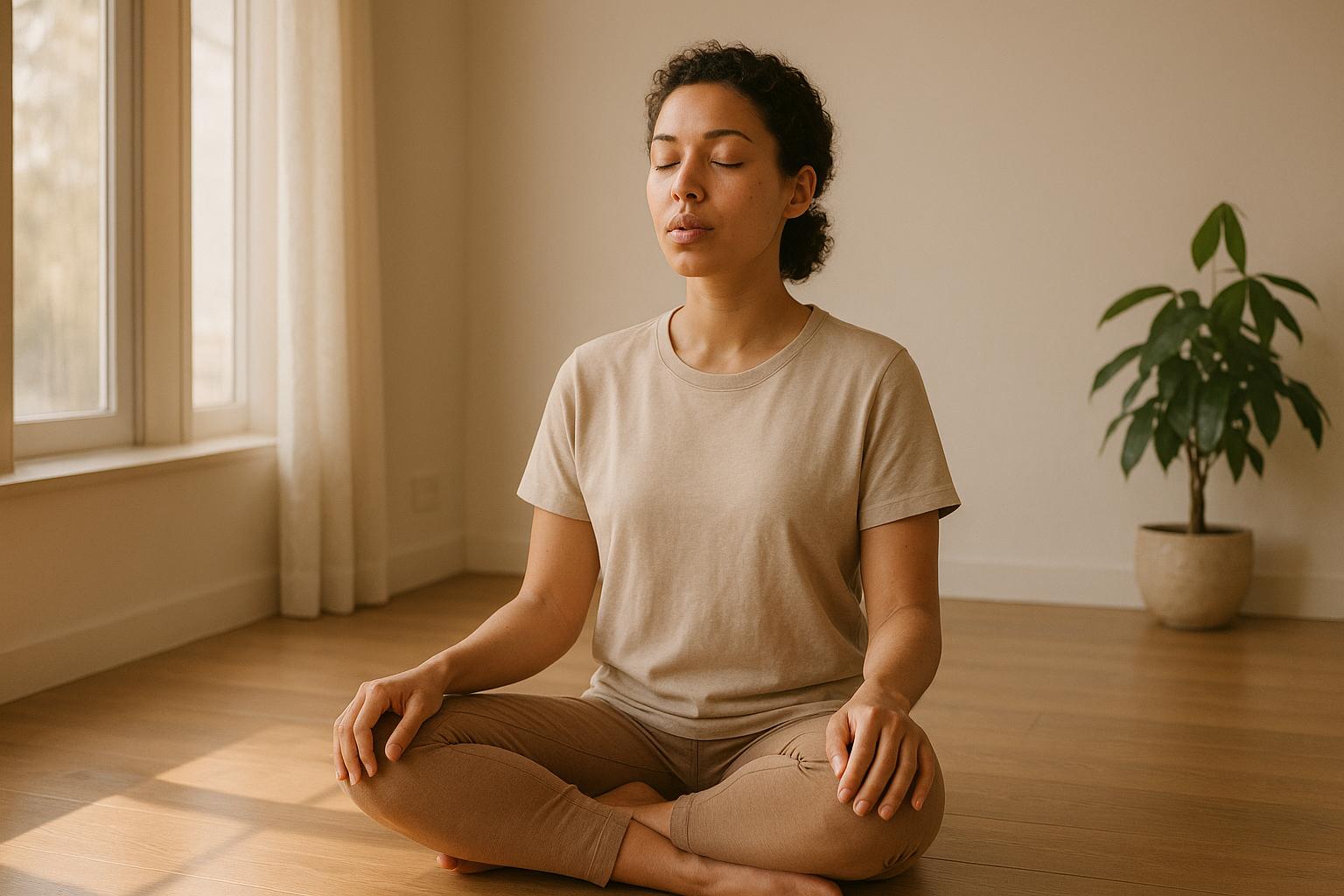
Resonance breathing is a simple technique where you slow your breathing to 5–7 breaths per minute. Studies show it can lower stress, improve heart rate variability (HRV), and enhance emotional and cognitive health. It works by activating the parasympathetic nervous system, which calms the body and mind. Research highlights benefits like reduced anxiety, better focus, and improved sleep, even for conditions like Long COVID and Generalized Anxiety Disorder (GAD). Start by practicing 5–10 minutes daily, inhaling and exhaling for equal durations (around 5–6 seconds per breath). Regular practice can make a noticeable difference in how you handle stress and maintain overall well-being.
5 Minute HRV Resonance Breathing Exercise (6 breaths per minute)
Research Studies on Resonance Breathing
Scientists have explored how resonance breathing affects stress levels and overall well-being, producing solid evidence of its physical and mental health benefits. Here’s a closer look at key studies that highlight these effects.
Major Published Studies
In 2017, researchers at Brigham Young University published findings in Frontiers in Public Health on resonance breathing’s impact on heart rate variability, blood pressure, and mood. After a 15-minute breathing exercise, participants practicing resonance frequency breathing showed:
- Improved positive mood scores
- A higher LF/HF heart rate variability ratio compared to the control group (p < 0.05)
- Reduced systolic blood pressure during the Paced Auditory Serial Addition Task (PASAT), with this reduction sustained during recovery (p < 0.05).
"Overall, results indicate that RF breathing contributes to healthier physiological response and mood, supporting its use in HRVB specifically and stress reduction generally." – Patrick R. Steffen, Ph.D., Department of Psychology, Brigham Young University
Another 2017 study published in Frontiers in Psychology examined diaphragmatic breathing, a technique closely related to resonance breathing. The researchers found that this method could enhance sustained attention, emotional state, and cortisol regulation, all of which are key indicators of stress management.
Latest Research Results
Recent studies have expanded our understanding of resonance breathing’s benefits. A 2022 study involving young adults aged 18–30 revealed that practicing resonance breathing for just four weeks significantly improved heart rate variability, cognitive performance, and perceived stress levels.
In February 2025, research highlighted its potential for individuals with high Generalized Anxiety Disorder (GAD) scores. Resonance frequency breathing was shown to increase heart rate variability, a critical factor in managing anxiety. This finding is especially relevant as anxiety disorders have seen a 25.6% global increase in recent years.
For those with Long COVID, a study of 99 participants reported significant improvements in areas like stress management (up to 61.8%), focus (57.5%), breathing ability (47.5%), overall wellness (47.3%), and sleep quality (34.9%). Notably, 92% of participants reported positive changes on the Patient Global Impression of Change Scale.
Age also appears to influence the effectiveness of resonance breathing. Studies comparing younger and older adults found that older individuals often experience greater benefits, particularly in restoring vagal outflow and reducing anxiety. Research has pinpointed specific mechanisms behind these effects, showing how resonance breathing enhances heart rate variability – a key marker of autonomic nervous system function.
"Higher vagal activity reflects greater physiological regulation via the parasympathetic nervous system, particularly the control of anxious sympathetic activation, such that higher HRV is – typically – an indicator of the ability to adapt appropriately to environmental and physiological stress."
These findings underscore that resonance breathing is more than a simple relaxation tool. It’s a scientifically supported approach to boosting stress resilience, improving cognitive abilities, and enhancing overall health for people across various demographics.
Health Benefits of Resonance Breathing
Resonance breathing offers a range of measurable benefits for your body, mind, and brain. These go far beyond simple relaxation, creating lasting improvements in how you function physically, emotionally, and cognitively.
Physical Health Benefits
Resonance breathing has a direct impact on both cardiovascular and respiratory health. One of the most noticeable effects is an improvement in heart rate variability (HRV), a key measure of how well your autonomic nervous system handles stress and maintains balance.
Research shows that practicing resonance breathing daily for four weeks increases parasympathetic activity (the "rest and digest" system) while reducing sympathetic activity (the "fight or flight" response). These changes are reflected in improved HRV parameters like SDNN and pNN50.
"Increased parasympathetic and decreased sympathetic activity were observed after practicing 20 minutes of resonance frequency breathing every day for four weeks. It also improved cognition and reduced perceived stress levels among young adults."
For individuals recovering from Long COVID, the benefits are even more striking. A study involving 99 participants found that resonance breathing training led to a 47.5% improvement in breathing ability. By slowing your breathing to six breaths per minute, this technique enhances oxygen saturation and baroreflex sensitivity, helping your body use oxygen more effectively.
| Physical Parameter | Change with Resonance Breathing |
|---|---|
| Heart Rate Variability (HRV) | Increased |
| Blood Pressure | Lowered |
| Stress Response | Reduced |
| Respiratory Rate | Reduced |
These physical changes also set the stage for improved mental clarity and cognitive function.
Mental and Emotional Benefits
Resonance breathing isn’t just good for your body – it works wonders for your mood and stress levels too. Studies show it helps reduce anxiety and improve overall emotional well-being. A meta-analysis of 24 studies confirmed that breathing at resonance frequency significantly reduces self-reported stress and anxiety.
The science behind this lies in how resonance breathing activates the vagus nerve, which connects to important brain areas like the amygdala, insula, hippocampus, orbitofrontal cortex, and locus coeruleus. These regions play critical roles in managing emotions, regulating stress, and stabilizing mood.
A 2017 study found that deep breathing lowers cortisol levels, your body’s primary stress hormone, while also improving attention. This shows that resonance breathing provides more than just temporary relief – it creates real physiological changes.
Interestingly, breathwork may even outperform mindfulness meditation in boosting mood and reducing stress. Research comparing stress management techniques found that cyclic sighing, a method emphasizing prolonged exhalations similar to resonance breathing, led to greater improvements in mood and a bigger drop in respiratory rate over a month compared to mindfulness practices.
Brain Function Improvements
Beyond its physical and emotional benefits, resonance breathing also enhances brain function. By improving HRV, it sharpens attention, memory, and executive skills like problem-solving and decision-making.
Chaitanya’s research team demonstrated this in cognitive testing, where participants who practiced resonance breathing for four weeks showed significant gains on Trail A and Trail B tests. These tests assess processing speed, visual attention, and mental flexibility – key components of cognitive performance.
"RFB has been associated with improved cognitive performance, including better attention and memory, likely due to its calming effect on the nervous system."
The cognitive improvements seem to stem from a better balance in the nervous system. Studies show that individuals with higher HRV perform better on cognitive tasks compared to those with low HRV. Since resonance breathing boosts HRV, it creates the ideal conditions for clear thinking and learning.
For young adults, practicing just a few minutes of resonance breathing daily can lead to reduced stress and better focus, making it especially useful for students, professionals, and anyone looking to stay mentally sharp throughout the day.
sbb-itb-593149b
How to Do Resonance Breathing
Resonance breathing is a simple yet powerful technique designed to reduce stress and improve heart rate variability (HRV). All you need is a quiet space and a few minutes. The goal is to slow your breathing to about six breaths per minute, creating a steady rhythm where your inhales and exhales are equal in length, aligning with your body’s natural flow.
Step-by-Step Guide
Here’s how you can practice resonance breathing effectively:
- Find a quiet, comfortable place to sit or lie down. If sitting, keep your posture upright to allow better lung expansion – imagine a string gently pulling the top of your head upward. Close your eyes and take a few deep breaths to settle yourself.
- Inhale through your nose for 4–6 seconds, focusing on filling your diaphragm instead of shallow chest breathing.
- Exhale through your mouth for 4–6 seconds. Aim for a pace of about six breaths per minute, with each inhale and exhale lasting around 5–6 seconds. However, adjust the timing to what feels most natural and comfortable for you.
- Keep your breaths steady and equal. Picture a smooth, continuous flow of air as you stay mindful of the sensation of breathing. If your mind wanders, gently bring your focus back to your breath.
- Customize the technique to suit your needs. If you feel lightheaded or uneasy, take short breaks or modify the timing until it feels right for you.
Tips to Get Started
Once you’ve learned the basics, these tips can help you refine your practice:
- Use a metronome or a breathing app to maintain a consistent rhythm. Counting silently in your head can also keep you on track.
- Visual aids, like tracing a square on paper or picturing one in your mind, can help you stay focused.
- Practice regularly, even when you’re not stressed. This way, your body will be familiar with the calming process when anxiety strikes.
- Guided meditations can provide structure and help you manage your breathing pace. Experiment with different timings – for example, starting with a moderate four-second count – to find what works best for you.
How Long to Practice
Start with sessions lasting 5–10 minutes, once or twice a day. This is enough to experience benefits like reduced stress and improved focus without feeling overwhelmed. As you become more comfortable, you can gradually extend your sessions. Studies suggest that practicing for about 20 minutes daily over four weeks can lead to noticeable improvements in HRV, cognitive performance, and stress levels in young adults.
The key is consistency. With regular practice, the calming effects of resonance breathing will become more pronounced. Over time, you may find it easier to maintain a steady, soothing breathing rhythm naturally, without needing external cues. This can lead to better stress management, improved mental clarity, higher energy levels, and even enhanced sleep quality.
Conclusion: Using Resonance Breathing for Stress Relief
Key Takeaways
Research highlights that resonance breathing is a powerful tool for reducing stress and enhancing both physical and mental health. Studies show that slowing your breathing to about 5–7 breaths per minute can significantly improve the body’s ability to handle stress. For instance, one study reported notable gains in heart rate variability (HRV), cognitive function, and stress reduction after just eight weeks of practice. Similarly, a meta-analysis of 24 studies confirmed that this breathing technique can effectively lower self-reported levels of stress and anxiety.
But the benefits don’t stop there. Resonance breathing also boosts HRV – a key indicator of overall wellness – and strengthens vagal tone, which supports better emotional regulation and cognitive function. Over time, regular practice may even reduce risks associated with cardiovascular issues while building both physical and emotional resilience. The best part? It’s simple to do, requiring only a few quiet minutes each day, making it an accessible practice for anyone.
How to Start Practicing
Adding resonance breathing to your daily routine is simple and doesn’t demand any special tools or expertise. All it takes is a bit of dedication and consistency as your body adjusts to a slower breathing pace. Aim for 5–10 minutes of practice each day to experience reduced stress and sharper focus.
You can try practicing in the morning to set a calm tone for the day, during a midday break to recharge, or as part of an evening routine to unwind. Over time, you might notice improvements in stress levels, sleep quality, mental clarity, and emotional stability.
The research is clear, the technique is easy, and the benefits are undeniable. Whether you’re looking to better manage stress, sharpen your mind, or improve your overall well-being, resonance breathing offers a simple yet effective approach. Start incorporating it into your routine today and discover how this practice can make a meaningful difference in your life.
FAQs
How does resonance breathing help calm the body and reduce stress?
Resonance breathing works to ease stress by engaging the parasympathetic nervous system, the part of your body responsible for relaxation. By deliberately slowing your breath and lengthening your exhalations, this technique stimulates the vagus nerve, which helps lower your heart rate. The outcome? A calmer state of mind and body, helping to alleviate stress and anxiety.
Is resonance breathing effective for reducing stress and anxiety in older adults compared to younger individuals?
Resonance breathing is an excellent method for managing stress and anxiety, no matter your age. Research shows it can be particularly beneficial for older adults, as it helps improve vagal tone – a crucial factor in the body’s ability to handle stress effectively.
This practice also increases heart rate variability, a key indicator of relaxation and emotional health. By incorporating resonance breathing into your routine, you can promote emotional balance and lower stress levels, whether you’re younger or older.
How can I add resonance breathing to my daily routine to reduce stress?
To weave resonance breathing into your daily life, begin by practicing slow, deep breaths using your diaphragm. Aim for a rhythm of about 5-6 breaths per minute, inhaling for roughly 5 seconds and exhaling for around 6 seconds. Feel free to adjust the timing to suit your comfort level.
Set aside moments during the day when you can unwind – perhaps in the morning, before meals, during a break, or right before bed. Practicing for 5-10 minutes, 3-4 times a day can help you fully tap into its benefits. Pairing this technique with mindfulness or other calming activities can further boost your emotional balance and ease stress.
