
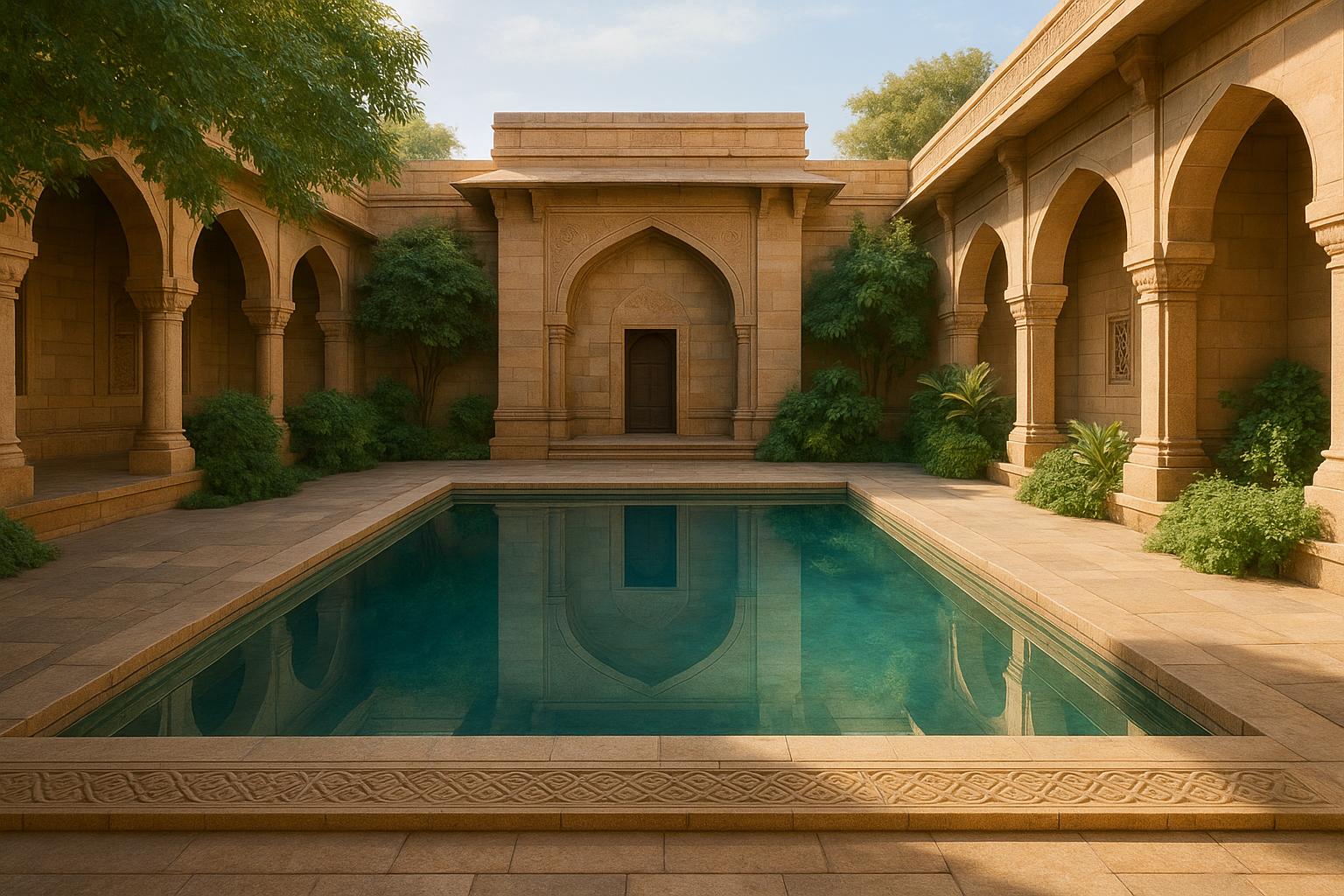
Water is more than a basic resource – it’s a powerful symbol in sacred spaces worldwide. In religious architecture, water represents purification, creation, and transformation. From the reflective pools of Islamic mosques to Hindu temple tanks and Buddhist Zen gardens, water plays both symbolic and practical roles. It fosters spiritual reflection, supports rituals, and even cools spaces in hot climates.
Key Takeaways:
- Symbolism: Water signifies cleansing, renewal, and spiritual journeys across religions like Christianity, Islam, Hinduism, and Buddhism.
- Usage in Architecture:
- Hinduism: Stepwells and temple tanks for ritual purification and devotion.
- Islam: Ablution fountains and paradise-inspired gardens.
- Buddhism: Reflective pools and Zen gardens for mindfulness.
- Practical Roles: Water features regulate temperature, mask noise, and enhance the sensory experience in sacred spaces.
Water’s timeless presence in religious architecture connects the physical and spiritual, bridging traditions and beliefs. Whether through ancient stepwells or modern memorials, it continues to shape spaces that inspire reflection and peace.
Aquatic Symbolism in Late Antique Constantinople
Core Symbolic Meanings of Water
Water holds profound symbolic significance across various religious traditions, embodying spiritual concepts that resonate universally. These meanings influence how architects and designers incorporate water into sacred spaces, creating environments that reflect spiritual journeys. Water’s symbolism unfolds in themes of purification, creation, and transformation.
Purification and Cleansing
One of water’s most recognized spiritual roles is purification. Across religions, water is used to cleanse both physical and symbolic impurities, preparing individuals for sacred encounters. This dual function makes it central to many purification rituals.
In Islam, ablution fountains are integral to mosque design. Before the five daily prayers, Muslims perform wudu – a ritual washing of the hands, face, arms, and feet in a specific sequence. These fountains, often placed in mosque courtyards, serve as reflective spaces as well as practical ones.
Christianity emphasizes water’s purifying role through baptismal fonts, which symbolize spiritual rebirth and the washing away of sins. Positioned within churches, these fonts mark the transition to a sacred life. Holy water receptacles at church entrances also allow congregants to bless themselves, reinforcing water’s cleansing power.
In Hinduism, sacred tanks and stepwells in temples serve both purification and devotion. Bathing in the Ganges River is a deeply rooted tradition, believed to purify the soul. During the Kumbh Mela festival, millions gather to bathe in its waters, seeking to cleanse their sins.
Judaism incorporates the Mikveh, a ritual bath used for full-body immersion to restore spiritual purity. These baths must meet strict religious criteria to ensure their water is suitable for purification.
Shinto practices include basin cleansing and Misogi, a cold-water immersion ritual, to prepare worshippers for spiritual activities.
While purification is one of water’s most evident roles, it also symbolizes life itself and the act of creation.
Life and Creation
Water’s essential role in sustaining life makes it a natural symbol of divine creation. Many religious texts highlight water as a foundational element of the universe, representing creation, fertility, and abundance.
The Vedas, for instance, state:
"the waters are the foundation of all this universe"
Similarly, the Torah describes:
"G-d’s spirit ‘hovered over the waters’ before anything was created"
These ideas inspire architectural water features that symbolize cosmic origins and divine provision. Such features remind worshippers of water’s spiritual capacity to renew, sanctify, and transform human existence.
In African traditional religions, water deities like the Yoruba’s Olokun influence sacred spaces, where water elements honor these life-giving forces. Buddhist teachings associate rivers and mountain snow with wisdom and enlightenment, linking natural water sources to spiritual clarity.
In Hinduism, the concept of the cosmic ocean as the source of all life is often reflected in temple water features, symbolizing this primordial force of creation.
Beyond its role in sustaining and creating life, water also serves as a marker of profound transitions and transformations.
Transition and Transformation
Water’s ability to shift between states – flowing, still, or evaporating – makes it a powerful symbol of transformation. It bridges the physical and spiritual, marking transitions from one state to another. Flowing water suggests ongoing change, while still pools encourage introspection.
In Christianity, baptismal pools symbolize the passage from an old life to a renewed spiritual existence. Similarly, Hindu temple tanks represent the journey from worldly distractions to spiritual enlightenment. In Islamic architecture, reflecting pools create moments of stillness, encouraging inner transformation.
Buddhist funeral rituals highlight water’s role in life transitions. During these ceremonies, water is poured until it overflows, symbolizing the soul’s passage from life to the afterlife. These practices have influenced temple designs, where water features honor and acknowledge life’s transitions.
Ceremonial pools and purification stations not only serve functional purposes but also create sacred spaces where transformation feels possible. These elements contribute to a spiritual landscape where the journey toward renewal and divine connection is ever-present.
Water Features in Major Religious Traditions
Water holds a special place in many religious traditions, shaping sacred spaces in ways that reflect deep spiritual meanings and practical uses. Let’s explore how water is woven into the architecture of Hinduism, Islam, and Buddhism.
Hindu Architecture: Sacred Tanks, Stepwells, and Riverfronts
In Hinduism, water is one of the essential elements of life, known as the Panch Mahabhoot, and plays a central role in temple architecture. Sacred tanks and stepwells were integral to ancient Indian temples, offering places for ritual purification before worship. These tanks weren’t just spiritual; they also boosted groundwater levels and served as community water sources. For instance, the Skanda Purana describes Ayodhya as a city interconnected by ponds, despite its proximity to the Sarayu River.
Stepwells, another hallmark of Hindu architecture, combined practical water access with spiritual significance. These structures often became community hubs where women gathered for daily water collection and religious rituals. A stunning example is Rani ki Vav in Patan, Gujarat, built in the 11th century by Queen Udayamati in memory of her husband. This stepwell features seven levels of stairs and over 1,500 intricate sculptures. Similarly, Chand Baori in Rajasthan, dating back to 800–900 CE, boasts 13 floors and 3,500 symmetrically arranged steps. The Pushkarani in Hampi, Karnataka, further underscores water’s importance in temple design.
"In traditional societies water was sacred and, concurrently, rivers were deified. This has many implications for the protection and management of water supplies." – late Dr. R. Nagaswamy, former Director-General of the Archaeological Survey of India
Islamic Architecture: Fountains, Pools, and Gardens
In Islamic architecture, water features are designed to reflect the beauty and promise of paradise. The Quran frequently describes gardens "beneath which rivers flow", with "water" mentioned 32 times, emphasizing its spiritual and symbolic importance .
Islamic gardens often follow the charbagh layout, where water channels divide the space into four parts, representing paradise as described in the Quran. Pools and fountains, such as salsabil fountains (named for a heavenly fountain), not only add visual appeal but also serve as reminders of purification and renewal .
The Alhambra Palace in Spain is a masterpiece of this tradition, featuring flowing water channels that bring to life the Quranic vision of paradise. In India, the Taj Mahal’s charbagh layout uses symmetrical water channels to create serene reflections, enhancing the monument’s spiritual atmosphere. Similarly, the Great Mosque of Córdoba includes a courtyard garden irrigated by an aqueduct, offering both shade and a peaceful space for worship. Modern adaptations, such as Al-Azhar Park in Cairo, continue to reinterpret these timeless elements for contemporary settings.
"Allah has promised to the believing men and the believing women gardens, beneath which rivers flow, to abide in them, and goodly dwellings in gardens of perpetual abode; and best of all is Allah’s goodly pleasure; that is the grand achievement." – Qur’an 9.72
Buddhist Architecture: Reflective Pools and Zen Gardens
In Buddhist architecture, water features are designed to inspire mindfulness and reflect the impermanence of life. Zen gardens, in particular, use water – or its visual representation through raked gravel – to create tranquil spaces for meditation and contemplation . The flowing nature of water mirrors the continuous cycle of life, while the act of raking gravel becomes a meditative practice itself.
A modern example is the Elizabeth Hubert Malott Japanese Garden at the Chicago Botanic Garden. Here, carefully placed rocks, fleetingly blooming plants, and weathered pine trees symbolize nature’s cycles and life’s transient beauty. As garden writer Nina Koziol explains:
"Zen gardens are intended for relaxation, meditation and contemplation. A special place is given to every plant, rock and the sand in an effort to create harmony, tranquility and balance. Nature is represented from a minimalistic point of view." – Nina Koziol
Through these serene designs, water becomes a metaphor for life’s flow and a tool for spiritual reflection.
sbb-itb-593149b
Practical and Sensory Roles of Water in Sacred Spaces
Expanding on water’s deep symbolic meaning, this section explores its practical and sensory roles in sacred spaces. Water features not only enhance the spiritual ambiance but also provide tangible benefits like natural cooling, soothing sensory effects, and thoughtful spatial organization that supports spiritual practices.
Climate Control
Water features often act as natural cooling systems in religious spaces, especially in regions with high temperatures where comfort is vital for worship. The process of evaporative cooling from water features can significantly lower the temperature in these spaces. For instance, a February 2023 study on the Al-Kulayni shrine in Baghdad, Iraq, revealed that its traditional design, incorporating water features, kept indoor temperatures 7°C (12.6°F) cooler than the outside air.
"Beyond its symbolism, the integration of water in religious architecture serves functional considerations, it regulates temperature, provides cooling effects, and contributes to the visual allure." – Angela Kathrin, Architect, Designer and Writer
In addition to cooling, water features help maintain optimal humidity levels in dry climates, creating a more comfortable environment for extended periods of prayer, meditation, or other spiritual activities.
Sound and Visual Effects
The presence of water creates a multi-sensory experience, transforming the atmosphere of sacred spaces. The gentle sounds of flowing water mask distracting noises, offering a calming audio backdrop ideal for prayer and meditation. Studies have shown that the sound of moving water can reduce stress and encourage mindfulness.
Reflective water surfaces also enhance the visual appeal of sacred spaces by adding depth and dynamic lighting effects. Modern techniques, such as strategically placed LED lighting, can further amplify these effects during evening services or rituals.
However, achieving the right balance is critical. Water features must be designed to provide enough sound to mask background noise without overwhelming spoken prayers or sermons. Beyond their sensory impact, water features also play a key role in defining and organizing sacred spaces.
Spatial Organization
Water features are often used to structure sacred spaces, creating natural boundaries and guiding movement while reinforcing a unified spiritual atmosphere.
"Though the symbolism of water is interpreted distinctively in every religion, there are interesting similarities in the ways that water features complement spatial arrangement, foster contemplative environments, and support a cohesive spiritual experience." – Angela Kathrin, Architect, Designer and Writer
In Islamic architecture, ablution areas symbolize the transition from the secular to the sacred, preparing worshippers physically and mentally for prayer. These spaces range from simple fountains to intricate chambers. A striking example is the Grand Mosque (Ulu Cami) in Bursa, Turkey, where an 18-cornered water fountain sits at the center of the prayer hall, under an open dome that allows natural light and rain to enter.
In Hindu temples, stepwells and water tanks serve both practical and spiritual purposes, creating descending paths that symbolize the journey toward devotion while providing water for ritual purification. Similarly, Christian baptismal fonts and receptacles for holy water signify the passage from the secular to the sacred. In Buddhist spaces, reflective pools and cascading fountains create zones for meditation and introspection, while Zen gardens offer clearly defined areas for quiet contemplation.
Comparison Table: Water’s Symbolic and Practical Uses by Tradition
The table below highlights how water is utilized across different traditions, showcasing its symbolic significance and practical roles.
| Aspect | Hindu Architecture | Islamic Architecture | Buddhist Architecture |
|---|---|---|---|
| Primary Water Features | Sacred tanks, stepwells (baolis), temple ponds, riverfront locations | Fountains, reflecting pools, ablution areas (Wudu) within courtyards | Reflective pools, Zen gardens |
| Symbolic Meanings | Life creation, cosmic waters, and stepwells symbolizing spiritual growth | Divine blessing, paradise gardens, and spaces for reflection | Transience of life, the flow of existence, and mindfulness |
| Purification Practices | Ritual bathing, immersion ceremonies, dispersal of ashes, and sacred artifact decommissioning | Pre-prayer cleansing (ablution) and ritual preparation for worship | Symbolic cleansing of the mind and preparation for meditation |
| Practical Functions | Personal ablutions, drinking water, washing clothes, transport, food source, and recreation | Ritual ablutions essential for worship | Supporting reflective and meditative practices |
| Spatial Organization | Separating sacred and secular spaces, guiding pilgrimage pathways | Transition zones between worldly and sacred spaces, often centered in courtyards | Dedicated areas for contemplation and mindfulness |
| Integration with Nature | Connection to natural water bodies like rivers and seasonal collections | Enclosed gardens evoking divine paradise imagery | Harmonizing with natural elements through intentional design |
| Architectural Examples | Golden Lotus Tank in Madurai, riverside temple complexes | Taj Mahal reflecting pools, Grand Mosque fountain in Bursa | Reflective pools and traditional Zen gardens |
"Water is not only a HOLY ritualistic necessity but also a key Design Element of Hindu Temples" – Dr. Uday Dokras
This comparison shows how each tradition weaves water into its sacred spaces, balancing ritual and practicality. In Hindu architecture, water features like stepwells and temple ponds facilitate ritual bathing and mark sacred boundaries. Islamic architecture uses fountains and reflective pools to evoke paradise and support ablution practices. Meanwhile, Buddhist designs integrate water into spaces for mindfulness and meditation, emphasizing life’s impermanence.
Beyond its symbolic depth – whether representing purification, creation, or mindfulness – water also fulfills essential practical roles. Hindu traditions rely on water for both sacred rituals and daily needs, while Islamic spaces prioritize ablution. Buddhist settings, on the other hand, use water features to enhance meditation and contemplation. Across these traditions, water is more than a design element – it is a bridge between the physical and spiritual realms.
Conclusion: Water’s Enduring Role in Religious Architecture
Water holds a universal presence in religious architecture, transcending cultures and time. Architect and writer Angela Kathrin captures its essence perfectly:
"In all of its fluid beauty, water still serves as a timeless metaphor to connect all of the world’s sacred spaces".
This deep connection stems from water’s essential role in human life and its powerful symbolic meanings across different faiths.
Despite varying interpretations, water’s symbolism remains a constant thread in religions worldwide. It signifies purification in Christianity and Islam, embodies divine qualities in Hinduism, and reflects life’s impermanence in Buddhism. These shared meanings allow water to bridge the physical and spiritual, making it a central feature in sacred spaces – whether ancient temple complexes or modern places of worship. This universal appeal ensures that water continues to inspire creative designs in contemporary sacred architecture.
Modern architects are finding new ways to incorporate water’s symbolic and practical roles. For example, the 9/11 Memorial in New York City uses twin waterfall pools to create a powerful space for reflection and healing. The growing focus on biophilic design and sustainable water systems shows how ancient wisdom can guide modern practices, blending tradition with innovation.
Whether through the stepwells of Hindu temples or the serene reflecting pools of modern mosques, water remains a key element in creating spaces that resonate deeply with the human spirit. Its presence reminds us that meaningful design goes beyond mere appearances – it fosters connection, reflection, and a sense of the sacred. Water, in all its forms, continues to be a timeless resource for crafting spaces that inspire and nurture the soul.
FAQs
What is the symbolic and practical significance of water features in religious architecture?
Water features in religious architecture carry both profound symbolism and practical benefits. Symbolically, water often embodies ideas like purity, spiritual renewal, and the cycle of life, making it an integral part of many sacred spaces. Take Islamic mosques, for instance, where water is central to ritual cleansing. Similarly, in Buddhist temples, it serves as a reminder of mindfulness and life’s transient nature.
On a practical level, water features play a key role in enhancing the experience of these spaces. They help regulate temperature, create a calming atmosphere, and elevate the visual appeal of the surroundings. These aspects not only enrich the spiritual journey but also offer worshippers a tranquil and restorative environment.
Why is water a significant symbol in various religions?
Water carries profound symbolic significance in many religions, often representing life, purity, renewal, and spiritual connection. In Christianity, it plays a key role in baptism, signifying cleansing and spiritual rebirth. Hinduism incorporates water in rituals aimed at purification and spiritual refreshment. Likewise, in Islam, water is integral to ablution, a practice of cleansing both body and soul before prayer.
This shared reverence for water arises from its essential role in sustaining life and its presence in nature, making it a powerful symbol of divine grace, transformation, and the ongoing cycle of existence across cultures worldwide.
How is water used in modern religious or memorial architecture?
In modern religious and memorial architecture, water plays a powerful role in inspiring reflection, tranquility, and remembrance. Take the 9/11 Memorial in New York City, for instance. Its expansive reflective pools serve as poignant symbols of loss and a space for deep contemplation. Similarly, indoor water features like fountains are becoming more common in memorial settings, offering a calm and symbolic environment. These elements not only add to the visual beauty of the space but also create a meaningful, spiritual connection for those who visit.
