
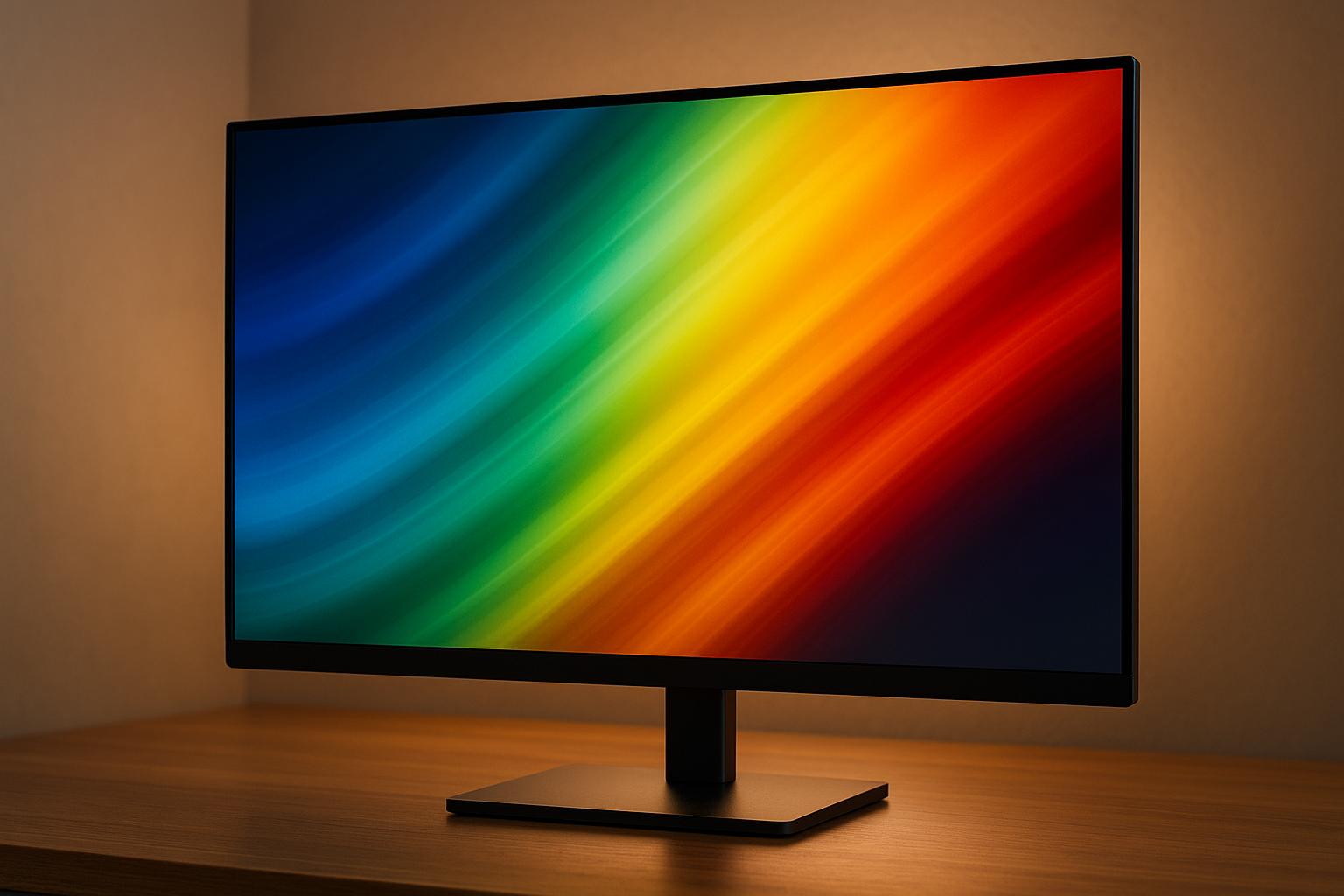
Colloidal quantum dots (QDs) are reshaping display technology by delivering unmatched color precision, brightness, and energy efficiency. These nanocrystals emit light in pure colors depending on their size, making them ideal for modern displays like QLED and QD-OLED. Here’s why they matter:
- Color Accuracy: QD displays cover over 90% of the Rec.2020 color space, far surpassing traditional LCDs and OLEDs.
- Brightness: They achieve peak levels up to 4,000 nits, 25–50% brighter than standard displays.
- Energy Savings: QDs consume 30–50% less power while offering superior performance.
- Durability: Unlike OLEDs, QDs use stable materials, avoiding issues like burn-in.
Despite these advantages, challenges like high production costs, environmental concerns with cadmium, and manufacturing defects remain. However, advancements in cadmium-free QDs and synthesis techniques are improving performance and addressing these issues.
With applications expanding into gaming, automotive displays, and even healthcare, QDs are set to dominate the display market, projected to grow from $2.5 billion in 2025 to $8 billion by 2033. Their future includes better manufacturing methods, wider adoption of electroluminescent QDs, and breakthroughs in stability and efficiency.
Nanosys at Display Week 2025: Quantum Dot Manufacturing, QD-EL, Automotive Displays, MicroLED, QDEF
How Quantum Dot Displays Work
Quantum dot displays operate through two main mechanisms, each contributing to the vibrant colors and improved performance seen in modern screens. Let’s break down how these tiny particles power some of today’s most advanced displays.
Photo-Emissive and Electro-Emissive Quantum Dots
Photo-emissive quantum dots work by absorbing light and re-emitting it at a different wavelength. In typical systems, blue LED backlights excite these quantum dots, causing them to emit pure red and green light. This process enhances both the brightness and color range of LCD displays, making colors pop on the screen.
Electro-emissive quantum dots, on the other hand, emit light directly when powered, functioning much like OLED pixels. Unlike photo-emissive quantum dots, which depend on an external light source, electro-emissive dots generate their own light using electricity.
Currently, photo-emissive quantum dots dominate the market and are commonly found in QLED TVs and other consumer electronics. Meanwhile, electro-emissive QD-LED displays remain in the experimental stage. At CES 2022, Samsung Display showcased early prototypes of QD-OLED panels, featuring peak brightness levels of up to 1,500 nits – far surpassing the performance of most OLED and LCD TVs.
Beyond individual pixel technology, quantum dot films play a crucial role in optimizing display performance.
Quantum Dot Films and Color Conversion Layers
Quantum dot films and color conversion layers significantly improve display efficiency by replacing traditional phosphors. These components use blue light to produce red and green light, solving a major inefficiency in conventional LCDs, where over two-thirds of backlight energy is lost due to color filters.
QD-OLED displays achieve up to 90% of the Rec.2020 color gamut – a 1.5x improvement over traditional OLED displays. This leap in color performance is largely due to the narrow emission spectrum of quantum dots, with full width at half maximum (FWHM) values between 20 and 30 nanometers, compared to the broader 40+ nanometers of organic emitters.
Real-world applications highlight the impact of this technology. For example, in 2024, Saphlux introduced a QD-COB (quantum dot chip-on-board) Mini/MicroLED display using NPQD red chips. This design replaced traditional AlInGaP LEDs, offering better color consistency, wider viewing angles, and an arsenic-free solution. Similarly, Sony and Samsung launched QD-OLED technology in 2022, building on Sony’s earlier innovations with cadmium-based QD-LCD displays.
The integration of mini-LED backlights with quantum dot films has also gained traction. This combination improves contrast ratio, peak brightness, color accuracy, and power efficiency, keeping quantum dot technology ahead of traditional LCD and OLED displays.
Advances in Quantum Dot Synthesis
Recent breakthroughs in quantum dot synthesis have enhanced color performance and energy efficiency while addressing environmental concerns. Efforts to develop cadmium-free quantum dots have led to better luminescence efficiency and stability through advanced core-shell structures and surface passivation techniques. These innovations have improved quantum yield and extended operational lifespans.
The cadmium-free quantum dot market was valued at $1.2 billion in 2024 and is projected to grow at a 12.5% annual rate, reaching $3.5 billion by 2033. Artificial intelligence and machine learning are also transforming quantum dot manufacturing, enabling precise synthesis, reducing defects, and lowering production costs. The overall quantum dot display market, valued at $4.4 billion in 2023, is expected to surge to $25.1 billion by 2033, with a 19% annual growth rate.
In May 2024, Samsung Electronics unveiled the world’s first QD-LED display at the SID Expo. Unlike traditional OLED panels that rely on organic materials, QD-LED displays use semiconductor materials, eliminating burn-in issues while offering greater durability and stability.
Collaborations are further accelerating advancements. For instance, in January 2024, Scrona and Avantama partnered to improve quantum dot processing using electrohydrodynamic (EHD) inkjet printing. By combining Scrona’s fine-pattern printing with Avantama’s perovskite quantum dots, they achieved higher absorption and better color purity.
These synthesis advancements allow quantum dots to outperform OLED and LCD displays, which typically cover only 70–75% of the Rec.2020 color range. The result? Brighter colors, deeper blacks, and an overall superior viewing experience in consumer electronics.
Benefits and Challenges of Quantum Dot Displays
Quantum dot displays are making waves for their impressive performance, but they also come with a unique set of challenges. Understanding these pros and cons sheds light on why this technology is gaining traction, even as it faces hurdles to wider adoption.
Key Benefits of Quantum Dot Displays
One of the standout features of quantum dot displays is their exceptional color performance. These displays can cover over 90% of the Rec. 2020 color spectrum and showcase more than a billion shades of color. That’s about 50% more than what conventional displays can achieve [15, 19].
Brightness is another area where quantum dots shine – literally. These displays are 25–50% brighter than traditional LED-backlit screens, with some models reaching a peak brightness of up to 2,000 nits. Even at these high brightness levels, they maintain impressive color accuracy.
Energy efficiency is another advantage. Quantum dot displays consume up to 30% less power while delivering 30% more brightness, making them a greener choice compared to conventional options [15, 16].
Durability is also a key strength. Unlike OLED displays, which rely on organic materials that can degrade over time and are prone to burn-in, quantum dot displays use stable semiconductor materials. This makes them a reliable choice for long-term use, especially in applications like commercial signage and professional monitors.
However, despite these strengths, quantum dot technology still faces challenges that limit its broader appeal.
Challenges in Quantum Dot Display Technology
While the benefits are compelling, quantum dot displays come with their share of obstacles. One of the biggest issues is cost. Manufacturing quantum dots is more expensive than producing competing technologies, and scaling up production to lower costs remains a challenge.
Environmental concerns add another layer of complexity. Early versions of quantum dots used cadmium, a toxic heavy metal that poses health and environmental risks. Strict regulations in places like Europe and North America, combined with disposal challenges, have forced the industry to pivot toward cadmium-free alternatives. By 2027, cadmium-free quantum dots are expected to account for over 75% of the global market for these materials [21, 22].
On the technical side, performance can be hindered by surface defects in quantum dots. These defects can trap electrons and holes, disrupting their recombination and reducing efficiency. Additionally, issues like aggregation during manufacturing can lead to inconsistent performance, highlighting the need for ongoing research and development.
Finally, supply chain issues complicate production. Factors like disruptions in manufacturing, high costs, and the limited availability of rare earth metals make scaling up quantum dot technology a tricky proposition.
Comparison Table: Quantum Dot Displays vs. Standard Displays
Here’s a quick look at how quantum dot displays stack up against other display technologies:
| Feature | LCD | QLED (Quantum Dot) | OLED |
|---|---|---|---|
| Display Technology | Liquid crystals with LED backlight | Quantum dots with LED backlight | Organic compounds emitting light per pixel |
| Color Accuracy | Limited by backlight filtering | High (precise color tuning with QDs) | Excellent (individual pixel control) |
| Brightness | Moderate | Very high (up to 2,000 nits) | Good, but lower than QLED |
| Contrast | Lower contrast ratio | High contrast (improved by QDs) | Infinite contrast (true blacks) |
| Energy Efficiency | Moderate | Higher (approximately 30% more efficient than LCD) | Lower (each pixel consumes power) |
| Durability/Lifespan | Long-lasting | Longer (no organic materials) | Shorter (prone to burn-in over time) |
| Cost | Lowest | Moderate | Highest |
This table highlights how quantum dot displays balance performance and practicality. They deliver superior brightness and energy efficiency compared to both LCD and OLED technologies. While they fall short of OLED’s perfect contrast and true blacks, their higher peak brightness and longer lifespan make them a strong contender.
The market reflects this balance. Today, over 15% of televisions sold globally feature quantum dot technology, and the market for quantum dot-based displays is projected to surpass $24 billion by 2029. This growth underscores how both consumers and manufacturers are increasingly seeing the potential of quantum dot displays, even as the technology works through its current challenges and higher production costs.
sbb-itb-593149b
Current Trends and Industry Adoption
With advancements in quantum dot (QD) synthesis and display technology, the industry is seeing rapid growth and widespread adoption. The quantum dot display market experienced double-digit growth in 2024 and is projected to expand by 27.5% in 2025.
Adoption in LCD, OLED, and Other Display Formats
In 2024, the LCD market grew by 2% year-over-year, driven by mini-LED integration. Meanwhile, the OLED segment surged by 38%, fueled by Samsung’s QD color conversion technology. QD-OLED monitors have gained traction, with their share of OLED monitor shipments expected to rise from 68% in 2024 to 73% in 2025.
Samsung Display dominated the OLED panel market for monitors in 2024, holding a 71.2% share. The company anticipates more than 50% growth in QD-OLED monitor shipments in 2025 compared to the previous year. This growth is supported by new product launches, such as 27-inch UHD and high-refresh-rate QHD 500 Hz monitors. In the notebooks segment, revenue skyrocketed by 228% year-over-year in 2024, largely due to Apple’s adoption of QD technology. Apple’s use of quantum dot displays has solidified their role as the go-to solution for color conversion in high-end MiniLED displays.
The overall quantum dot technology market is valued at $2.5 billion in 2025 and is expected to grow at a compound annual growth rate (CAGR) of 15%, reaching $8 billion by 2033. These trends indicate that QD technology is becoming a key component of next-generation products.
Commercial Products Using Quantum Dot Technology
Quantum dot technology has found its way into a variety of consumer products, including televisions, monitors, and automotive displays. In February 2023, Samsung launched its first 77-inch OLED TV, the Samsung 77" OLED S95C, featuring quantum dot technology and offering brighter visuals with 8.3 million self-illuminating pixels. Building on this success, Samsung released a QLED 4K TV in June 2024, available in 55", 65", and 75" sizes, combining quantum dot and quantum HDR technology for stunning 4K resolution.
Gaming has emerged as a major market for quantum dot displays. In January 2024, Alienware introduced two QD-OLED gaming monitors: a 32" 4K model and a 27" 360Hz model, showcasing the technology’s potential for premium gaming experiences. The automotive sector is also adopting QD displays. Hyundai Mobis unveiled its QL Display in December 2023, a curved 27-inch screen with local dimming technology and a sleek 14.5 mm design.
Quality certifications are helping to boost consumer trust. In May 2025, Samsung Electronics announced that its QLED TVs had received the "Real Quantum Dot Display" certification from TÜV Rheinland. TVs accounted for the largest revenue share in the quantum dot display market in 2024. The Quantum Dot Display QLED market is projected to grow from $5.2 billion in 2025 to $15.4 billion by 2032, with a CAGR of 16.5%. These innovations are supported by strategic partnerships that are driving further advancements.
Partnerships Driving Quantum Dot Development
Collaborations are playing a crucial role in advancing quantum dot technology. LG Display invested $40 million in Nanosys, while BOE Technology Group also partnered with the company to push the boundaries of QD development. In November 2023, Samsung Electronics teamed up with QD Vision to enhance QD-OLED technology for laptops, improving color accuracy and user experience.
Environmental concerns are shaping partnerships as well. In May 2023, Nanoco Technologies entered a licensing agreement with Guangdong Poly Optoelectronics Co., Ltd. to develop cadmium-free quantum dot solutions for advanced displays and lighting films. Industry consolidation is evident, with Shoei Chemical, Inc. and Shoei Electronic Materials, Inc. acquiring Nanosys, Inc. in September 2023 to secure expertise in advanced materials.
Quantum dot technology is also making strides beyond displays. In July 2025, UbiQD signed an exclusive agreement with First Solar, Inc. to supply fluorescent QD technology for use in thin-film bifacial photovoltaic solar panels.
"The technological shift from LCD to OLED in the monitor market is expected to accelerate further, driven by the differentiated image quality and technological superiority demonstrated by QD-OLED."
– Brad Jung, Vice President and Head of the Large Display Marketing Team at Samsung Display
These partnerships are creating a strong ecosystem that supports the growth of quantum dot technology. As investment continues, applications are expanding into areas like augmented reality, virtual reality, and renewable energy, setting the stage for a dynamic future.
Future Outlook for Quantum Dot Displays
Quantum dot displays are projected to grow from $59.9 billion in 2023 to $476.5 billion by 2032, marking a 25.9% compound annual growth rate (CAGR). This signals a massive expansion for the technology, with applications spreading across various industries.
Expected Improvements in Quantum Dot Technology
Researchers are focusing heavily on cadmium-free options like indium phosphide and perovskite quantum dots. These alternatives aim to balance environmental safety with high performance, addressing concerns about toxic materials.
On the manufacturing side, there’s a shift from batch processes to continuous production methods. This change is driving down costs while improving the consistency of quantum dot displays. One exciting development is the rise of electroluminescent quantum dot displays (QD-EL or QLED), where quantum dots act as direct emissive elements. These displays are competing head-to-head with OLEDs, offering similar picture quality but with added durability and efficiency. For instance, TCL‘s QD-EL technology delivers features like deep blacks, high contrast, 4K resolution, rapid response times, and over 85% Rec.2020 color coverage.
"It is closer than many people realize." – Jeff Yurek, Head of Marketing, Nanosys
Material advancements are also making waves. By fine-tuning the core-shell-ligand interface, adding anti-oxidation layers, and using new coatings, researchers have significantly improved stability. Pure blue quantum dot devices now boast a T50 lifespan of over 41,000 hours at 100 cd/m². These innovations not only enhance display quality but also open doors for new applications beyond traditional screens.
Beyond Displays: Other Applications of Quantum Dots
Quantum dots are branching out into fields like healthcare and automotive design, thanks to their improved performance. In healthcare, they are being used as ultra-bright, long-lasting fluorescent labels, aiding in high-resolution imaging and providing detailed diagnostic data through techniques like MRI and PET. Meanwhile, the automotive sector is exploring their use in electric vehicles and advanced cockpit designs. These applications include ruggedized displays with vibrant colors, better sunlight visibility, and low power consumption.
Other emerging uses include augmented reality displays, advanced lighting systems, and security technologies. For AR, quantum dots are especially valuable for achieving accurate colors and high brightness. The broader Quantum Dot and Quantum Dot Display market is expected to hit $13,067.6 million by 2030, growing at a CAGR of 19.9% from 2023 to 2030.
Overcoming Barriers to Wider Adoption
Despite their potential, quantum dots face technical challenges. One major hurdle is closing the performance gap between indium phosphide (InP) and cadmium selenide (CdSe) quantum dots. While CdSe QDs can achieve full width at half maximum (FWHM) values as narrow as 20 nm in labs, InP QDs typically hover around 40 nm and struggle to reach 35 nm.
To tackle these issues, researchers are exploring new protective coatings, advanced ligands, and simpler deposition methods. For perovskite quantum dots, refining synthesis conditions – like adding extra halides – is helping reduce defects and boost performance. A notable breakthrough came from Shi et al., who developed PbS colloidal quantum dot inks in an iodine-rich environment. This method prevents aggregation and fusion, achieving certified efficiencies of 10% on modules measuring 12.60 cm².
The industry’s move toward cadmium-free quantum dots, driven by regulatory pressures, has introduced temporary performance gaps. By 2018, cadmium-free options held 80% of the market share. However, improved stability is allowing for the use of simpler, more affordable barrier films. Advanced encapsulation techniques are also being developed to prevent light-induced degradation and improve the chemical and thermal stability of metal halide perovskite quantum dots. Solving these challenges will be essential to unlocking the full capabilities of quantum dot technology.
Conclusion
Colloidal quantum dots are transforming display technology with their exceptional ability to deliver vibrant and precise colors. Their emission linewidths, under 30 nm, far surpass OLEDs’ 60 nm+, enabling displays to cover approximately 95% of the BT.2020 color gamut. This advancement marks a major leap forward in display performance.
In a notable 2015 study, Han et al. showcased how combining UV micro-LEDs with colloidal quantum dots and distributed Bragg reflectors resulted in remarkable luminous flux improvements: 194% for blue, 173% for green, and 183% for red. Fast forward to today, products like Saphlux’s 2024 QD-COB displays demonstrate the real-world potential of this technology.
"Quantum dots, the minuscule semiconductor particles, are poised to revolutionize display technology, offering a multitude of advantages that can reshape our visual experience." – Amilia Stone
Quantum dot LEDs are now achieving external quantum efficiencies that rival or exceed theoretical limits, with red-emitting devices reaching brightness levels of up to 100,000 cd/m² .
However, challenges remain. The industry must bridge the performance gap between cadmium-free options and traditional materials, refine manufacturing processes for greater consistency, scale up production to industrial levels, address surface defects that hinder electron–hole recombination, and tackle toxicity concerns related to biological systems .
Beyond displays, quantum dots are finding uses in healthcare imaging, automotive technologies, and quantum information systems. These emerging applications highlight their growing importance across industries. As researchers continue to improve their stability and efficiency, colloidal quantum dots are set to play a central role in shaping the future of visual technology.
FAQs
What are the environmental challenges of quantum dot technology, and how are they being resolved?
The main environmental concerns associated with quantum dot technology revolve around the use of hazardous materials like cadmium and lead. If these substances are improperly disposed of or released, they can harm ecosystems and potentially accumulate in living organisms. Moreover, the environmental toll of manufacturing processes has also drawn attention.
To tackle these challenges, manufacturers are turning to safer, non-toxic alternatives, such as quantum dots derived from natural or recycled materials. They are also embracing eco-conscious production methods, including green synthesis techniques and continuous flow processes, which help cut down on waste and lessen environmental strain. These efforts are shaping a future where quantum dot technology can be used more responsibly in cutting-edge display technologies.
What are the advantages of quantum dot displays compared to OLED and LCD screens in terms of energy efficiency and color performance?
Quantum dot displays bring some exciting perks compared to traditional OLED and LCD screens. For starters, they’re more energy-efficient, especially in bright scenes, since they require less power to produce vivid colors and maintain high brightness. This makes them a smart choice for devices where energy savings matter.
On top of that, these displays deliver a wider color range and impressive color accuracy, resulting in images that are more vibrant and lifelike. They also shine with higher brightness and stronger contrast ratios, making them perfect for high-end TVs, monitors, and cutting-edge gadgets where top-notch image quality is a must. Their ability to balance efficiency with stunning visuals truly sets them apart in display technology.
What new technologies are helping to lower the production costs of quantum dot displays, and how could this influence their use in everyday devices?
Recent developments are driving down the production costs of quantum dot displays. Among these are photopatternable quantum dot inks, which streamline manufacturing, recycling processes capable of recovering up to 80% of unused materials, and continuous flow production methods that improve consistency while reducing expenses.
As costs decrease, quantum dot displays are becoming more accessible for everyday consumer electronics such as smartphones, tablets, and TVs. This shift could result in broader adoption, allowing more people to enjoy their vivid colors and energy-saving benefits.
