
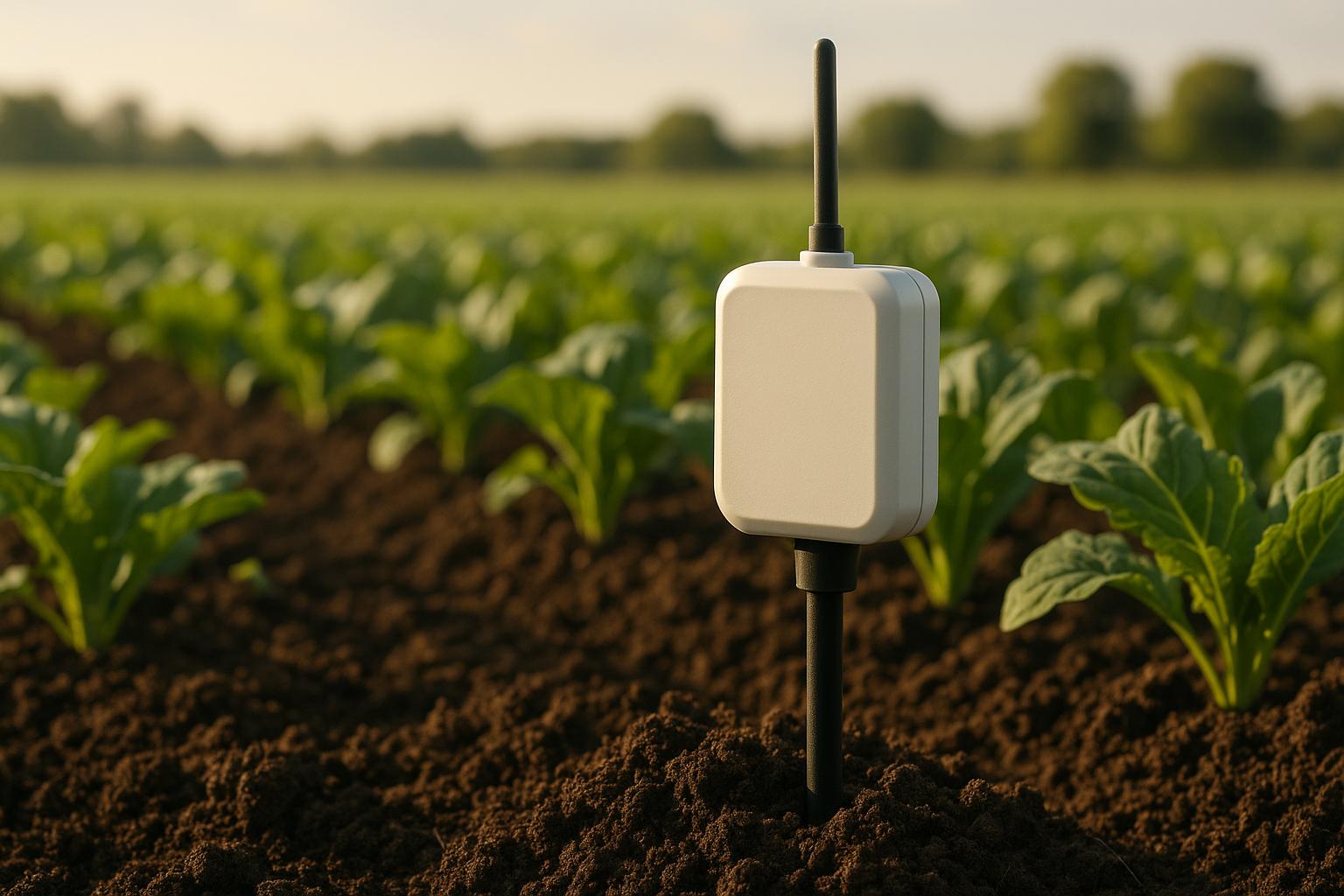
Real-time soil sensors are transforming farming by providing instant data on soil conditions like moisture, temperature, pH, and nutrients. Unlike older methods that take days for results, these sensors deliver immediate insights, enabling farmers to make quick, informed decisions. Here’s what you need to know:
- What They Do: Measure soil moisture, temperature, pH, nutrients, and even detect pests or pollutants.
- How They Help: Optimize irrigation, reduce waste, improve crop health, and increase yields.
- Key Technologies: Capacitance sensors, TDR sensors, tensiometers, and more, each with specific strengths and costs.
- Data Transmission: Wireless systems send data to smartphones or computers for remote monitoring.
- Challenges: High costs, connectivity issues, and data privacy concerns slow adoption.
- Future Trends: AI, IoT, and nanotechnology are making sensors more precise and accessible.
Core Technologies Behind Soil Sensors
Types of Soil Sensors
Real-time soil monitoring relies on various sensor types to measure critical properties. Knowing these options helps farmers select tools that align with their goals and budget.
Soil moisture sensors are the backbone of most systems. They measure either the volumetric water content (VWC) or soil water tension, which indicates how much effort plant roots need to extract water from the soil.
- Capacitance sensors are a popular choice for measuring VWC. They are relatively quick and affordable, costing around $250–350 per sensor, with data loggers priced between $500 and $2,500. These sensors perform well in saline soils but are sensitive to varying soil conditions and only monitor a small area.
- Time Domain Reflectometry (TDR) sensors offer high precision by measuring the time it takes for electrical signals to travel through the soil. They typically don’t require soil-specific calibration, but their systems can be pricey, with similar sensor costs of $250–350 and data loggers ranging from $1,000 to $3,500.
For soil water tension, tensiometers are an affordable option at approximately $80 per sensor. They measure the suction plants need to draw water, which is vital since crops often face stress when soil water depletion hits 30–50% of the available water capacity. However, tensiometers demand regular maintenance and don’t work in freezing conditions.
Granular matrix sensors, priced at $40–50 per sensor, strike a balance between cost and performance. These sensors, often paired with handheld meters or data loggers ($250–500), provide accurate readings in medium to fine soils and support remote logging. However, they respond slowly to changes and need calibration for each soil type.
Other sensors focus on nutrients, pH, and salinity. Nutrient sensors can now detect elements like nitrogen, phosphorus, and potassium in real time, while pH and salinity sensors measure acidity and salt levels, which impact nutrient availability and plant health. Temperature sensors track soil activity and help predict growth rates.
Together, these sensors supply real-time data to integrated farm management systems, creating a comprehensive view of soil health.
How Sensors Collect and Send Data
Soil sensors work by translating environmental conditions into digital data, making it easier for farmers to make informed decisions. They continuously monitor factors like moisture, temperature, pH, and nutrients, converting these readings into electrical signals. For example, the Ecowitt WH51L records moisture every 70 seconds and switches to 10-second intervals during rapid changes.
Once collected, sensor data is sent to farm management platforms, often using wireless technology to eliminate the need for extensive wiring. Systems like Soil Scout transmit data wirelessly to a base station, which then uploads it to cloud servers via 4G/3G/2G connections. For areas with poor cellular coverage, devices like Echo Repeaters extend the wireless range up to 5–10 kilometers in a straight line.
For shorter distances, radio frequency (RF) transmission is a practical choice. The Ecowitt WH51L, for example, operates on RF signals at 915/868/433 MHz.
Data loggers play a crucial role in this process. They gather information from multiple sensors and send it to cloud-based systems, enabling farmers to access real-time data remotely. The Hawk IoT Data Logger, for instance, works with various wireless soil moisture sensors to relay data to farm management platforms.
This seamless flow – from measurement to data transmission – creates a continuous feedback loop. Sensors capture soil conditions, convert them into signals, and transmit the data to central systems. Farmers can then access this information on web dashboards via smartphones or computers, enabling proactive decisions that enhance precision agriculture.
| Sensor Type | Price Range | Key Advantages | Main Limitations |
|---|---|---|---|
| Capacitance | $250–350 per sensor + $500–2,500 logger | Quick response; works in saline soils | Small area coverage; affected by soil conditions |
| TDR | $250–350 per sensor + $1,000–3,500 logger | Highly accurate; minimal calibration needed | Expensive; limited area of influence |
| Tensiometers | ~$80 per sensor + ~$140–155 transducer | Low cost; unaffected by salinity | Requires frequent maintenance; limited range |
| Granular Matrix | $40–50 per sensor + $250–500 logger | Accurate in medium to fine soils; supports remote logging | Slow response; needs soil-specific calibration |
| Neutron Probe | ~$10,000 per unit + ~$25–30 per tube | Extremely accurate; covers a large area | Uses radioactive material; requires manual readings |
How Real-Time Data Collection Works
Sensor Setup and Networking
Placing sensors correctly is the backbone of accurate soil moisture monitoring. To get reliable data, you’ll need to carefully plan sensor placement and follow the manufacturer’s installation guidelines. Missteps here can lead to inaccurate readings and wasted resources.
Start by identifying locations that represent the different soil types in your field. Tools like soil databases – such as those provided by the Growers Irrigation Academy – can help pinpoint these variations. Once you’ve mapped the soil diversity, distribute sensors accordingly.
Depth matters, too. Sensors should be installed at levels that align with your crop’s rooting zone. For crops with deep roots, placing sensors at multiple depths can provide a clearer picture of moisture distribution and help detect issues like leaching. For crops with shallow roots, sensors closer to the surface are more effective.
Sensor placement within a field also plays a big role in data accuracy. Typically, stationary sensors are installed between plants in a crop row to capture the conditions most relevant to plant growth. You can place sensors using methods like horizontal trenching or vertical placement with an auger. To ensure accurate readings, minimize soil disturbance during installation, and make sure the sensors have good contact with the soil. Mark their locations with flags and avoid placing them near pivot wheel tracks to reduce the effects of soil compaction.
Once installed, sensors need to connect to a network to transmit data. For large-scale farms, LoRaWAN networks offer a long-range, low-power option. Cellular networks are another reliable choice, provided there’s strong coverage in the area. In places with poor cellular service, ZigBee mesh networks can step in by relaying data to a central hub.
After setup, sensor data is integrated into digital platforms, making real-time analysis and decision-making possible.
Data Transfer and Integration
Real-time data collection balances the need for frequent updates with the limitations of battery life. Data loggers collect readings from multiple sensors and send them to cloud-based platforms for analysis.
Wireless sensor networks (WSNs) play a key role in gathering and processing data, especially for tasks like monitoring crop diseases or managing pests. As Neil Sharp from ESCATEC puts it:
Sensors act as the eyes and ears of modern farming technology, providing real-time data on environmental conditions, soil health, crop growth and machinery performance.
This steady flow of data feeds into farm management software, which transforms raw readings into actionable insights. By combining soil moisture data with weather forecasts, irrigation schedules, and crop models, farmers can make informed decisions. For example, integrating soil moisture readings with irrigation tools helps optimize water use. While many farms rely on periodic updates every two to three days, some operations demand continuous monitoring, which automated systems can provide. These insights are then displayed on web dashboards, accessible through smartphones or computers, allowing farmers to manage their fields remotely.
U.S. Farm Considerations
In the U.S., real-time data collection methods must align with specific measurement and operational standards. Unlike metric systems used elsewhere, U.S. farms rely on imperial units. Sensor depths are measured in inches or feet, irrigation rates are calculated in inches per week, and field sizes are expressed in acres. Temperature readings are reported in Fahrenheit, which can influence decisions like planting schedules or fertilizer applications.
The larger field sizes common in U.S. agriculture often require more sensors to capture soil variability accurately. For instance, in the Midwest, center pivot irrigation systems are popular, and sensor placement must account for challenges like wheel tracks and soil compaction.
Another factor is connectivity. Cellular coverage in rural areas can be spotty, so farmers in these regions may turn to mesh networking solutions to ensure reliable data transfer. This adaptability helps maintain the flow of information, no matter the location.
Soil moisture sensors: What are they and how to install them?
sbb-itb-593149b
Applications in Precision Farming
Real-time soil sensors are transforming agriculture by replacing guesswork with precise, data-driven decisions. These sensors form the backbone of precision farming, offering continuous insights that help farmers use resources more efficiently and increase productivity. Let’s dive into how these technologies are being applied in real-world farming practices.
Irrigation and Water Conservation
Smart irrigation systems, powered by soil moisture sensors, are changing how farms manage water in the U.S. By monitoring moisture levels in real time, these systems ditch rigid watering schedules and instead irrigate only when plants need it. This approach not only conserves water but also improves irrigation efficiency – studies show these systems can reduce water use by up to 50% and increase efficiency by nearly 30%.
"Smart irrigation brings together cutting-edge technology, sensors, data analytics, and automation to optimize water usage and make over- or underwatering a thing of the past." – KORE Wireless
These systems go beyond just measuring moisture. They combine sensor data with weather forecasts and crop water requirements to make smarter decisions. For instance, if sensors detect sufficient moisture and rain is expected, irrigation is delayed. On the flip side, if conditions remain dry, the system activates automatically to prevent plants from reaching critical stress levels, avoiding wasteful overwatering.
This technology also tailors irrigation to specific zones within a field, adjusting for soil differences and topography. Farmers are advised to water just enough to bring moisture levels close to field capacity, leaving room for rainfall, and to factor in pumping capacity when scheduling irrigation.
Real-world success stories highlight these benefits. In 2020, Markhaven, a major supplier of organic tomatoes and cucumbers, adopted the SoilSense system, finding it more dependable and user-friendly than their previous setup. Similarly, Denmark’s largest apple producer, Ørskov Foods, uses SoilSense to manage tree growth, improve yields, and optimize water use.
Nutrient Management and Fertilizer Use
Precision farming isn’t just about water – it’s also revolutionizing how fertilizers are applied. Real-time soil nutrient sensors track essential elements like nitrogen, phosphorus, and potassium using advanced methods such as ion-selective electrodes and optical spectroscopy. This eliminates the delays of traditional soil sampling, enabling immediate adjustments.
Research shows the impact of these technologies. For example, canopy sensor-based nitrogen management in rice reduced nitrogen application rates by 12%, improved nitrogen use efficiency, and boosted grain yield by over 10%. In wheat, GreenSeeker-guided nitrogen management saved 32 kg/ha of fertilizer nitrogen while increasing grain yield by 10.6%.
The secret to success lies in site-specific management. Sensor data is used to create variable rate application maps, ensuring that areas with higher nutrient levels receive less fertilizer, while deficient zones get targeted applications. This prevents both over-fertilization and under-fertilization. In Colorado, using sensor-based variable rate nitrogen application for maize led to higher yields and better nitrogen efficiency.
Crop Health Monitoring and Yield Prediction
Continuous sensor data is also enhancing crop health and yield predictions. By tracking factors like soil moisture, temperature, pH, and nutrient levels, these sensors give farmers the tools to detect issues early – whether it’s nutrient deficiencies, water stress, or pH imbalances. This proactive approach helps maintain healthy crops and improve yields.
Integrating sensor data with machine learning models takes this a step further. These models consider soil characteristics, climate, crop variety, and management practices to refine yield predictions. Farmers can then make informed decisions about when to harvest, how to store crops, and even marketing strategies.
Field tests highlight the potential of these systems. They’ve been shown to increase crop yields by 26%, cut water usage by 41%, and reduce biochemical inputs by 33%, thanks to early stress detection and AI-driven precision management. By identifying problems before visible symptoms appear, farmers can act quickly to protect their crops.
"Soil water sensors are essential tools in smart farming for optimizing irrigation and increasing crop yield." – Aware Monitoring Systems
For U.S. farmers, integrating this technology is straightforward. Cloud-based platforms compile data from multiple sensors into detailed field maps, while mobile apps provide real-time alerts and recommendations. This ensures farmers can respond quickly, no matter where they are.
Challenges and Future Directions
Real-time soil sensors are reshaping agriculture, but they come with their own set of hurdles. Addressing these challenges – and exploring ongoing advancements – can guide farmers in deciding how to incorporate this technology into their practices.
Current Limitations
Cost remains a barrier for many farmers across the U.S. The pricing disparity between sensor types is striking. For instance, ultrasonic sensors like the UGT582 are priced at about $173, while a basic conductive soil moisture sensor, such as the Adafruit STEMMA, costs only $7.50. This forces farmers to compromise between precision and affordability, leading to slower adoption rates, especially for those with limited budgets.
Concerns over data sharing and ownership are another obstacle to widespread adoption of AI-integrated systems. As the Government Accountability Office (GAO) highlights:
Farmers often do not trust the ways farm data are being collected and managed; thus, terms and conditions regarding data use should be simple, transparent, and accountable. – GAO
Connectivity issues also persist, particularly in rural areas where reliable internet infrastructure is scarce. Additionally, the lack of standardized protocols creates compatibility problems between various precision agriculture tools. Many farmers also need training to fully understand and use sensor data effectively.
These challenges are driving a wave of innovation aimed at overcoming these barriers.
New Trends and Developments
Emerging technologies are tackling these limitations head-on, promising to reshape how soil sensors function and are used in the field.
Artificial intelligence is transforming soil management by analyzing raw sensor data to provide actionable insights. This includes improvements in monitoring crop health, detecting diseases, and managing weeds.
Better connectivity solutions are broadening sensor applications. The agricultural IoT market is expected to grow by 20% annually, potentially adding $350 billion in value to global food production by 2025. Technologies like 5G, LoRaWAN, and NB-IoT are enabling real-time remote monitoring and faster data processing.
Nanotechnology is pushing the boundaries of precision. These sensors allow for real-time, microscopic-scale monitoring, offering more accurate measurements and potentially lowering costs through miniaturization.
Blockchain integration with IoT sensors is also gaining attention. By providing transparency, real-time tracking, and secure record-keeping, blockchain could address concerns over data security and build trust in farm data management systems.
Farmers are finding practical solutions to reduce costs. One approach involves gradually adopting technology – starting with basic software and scaling up as budgets permit. Open-source platforms can cut licensing fees, while government grants and subsidies help offset equipment and training expenses.
Edge computing and modern satellite technologies, such as Starlink, are reducing the need for constant internet connectivity by processing data locally.
To address cybersecurity risks, new measures include frequent software updates, strong encryption, and strict access controls. Isolating IoT devices on separate networks and using monitoring systems to detect suspicious activity also enhance data protection.
The impact of these innovations is already evident. In California’s Central Valley, IoT-enabled irrigation systems have cut water usage by 30%, while AI-guided precision planting has improved crop emergence rates by 15% compared to traditional methods.
Looking ahead, researchers are developing biodegradable sensors and exploring materials that enhance sensitivity, durability, and selectivity. With the global population projected to grow by 34% by 2050 – requiring a 60% increase in food production – advancements in soil sensor technology are becoming increasingly vital for sustainable farming.
Conclusion
Main Points
Real-time soil sensors are transforming how farmers monitor soil conditions. Unlike traditional methods that can take weeks, these sensors provide detailed measurements in just one to two hours for every 50 acres, offering both speed and precision.
The economic benefits are equally compelling. Research from Clemson University shows that soil moisture sensors can boost farmers’ net income by 20% by optimizing irrigation for crops like peanuts, soybeans, and cotton. In Italy, pear orchards equipped with sensors reduced water usage by up to 50%, and a strawberry grower reported saving over $700 per hectare.
Yet, adoption remains surprisingly low. Only 12% of U.S. farms currently use soil moisture sensors for irrigation scheduling. Considering that 30% of nitrate fertilizers in the U.S. end up polluting waterways, and even advanced irrigation systems can waste up to 50% of water, the potential for improvement is enormous.
To address these issues, advancements in IoT and AI are making soil sensors more user-friendly and accessible, offering actionable data that can drive immediate improvements. The stakes are high: with global food production needing to increase by over 70% by 2050 to meet population demands, tools like real-time soil sensors, combined with AI and nanotechnology, are critical for meeting these challenges sustainably.
What’s exciting is how the technology has become more affordable and practical, making it easier for farmers to adopt. For U.S. agriculture to stay competitive and sustainable, embracing these advanced sensor systems is no longer optional – it’s a necessity for advancing precision farming and ensuring long-term success.
FAQs
How do real-time soil sensors help save water and boost crop production?
Real-time soil sensors are changing the game in agriculture by delivering precise, up-to-the-minute insights into soil moisture and nutrient levels. With this data, farmers can fine-tune their irrigation, giving crops exactly the right amount of water at the right time. The result? Less water wasted and more efficient use of this vital resource.
But the benefits don’t stop there. These sensors also help farmers keep a close eye on soil nutrients, allowing for timely adjustments that promote healthier soil. Healthier soil means better crop growth, leading to higher yields and improved quality. By blending advanced technology with smarter farming practices, real-time soil sensors are reshaping how we care for our land and grow our food.
What challenges do farmers face when using real-time soil sensors?
Farmers face several obstacles when it comes to using real-time soil sensors. One major challenge is the high upfront cost of the equipment. For smaller farms, this initial investment can feel overwhelming and may not be financially feasible. On top of that, many rural areas struggle with limited internet access, which can make it tough to transmit or retrieve real-time data reliably.
There are also technical issues to consider. Sensors need to withstand harsh weather conditions, and maintaining their accuracy over time can be tricky. Another hurdle is data integration – merging sensor data with existing farm management systems often proves to be a complicated process. Finally, there’s the matter of data security and privacy. These concerns can make farmers wary about fully committing to the technology.
How are AI and IoT innovations making soil sensors more affordable and effective for farmers?
Advances in AI and IoT are transforming soil sensors into smarter and more user-friendly tools for farmers. These sensors track essential factors like soil moisture, nutrient content, and temperature in real time. The data they gather is processed by AI systems, which then offer actionable insights to guide decisions on irrigation, fertilization, and overall crop care.
By streamlining data collection and analysis, these technologies not only cut down on labor costs but also conserve resources and boost crop yields. This evolution is making high-tech soil monitoring solutions more affordable and accessible, enabling farms of all sizes to embrace modern and sustainable farming methods.
