
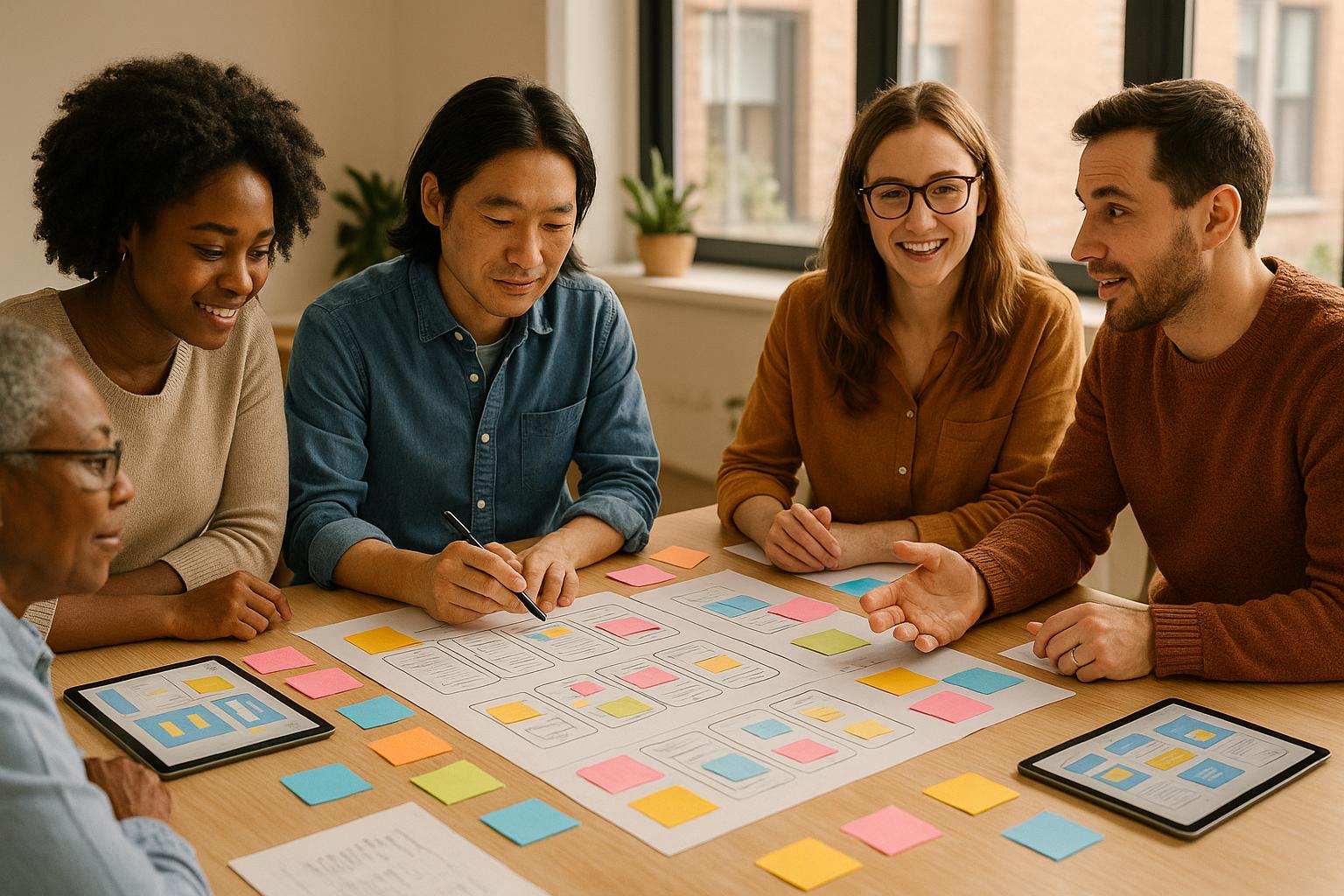
Co-creation is a collaborative design approach where designers, users, and stakeholders work together to create products or solutions. Unlike traditional methods, it prioritizes user involvement throughout the process to ensure the final output aligns with their needs.
Key Takeaways:
- Why It Matters: 61% of businesses say co-creation improves product success, and 54% report increased social impact.
- Real-World Examples:
- Budweiser Black Crown: Co-created with 25,000 participants, boosting sales.
- DHL Parcelopter Drone: Developed through 6,000+ workshops, improving customer satisfaction.
- Core Principles:
- Build trust through transparency.
- Treat all participants as equal partners.
- Encourage active participation to ensure meaningful contributions.
- Steps to Co-Creation:
- Identify problems and stakeholders.
- Run collaborative workshops.
- Prototype, test, and refine with user feedback.
- Advanced Strategies:
Co-creation is reshaping design by involving users directly, leading to better solutions and stronger connections between businesses and their audiences.
Co-Creation using the 3 Co’s Framework
Core Principles of Effective Co-Creation
Co-creation has become a cornerstone of modern design, but it’s not something that happens by chance. It requires intentional effort guided by specific principles. These principles ensure that collaboration is meaningful, productive, and capable of delivering real results. Without them, even the best intentions can lead to frustration or failure.
Building Trust and Transparency
Trust is the foundation of any successful co-creation effort. Without it, participants may hesitate to share their best ideas, avoid taking risks, or disengage entirely. Transparency plays a huge role in building this trust – 88% of people say it’s a top priority for fostering confidence in a process.
Experts from PricewaterhouseCoopers LLP, including Maria Castañón Moats, Paul DeNicola, and Matt DiGuiseppe, describe trust as a process of delivering on promises and being open about decisions:
"Trust is earned by saying what we will do, sharing why, and delivering what we said we would – transparently. When expectations aren’t met, explain the reasons and adjust accordingly."
Transparency isn’t just about good intentions; it requires clear systems for sharing information and encouraging open dialogue. This openness helps break down silos and sparks the kind of conversations that lead to fresh ideas. To make transparency a reality, you need to establish clear norms and behaviors for everyone involved. Document key decisions, explain the reasoning behind them, and create clear communication plans to keep everyone informed.
Leaders play a critical role in setting the tone. Hosting regular Q&A sessions, inviting feedback, and making information readily available can go a long way toward fostering a transparent culture. Overcommunication is better than leaving people in the dark – 41% of employees who are "quiet quitting" cite a lack of engagement or poor workplace culture as their main reasons.
With trust and transparency in place, the next step is to ensure all participants feel like equal contributors.
Creating Equal Partnership
For co-creation to succeed, everyone involved needs to feel like a genuine partner, not just a participant. This means going beyond simply inviting people to the table – it’s about sharing power, valuing diverse perspectives, and working toward common goals.
When stakeholders are treated as equal partners, they feel a stronger sense of ownership and engagement. This leads to solutions that are not only creative but also practical and effective. Co-creation thrives on inclusivity, where listening and collaboration begin from the very start of a project.
To create an environment of equal partnership, start by defining shared goals and expectations. Actively seek out and respect different perspectives, and use tools that give everyone equal access to information and decision-making processes. These efforts are paying off – 58% of businesses are now experimenting with co-creation projects to drive innovation. Equal partnerships tap into the collective energy, ideas, and resources of everyone involved, leading to better outcomes.
Once equality is established, the focus shifts to ensuring active and meaningful participation.
Getting Active Participation
Active participation isn’t just about showing up – it’s about being fully engaged throughout the entire process. For co-creation to work, participants need to see that their contributions matter and have a real impact.
When people see the value of their involvement, they’re more likely to stay engaged and bring their best ideas to the table. This requires a balance of encouraging diverse opinions while keeping the project’s goals and feasibility in mind.
To keep participation active and consistent, regularly evaluate progress and make adjustments as needed. Use collaborative tools that allow participants to share ideas and stay connected between formal meetings. Encourage open feedback and recognize those who demonstrate strong collaboration skills.
The ultimate goal is to create an environment where participation feels natural and rewarding, not forced or superficial. When people feel heard and see their ideas being implemented, they become deeply invested in the project’s success.
Step-by-Step Guide to Co-Creation in Design
Now that you’re familiar with the basics, let’s dive into how to bring co-creation to life. This guide will walk you through the process – from pinpointing the right challenges and involving the right people to refining your design into something meaningful.
Finding Problems and Key Stakeholders
Every successful co-creation project begins with a clear understanding of the problem and the people who can help solve it. Stakeholder insights are critical at every stage. Your first step? Identify the key individuals or groups who are directly or indirectly connected to your project. Stakeholder analysis helps you understand and prioritize these groups based on their influence and how they’re impacted by your work.
As Jay Lee, SVP at the NBA, wisely points out:
"What I have found is that relationships are better than roadmaps. Understand who your stakeholders are, who your partners are, what’s important for them, and how they’re trying to deliver on the vision that you all share. Establish that first and invest in those relationships to understand what’s truly at stake."
Start by brainstorming a list of potential stakeholders – this could include customers, team members, external experts, or business partners. Once you have your list, tools like a Power-Interest Grid can help you prioritize them based on their level of influence and interest. From there, dig deeper by conducting interviews or surveys to uncover their needs, motivations, and expectations. Document everything clearly and create a communication plan to keep everyone aligned as your project evolves [20, 21].
Once you’ve nailed down your stakeholders and their priorities, you can move on to collaborative workshops to shape and refine ideas.
Running Collaborative Workshops and Discussions
With your key stakeholders in place, the next step is to bring everyone together. Collaborative workshops are an excellent way to gather input, validate ideas, and build momentum for your project. The structure of your workshop will depend on its goals – whether you’re looking to confirm your findings, address knowledge gaps, or brainstorm creative solutions.
Diversity is a game-changer here. A mix of participants ensures a variety of perspectives, while a range of activities keeps the energy high and ideas flowing [24, 25]. For example, when Amazon was designing the Kindle, they focused on clear goals at every stage – from the screen technology to the user experience – showcasing how targeted collaboration can lead to great results.
Set the stage for success by defining clear objectives and encouraging active participation. Use a mix of presentation techniques and feedback methods, and leave room for unexpected but valuable discussions. A skilled facilitator is key – they’ll guide the process, establish ground rules, and create an open, safe environment where everyone feels comfortable sharing their ideas [25, 29].
Once the workshops wrap up, it’s time to turn those ideas into actionable prototypes.
Prototyping, Testing, and Improving with Stakeholders
The final phase is where ideas take shape. Start with low-fidelity prototypes – think sketches or basic models – to quickly explore concepts without a big upfront investment [30, 32]. This lets you test multiple ideas at once and refine them through rapid iterations.
Involve stakeholders from the very beginning of the testing phase. Their feedback is essential for shaping prototypes that address real needs. Techniques like User Acceptance Testing (UAT) bring end-users into the process to define criteria and test scenarios. Another effective approach is RITE (Rapid Iterative Testing and Evaluation), which allows for real-time feedback and adjustments. As Dennis Wixon from Microsoft Research explains:
"The goals of the RITE method are to identify and fix as many issues as possible and to verify the effectiveness of these fixes in the shortest possible time."
RITE testing encourages collaboration between team members and stakeholders, speeding up the process of refining and improving your prototype.
Don’t shy away from setbacks – they’re opportunities to make your design even better. Keep track of each iteration, documenting feedback and changes. Stakeholder engagement is crucial at this stage, as Sarah Gibbons from NN/g notes: stakeholders "translate into resources, bandwidth, and approval". Prioritize feedback based on its relevance, impact, and feasibility, ensuring that the most meaningful insights guide your design forward.
sbb-itb-593149b
Advanced Strategies for Better Co-Creation Results
Take your co-creation efforts to the next level with strategies that promote deeper collaboration and sustainable progress.
Using Technology for Better Collaboration
Technology has reshaped how teams work together, especially in today’s remote and hybrid work settings. Collaborative software now bridges the gap between stakeholders across the globe. Research shows that co-creation projects are 30% more likely to succeed than those without collaboration, and companies that prioritize user needs experience a 400% boost in customer loyalty. Additionally, the global market for team collaboration software is projected to surpass $21.69 billion by 2030.
Digital tools and platforms make remote teamwork not just possible but seamless. For example, Tesla uses software like Siemens’ Teamcenter and Dassault Systèmes’ CATIA to align its design and engineering teams. Similarly, Nike employs digital design platforms and virtual collaboration spaces – such as CLO 3D for virtual garment development – to streamline global teamwork and reduce the need for physical prototypes. In architecture, tools like Autodesk’s Revit allow firms like Skidmore, Owings & Merrill and Foster + Partners to work within unified models that improve accuracy and efficiency.
Sharon Lee Thony from SLT Consulting highlights the impact of these tools:
"Technology empowers our team by streamlining collaboration, content creation, and analytics. Tools like Asana improve workflow, while AI platforms optimize ad targeting and performance."
AI-powered tools also bring clarity to team performance and project tracking, while social technologies can enhance the productivity of high-skill knowledge workers by 20–25%. To truly benefit from these advancements, it’s important to create an environment of trust, encourage open communication, and establish structured feedback systems. Platforms that allow anonymous input can also ensure that everyone has a voice.
These technological innovations lay the groundwork for agile practices that further refine the co-creation process.
Applying Agile Principles for Iterative Co-Creation
Agile methodologies offer a flexible, responsive framework for co-creation. By breaking tasks into smaller, manageable cycles – covering design, implementation, testing, and deployment – teams can quickly adapt to changing needs and stakeholder feedback.
The Agile Manifesto captures this approach perfectly:
"Welcome changing requirements, even late in development. Agile processes harness change for the customer’s competitive advantage."
This mindset transforms challenges into opportunities for improvement. Delivering prototypes or design iterations regularly keeps stakeholders engaged while inviting continuous feedback. As another Agile principle states:
"Our highest priority is to satisfy the customer through early and continuous delivery of valuable software."
Face-to-face communication, even in digital formats, remains essential:
"The most efficient and effective method of conveying information to and within a development team is face-to-face conversation."
Self-organizing teams often produce the best solutions, and regular retrospectives ensure ongoing improvement:
"At regular intervals, the team reflects on how to become more effective, then tunes and adjusts its behavior accordingly."
Finally, simplicity is key – focusing on “maximizing the work not done” helps teams prioritize what truly matters.
While iterative design drives progress, maintaining strong partnerships with stakeholders is equally important for long-term success.
Maintaining Long-Term Relationships with Stakeholders
Sustaining co-creation success depends on building and nurturing long-term relationships with stakeholders. A strategic approach to stakeholder management fosters trust, which is often called "the social glue that holds business relationships together".
Troy Buer, PhD, from the University of Virginia School of Medicine, emphasizes this:
"Dynamic relationships are based on trust – the confidence one has in the character and competence of another."
Transparency is critical. Sharing regular updates – both achievements and challenges – encourages stakeholders to actively participate in problem-solving. Practices like active listening, consistent delivery, and empathetic communication strengthen these bonds.
Beyond formal interactions, look for informal ways to connect, such as networking events or online communities. Tailor your communication style to individual preferences, monitor engagement levels, and acknowledge contributions. These efforts not only build trust but also create a foundation for ongoing collaboration, empowering teams to tackle future challenges together.
Comparing Co-Creation Methods and Tools
Choosing the right co-creation method is all about understanding your project’s needs and the expectations of your stakeholders. Companies like BMW and Nike have set the bar high in this area. BMW’s Co-Creation Lab allows for quick feedback and real-time updates, while Nike realized early on that customers wanted to be part of the design process, creating stronger connections that go beyond simple transactions.
One of the biggest advantages of co-creation is how quickly it delivers feedback compared to traditional research methods. Instead of waiting months for user insights, co-creation workshops provide immediate responses from participants. The table below breaks down various co-creation methods, highlighting their strengths, challenges, and best use cases.
Comparison Table of Co-Creation Methods
| Method | Key Advantages | Primary Limitations | Ideal Use Cases | Time Investment |
|---|---|---|---|---|
| In-Person Workshops | Instant feedback, rich non-verbal cues, high engagement, natural brainstorming | Limited reach, higher costs, scheduling challenges | Solving complex problems, building relationships, discussing sensitive topics | 1–3 days intensive |
| Virtual Co-Creation Platforms | Global access, cost-effective, flexible scheduling, easy digital documentation | Fewer detailed responses, potential tech issues, less personal connection | Remote teams, budget-conscious projects, ongoing collaboration | 2–4 hours per session |
| Advisory Boards | Expert insights, long-term perspective, strategic guidance, credibility | Limited diversity, risk of groupthink, slower decisions, higher commitment | Strategic planning, market validation, expert feedback | Monthly 2–3 hour meetings |
| Online Communities | Continuous engagement, diverse input, scalable feedback, organic discussions | Requires heavy moderation, quality control issues, participant retention challenges | Long-term product development, brand building, loyalty programs | Daily monitoring, weekly facilitation |
| Design Sprints | Quick prototyping, focused results, cross-team alignment, time-boxed outcomes | Intense time demands, needs skilled facilitation, limits deep exploration | Urgent decisions, new product ideas, team alignment | 5 consecutive days |
Interestingly, research shows that while virtual workshops may result in shorter responses, the quality of ideas often matches that of in-person sessions. This insight has become especially relevant as virtual methods gained traction during the COVID-19 pandemic.
Frank Spillers, CEO of Experience Dynamics, captures the spirit of co-creation perfectly:
"Everything in service design is co-created. And what that means is that you’re doing this with stakeholders."
For co-creation to succeed, tailoring the workshop to your goals and participants is crucial. For example, technical teams might benefit most from prototyping sessions, while customer-facing teams might find journey mapping exercises more valuable. It’s also important to select participants with diverse expertise and ensure they’re comfortable with the chosen co-creation method.
The outputs of each method can vary widely. Workshops often result in journey maps, service blueprints, or prototypes. Advisory boards, on the other hand, typically provide strategic recommendations and market insights, while online communities are great for ongoing feedback and identifying emerging trends.
To avoid technical hiccups, test your co-creation platforms thoroughly, and pilot sessions with target users can help uncover any usability issues.
It’s also worth noting that co-creation differs from other collaborative approaches. Unlike crowdsourcing, which gathers input from a large group on specific topics, co-creation involves deeper, more iterative collaboration among participants. This difference impacts both the time required and the depth of insights you can achieve.
To ensure success, align your chosen method with your project’s goals. Start with warm-up exercises to build rapport, move into ideation activities, and wrap up with feedback sessions. This structured flow helps maintain focus and ensures participants stay engaged throughout the process.
Conclusion: Making the Most of Co-Creation in Design
Co-creation has become a standout strategy in modern design, offering a fresh way to tackle challenges and innovate. As Dennis Hambeukers explains:
"Co-creation is one of the highest performing problem solving strategies. If you do it right that is. Not only does it increase the total mental capacity that is being applied to solving problems, it also creates the crucial engagement for solutions. You end up with validated ideas that are the result of massive thinking power."
At its core, co-creation shifts the focus of innovation by working directly with a community. This approach aligns seamlessly with user-centered design, prioritizing human experiences and ensuring that solutions are grounded in real-world needs.
The key to effective co-creation lies in three elements: community, collaboration, and context. Together, these not only lead to more thoughtful and user-driven products but also foster stronger connections between businesses and their stakeholders. By inviting diverse voices – especially customers – into the process, companies can create solutions that genuinely reflect what people value and expect.
For co-creation to thrive, it’s essential that all participants see tangible benefits from their involvement. This means creating spaces where stakeholders can interact openly and share their insights in meaningful ways. Companies that excel at this tap into new perspectives and skills, breaking down barriers and sparking innovation.
A structured approach is crucial to sustaining these benefits. This includes setting clear goals, establishing budgets, defining timelines, and outlining constraints to keep everyone aligned. Professional facilitators and organized brainstorming sessions can also help maintain focus and creativity throughout the process.
Approaching co-creation with curiosity and adaptability is equally important. Building strong, collaborative partnerships takes time, but the payoff is worth it. Treat each design decision as an opportunity to test and refine ideas, ensuring that the end result truly serves the people it’s meant for.
By fostering trust and encouraging active participation, co-creation reshapes how innovation happens. Involving customers from the outset allows businesses to design experiences that resonate deeply, even before the supporting systems are in place. This not only elevates products but also transforms customer engagement strategies. With the help of technology and agile methods, companies can sustain these dynamic collaborations.
The future belongs to organizations that embrace teamwork, prioritize stakeholder input, and encourage creative exchanges between design teams and users. These are the companies that will unlock possibilities far beyond what traditional methods can achieve.
FAQs
What makes co-creation different from traditional design, and why is it beneficial?
Co-creation stands out from traditional design approaches by actively bringing stakeholders – especially customers – into the design process. Rather than depending solely on a small group of designers, this method promotes collaboration and incorporates a variety of perspectives. The result? Solutions that are more aligned with user needs and often more inventive.
Some major advantages of co-creation include discovering new ideas, crafting products that better align with what customers actually want, and building stronger customer loyalty. By lowering risks and increasing the chances of success, co-creation has become a go-to strategy for businesses striving to stay ahead in today’s fast-moving market.
What are the best tools and strategies for successful co-creation in a remote or hybrid work setting?
To create a strong foundation for co-creation in remote or hybrid work settings, start with trusted digital collaboration tools like Zoom, Google Workspace, or Notion. These tools simplify communication, facilitate brainstorming, and keep project management organized, helping everyone stay on the same page.
Promote an open and collaborative environment by setting clear objectives, offering regular feedback, and incorporating team-building activities. Establishing structured communication channels and adopting flexible workflows can boost both productivity and engagement. Most importantly, make sure every team member feels heard and appreciated by encouraging active participation from everyone, no matter their location or role.
What steps can businesses take to ensure long-term success and keep stakeholders engaged in co-creation projects?
To ensure lasting success and keep stakeholders engaged in co-creation projects, businesses need to start with a clear definition of their project goals. Creating an open and welcoming environment where every participant feels valued is equally important. Early involvement of stakeholders, paired with regular communication, lays the groundwork for trust and alignment throughout the entire process.
Consistently offering feedback, acknowledging contributions, and showing how stakeholder input directly influences outcomes can deepen engagement. Tools that support collaboration, along with a commitment to transparency, help simplify participation and keep everyone motivated and focused on the project’s success.
