
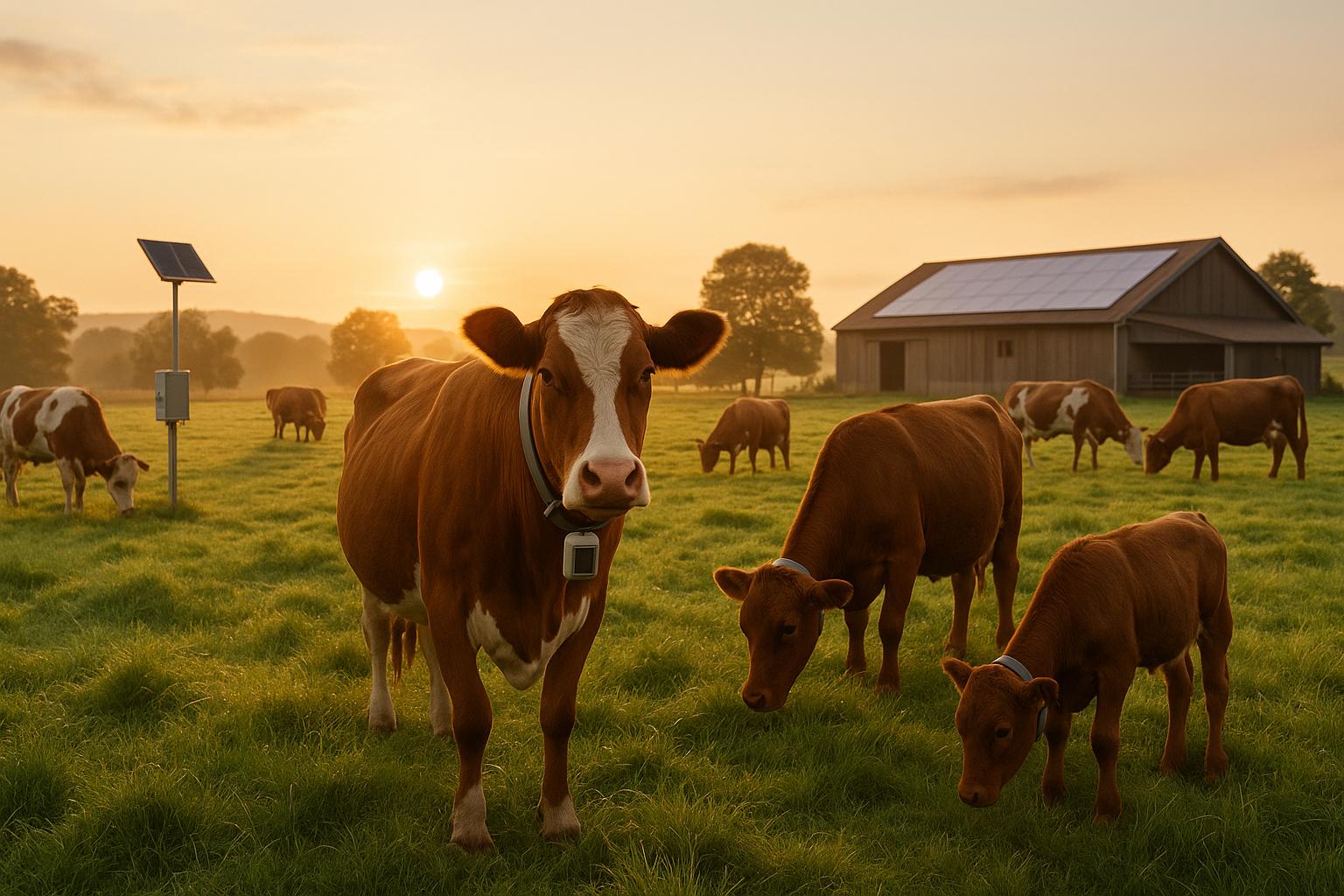
IoT sensors are transforming livestock farming by providing real-time data to improve animal health, optimize resources, and reduce environmental impact. Here’s what you need to know:
- What they do: IoT sensors monitor livestock health, track environmental conditions, and automate feeding and watering systems.
- How they help: Farmers can detect diseases early, cut costs, and minimize waste. For example, wearable sensors identify health issues days before symptoms appear, and environmental sensors maintain optimal living conditions.
- Adoption trends: By 2025, over 75% of U.S. farms are expected to use IoT tools, driven by rising demand for efficient and eco-conscious farming.
- Challenges: Limited internet access, high costs, and data privacy concerns remain hurdles for widespread adoption.
IoT technology is reshaping agriculture, offering measurable improvements in productivity, animal welfare, and resource management. While challenges exist, the benefits make it a valuable tool for modern farming.
IoT analysis of cattle activity "U-motion(R)" — Long version
Main Types of IoT Sensors and How They Work
Modern livestock farms use three key types of IoT sensors to build a well-rounded monitoring system. Each type focuses on a specific aspect – animal health, environmental conditions, or resource management – helping farmers make informed decisions.
Wearable Sensors for Animal Health Tracking
Wearable sensors, like RFID tags and GPS trackers, are designed to keep tabs on animals’ vital signs, behavior, and location in real time. These devices either process data directly or send it to a gateway using advanced machine learning algorithms for analysis.
For instance, a GPS collar can track grazing patterns and pinpoint an animal’s location in vast pastures. In one example, a GPS/GSM calving alarm system (GPS-CAL) successfully predicted birthing times and sent automated messages to farmers with the date, time, animal ID, and GPS location of the event.
These sensors also monitor movement patterns with impressive precision. By analyzing behaviors like grazing, resting, or signs of distress, they provide insights into the animals’ well-being and social interactions. Machine learning further sharpens this behavioral analysis, helping identify health issues early. Research has shown notable differences in the behavior and health indicators of sick versus healthy animals.
This real-time tracking ensures that farmers and veterinarians receive immediate alerts when something seems off, enabling prompt intervention.
While wearable sensors focus on individual animals, environmental sensors address the overall conditions of the farm.
Farm Condition Monitoring Sensors
Environmental sensors play a critical role in maintaining healthy living conditions for livestock while reducing resource waste. These devices measure factors like temperature, humidity, and air quality within livestock facilities.
Take temperature and humidity sensors, for example. They work together to maintain optimal conditions for different animals. Dairy cows, for instance, thrive within specific temperature ranges. Sensors can automatically activate ventilation or cooling systems when the environment veers outside these limits, allowing farmers to adjust systems in real time.
Air quality sensors are equally important, as they detect harmful gases that can endanger animal health. The European Food Safety Authority (EFSA) has set clear thresholds for livestock facilities. For pigs, air quality is deemed poor when CO₂ levels exceed 3,000 ppm, carbon monoxide surpasses 10 ppm, hydrogen sulfide rises above 0.5 ppm, or ammonia (NH₃) goes beyond 10 ppm. Similar standards apply to dairy cows. A study on a rabbit farm using six N11 devices found significant variations in gas concentrations, with NH₃ levels exceeding 10 ppm in some areas, emphasizing the need for better ventilation.
By continuously monitoring these factors, environmental sensors help create a safer, more comfortable environment for livestock.
Automated Feeding and Water Systems
IoT-powered feeding and watering systems ensure livestock receive proper nutrition and hydration while minimizing waste. These systems track feed levels, consumption rates, water quality, and even individual animal intake patterns.
For example, load cell sensors monitor feed levels and send alerts when refills are needed, while flow sensors keep an eye on water usage and detect leaks. Ensuring a steady supply of clean water is essential for maintaining animal health.
RFID-enabled feeding stations take this a step further by tracking each animal’s food and water intake. This detailed data helps farmers quickly identify animals that may not be eating or drinking normally – often an early sign of health issues.
By combining these sensors with networked technology, farms now use intelligent sensor nodes that can process, store, and transmit data locally. This setup ensures critical feeding and watering operations continue even during connectivity problems.
Together, these systems form a connected network that boosts efficiency and supports sustainable farming practices.
Benefits of IoT Sensors for Farms and the Environment
IoT sensors are transforming farming by addressing critical challenges like disease prevention, resource efficiency, and environmental sustainability. In livestock farming, these technologies improve animal welfare, cut costs, and reduce environmental impact through data-driven strategies.
Early Disease Detection and Reduced Antibiotic Use
IoT sensors play a key role in identifying health issues in livestock by continuously tracking vital signs and behavior. Studies show that digital monitoring can detect 70% of illnesses in animals days before symptoms become visible, enabling farmers to act quickly with targeted treatments. This approach not only curbs the spread of diseases but also minimizes reliance on broad-spectrum antibiotics. For example:
- EU swine farms reported a 52% reduction in antimicrobial use for fattening pigs and a 32% drop for breeding animals.
- Austrian pig farms using PCV-2 vaccines saw a 67% decrease in antibiotic treatments.
- E. coli vaccine trials in poultry led to a 75% reduction in treatments.
Additionally, machine learning algorithms process data from wearable sensors to spot irregularities in heart rate, temperature, and movement, allowing for timely interventions. These advances not only enhance animal health but also improve farm profitability.
Smarter Resource Management and Cost Savings
IoT sensors significantly enhance resource efficiency, benefiting both farmers and the environment. For instance:
- Crop yields can increase by 15%, while water usage drops by 20%. Precision irrigation alone can cut water use by up to 30% .
- Nutrient sensors help reduce fertilizer usage by up to 40%, leading to substantial cost savings.
- Smart climate control systems optimize farm environments, reducing energy costs.
The Food and Agriculture Organisation (FAO) highlights these benefits, noting that precision irrigation improves yields while saving water. The market for IoT in agriculture reflects this growing interest, with projections showing growth from $11.5 billion in 2021 to $32.8 billion by 2032. Such advancements directly support sustainable farming practices.
Lowering Environmental Impact
IoT sensors are also helping farms reduce their environmental footprint by optimizing production and cutting emissions. Livestock farming contributes 14.5% of global greenhouse gas emissions, with food production and processing accounting for 45%, enteric fermentation from ruminants 39%, and manure management 10%. Projects like Romania’s FarmSustainaBl use Libelium Plug & Sense! Smart Environment stations to monitor gases such as NOx, COx, CH4, and NH3, enabling farms to adjust practices and lower emissions.
Soil degradation, which affects 33% of the world’s soil, is another critical issue. In India, the eSagu project uses IoT sensors to monitor soil health, offering farmers real-time advice on irrigation and fertilizer use. This not only improves crop yields but also reduces environmental harm. Similarly, the Digi4Live project showcases how smart technologies can enhance animal welfare while promoting sustainable farming.
sbb-itb-593149b
Challenges and Things to Consider with IoT
IoT sensors bring immense potential to sustainable livestock farming, but they also come with challenges that farmers need to navigate. From technical obstacles to financial burdens, adopting these technologies requires careful planning and informed decision-making.
Technical Problems in Farm Settings
Farms present a unique set of challenges for IoT systems. One of the biggest hurdles is connectivity. According to a USDA report, 60% of U.S. farmland lacks reliable Internet access. This makes it difficult for sensors to transmit real-time data, creating a major roadblock for IoT adoption.
On top of that, farm environments can be harsh. Sensors must withstand extreme weather, exposure to chemicals, and other environmental hazards that can lead to frequent failures and expensive replacements. Another issue is integrating data from multiple sensors. Without unified systems, the data often remains fragmented and less useful.
There’s also a skills gap to consider. Only 25% to 30% of farmers currently use precision agriculture techniques, partly because many lack the technical expertise to set up and manage IoT systems.
To overcome these challenges, farmers can explore solutions like edge computing, which processes data locally and reduces reliance on constant Internet connectivity. Satellite technology and low-power wide-area networks also provide alternative connectivity options for remote areas. Additionally, partnering with vendors that offer managed IoT services can help bridge the technical knowledge gap.
Costs and Return on Investment
The financial demands of IoT technology can be daunting, especially for smaller farms. Initial investments are steep, with precision farming setups costing significantly more than traditional methods.
| Farming Method | Initial Cost (per 100 acres) | Annual Maintenance | Average Yield per Acre | ROI (5-year average) |
|---|---|---|---|---|
| Traditional | $8,000 | $400 | 150 bushels (corn) | ~8% |
| Precision/IoT | $35,000 | $2,000–$3,500 | 165–180 bushels (corn) | 20–35% |
For example, entry-level GPS systems range from $5,000 to $10,000, while advanced RTK auto-steering systems can cost $16,000 to $20,000. Basic sensor nodes start at around $100 per unit, but comprehensive systems require multiple sensors across the farm. Software costs add another $500 to $10,000 annually, with larger operations paying between $2,000 and $15,000 per year.
Despite these costs, the potential returns are promising. Farms that use IoT effectively can see up to a 15% increase in profits and reduce operational costs by as much as 30%. Integrating AI into analytics can further boost productivity by up to 50%.
To manage costs, farmers should start by establishing performance benchmarks and tracking key metrics like revenue, costs, and yields. Phased rollouts allow farmers to test technologies on a smaller scale before fully committing, reducing financial risks. Additionally, government subsidies and open-source solutions can help lower initial expenses.
Data Privacy and Following Regulations
Data security is another critical concern for farmers adopting IoT. Protecting sensitive farming information is essential not only for operational efficiency but also for maintaining trust. Farmers worry about who has access to their data, how it’s used, and whether it could be exploited. This is especially important given that decisions affecting over 900 million acres of U.S. farmland depend on this data.
IoT devices are vulnerable to cyber-attacks, which can compromise farm data and even disrupt operations. Regulatory uncertainty adds to the complexity. While states like California have advanced data privacy laws, others, such as North Carolina, are still developing their frameworks.
Farmers can take several steps to protect their data. End-to-end encryption ensures secure data transmission and storage, while regular firmware updates help address emerging security threats. Secure device authentication protocols can prevent unauthorized access.
Another effective strategy is data minimization – collecting only the information necessary for operations. Farmers should choose vendors with transparent data policies and user-controlled sharing options. For instance, companies like Farmonaut provide robust security measures that give farmers control over their data across all 50 states.
When selecting IoT providers, it’s important to prioritize those that offer user-friendly tools for managing data permissions and regular security audits. Clear data retention policies also play a key role in safeguarding sensitive farming information.
Case Studies and Examples from Working Farms
These real-world examples highlight how technology is driving measurable gains in productivity, animal health, and resource management, making IoT investments well worth it.
IoT in Cattle Farming
Cattle farming has seen impressive results with IoT technology, particularly in health monitoring and grazing management. One standout example comes from C-Lock, a leader in agricultural tech. Dr. Patrick Zimmerman, the company’s CEO and Founder, shares his perspective:
"I knew from my upbringing that there were lots of opportunities to apply cutting-edge technology and state-of-the-art science to farming practices in order to improve efficiency, improve the bottom line and also reduce the environmental footprint."
The ability to monitor in real time has been a game changer, as Scott Zimmerman, President of C-Lock, explains:
"Internet connectivity and data transmission allow us to really monitor our units wherever they are located. If we didn’t have that connectivity our business would have failed."
One example of this technology is GPS collar systems, which have reduced livestock losses by 20% through improved tracking and movement monitoring. This gives ranchers better control over pasture management while minimizing risks to their herds.
Another innovation is IoT-powered wearable devices. These sensors can detect health issues in cattle up to three days before symptoms become visible. This early warning system allows farmers to act quickly, reducing the spread of disease and cutting treatment costs.
In Canada, IoT solutions have also shown environmental benefits. Farms using these technologies reported a 12% reduction in methane emissions from cattle, achieved through optimized feeding and smarter grazing practices. These advancements not only improve efficiency but also help address environmental concerns tied to livestock farming.
IoT in Dairy Farming
Dairy farms have seen some of the most striking productivity improvements thanks to IoT. For instance, Danish dairy farms using IoT-based feeding systems reported a 15% increase in milk production.
Dr. Meredith Harrison, Chief Scientific Officer at C-Lock, explains the economic impact of these technologies:
"Feed costs can represent over 70% of a farmer’s total operating costs. Feeding those animals is really expensive. It’s about $10 per day to feed a dairy cow. These solutions help target highly feed-efficient animals."
In Germany, farms using smaXtec monitoring systems achieved remarkable results, including 80% fewer severe disease cases and zero animal losses due to illness. These systems also boosted milk production, proving that healthier cows directly lead to higher yields.
In the U.S., IoT technology like GEA CowScout powered by Nedap has improved reproductive efficiency. One farmer increased pregnancy rates from 25% to 33%, significantly reducing the time between calving cycles and boosting overall herd productivity.
Dr. Jan du Preez, a veterinarian, underscores the importance of health in dairy operations:
"If your animals aren’t healthy, you cannot make money."
IoT in Poultry Farming
Poultry farming has also embraced IoT, with a focus on precision monitoring and automation. Given the scale of the industry – U.S. chicken meat consumption far outpaces global averages – these technologies are particularly impactful.
Between 2010 and 2023, global chicken meat production grew at a compound annual rate of 3%, reaching approximately 137 million metric tons. Egg production, meanwhile, exceeded 88 million metric tons in 2023, reflecting nearly 25% growth over the past decade.
IoT systems in poultry farms emphasize environmental control. Chickens are highly sensitive to changes in temperature, humidity, and air quality, so automated climate systems ensure optimal conditions 24/7. This reduces stress on the birds and improves feed efficiency.
Automated feeding systems take this a step further by monitoring consumption and adjusting feed delivery in real time. This approach not only enhances growth rates and egg production but also minimizes waste.
Health monitoring sensors are another critical tool. In densely packed commercial operations, early detection of disease can prevent outbreaks that might otherwise devastate entire flocks. These systems enable quick containment measures, protecting both the animals and the farmer’s bottom line.
Across cattle, dairy, and poultry farming, IoT technologies consistently deliver results – healthier animals, higher productivity, and more efficient resource use. While the upfront costs can be high, the long-term benefits in terms of reduced losses, lower operational expenses, and increased output make IoT an attractive option for farms looking to stay competitive.
Conclusion
IoT sensors are reshaping livestock farming, delivering measurable benefits in key areas like animal health, productivity, resource management, and operational efficiency.
Key Takeaways
IoT technology is making a noticeable impact. Farms using these sensors have reported up to an 80% reduction in animal diseases and significant savings in resources. The economic upside is equally promising – one large dairy farm saw a 20% productivity increase after adopting IoT solutions. These examples highlight the potential for continued advancements in this field.
What’s Next for IoT in Livestock Farming
The future of IoT in livestock farming looks bright, with even more breakthroughs on the horizon. The agriculture IoT market, valued at $28.65 billion in 2024, is projected to grow at a 10.5% annual rate through 2030. Technologies like 5G and AI are set to drive real-time monitoring and advanced predictive analytics to new levels.
Emerging innovations in sensors – such as wearable, implantable, and image-based devices – are expected to provide even deeper insights into animal health and behavior by detecting biomarkers. Additionally, the services segment, covering installation, maintenance, and analytics, is forecasted to grow at a 13.1% annual rate as more farmers seek these solutions.
Blockchain technology is also gaining traction, offering secure and transparent food traceability throughout the supply chain. This aligns with increasing consumer demand for transparency in food production and its environmental impact.
Currently, IoT adoption varies significantly by farm size. While 60% of large farms use IoT sensors for tasks like livestock health and feed management, only 20% of small and medium-sized farms have adopted these tools. As costs decrease and systems become more accessible, smaller farms are likely to embrace these technologies, narrowing the adoption gap.
FAQs
How do IoT sensors help farmers manage connectivity issues in remote areas?
IoT sensors are built to function effectively in places where internet access might be spotty or unreliable. Thanks to local data processing and storage, they can gather and analyze information right on-site. Once a connection becomes available, the data is sent through gateways, ensuring that no important details are missed. This setup enables farmers to keep monitoring their operations and automating key tasks, even in remote areas with inconsistent internet connectivity.
How can small farms save money and see a return on investment by using IoT technology?
Small farms that embrace IoT technology often experience a return on investment within 1 to 3 years. This quick payoff is largely driven by savings in key areas like reduced labor costs, lower veterinary bills, and more efficient use of resources such as feed, water, and energy.
On top of that, IoT sensors provide real-time data on livestock health, environmental conditions, and overall operations. With this information, farmers can make smarter decisions, resulting in healthier animals, increased yields, and less waste. These improvements not only boost productivity but also support long-term financial stability.
How do IoT sensors protect farmers’ data and ensure it’s secure from misuse?
IoT sensors come equipped with strong data privacy and security features to protect farm data. These include local data processing to limit exposure, advanced cybersecurity protocols to defend against breaches, and identity and access management (IAM) systems to regulate access to sensitive information.
By integrating these technologies, IoT systems give farmers greater control over their data while cutting down the risk of unauthorized access or cyber threats. This provides reassurance for farmers who depend on IoT to support sustainable farming methods.
