
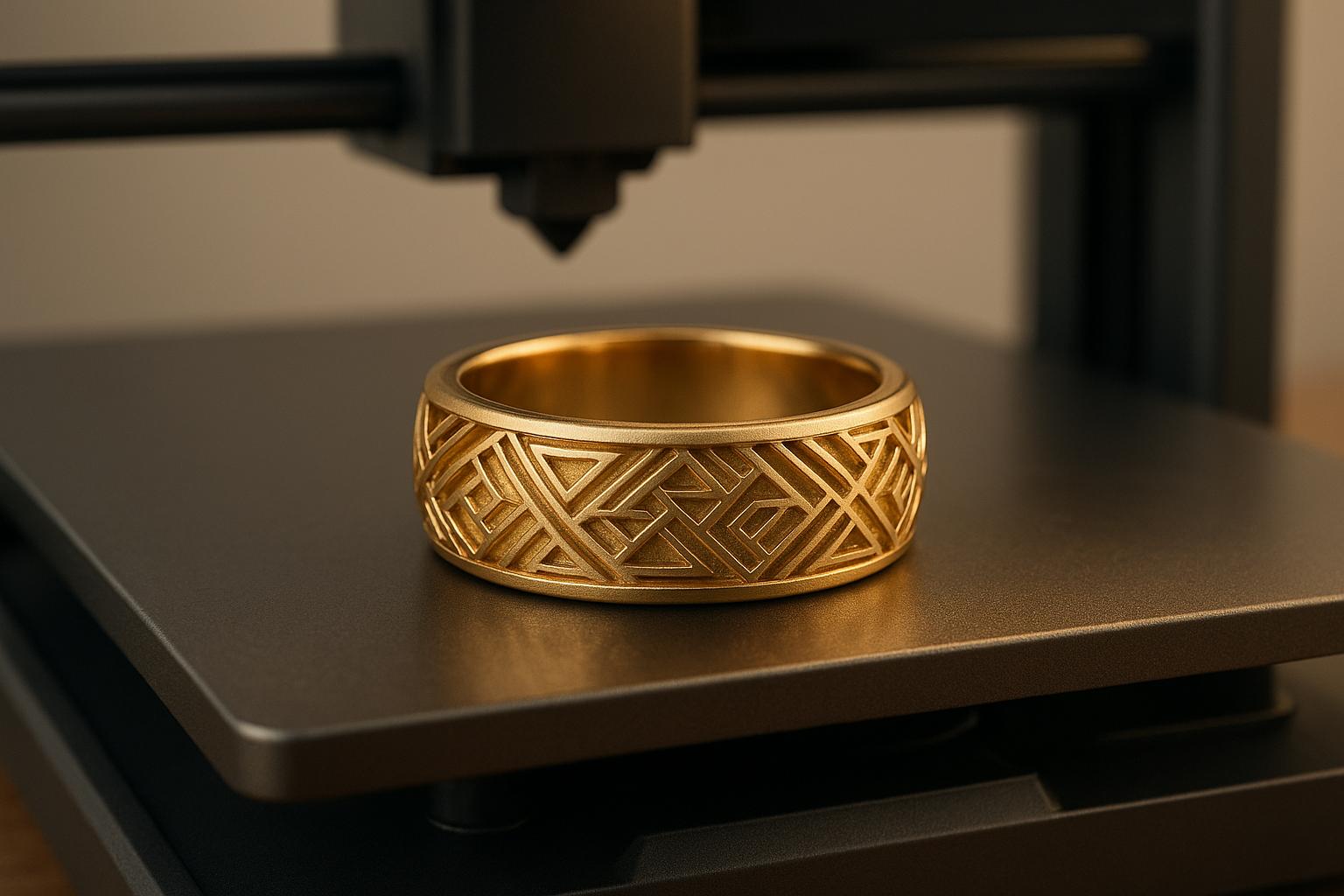
3D printing is reshaping jewelry design by combining digital tools with craftsmanship. Here’s what you need to know:
- 90% of jewelry now involves 3D printing, enabling intricate designs with precision down to 25 microns.
- It speeds up production, turning designs into prototypes in hours instead of weeks.
- Designers can create customized, detailed, and eco-conscious pieces while reducing waste.
- Tools like CAD software (e.g., RhinoGold, MatrixGold) and high-resolution printers (e.g., Phrozen Sonic Mini 8K) are essential.
- Materials range from castable resins for prototypes to direct metal printing for finished pieces.
While the technology offers precision and flexibility, challenges include high upfront costs, material limitations, and a steep learning curve. With the market projected to grow to $18.5 billion by 2030, 3D printing is becoming a key part of modern jewelry design.
How I Used a 3D Printer To Make an Engagement Ring!
Key Tools and Technologies for 3D-Printed Jewelry
Creating 3D-printed jewelry is a fascinating blend of artistry and technology. From software to printers to materials, these tools help transform digital concepts into wearable masterpieces. Understanding them can unlock new levels of creativity and streamline the production process.
CAD Software for Jewelry Design
At the heart of modern jewelry design is computer-aided design (CAD) software. These programs let designers create intricate, precise, and customizable pieces with mathematical accuracy.
Two standout options in the professional jewelry design world are RhinoGold and MatrixGold. RhinoGold is known for its detailed modeling capabilities, while MatrixGold offers an intuitive interface and advanced features like parametric history and seamless 3D printing integration.
For those seeking a free option, Blender is a powerful choice, though it has a steeper learning curve. Beginners might prefer user-friendly tools like TinkerCAD, while Fusion 360 offers versatility at around $495 per year, with free plans available for students and startups.
For organic, detailed designs, ZBrush excels with its sculpting tools. Its pricing – approximately $895 for a perpetual license or $360 annually – makes it a flexible option for designers focusing on intricate textures and forms.
3D Printers for Jewelry Applications
Once the design is ready, it’s time to bring it to life using high-precision 3D printers. Resin-based printers, particularly those using SLA, LCD, and DLP technologies, are the go-to choice for jewelry production due to their high resolution and ability to work with castable wax resins.
The Phrozen Sonic Mini 8K, priced at around $500, delivers exceptional detail with a resolution of 22 microns – three times finer than a human hair. As Dan from Clear Mind Jewelry puts it:
"The higher the detail, the greater the product quality is, which is why high resolution can easily make or break their jewelry’s quality or credibility."
For professional studios, the Formlabs Form 4 is a standout option. At $3,500, it offers faster print speeds – up to five times quicker than its predecessor – without sacrificing precision. For large-scale production, the Flashforge WaxJet 400 ($52,000) uses material jetting technology, making it ideal for manufacturers producing hundreds of pieces monthly.
When choosing a printer, focus on fine detail capabilities (down to 8 microns) and adjustable speed settings for balancing rapid prototyping with detailed final prints. This attention to quality is crucial in a market projected to surpass $8 billion by 2029.
| Printer | Technology | Build Volume | Resolution | Price |
|---|---|---|---|---|
| Elegoo Saturn 4 Ultra | LCD | 8.6" x 4.8" x 8.7" | 19 microns | $399 |
| Phrozen Sonic Mini 8K | LCD | 8.8" x 5.0" x 9.3" | 22 microns | ~$500 |
| Formlabs Form 4 | LCD | 7.9" x 4.9" x 8.3" | 25 microns | $3,500 |
| Asiga Ulta 50 | DLP | 7.4" x 4.2" x 5.1" | 35 microns | $15,000 |
Materials for 3D-Printed Jewelry
The choice of material plays a huge role in determining the look, durability, and cost of a jewelry piece.
Castable resins are a cornerstone of jewelry production. These resins are designed for lost-wax casting with precious metals, minimizing residue during the process. Proper post-curing ensures durability and consistency.
For direct metal printing, metal powders allow for intricate designs in gold, silver, or platinum using powder bed fusion. While this method offers unmatched design flexibility, it comes with higher costs.
For prototyping and lightweight designs, plastic-based resins and nylon are affordable and practical. They’re perfect for testing fit and form before transitioning to metal production. Metal-filled filaments, which combine metal powder with a polymer binder, require additional steps like sintering to achieve their final properties. Designers must also account for shrinkage, typically 15% to 20%, to ensure accurate sizing.
Innovative materials are also making waves. Flexible resins allow for bendable components, improving comfort, while high-temperature resins are great for creating vulcanized rubber molds. Eco-conscious designers are turning to biodegradable polymers, recycled plastics, and bio-based resins as sustainable options. Meanwhile, smart materials with self-healing or conductive properties are pushing the boundaries of what’s possible in jewelry design.
Selecting the right material involves balancing factors like skin compatibility, durability, and production method. Advances in materials not only improve precision but also open up new creative possibilities, making them a vital part of the 3D-printed jewelry process.
The 3D Printing Process: From Concept to Final Piece
Turning a jewelry idea into a finished masterpiece involves three key phases that combine traditional craftsmanship with modern technology. Let’s break down how advanced CAD tools and 3D printing bring these designs to life.
Digital Modeling and Rendering
Everything starts in the digital world. Designers use CAD software like Rhino, MatrixGold, or ZBrush to create detailed, true-to-scale 3D models that ensure precision and efficiency. These models don’t just save time – they also help minimize errors by providing exact specifications. This way, mistakes during casting or setting are far less likely.
To make the design even more realistic, 3D rendering adds elements like depth, texture, and lighting. This allows designers to preview the piece from every angle and make adjustments before moving forward. Tools like slicing software are also used to check wall thickness and add proper support structures, preventing weak spots while saving on materials. Once the digital model is finalized, it’s ready to move from the screen to a physical prototype.
3D Printing and Prototyping
With the digital design perfected, the next step is to print the model using resin or wax. High-resolution 3D printers can capture intricate details as fine as 25 microns, making them ideal for jewelry design.
"With the quality that you can get with SLA 3D printing for printing these jewelry pieces, you can jump straight from the 3D printed part to a master mold", said Formlabs’ Jewelry Vertical Product Manager Amos Dudley.
Material selection is critical here. Castable resins are often used because they burn out cleanly during the casting process, leaving no residue. After printing, the model is cleaned thoroughly – usually with isopropyl alcohol baths – and then cured under UV light to achieve the desired hardness and stability. This prototype serves as a proof-of-concept before moving on to traditional casting methods.
Casting and Finishing
The final transformation happens through investment casting and finishing. The process starts by attaching the 3D-printed model to a wax tree, which helps guide molten metal into the mold. A layer of investment plaster is applied around the assembly, creating a heat-resistant mold. During the burnout stage, the resin model is removed, leaving a cavity ready for the molten metal.
Using centrifugal force, molten precious metal is poured into the mold, ensuring that even the tiniest details are captured. Once the metal cools, the investment plaster is broken away, revealing the raw casting.
From here, the piece undergoes finishing and polishing to achieve a flawless look. Sanding is done with grits ranging from coarse (100) to ultra-fine (2000) to create a smooth, polished surface. For precision work, it’s important to account for about 0.2 mm of material loss during polishing and ensure the 3D model is watertight to avoid complications during the earlier stages. For metal-filled filaments, polishing compounds can enhance the metallic shine, while softer materials benefit from a gentle polish with a soft cloth.
This blend of digital precision and hands-on craftsmanship ensures that every piece is not only visually stunning but also structurally sound and ready for the market.
sbb-itb-593149b
Benefits and Drawbacks of 3D Printing in Jewelry Design
Building on our earlier discussion of tools and processes, let’s dive into the practical upsides and challenges of using 3D printing in jewelry design. Like any transformative technology, it brings new opportunities alongside its own set of hurdles. By understanding these trade-offs, designers can better decide when and how to incorporate 3D printing into their workflow.
Benefits of 3D Printing
Precision and Complex Design Capabilities
3D printing allows for an unmatched level of detail, with precision reaching as fine as 25 microns. This technology makes it possible to create designs that would be nearly impossible to achieve by hand, such as intricate filigree, moving components, and highly complex geometries. It essentially expands the creative boundaries of jewelry design.
"Working with 3D printing as production method opens up a new world of shapes and aesthetics. It allows RADIAN to use innovative materials and create unique and artistic statement pieces."
Time and Cost Efficiency
One of the standout advantages of 3D printing is its speed. Prototypes that once took days can now be produced in just hours, enabling designers to iterate quickly and test multiple ideas. This efficiency translates into significant cost savings as well. Frank Caplow of Delmas Diamonds & Jewelers highlights how this technology has improved profitability:
"B9Creations 3D printers have added a 30% additional profit margin to everything I make because I no longer have to pay anyone to produce my products, and I have a milling machine, but I can’t use it on a lot of things. Having a 3D printer is like paying a fantastic employee a one-time salary and never paying them again." – Frank Caplow, Delmas Diamonds & Jewelers
Material Efficiency and Personalization
Because 3D printing is an additive process, it uses only the exact amount of material needed, reducing waste significantly. It also simplifies customization – whether it’s resizing dimensions, adding engravings, or creating bespoke designs, the process is far less labor-intensive compared to traditional methods.
Drawbacks of 3D Printing
Despite its benefits, 3D printing comes with its own set of challenges that designers need to navigate.
Material Limitations and Durability Issues
The range of materials suitable for 3D printing in jewelry is still relatively narrow. While resins are excellent for prototyping, they often lack the strength required for finished pieces. Metal 3D printing, while promising, brings its own complexities. As Richard Merlino from Metal 3D Printing Company explains:
"The biggest challenge in metal 3D printing is ensuring the material is as strong as solid material. This takes very careful process control and lots of training."
High Initial Costs and Learning Curve
Investing in quality 3D printing equipment can be expensive, and there are ongoing costs for materials, maintenance, and software. Additionally, mastering the necessary skills – like CAD software, understanding printer settings, and learning post-processing techniques – can be daunting, especially for artisans more accustomed to traditional methods.
Post-Processing Challenges
Most 3D printed jewelry pieces are far from finished once they come off the printer. Cleaning, UV curing, and polishing are just a few of the steps required to make the piece production-ready. Moreover, finding materials that burn out cleanly during casting without leaving residue is an ongoing issue.
Quality Control Difficulties
Maintaining consistent quality in 3D printing is no small feat. Factors like ambient temperature, resin age, humidity, and printer calibration can all impact the final product. Unlike traditional crafting, where adjustments can be made in real time, issues with a 3D print often aren’t discovered until the entire process is complete.
Comparison Table: Pros vs. Cons
| Aspect | 3D Printing Advantages | 3D Printing Disadvantages |
|---|---|---|
| Design Complexity | Enables intricate details and complex geometries | Limited by material properties in certain cases |
| Speed | Prototypes completed in hours, enabling rapid iteration | Post-processing can extend overall production time |
| Cost | Eliminates tooling expenses, boosting profit margins | High initial investment and ongoing costs |
| Materials | Reduces waste by using only necessary material | Limited material options; durability concerns |
| Customization | Simplifies personalization with minimal setup | Requires individual file preparation for each design |
| Quality Control | Achieves precise results when properly calibrated | Managing variables demands technical expertise |
| Skill Requirements | Allows intricate designs without advanced hand skills | Requires steep learning curve for CAD and post-processing |
3D printing isn’t here to replace traditional jewelry-making methods – it’s a powerful tool that complements them. While it excels in specific areas like precision and customization, it also comes with challenges that require careful consideration and expertise to overcome.
New Developments and Trends in 3D-Printed Jewelry
The global 3D-printed jewelry market is on track to hit $3.3 billion by 2030, growing at an impressive annual rate of 20.6% from 2024 onward. This growth reflects the rapid evolution of technology, which is reshaping jewelry design with advancements in complexity, customization, and eco-conscious practices.
Complex and Lightweight Designs
Thanks to high-resolution printers and advanced design software, jewelry makers can now create intricate and lightweight pieces like never before. Think delicate lattice patterns in rings or earrings with fluid, interconnected components. These innovations not only enhance artistic expression but also reduce material waste while maintaining durability.
Direct Metal Laser Sintering (DMLS) is one standout technology, enabling the direct creation of metal jewelry and significantly cutting down production time compared to traditional casting methods. Companies like Carbon 3D and HP are also pushing the envelope with faster production techniques. Meanwhile, AI-powered generative design tools allow designers to explore thousands of variations, opening up endless possibilities for unique creations.
Personalization and Customization
Personalization has become a major selling point in the jewelry world. Studies show that 70% of younger shoppers are willing to pay more for personalized pieces, and this trend is expected to dominate well into 2025. With 3D printing, customers can now actively participate in the design process, tweaking base designs or creating entirely new pieces to suit their tastes.
CAD software integrated with 3D printers makes it easy to adjust dimensions, add engravings, or incorporate meaningful symbols. Laser engraving and 3D printing technologies have taken precision to the next level, allowing brands to offer scalable yet individualized designs. Digital platforms are also playing a critical role, with online sales expected to grow at a 21.5% annual rate from 2024 to 2030. Cloud-based tools further streamline collaboration between designers and manufacturers, making the process more efficient.
Eco-Friendly Practices in Jewelry Design
Sustainability is increasingly influencing jewelry design, and 3D printing is leading the charge toward greener practices. New materials, like bio-compatible metals and sustainable polymers, are paving the way for environmentally responsible production. As Lorena Diaz puts it:
"Sustainable 3D jewelry isn’t a trend – it’s a reflection of a deeper transformation in how we consume and understand design".
3D printing minimizes waste by building layer by layer, using up to 95% recycled materials in the process. For example, Cloud Factory Jewelry reports that its metal 3D printing methods reduce the carbon footprint by 80% compared to traditional techniques. Some companies have gone even further, using 100% recycled 925 Sterling Silver and reprocessing over 95% of leftover metals. Plant-based materials like PLA are also gaining traction for their biodegradable properties, alongside recycled metals and eco-friendly resins.
The industry is already showcasing these sustainable innovations. In November 2021, LACE by Jenny Wu teamed up with Impossible Objects to release a line of 3D-printed carbon fiber jewelry, including earrings and bracelets made with advanced composite manufacturing. A year later, Christian Tse and Formula 3D collaborated with Desktop Metal to introduce sterling silver jewelry crafted through 3D printing. These examples highlight how designers are merging cutting-edge technology with sustainable materials to create stunning pieces that reduce environmental impact. Some are even incorporating unconventional materials like textile waste and bioplastics, proving that creativity and sustainability can go hand in hand.
Conclusion: The Future of 3D Printing in Jewelry
The 3D-printed jewelry market is projected to grow significantly, climbing from $4.21 billion in 2025 to $8.05 billion in 2029, with an impressive annual growth rate of 17.6%. This growth is reshaping how jewelry is conceived, created, and consumed.
Cutting-edge advancements in AI, machine learning, smart materials, and IoT are not only speeding up production but also paving the way for wearable innovations. For instance, using lattice and honeycomb infill patterns can cut gold usage by up to 30%. These breakthroughs highlight how technology can fuel creativity while conserving resources, signaling a more accessible and forward-thinking future for jewelry design.
3D printing is also transforming the jewelry industry by making customization and rapid prototyping more accessible, meeting the growing demand for sustainable practices. Unlike traditional manufacturing, which required heavy investments and lengthy timelines, 3D printing allows for faster iterations and adaptability. This shift aligns with changing consumer preferences, as 65% of shoppers now prioritize sustainable products. These trends tie back to earlier discussions on the importance of precision, sustainability, and personalization in 3D-printed jewelry.
Looking ahead, emerging technologies like virtual try-ons in the metaverse and blockchain for traceability promise to redefine customer experiences. As Jae’s Jewelers notes:
"Jewelry design technology in 2025 is revolutionizing how we create and experience fine jewelry…these innovations offer Miami couples personalized, sustainable, and accessible options".
The future of jewelry design lies at the intersection of traditional craftsmanship and digital innovation. This fusion delivers sustainable, one-of-a-kind pieces that not only reflect individual tastes but also push the boundaries of creativity.
FAQs
How does 3D printing enhance jewelry design with customization and sustainability?
3D printing has transformed the jewelry industry, making it possible to create intricate, custom designs that were once out of reach with traditional techniques. Designers can now bring unique, one-of-a-kind ideas to life, aligning perfectly with individual tastes – all while keeping production costs more manageable.
This technology also supports a more eco-friendly approach by cutting down on material waste and enabling on-demand production. Instead of relying on mass production, pieces are made only when needed, which helps avoid overproduction and reduces environmental strain. Plus, the precision of 3D printing ensures materials are used efficiently, offering a smarter, greener way to craft modern jewelry.
What are the main challenges of using 3D printing in jewelry design?
While 3D printing has transformed the jewelry design process, it’s not without its hurdles. One major challenge is material limitations – certain metals or resins may not perform well with 3D printing, and achieving a polished, high-quality surface often demands considerable post-processing. Costs can also add up quickly, especially when using advanced printers or rare, specialized materials.
On top of that, technical issues like porosity, shrinkage, and fragility can affect the durability and appearance of metal prints. Highly intricate designs may be tough to replicate with precision, leaving some pieces short of the fine details that jewelry often requires. However, as technology continues to advance, many of these obstacles are being tackled, making 3D printing an increasingly practical tool for jewelers.
What are the upcoming trends and innovations in 3D-printed jewelry design?
The world of 3D-printed jewelry is evolving rapidly, with some fascinating trends shaping its future. One standout development is multi-material printing, which enables the creation of jewelry pieces that blend various textures and colors seamlessly into a single design. At the same time, AI-powered design tools are transforming how jewelry is conceptualized, making it easier than ever to craft pieces that are both highly personalized and meticulously optimized.
Another game-changer is the progress in direct metal 3D printing, which now supports premium materials like platinum and titanium, opening up new possibilities for luxurious and durable designs. The industry is also embracing faster, eco-conscious production methods and decentralized manufacturing, empowering independent designers to turn their visions into reality with fewer barriers.
With the market expected to hit $3.3 billion by 2030, 3D printing is not just a trend – it’s redefining how jewelry is designed, made, and tailored to individual tastes.
