
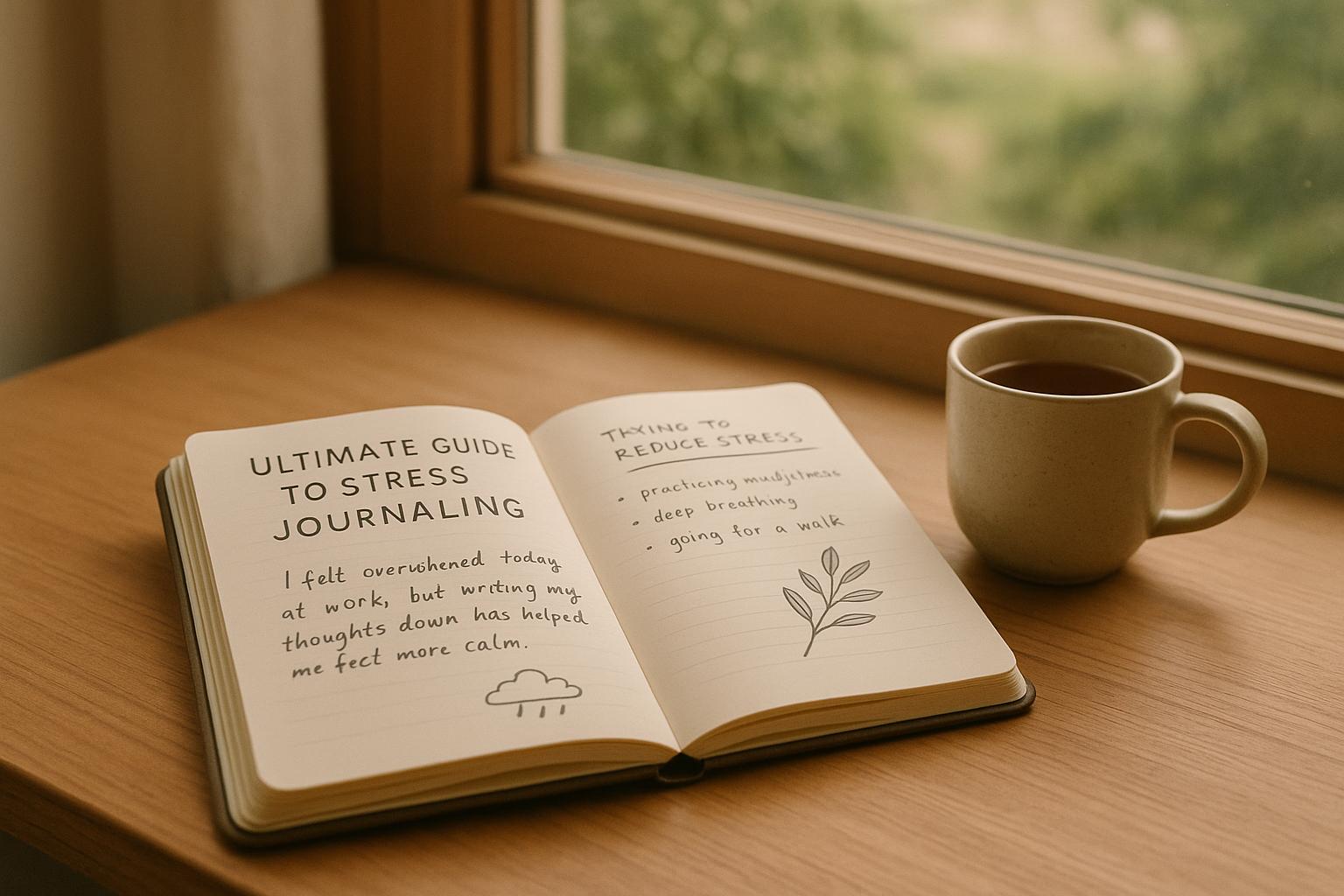
Stress journaling is a simple way to manage emotions and reduce stress by writing about your thoughts and experiences. Here’s what you need to know:
- What it is: A focused journaling practice to identify stress triggers and emotional responses.
- Why it works: Writing helps organize emotions, lowers cortisol levels, and improves mental and physical health.
- Who it’s for: Anyone dealing with stress, anxiety, or life changes, especially those seeking a low-cost, flexible tool for emotional clarity.
- How to do it: Use techniques like expressive writing, prompts, or gratitude journaling. Consistency is key – start small (5–10 minutes daily) and build from there.
Stress journaling can improve emotional awareness, reduce anxiety, and even enhance sleep and physical well-being. All you need is a pen, paper, or a digital tool to get started.
Journaling For Stress Relief
Benefits of Stress Journaling
Stress journaling has a proven track record of improving both mental and physical well-being. By making it a regular practice, you can reshape how your mind and body handle stress. Let’s dive into how it helps in managing emotions, improving physical health, and fostering personal growth.
Mental and Emotional Health Benefits
When life feels overwhelming, journaling can help you make sense of your emotions. Writing things down not only provides an emotional outlet but also helps your brain untangle complex thoughts, reducing stress and anxiety in the process. This habit encourages a shift in perspective, making it easier to handle challenges with a clearer, calmer mindset.
Journaling has been shown to lower stress hormone levels. It also promotes self-awareness and mindfulness by encouraging you to reflect on your thoughts and behaviors. Over time, this can help you identify emotional triggers and develop healthier responses to anxiety.
Another perk? It helps you sort out priorities. Writing allows you to step back and figure out what actually needs your attention, while also giving you space to practice positive self-talk and address negative thought patterns. Plus, the creative process of journaling can unlock solutions to problems that once felt impossible to solve.
Interestingly, research suggests that women may experience greater anxiety relief from journaling compared to men. And sticking with it for over 30 days tends to amplify the mental health benefits. Studies even show that writing about your deepest thoughts and feelings can lead to fewer sick days at work.
Physical Health Benefits
Journaling doesn’t just help your mind – it benefits your body, too. In a study at the University of Chicago Medical Center, patients with anxiety disorders who journaled three times a week saw a 37% reduction in anxiety symptoms, compared to just 12% in the control group.
"The patients who showed the most significant improvements were those who used their journals to not only express emotions but also to identify patterns and develop coping strategies for future stressors." – Dr. Elizabeth Scott, Psychologist specializing in stress management
Companies are also taking note. Aetna introduced a guided journaling program and saw a 28% drop in employee stress levels, a 20% improvement in sleep quality, and productivity gains of around $3,000 per employee.
Even a simple 15-minute journaling session, three times a week, can lower blood pressure and boost overall well-being, as reported in JMIR Mental Health. And when it comes to sleep, a study in the Journal of Experimental Psychology found that writing a to-do list for the next day helped participants fall asleep 9 minutes faster than those who wrote about completed tasks.
"The act of journaling before bedtime has profound psychological benefits… Engaging in reflective practice through journaling facilitates a mental unwind, promoting a calmer state conducive to quality sleep." – Dr. Jordan Burns DC, MS
Journaling has also been linked to reduced physical pain, stronger immune function, and relief from inflammatory conditions, showing its value as a tool for overall health management.
Building Strength and Personal Growth
Journaling isn’t just about short-term stress relief – it’s a way to build long-term resilience. By regularly reflecting on your emotions and experiences, you gain deeper insights into your reactions, helping you navigate life’s challenges with greater stability.
Over time, journaling helps you spot patterns in your stress triggers, allowing you to either avoid them or develop better coping mechanisms.
"The act of converting emotions and images into words changes the way a person organizes and thinks about trauma… By integrating thoughts and feelings, the person can more easily construct a coherent narrative of the experience." – Dr. Pennebaker
Each time you process a stressful event through writing, you strengthen your ability to handle future challenges. Regular journaling also boosts confidence in your problem-solving skills and emotional resilience.
According to a survey by Bullet Journal creator Ryder Carroll, 76% of consistent users reported lower anxiety levels after three months. Similarly, a study from the Journal of Personality and Social Psychology found that gratitude journaling increased happiness and optimism by 25%.
Journaling also stabilizes physical responses like breathing and heart rate, creating a sense of calm that allows for clearer thinking. This state of relaxation makes it easier to process emotions, tackle problems, and make thoughtful decisions, paving the way for meaningful personal growth and better stress management.
Stress Journaling Techniques That Work
If you’re ready to explore the benefits of stress journaling, these techniques offer different ways to dive in. Each method has its own spin, so you can pick the one that feels most natural or fits your current needs.
Expressive Writing
Expressive writing is all about letting your thoughts and feelings flow onto the page. Think of it as a personal therapy session – just you and your journal. This method involves writing openly about your emotions, especially those tied to stressful or tough experiences. There’s no need to worry about grammar or structure; the goal is to release what’s on your mind.
To get started, find a quiet spot where you won’t be interrupted. Set aside around 30 minutes, three or four times a week, and just write. Whether you use full sentences, bullet points, or even doodles, it’s all about expressing yourself. Over time, this practice can help you process your emotions and respond more calmly to future stress [3, 9].
Prompt-Based Journaling
If you’re not sure where to start, prompt-based journaling can be a helpful guide. This method uses specific questions to spark your writing. For instance, you might reflect on:
- How do the changes in your life make you feel?
- What are three things you’re grateful for today?
You can also customize prompts to suit your situation. If work is stressing you out, try asking yourself what feels most overwhelming or what small change could make tomorrow easier. These targeted questions can help you focus and make journaling feel less intimidating.
Gratitude Journaling
Gratitude journaling shifts your attention from what’s stressing you out to what’s going well. Every day, jot down three or more things you’re thankful for – no matter how small. It could be a sunny morning, a kind text, or even just a great cup of coffee.
This simple practice rewires your brain to notice the positives, even during tough times. Over time, it can lift your mood, ease feelings of depression, and make you more resilient to stress. Try making this a nightly habit to end your day on a positive note [3, 9].
These techniques give you flexible ways to turn stress into something productive. Whether you’re venting emotions, reflecting through prompts, or focusing on gratitude, there’s a method here to help you find calm and clarity.
sbb-itb-593149b
How to Make Stress Journaling Work for You
Now that you’re familiar with the techniques, let’s focus on how to turn stress journaling into a habit that sticks. The difference between trying it once and making it a regular, life-enhancing practice lies in how you integrate it into your routine. Here are some practical tips to help you make it a lasting part of your day.
Creating a Daily Routine
Consistency matters more than perfection when it comes to journaling. You don’t need to write pages every day – just showing up regularly makes a difference. Studies show that even brief writing sessions can lower stress by up to 30% and improve emotional awareness by 50%.
Start small. Dedicate 5–10 minutes a day to journaling. Even committing to 15 minutes a few times a week can have a big impact on reducing stress and gaining clarity. Pick a time that works best for you – whether it’s while sipping your morning coffee, during a quiet lunch break, or right before bed when distractions are minimal.
One effective way to make journaling a habit is to tie it to something you already do. For instance, keep your journal next to your coffee mug or on your nightstand if you’re in the habit of checking your phone before bed. This “habit-stacking” approach makes it easier to remember.
Set reminders on your phone or use calendar alerts until journaling feels natural. And don’t stress about missing a day – just pick it back up the next time. Even a quick 5-minute entry is better than skipping it altogether. The goal is to make progress, not to be perfect.
Once you’ve established a routine, having the right tools can make the process even smoother.
Picking the Right Tools
Your journaling tools should simplify the process and inspire you to write. The beauty of journaling is that it doesn’t require anything fancy. As social media journaler Emily Datz puts it:
"One of my favorite things about journaling is how you can start with a blank notebook and a pen."
If you prefer traditional journaling, choose a notebook that feels inviting. Some people like lined pages for structure, while others prefer blank ones for creative freedom.
Digital journaling is another great option, especially if you’re always on the go. A 2019 study found that digital journaling users were 27% more likely to stick with the habit over time.
Here are some options to consider:
- Traditional notebooks for those who enjoy the tactile experience of writing by hand.
- Bullet journals for tracking habits and setting goals alongside your journaling.
- Gratitude journals with built-in prompts to guide your entries.
- Password-protected apps for added privacy.
Ultimately, the best tools are the ones that motivate you to keep writing. If a beautifully designed notebook inspires you, it’s worth the investment.
Solving Common Problems
Even experienced journalers hit roadblocks now and then. Here’s how to tackle some common challenges:
"I don’t know what to write about."
Prompts can help. Start with simple questions like, “How am I feeling right now?” or “What’s causing me stress today?”
"I don’t have time" or "I keep forgetting to journal."
Incorporate journaling into an existing routine and set reminders. A survey of over 2,000 journalers found that 64% preferred writing in the evening, while 32% chose mornings.
"I’m worried about privacy."
Opt for a password-protected digital journaling app. Remember, this is your personal space, and its value comes from the act of writing, not from how polished it looks.
"I’m too critical of my writing."
Don’t let self-judgment stop you. As Joshua Smyth, a Distinguished Professor at Penn State University, explains:
"Journaling is a tool to put our experiences, thoughts, beliefs, and desires into language, and in doing so it helps us understand and grow and make sense of them."
Focus on the process, not the end result. Your journal is a tool for self-reflection, not a masterpiece.
"Journaling makes me feel worse."
If writing feels overwhelming, try shifting your focus or take a short break. Avoid dwelling solely on negative emotions. Instead, explore what’s behind them and think about potential solutions. Dr. Elizabeth Scott, a psychologist specializing in stress management, emphasizes:
"The patients who showed the most significant improvements were those who used their journals to not only express emotions but also to identify patterns and develop coping strategies for future stressors."
Take time to review your progress and adjust your approach as needed. Check in with yourself to see what’s working and what isn’t, and make tweaks to keep your journaling habit sustainable.
Assistant Professor Allison Quatrini from Eckerd College highlights the payoff of sticking with it:
"I’m able to organize thoughts and feelings on paper so they no longer take up room in my head. If I get them out on the page and clear the mental decks, it sets up the rest of the day to not only be more productive but be more relaxed."
With the right tools, a solid routine, and strategies to overcome challenges, stress journaling can become a dependable way to find calm in your everyday life.
Start Your Stress Journaling Journey
It’s time to dive into stress journaling and make it a part of your daily life. The great thing about stress journaling? It’s incredibly flexible – there’s no one-size-fits-all approach. You can tailor it to suit your lifestyle and what works best for you.
Key Points to Keep in Mind
Before you begin, here are a few helpful tips to guide you:
- Keep it simple and consistent. Choose a medium you’re comfortable with, whether it’s a notebook, an app, or a document.
- Start small. Dedicate just 5–10 minutes a day if you’re new to journaling.
- Write freely. Don’t stress over grammar, spelling, or structure. The goal is to let your thoughts flow.
- Use prompts if you’re stuck. Questions like "How am I feeling right now?" or "What’s been on my mind today?" can help get you started.
- Make it part of your routine. Tie journaling to something you already do daily, like your morning coffee or winding down before bed.
With these tips in mind, you’re ready to start your journey.
Taking Your First Step
Pick your journaling tool. Whether it’s a notebook, a digital document, or a mobile app, choose something you’ll stick with.
Find your writing space. Settle into a quiet, comfortable spot where you can write without interruptions. It could be your kitchen table, a park bench, or a cozy corner of your home.
Write your first entry. Start simple: "Today I felt…" Spend five minutes writing honestly about your thoughts and emotions.
Experiment and explore. Over the next few weeks, try out different styles. Maybe gratitude journaling will click, or perhaps a stream-of-consciousness approach feels more natural. Give yourself the freedom to find what works best for you.
Look back and reflect. After a few weeks, take time to review your entries. As author Nisha Salim points out:
"Regularly reviewing your past entries can offer valuable insights into your personal growth and transformation. It’s like having a personal diary of your mental and emotional journey."
Be kind to yourself. Building a new habit takes time. If you miss a day or two, don’t stress – just pick it back up. Set reminders or block out time in your calendar until journaling becomes second nature .
Stress journaling is a personal process, and it will look different for everyone. Start where you are, use what you have, and remember that even small, consistent steps can make a big difference in managing stress and understanding yourself better.
FAQs
What are some practical tips for staying consistent with stress journaling?
Building a regular stress journaling habit doesn’t have to be overwhelming. One helpful approach is to carve out a specific time each day for it. Whether it’s during your morning coffee or as part of your bedtime routine, linking journaling to an activity you already do can make it feel effortless.
Start small – there’s no need to fill pages. Writing just a few sentences or responding to a simple prompt is enough to get started. The goal isn’t perfection; it’s about creating a space to reflect and release stress. With time, journaling can become a comforting ritual that nurtures your mental health.
How can I track the impact of stress journaling on my mental and physical well-being over time?
To evaluate how stress journaling is influencing your mental health, consider using tools like the Perceived Stress Scale (PSS) or Generalized Anxiety Disorder-7 (GAD-7). These tools can help track changes in your stress and anxiety levels over time, giving you a clearer picture of your mental state.
For physical health, look out for improvements such as less muscle tension, fewer headaches, or smoother digestion. Over time, you might even notice broader benefits like lower blood pressure or a reduction in doctor visits.
Keeping a simple record of your symptoms and mood alongside your journaling can offer valuable insights. As time goes on, you may start to see patterns that reveal how journaling is contributing to your overall well-being.
Can I combine stress journaling with other techniques to manage stress more effectively?
Pairing stress journaling with other stress-relief techniques can amplify its benefits. Activities like mindfulness meditation, deep breathing exercises, or yoga can work alongside journaling to help you process emotions and stay centered. Research even shows that using multiple methods together can result in a bigger drop in stress levels than relying on just one.
Consider weaving journaling into a larger routine, such as therapy sessions or relaxation practices, to support emotional balance and mental health. The goal is to discover the mix that suits you best and make it a consistent part of your daily or weekly habits.
