
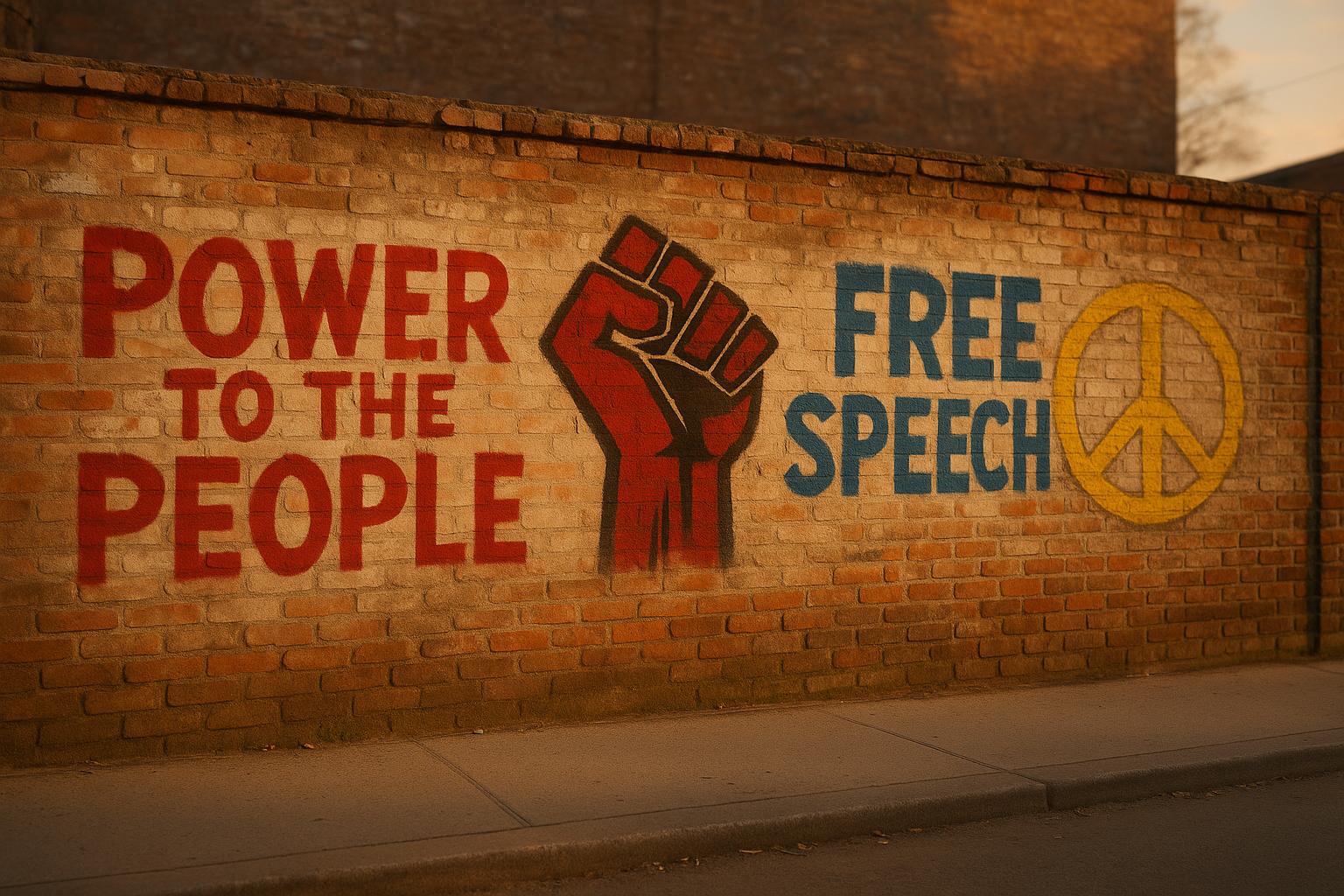
Political graffiti challenges the balance between free speech and property rights. While the First Amendment protects political expression, including graffiti, this protection isn’t absolute. Laws often prioritize property rights, making graffiti without permission illegal. Key points include:
- Free Speech Protections: Courts recognize political graffiti as symbolic speech. However, its legality depends on context, such as location and property type.
- Property Laws: Graffiti on private or public property without consent is typically considered vandalism, even if it’s political.
- Legal Cases: Examples like Ecko.Complex LLC v. Bloomberg and the 5Pointz decision highlight tensions between artistic expression and property rights.
- Solutions: Legal graffiti spaces, like Detroit’s Grand River Creative Corridor, offer alternatives for artists to share messages without breaking laws.
Navigating these laws requires understanding the intersection of expression, property rights, and community interests.
Judge rules SPD can’t enforce property destruction laws | FOX 13 Seattle
Free Speech Laws and Legal Limits
The intersection of free speech and political graffiti creates a complicated legal landscape where constitutional rights collide with property laws. For activists, artists, and legal professionals navigating these issues, understanding the boundaries is essential.
First Amendment Protection for Political Expression
The First Amendment safeguards political expression, which includes graffiti. The Supreme Court has consistently ruled that visual forms of expression – from paintings to sculptures – fall under its protection. This protection even extends to symbols and statements that challenge authority.
Several landmark cases have clarified the scope of this protection. In Cohen v. California, the Supreme Court overturned the conviction of a man arrested for wearing a jacket with the phrase "F— the Draft" in a courthouse. Justice Harlan famously noted:
"One man’s vulgarity is another man’s lyric".
This decision reinforced strong protections for offensive symbolic speech. Similarly, in Texas v. Johnson, the Court ruled that flag burning constitutes protected political expression, emphasizing that the government cannot suppress speech simply because it is offensive. These rulings affirm that symbolic forms of expression – like political graffiti – are constitutionally protected.
However, the extent of this protection depends heavily on the setting. Courts recognize different types of forums for speech, such as traditional public forums (like parks and sidewalks), designated public forums, and nonpublic forums. In nonpublic forums, the government has greater authority to regulate speech, as long as the restrictions are reasonable and viewpoint-neutral.
The "time, place, and manner" doctrine also plays a crucial role in how First Amendment protections apply to political graffiti. Content-neutral regulations can limit expressive activities if they serve important government interests and are narrowly tailored. In practice, this means that while the government cannot restrict graffiti based on its message, it can regulate when, where, and how such expression occurs.
Ultimately, while the First Amendment protects the message, property laws often dictate where that message can appear.
Where Free Speech Meets Property Laws
Property rights present one of the biggest challenges to First Amendment protections for political graffiti. The general rule is straightforward: graffiti created without the property owner’s permission is illegal. On private property, owners have broad discretion to control what messages appear on their buildings, regardless of the artistic or political significance of the graffiti.
The situation becomes more nuanced on public property. While the government cannot engage in viewpoint discrimination, it has more authority to regulate expression on government-owned property compared to private entities. A notable example is Women for America First v. Adams, where New York City’s control over street murals was upheld. The court ruled that murals on public streets could be classified as government speech, granting the government editorial control over the messages.
Jurisdictional differences add another layer of complexity. In some areas, laws distinguish between permanent and temporary forms of graffiti. Interestingly, property owner consent – whether given beforehand or retroactively – can transform what would otherwise be considered illegal vandalism into lawful expression. Additionally, the Visual Artists Rights Act (VARA) offers limited protections for certain graffiti works, shielding them from modification or destruction by third parties. However, this protection does not prevent property owners from removing the graffiti entirely.
For those using street art as a medium for political expression, understanding these overlapping legal frameworks is critical. While the First Amendment offers robust protection for the content of political messages, it does not override property laws or eliminate the need for permission when using someone else’s property as a canvas. This delicate balance highlights the ongoing challenges faced by activists and property owners in defining the boundaries of acceptable political expression.
Problems and Debates Around Political Graffiti
The tension between creative expression and legal boundaries sparks ongoing conflicts involving artists, property owners, and communities. Central to these debates are questions about who controls public spaces and how to balance competing rights. Below, we explore these challenges and key legal cases that have shaped the conversation around political graffiti.
Creative Freedom vs. Legal Limits
Whether political graffiti is considered art or vandalism plays a major role in determining its protection under the First Amendment. If classified as vandalism, it often receives little to no constitutional protection. However, when recognized as art, it may be afforded broader safeguards. This distinction largely depends on factors like authorization and whether the graffiti causes physical harm to property.
Definitions of graffiti vary by jurisdiction. For example, California requires proof of malicious intent, New York treats graffiti as intentional property damage, and Washington, D.C. prohibits any tangible alteration to property. Newer forms of protest art – like chalk drawings, light projections, and washable paint – further complicate matters. These mediums temporarily alter surfaces without causing lasting harm, raising questions about whether they constitute "damage" or simply "defacement".
Strict liability laws for unauthorized markings add another layer of complexity. Such policies often disproportionately affect communities of color and low-income neighborhoods. At the same time, property owners face a dilemma: Should they embrace graffiti as creative expression or prioritize protecting their investments? The commercialization of street art has only deepened the divide, with some owners profiting from unauthorized works while others demand their removal.
One proposed solution is community consent, where local approval could serve as a middle ground. Advocates suggest that ethical street art should reflect the wishes of the community. However, defining who represents a community and how to secure meaningful consent remains a difficult issue. These debates provide the backdrop for key legal cases that continue to shape enforcement practices.
Important Legal Cases and Their Effects
Although few graffiti-related cases make it to the Supreme Court, several landmark rulings have defined the legal boundaries of political expression and symbolic speech. One notable case is the 5Pointz decision. In this case, a developer whitewashed a building in Queens, New York, that had served as a legal graffiti space for years. The court ultimately awarded $6.75 million to the artists under the Visual Artists Rights Act. While the ruling came after the destruction of hundreds of works, it highlighted the tension between protecting artistic expression and enforcing property rights.
Other key cases have affirmed the protection of symbolic expression, but the government speech doctrine complicates matters. This doctrine gives public entities wide discretion to decide which artworks are displayed on government property, allowing them to endorse certain messages while rejecting others.
The approach to enforcement has also shifted over time. In the 1990s, many cities relied on dedicated graffiti task forces. Today, responses are more varied: some cities celebrate street art as a cultural asset, while others maintain strict zero-tolerance policies. Street artist Banksy captured the heart of this debate with his critique:
"The people who truly deface our neighborhoods are the companies that scrawl giant slogans across buildings and buses trying to make us feel inadequate unless we buy their stuff." – Banksy
This sentiment underscores the ongoing struggle over what constitutes legitimate public messaging versus unwanted visual clutter. As the legal system continues to grapple with these questions, the balance between free expression and property rights in urban spaces remains a contentious issue.
sbb-itb-593149b
Legal Options and Policy Solutions
Prohibition often forces political graffiti into the shadows. However, some communities are finding ways to strike a balance between protecting property rights and honoring free speech. These approaches recognize that political art can play a meaningful role in democracy while addressing concerns about unauthorized markings. Let’s explore some practical legal options and evolving policy ideas reshaping urban artistic expression.
Legal Graffiti Spaces: A Compromise Between Freedom and Order
Legal graffiti walls offer a middle ground where artists can express themselves without facing legal consequences. These designated areas allow for political messaging while protecting property owners. Stockholm’s klotterplanket, established in 1968, was one of the first legal walls and has inspired similar initiatives around the world.
In the United States, cities spend a staggering $12 billion annually on graffiti cleanup, with Los Angeles alone accounting for $7 million. Providing legal spaces for graffiti can help redirect artistic efforts and reduce these hefty expenses. For instance, Canberra, Australia, now features over 30 legal walls.
Unlike commissioned murals, legal graffiti walls offer artists more creative freedom. These spaces are open to everyone in the community, with basic rules in place – no hate speech, and artists must accept that their work may be painted over.
Detroit’s Grand River Creative Corridor, launched in 2012 by 4731 Gallery, is a prime example. This initiative spans 15 buildings, showcasing over 100 artworks, and even includes an outdoor gallery at a bus stop. The project also incorporates neighborhood cleanup efforts.
Of course, some critics argue that legal spaces strip graffiti of its rebellious spirit. Still, these initiatives highlight attempts to balance artistic expression with legal boundaries.
| Aspect | Sanctioned Graffiti | Unsanctioned Graffiti |
|---|---|---|
| Legal Status | Allowed in designated areas | Illegal, with risk of fines/arrest |
| Community Impact | Builds neighborhood pride | Often seen as vandalism |
| Cost to Cities | Low maintenance costs | High cleanup expenses |
| Artistic Freedom | Some content restrictions | Total creative control |
| Visibility | Prominent, approved locations | Found on private/public surfaces |
| Long-term Preservation | Frequently repainted | Often removed quickly |
New Policy Approaches
In addition to legal walls, cities are adopting policies to better manage political graffiti. Many are turning to content-neutral regulations that focus on the time, place, and manner of expression, ensuring political messages aren’t censored.
Bogotá, Colombia, stands out with its "Graffiti District" strategy, launched in 2016. Over four years, the city invested more than $800,000 into this initiative, which spans all 20 localities. It has supported 269 artists and 103 groups, awarding 428 scholarships and incentives to nurture emerging talent.
Street art festivals and temporary legal initiatives are also gaining traction in U.S. cities. These events provide platforms for political expression and foster collaboration between artists and communities. As attitudes shift, cities are creating dedicated street art districts and commissioning public projects to embrace this evolving art form.
To design effective policies, it’s crucial to clearly define what separates protected First Amendment activity from vandalism. Legal experts stress that without precise guidelines, regulations may unintentionally stifle legitimate expression.
Successful policy frameworks often involve ongoing conversations among artists, residents, and local officials. Regular forums and transparent processes for proposing new legal spaces or temporary installations ensure that policies remain responsive to community needs and artistic trends.
Additionally, the economic potential of street art is hard to ignore. Some graffiti works by renowned artists now sell for hundreds of thousands of dollars in the art world. This has prompted cities to explore ways to support and benefit from street art while preserving its grassroots essence. By building on past legal debates, these strategies pave the way for more inclusive and economically savvy approaches to political graffiti.
Conclusion: Balancing Rights and Responsibilities
Political graffiti sits at the intersection of artistic expression and legal boundaries. As cities wrestle with these challenges, achieving the right balance means understanding the interplay between constitutional freedoms and practical limitations. Both freedom of speech and property rights are cornerstones of democracy, and navigating this space demands thoughtful strategies from activists and policymakers alike.
Key Points for Activists and Artists
Artists involved in political graffiti face the challenge of exercising their First Amendment rights while adhering to property laws. While the First Amendment offers protections, the context – such as location and timing – plays a critical role. Legal protections vary significantly depending on whether the space is public, private, or regulated. Additionally, restrictions tied to time, place, and manner are enforceable if they remain content-neutral and serve legitimate government interests.
The 2023 Seattle case offers an important lesson. In this instance, a federal judge blocked the enforcement of a broad anti-graffiti law after activists were arrested for writing Black Lives Matter messages with chalk. The court found that the law allowed arrests based on the content of the message rather than the act itself. This underscores the importance of recognizing when regulations cross constitutional boundaries.
For artists, documenting their intent can be a valuable tool in legal defense. It’s also wise to consult legal experts familiar with First Amendment issues before embarking on politically sensitive projects. Building community support and advocating for artistic expression can further protect these rights.
Whenever possible, seek permission or opt for legal alternatives such as designated graffiti walls or community art programs. Initiatives like Toronto’s StreetARToronto provide funding and support for legal street art, allowing artists to express themselves without risking legal consequences.
Ethical street art also involves respecting the community and its environment. Gaining community consent ensures the artwork aligns with public interests. Navigating public, private, and designated spaces thoughtfully is key to creating impactful and safe expressions.
The Future of Political Graffiti and Free Expression
Looking ahead, the future of political graffiti will hinge on policies that protect free expression while addressing property rights. As cities develop more nuanced approaches, the perception of graffiti is shifting – from being seen solely as vandalism to being recognized as a form of political dialogue and community connection.
Content-neutral regulations are emerging as a cornerstone for effective policymaking. As Supreme Court Justice Thurgood Marshall once said:
"Above all else, the First Amendment means that government has no power to restrict expression because of its message, its ideas, its subject matter, or its content".
Policies that focus on the unauthorized nature of graffiti, rather than its message, are proving to be more effective. These frameworks address factors like size and placement without censoring the content itself.
Legal graffiti spaces and street art districts, such as Miami’s Wynwood Walls, highlight how former industrial zones can be transformed into vibrant hubs of cultural activity, benefiting entire communities.
While tensions between creative freedom and property rights remain, the growing trend of collaborative solutions offers hope. Cities, artists, and communities are increasingly working together to create spaces that respect constitutional rights while addressing property concerns. As Justice Louis Brandeis aptly noted:
"If there be time to expose through discussion the falsehood and fallacies, to avert the evil by the processes of education, the remedy to be applied is more speech, not enforced silence".
The future of political graffiti as a tool for democratic engagement will depend on ongoing conversations among all stakeholders – artists, property owners, city officials, and community members. By crafting thoughtful policies, we can ensure that political graffiti continues to ignite meaningful social discussions while respecting the rights of all involved.
FAQs
Does the First Amendment protect political graffiti, and what are its legal limits?
The First Amendment does safeguard political graffiti as a form of free speech, but there are clear boundaries to this protection. When graffiti crosses into vandalism or causes damage to private or public property, it falls outside the scope of free speech rights. Courts have consistently reinforced anti-graffiti laws, making it clear that the right to free expression does not justify property destruction.
That said, political or artistic graffiti might be protected if it’s created with proper permission and adheres to property laws. Whether graffiti is considered protected speech or illegal vandalism often hinges on the specific context and the legal framework of the jurisdiction where it occurs.
How can artists create political graffiti legally without violating property laws?
Artists aiming to create political graffiti legally should always secure permission from property owners or focus on spaces specifically designated for public art. Without proper consent, graffiti is often classified as vandalism, which is illegal and not safeguarded by the First Amendment.
The Visual Artists Rights Act (VARA) does offer some protections for recognized works of art, but these do not override property ownership rights. While political graffiti can serve as a form of free speech, it still has to operate within legal limits. To steer clear of potential legal trouble, artists can consider participating in community mural projects or teaming up with organizations that promote public art.
How do designated graffiti spaces support artists while respecting property rights, and what are some successful examples?
Designated graffiti spaces offer a legal and creative way for artists to showcase their work while helping to curb illegal vandalism. By providing a controlled environment, these spaces strike a balance between respecting property rights and encouraging artistic expression.
Take Portland’s free wall initiative, for example, or various community mural projects. These programs don’t just brighten up urban landscapes – they also bring people together, foster collaboration, and help artists develop their skills. It’s a clear example of how street art can bring positive change to public spaces.
