
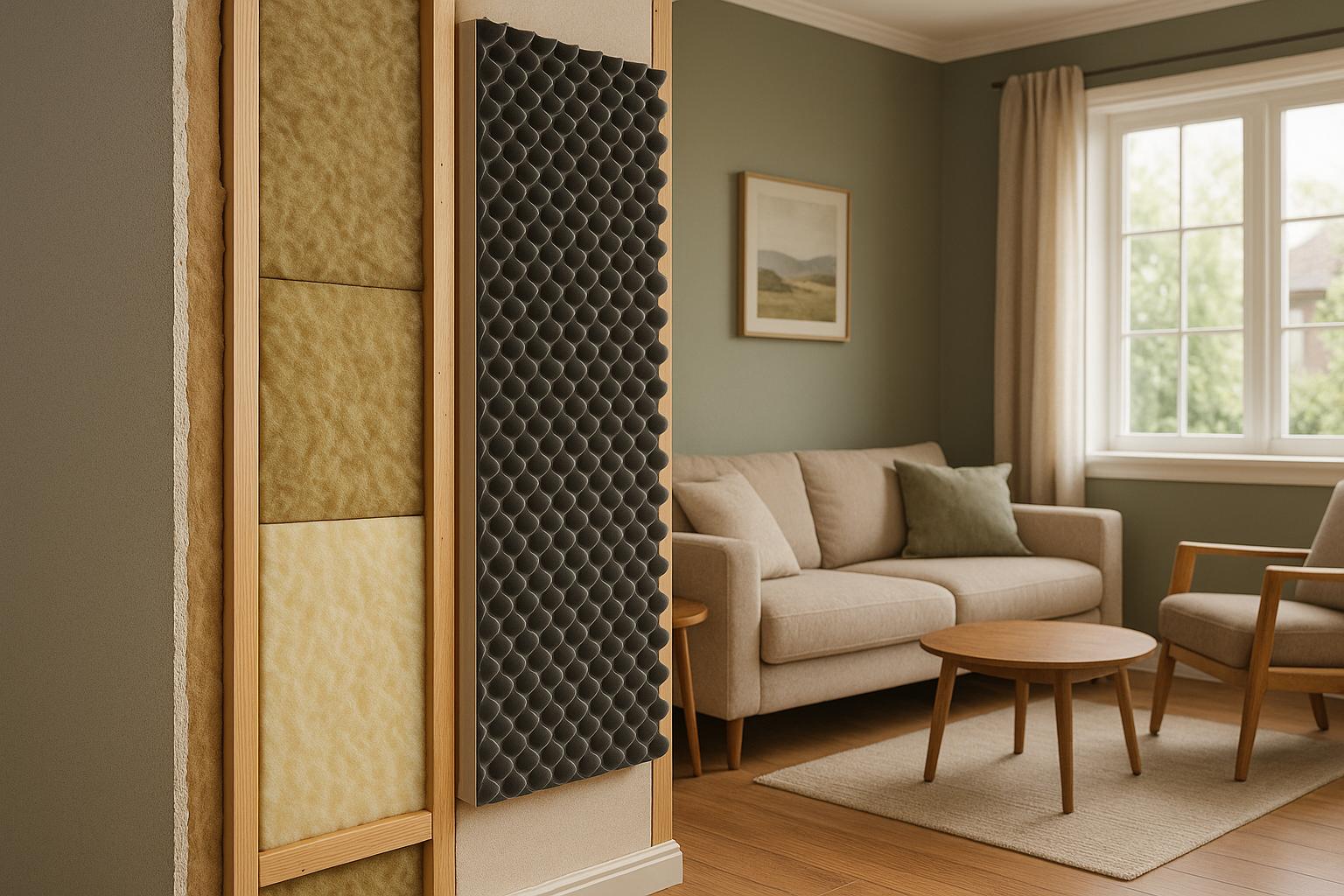
Noise can ruin the peace in your home, but acoustic insulation can help. The right materials not only reduce noise but can also lower energy bills by up to 20%. From mineral wool to acoustic foam panels, each solution offers unique benefits for walls, ceilings, and floors. Here’s a quick overview of the top options:
- Mineral Wool: High sound absorption, fire-resistant, costs $1.40–$2.50/sq ft.
- Fiberglass: Affordable, moderate soundproofing, $0.30–$1.50/sq ft.
- Spray Foam: Seals gaps, moderate soundproofing, $1.00–$4.50/sq ft.
- Blown-In Cellulose: Eco-friendly, absorbs sound well, $0.60–$4.20/sq ft.
- Cotton (Denim): Made from recycled jeans, great sound absorption, $1.00–$1.50/sq ft.
- Mass Loaded Vinyl (MLV): Blocks sound effectively, $1.11–$3.50/sq ft.
- Acoustic Foam Panels: Reduces echoes, $2–$17/sq ft.
- Felt Acoustic Panels: Stylish and functional, $2–$8/sq ft.
- Acoustic Sound Mats: Ideal for floors, $10–$30/sq ft installed.
- Acoustic Underlayment: Affordable floor noise reduction, $0.39–$1.36/sq ft.
Each material suits different needs – whether you’re soundproofing walls, dampening floor noise, or reducing echoes. For eco-conscious choices, options like cellulose or denim insulation stand out. Use the detailed guide below to find the best fit for your project.
What Insulation Is Best For Soundproofing
How to Choose Acoustic Insulation Materials
Picking the right acoustic insulation material starts with understanding the type of noise you’re dealing with and where the insulation will be installed. Some materials, like acoustic foam panels, are designed to absorb sound and reduce echoes, while others, like Mass Loaded Vinyl, block sound from traveling through walls and structures.
Understanding Noise Types and STC Ratings
The first step is identifying the type of noise. Is it airborne noise (like voices, music, or TV sounds) or impact noise (like footsteps or objects being dropped)? Each requires different solutions to address effectively.
Also, pay attention to Sound Transmission Class (STC) ratings. These ratings measure how well a material prevents sound from passing through it. The higher the STC rating, the better the soundproofing. For residential spaces, an STC rating of 50 or higher is typically sufficient to reduce noise effectively.
Location-Specific Material Selection
Different parts of your home require different insulation strategies. For instance:
- Walls: Materials like decoupling systems or layered acoustic mats are excellent for reducing noise through walls.
- Ceilings: Overhead installations need specialized solutions like acoustic ceiling tiles, resilient clips, or hat channels. Keep in mind the method of installation and the added weight of the materials.
- Floors: Floors are tricky because they must handle both airborne and impact noise. Products like underlayment mats or dense acoustic boards are often used here.
Thermal Benefits and Energy Efficiency
Some acoustic insulation materials, such as acoustic mineral wool, can also improve your home’s thermal performance. This dual-purpose benefit can help lower energy bills over time.
Sustainability Considerations
If sustainability is a priority, look for materials with a high percentage of recycled content. For example, cellulose insulation contains 75–85% recycled material, and recycled PET panels repurpose billions of plastic bottles.
Additionally, low-VOC (Volatile Organic Compound) materials are a healthier choice for indoor air quality. Certifications like LEED, GREENGUARD, and FSC can help you identify environmentally responsible options.
While some eco-friendly materials come with higher upfront costs, they often provide long-term value. For instance:
- Cork: Though pricier than synthetic options, cork has a lifespan of nearly 50 years and can eventually pay for itself.
- Sheep’s wool and denim insulation: These materials are more expensive than fiberglass but are safer to handle and better for the environment, making them a great choice for homeowners focused on sustainability.
Innovative solutions are also reshaping the market. For example, in June 2025, Hempitecture introduced FiberFill, a natural fiber blow-in insulation made from FSC-certified materials. Similarly, Gramitherm insulation captures 1.5 kg of CO₂ for every kilogram of product, actively reducing carbon emissions.
If you’re aiming for tax benefits, consider materials with low embodied carbon (the emissions produced during manufacturing and transport). Using LEED-certified materials might even qualify you for tax credits tied to sustainable building practices.
1. Mineral Wool Insulation (Rock Wool)
Mineral wool insulation, often referred to as rock wool or stone wool, is a top choice for reducing noise in homes. Made by heating basalt volcanic rock and spinning it into fibers, this dense material excels at absorbing sound and blocking noise between spaces.
Soundproofing Performance (NRC, STC Ratings)
Mineral wool stands out for its impressive soundproofing capabilities. With an STC rating between 45 and 52, it ranks among the best insulation options for noise control. This performance is largely due to its higher density compared to alternatives like fiberglass. Additionally, it has a Noise Reduction Coefficient (NRC) rating of 0.95 to 1.05, meaning it absorbs sound effectively. For comparison, adding fiberglass insulation to a standard wall with an STC of 33 only increases the rating to 39.
Cost (Approximate Pricing per Square Foot in USD)
Mineral wool insulation costs range from $1.40 to $2.10 per square foot when factoring in materials and installation. Material costs alone typically fall between $1.00 and $2.50 per square foot, while more complex installations can push the total up to $4.00 per square foot. While pricier than fiberglass, mineral wool’s superior soundproofing and higher R-values can make it a worthwhile investment. Plus, its durability – lasting up to 50 years – adds long-term value to its upfront cost.
Eco-Friendliness (Recycled Content and Sustainability)
Mineral wool offers a balance between performance and environmental considerations. For instance, ROCKWOOL stone wool insulation blends basalt volcanic rock with recycled and upcycled materials. The recycled content varies by manufacturer: Owens Corning’s Thermafiber product contains at least 70% recycled material, while Rockwool products typically include 20%-40% recycled content, depending on the production site. Although its manufacturing process is energy-intensive, the material’s recyclability provides a key environmental benefit. When compacted, mineral wool’s volume can shrink by over 90%, simplifying recycling at the end of its life cycle. While not the most eco-friendly option, it performs better environmentally than petroleum-based insulations like polystyrene. Its durability, recyclability, and energy efficiency make it a solid choice for sustainable home design.
Suitability for Installation Areas (Walls, Floors, Ceilings)
Mineral wool’s versatility makes it suitable for walls, floors, and ceilings. Available in both batt and loose-fill forms, it can meet various construction needs. In walls, mineral wool batts fit snugly between studs to minimize noise transfer between rooms. For ceilings, it helps reduce airborne noise from above and dampens impact sounds. Floors benefit from its ability to manage both airborne and impact noise effectively. Its dense structure also reduces resonance in building cavities, making it especially useful for controlling low-frequency sounds. This adaptability ensures mineral wool can handle a wide range of home insulation challenges.
2. Fiberglass Insulation
Fiberglass stands out as a popular choice for acoustic insulation in the U.S., with 71% of new single-family homes using it in 2019. Its affordability, availability, and decent soundproofing make it a go-to option for many homeowners. Let’s take a closer look at its performance, cost, environmental benefits, and where it works best.
Soundproofing Performance (NRC, STC Ratings)
Fiberglass can enhance a standard wall’s Sound Transmission Class (STC) rating from 33 to 39, while offering a Noise Reduction Coefficient (NRC) of 0.90–0.95. This means it’s excellent at absorbing sound and reducing echoes, making rooms quieter and acoustics clearer. However, because of its lower density, it’s less effective at blocking sound from traveling between rooms.
Cost (Approximate Pricing per Square Foot in USD)
Fiberglass is one of the most cost-effective insulation materials available. Material costs range from $0.30 to $1.50 per square foot, while attic installations typically cost $0.90 to $1.80 per square foot. A roll covering 40–75 square feet usually costs $20 to $90, and insulating a 1,000-square-foot area can range from $500 to $1,100. Even with a 90% price hike in Q2 2021, its long lifespan of 80–100 years makes it a worthwhile investment.
Environmental Impact (Recycled Content and Energy Savings)
Fiberglass is made with 40–60% recycled glass, and some manufacturers, like Knauf Insulation, use over 55% recycled materials. Once installed, it can save over 100 times the energy used during its production. Additionally, advancements in manufacturing have reduced its energy consumption by 8.1% per kilogram in Europe between 2015 and 2021.
Installation Versatility (Walls, Floors, Ceilings)
Fiberglass works well in walls, floors, ceilings, and even duct systems. It comes in various forms, like batts, rolls, and loose-fill, making it easy to fit between studs and joists for moderate soundproofing and insulation. While it’s effective at reducing airborne noise, it’s less capable of minimizing impact sounds compared to denser materials. Its natural flame-retardant properties and an R-value of 2.9–3.8 per inch also make it a solid choice for thermal insulation in areas with moderate climates.
3. Spray Foam Insulation
Spray foam insulation is known for creating an airtight seal, which helps eliminate sound leaks and absorb airborne noise. While it’s not the top choice for pure sound absorption, its ability to seal air makes it a valuable component in soundproofing projects.
Soundproofing Performance (NRC, STC Ratings)
Spray foam offers moderate soundproofing capabilities, with STC ratings between 37 and 39 and an NRC of about 0.75. Open-cell spray foam performs better with mid to high frequencies, achieving STC ratings between 38 and 50. On the other hand, closed-cell foam, with STC ratings of 36 to 37, is more effective at blocking low-frequency sounds but provides less absorption overall.
It can reduce noise transmission by up to 50%. However, spray foam is less effective against impact noise – like footsteps or vibrations – because it lacks the mass and density needed to counter such sounds. These performance considerations help explain its higher cost and versatility, which we’ll explore next.
Cost (Approximate Per Square Foot Pricing in USD)
Spray foam insulation is on the pricier side of insulation options. Professional installation costs range from $1.00 to $4.50 per square foot – open-cell foam typically costs $1–$2, while closed-cell foam runs between $2.50 and $4.50 per square foot. For DIY enthusiasts, kits are available for $0.75 to $2.00 per square foot. A full-house spray foam insulation project averages around $6,000, with labor accounting for 30% to 50% of the total cost.
Although the initial investment is steep, homeowners often see energy savings of 15% to 30% on heating and cooling bills, making spray foam a cost-effective choice over time.
Suitability for Installation Areas (Walls, Floors, Ceilings)
Spray foam’s versatility makes it suitable for a wide range of installation areas. Thanks to its sealing properties, it performs well in residential spaces, including concrete, cavity, and block walls. It can also be injected into existing wall cavities, making it a flexible option for retrofits. The Sprayman Team highlights its effectiveness in sealing rim joist bays, sill plates, and other hard-to-reach areas.
For optimal results, install spray foam at temperatures between 60°F and 80°F. When properly applied, it can last up to 80 years and reduce energy consumption by as much as 30% in walls and ceilings.
While spray foam excels at air sealing, it’s most effective for soundproofing when used alongside other noise-reduction methods. Experts suggest combining it with materials that add mass or decoupling techniques to achieve better overall noise reduction.
4. Blown-In Cellulose Insulation
Blown-in cellulose insulation, primarily made from recycled newspaper, forms a dense barrier that absorbs sound and reduces vibrations throughout your home.
Soundproofing Performance (NRC, STC Ratings)
Cellulose insulation is known for its reliable ability to absorb sound. Testing shows it achieves an STC rating of 44 and an NRC of 0.80, cutting sound power by about 60% compared to fiberglass batts.
"Rooms are noticeably quieter with Nu-Wool’s blown-in soundproof insulation, which deadens the transfer of sound from one room to another." – Nu-Wool
It effectively fills gaps around wiring and plumbing, blocking sound leaks and delivering solid acoustic performance – all without breaking the bank.
Cost (Approximate Per Square Foot Pricing in USD)
In addition to its soundproofing benefits, blown-in cellulose insulation is budget-friendly. Professional installation costs typically range from $0.60 to $4.20 per square foot, while material costs alone fall between $0.30 and $1.80 per square foot. For those opting to handle the job themselves, DIY options and equipment rentals can help lower expenses. Dense-pack cellulose, which offers even better soundproofing, costs around $1.60 to $4.20 per square foot. On average, attic insulation projects cost approximately $1.80 per square foot.
Eco-Friendliness (Sustainability, Recycled Content)
Cellulose insulation stands out as an environmentally conscious choice, made from 75% to 85% recycled paper fiber. This not only diverts waste from landfills but also helps reduce greenhouse gas emissions.
"One outstanding solution to both concerns is cellulose insulation, an eco-friendly material made primarily from recycled paper." – Koala Insulation
In the U.S., about 62 million newspapers are printed daily, with nearly 44 million ending up in landfills. Recycling just 10% of these discarded newspapers could save around 25 million trees each year. Unlike synthetic materials, cellulose insulation is biodegradable and supports a circular economy by keeping resources in use rather than extracting new ones.
Suitability for Installation Areas (Walls, Floors, Ceilings)
Blown-in cellulose is highly versatile, making it a great fit for attics, existing walls, and basement ceilings. It can be installed into walls through small holes, flowing around obstacles like wiring and plumbing to block sound effectively.
In attics, the material is simply blown onto the floor surface, making installation straightforward. For ceilings, cellulose not only cuts down on airborne and impact noise from above but also reduces air infiltration by up to 30%. Pairing cellulose with materials like spray foam can further enhance noise reduction.
5. Cotton (Denim) Insulation
Cotton insulation, often referred to as denim insulation, is a standout option for those seeking effective soundproofing with an eco-conscious twist. Made from recycled jeans and cotton fibers, it combines impressive acoustic performance with a commitment to sustainability.
Soundproofing Performance (NRC, STC Ratings)
When it comes to soundproofing, cotton insulation holds its own with an NRC rating of 1.15 and an STC rating of 51. These numbers place it among the top-performing materials for absorbing sound. To put this into perspective, other insulation types like spray foam (0.70 NRC), fiberglass (0.9–0.95 NRC), mineral wool (0.95+ NRC), and cellulose (0.80+ NRC) fall slightly behind in comparison.
"Denim inherently has a high Noise Absorption Coefficient, allowing it to block a wide range of noises at just a few inches thick." – Gold Star Insulation
Products like Bonded Logic‘s UltraTouch™ denim insulation take this performance even further. Using patented manufacturing techniques, UltraTouch™ achieves impressive Noise Reduction Coefficients and above-average STC ratings, making it a strong contender in the soundproofing market.
Cost (Approximate Per Square Foot Pricing in USD)
Cotton insulation typically costs between $1.00 and $1.50 per square foot, with some premium options going up to $3.00. While this is higher than the cost of fiberglass insulation (usually $0.30 to $0.90 per square foot), the added expense reflects its superior acoustic properties and environmental advantages. Moreover, cotton insulation offers an R-value of approximately R3.5 per inch, comparable to cellulose insulation.
Eco-Friendliness (Sustainability, Recycled Content)
Cotton insulation shines in the sustainability department. UltraTouch™ Denim Insulation, for instance, is made from 80% post-consumer recycled fibers, the highest recycled content among batt insulation options. Every month, UltraTouch™ diverts 19.5 million pounds of waste from landfills and recycles 300 tons of denim. Its production process is low-energy and avoids harmful chemicals, further emphasizing its eco-friendly nature.
A notable example of its use comes from Levi Strauss & Co., which incorporated Bonded Logic denim insulation into their San Francisco office remodel in 2014. This project repurposed the equivalent of 25,500 pairs of jeans, sourced through wholesale programs, nonprofit partnerships like Goodwill, and even counterfeit denim, all processed into insulation by Phoenix Fibers.
"To manufacture a sustainable product has been our mission from day one." – Sean Desmond, Senior Brand and Product Management Executive
Suitability for Installation Areas (Walls, Floors, Ceilings)
Cotton insulation is a versatile choice for walls, floors, and ceilings. It not only dampens sound but also helps regulate humidity and resists moisture, making it suitable for a variety of environments. To maximize its effectiveness, consider pairing it with acoustic sealants to close any gaps in walls or ceilings.
sbb-itb-593149b
6. Mass Loaded Vinyl (MLV)
Mass Loaded Vinyl (MLV) is a dense, flexible material that blocks sound by adding mass to surfaces. Unlike materials that absorb sound, MLV works by increasing the density of walls, floors, and ceilings, effectively reducing noise from sources like speech, music, and traffic.
Soundproofing Performance (STC Ratings)
MLV’s ability to block sound depends on its thickness and weight. For instance, a 1/8-inch thick sheet (weighing 1 lb per square foot) typically achieves an STC rating of 26, while a thicker 1/4-inch version (2 lbs per square foot) can reach an STC rating of 32.
| Weight | 125 Hz | 250 Hz | 500 Hz | 1000 Hz | 2000 Hz | 4000 Hz | STC |
|---|---|---|---|---|---|---|---|
| 0.6 lb/sq ft | 9 | 14 | 17 | 23 | 28 | 32 | 22 |
| 1 lb/sq ft | 14 | 16 | 21 | 27 | 29 | 47 | 26 |
| 2 lb/sq ft | 16 | 22 | 26 | 32 | 35 | 40 | 32 |
Products like AudioSeal® (rated 4.8/5) and Soundsulate (rated 4.2/5) highlight MLV’s effectiveness in real-world applications. For best results, MLV is often paired with other soundproofing materials and installed using proper techniques.
Cost (Approximate Per Square Foot Pricing in USD)
MLV pricing varies based on thickness and supplier, ranging from $1.11 to $3.50 per square foot. Bulk purchases can help reduce costs. For professional-grade options, Quiet Barrier® HD rolls are priced at $388.09, while individual sheets cost $137.99.
Eco-Friendliness
MLV has become a greener alternative to older lead-based soundproofing materials. For example, Quiet Barrier® is made in the US using 15% recycled materials, making it eligible for LEED certification projects. Similarly, AudioSeal® uses polyolefin elastomer (POE), which is free of plasticizers and harmful chemicals, ensuring safety even in fire situations.
Installation Areas (Walls, Floors, Ceilings)
MLV is versatile and can be installed on walls, ceilings, floors, and even around pipes and ducts to reduce noise transmission. For floor installations, it’s recommended to lay the material in a brickwork pattern and secure it with glue. To maximize effectiveness, seal seams with acoustic caulk and consider using furring channels or sound clips.
The Soundsulate 1 lb MLV has received a 4.2 out of 5-star rating from 344 Amazon customers. Many users highlight its effectiveness under laminate flooring, though some mention a temporary odor that fades over time.
7. Acoustic Foam Panels
Acoustic foam panels are lightweight, specially designed to absorb sound rather than block it. They work by reducing echo and reverberation within a room, helping to create a more acoustically controlled environment. These panels are often used alongside other soundproofing methods to achieve a quieter space.
Typically made from polyurethane foam, they come in various shapes like pyramids, wedges, or egg crates. These designs are crafted to trap and dissipate sound waves, effectively minimizing unwanted echoes and reflections.
Soundproofing Performance (NRC, STC Ratings)
When considering acoustic foam panels, it’s important to distinguish between sound absorption and soundproofing. The Noise Reduction Coefficient (NRC) measures how well a material absorbs sound within a room, while the Sound Transmission Class (STC) indicates how effectively it blocks sound from traveling between spaces. Acoustic foam panels are excellent at sound absorption, with an NRC of around 0.75, meaning they absorb 75% of the sound that hits them. However, their lightweight and porous structure makes them less effective at preventing sound from passing through walls or between rooms.
Cost (Approximate Per Square Foot Pricing in USD)
Acoustic foam panels are one of the most affordable options for acoustic treatment. Prices typically range between $2 and $17 per square foot. While polyurethane foam is cost-effective compared to higher-end acoustic materials, it does have some drawbacks. It is not fire-rated, which makes it unsuitable for commercial use, and it is more prone to damage than sturdier alternatives.
Suitability for Installation Areas (Walls, Floors, Ceilings)
These panels are primarily designed for walls and ceilings but are generally not suitable for floors. They excel in spaces where sound absorption is the main goal, such as home studios, home theaters, living rooms, and home offices. For home studios, strategic placement is key – installing panels behind speakers, on the wall opposite the speakers, and at first reflection points can make a significant difference. In home theaters, placing panels in corners can help manage bass waves and enhance sound clarity.
For wall-mounted installations, panels should ideally be at least one inch thick for effective performance. Covering 15% to 30% of the wall’s surface area can noticeably reduce echo and improve acoustics, with strategic placement being more impactful than covering an entire wall. In bedrooms, while these panels can reduce sound reflections and add a layer of privacy, they won’t block noise from neighboring rooms. Pairing them with soft furnishings like rugs, carpets, and curtains can further improve their effectiveness.
8. Felt Acoustic Panels
Felt acoustic panels are a sleek and eco-conscious way to manage sound in your space. Made from dense, porous materials, these panels absorb sound waves as they travel through, reducing echo and reverberation. Compared to traditional foam panels, felt panels bring a more polished and modern look to the table.
Typically crafted from PET (polyethylene terephthalate) fibers, these panels can be molded into a variety of shapes, designs, and colors to match your home’s style. Their dense fiber structure makes them a practical and visually appealing solution for areas where both aesthetics and sound control are priorities. Let’s dive into their performance, pricing, and more.
Soundproofing Performance (NRC, STC Ratings)
Felt acoustic panels are particularly effective at absorbing sound rather than blocking it. Their Noise Reduction Coefficient (NRC) ratings generally range from 0.40 to 0.90, placing their performance between that of carpeting and acoustic foam. For example, AlphaSorb® Designer Premium Acoustic Felt Wall Panels have an NRC rating of 0.5, meaning they absorb 50% of the sound that hits them. Higher-end models can even achieve an STC rating of 31, offering a decent level of sound isolation.
Cost (Approximate Per Square Foot Pricing in USD)
In terms of pricing, felt acoustic panels sit in the mid-range of acoustic treatment options. For instance, Slab HarmonyCARV Acoustic Felt Wall Panels are available for around $11.63 per square foot, with each 22″×22″×3/8″ panel priced at $39.00 and sold in boxes covering approximately 26.83 square feet. On the higher end, options like AlphaSorb® Fabric Wrapped Acoustic Panels and Series 200 Polyester Acoustic Panels range from $68.39 to $707.99 or $71.99 to $133.99, depending on their size and features.
Eco-Friendliness (Sustainability, Recycled Content)
Felt acoustic panels are a standout choice for those seeking sustainable soundproofing solutions. Many are made using recycled PET plastic bottles, making them an environmentally friendly option. For example, ARCHISONIC® Felt panels incorporate 88 recycled plastic bottles per square meter of material. Similarly, BAUX Acoustic Felt Recycled PET panels contain 60–65% post-consumer recycled content and are created from GRS-certified recycled PET bottles sourced from European recycling facilities. Moreover, these panels are often produced with low VOC materials, further emphasizing their eco-friendly credentials.
Suitability for Installation Areas (Walls, Ceilings)
Felt acoustic panels are primarily designed for use on walls and ceilings. Their lightweight build and stylish appearance make them a great fit for spaces like living rooms, home offices, and bedrooms – places where both sound absorption and visual appeal are essential. They’re especially effective when placed on walls opposite seating areas or behind entertainment centers to minimize sound reflections. For the best results, aim to cover 15%–25% of the wall surface at ear level and at the first reflection points.
9. Acoustic Sound Mats
Acoustic sound mats are designed to block sound transmission and reduce footstep noise, making them a great choice for multi-story homes and apartments. These mats are typically made from dense materials like rubber, vinyl, or composite fibers. Their effectiveness lies in their ability to add mass and create a barrier that stops sound vibrations from traveling through structural elements. For instance, the Acousti-Mat® Floor Underlayment uses extruded nylon filaments paired with a heat-bonded non-woven top layer, which is particularly effective at reducing impact noise.
Soundproofing Performance (NRC, STC Ratings)
Acoustic sound mats are evaluated based on their Sound Transmission Class (STC) ratings, which measure their ability to block sound. High-quality mats typically achieve STC ratings between 40 and 50 when installed correctly as part of a floor assembly.
Here’s what these ratings mean: an STC of 40 allows loud conversations to be heard but not clearly understood, while an STC of 45 ensures private conversations remain unintelligible. This makes acoustic sound mats especially effective at minimizing footstep noise, dropped objects, and other impact sounds that often travel between floors. Such performance makes them a reliable solution for reducing floor-to-floor noise.
Cost (Approximate Per Square Foot Pricing in USD)
The cost of acoustic sound mats varies depending on the type of installation. For existing rooms, professional installation costs range from $10 to $30 per square foot, while for new construction, the cost is slightly lower at $12 to $25 per square foot.
The Acousti-Mat® product line offers multiple thickness options, which impact both performance and price. For example:
- 3/8-inch mats: Available in 60-inch by 72-foot rolls, covering 360 square feet.
- 3/4-inch mats: Available in 60-inch by 40-foot rolls, covering 200 square feet.
Thicker mats generally provide better sound isolation, but they also come with a higher price per square foot.
Suitability for Installation Areas (Walls, Floors, Ceilings)
Acoustic sound mats are versatile and can be installed in various areas, though floors are the most common application. They are particularly effective in multi-story buildings like condominiums, apartments, offices, hotels, and schools. These mats excel at reducing impact noise between floors, making them ideal for spaces like bedrooms, home offices, or entertainment areas located below high-traffic zones.
For walls and ceilings, these mats can also be effective at addressing structural noise transmission. When installed in wall cavities or behind drywall, they add mass that blocks sound from traveling between rooms. On ceilings, they are especially useful in spaces like basements or between floors where impact noise is a significant concern.
To maximize their effectiveness, it’s important to focus on first reflection points and areas where sound transmission is most problematic. For home theaters, placing mats in corners can help manage low-frequency sounds that tend to accumulate there. In bedrooms and living rooms, targeting shared walls and ceilings directly below high-traffic areas upstairs can greatly reduce noise disturbances.
10. Acoustic Underlayment
Acoustic underlayment is a specialized layer placed between the subfloor and the final flooring surface – whether it’s hardwood, vinyl, tile, or carpet. This thin layer not only smooths out the subfloor but also plays a big role in cutting down noise transfer between floors.
"Soundproof floor underlayments are designed with noise reduction in mind…these sheets reduce both impact and airborne noise, so the people a floor below won’t even know you are there." – SoundAway.com
It effectively tackles two types of noise: impact sounds (like footsteps or dropped objects) and airborne noise (such as conversations or music). Many homeowners’ associations require specific acoustic ratings for flooring, and high-quality underlayments often meet these standards without the need for expensive flooring upgrades.
Soundproofing Performance (NRC, STC Ratings)
Acoustic underlayments are measured using Impact Insulation Class (IIC) and Sound Transmission Class (STC) ratings. Building codes typically require a minimum IIC of 50, but premium underlayments can deliver ratings above 70 for IIC and high 60s for STC when installed correctly. They also achieve ΔIIC ratings of over 24, showcasing their effectiveness.
For instance, WhisperMat-HW offers IIC ratings between 51 and 72, while LVT Underlay ranges from 50 to 73, depending on the construction of the floor-to-ceiling assembly.
Cost (Approximate Per Square Foot in USD)
Acoustic underlayment is a cost-effective way to soundproof floors, with prices ranging from $0.39 to $1.36 per square foot. For example:
- QuietWalk underlayment: $0.36–$0.70 per square foot [79]
- Eco Silent Sound Underlayment: Around $0.72 per square foot
- QuietBoard: Up to $1.36 per square foot
Eco-friendly options with vapor barriers typically cost around $0.65 per square foot. These prices make acoustic underlayment an attractive and affordable solution for improving floor sound insulation.
Eco-Friendliness (Sustainability, Recycled Content)
For those prioritizing environmentally friendly options, acoustic underlayment offers several sustainable choices. Recycled rubber underlayments, often made from repurposed tires, are among the most eco-conscious solutions.
Products like Lumber Liquidators’ Eco Silent Sound Underlayment and QuietBoard are crafted entirely from recycled materials. They also emit low levels of VOCs and hold GreenGuard Gold certification, ensuring they meet high environmental standards. For vinyl flooring, recycled fiber underlayments provide another green option while maintaining excellent noise reduction.
Suitability for Installation Areas (Walls, Floors, Ceilings)
Acoustic underlayment is a versatile and budget-friendly choice for reducing floor noise. It’s particularly useful in multi-story buildings like apartments and condos, where minimizing noise from upstairs activity is essential.
Different flooring materials may require specific underlayments. For example:
- Recycled rubber underlayments: Work well with most flooring types but are not ideal for vinyl.
- Recycled fiber underlayments: Recommended specifically for vinyl flooring.
In moisture-prone spaces like bathrooms or basements, it’s important to choose underlayments with moisture and mildew resistance to avoid long-term damage.
Acoustic underlayment is also great for specialized uses. In home gyms, thicker underlayments can absorb noise from dropped weights. In apartments, high-performance underlayments help meet building acoustic standards. Additionally, they can improve energy efficiency by adding an insulating layer beneath your flooring.
Acoustic Insulation Materials Comparison Chart
Selecting the best acoustic insulation for your home depends on factors like your specific needs, budget, and the area you’re insulating. Each material has unique strengths and limitations, making it more suited to certain applications over others.
To simplify your decision-making, the chart below provides a side-by-side comparison of key materials. It outlines performance ratings, approximate costs per square foot in USD, and other essential details. Performance is based on Sound Transmission Class (STC), Noise Reduction Coefficient (NRC), or Impact Insulation Class (IIC) values, while cost estimates reflect current market prices.
| Material | Performance (STC/NRC/IIC) | Cost Range | Eco-Friendliness | Ideal Application | Key Advantages | Main Drawbacks |
|---|---|---|---|---|---|---|
| Mineral Wool | High (45–52 STC) | $1.20–$2.50/sq ft | Moderate recycled content | Walls, ceilings | Fire-resistant, moisture-resistant, excellent sound absorption | Higher cost; requires protective gear during installation |
| Fiberglass | Moderate (39–43 STC) | $0.50–$1.50/sq ft | Low recycled content | Walls, attics | Affordable, lightweight, widely available | Less dense for optimal soundproofing; may cause skin irritation |
| Spray Foam Insulation | High (varies by thickness) | $1.50–$3.00/sq ft | Limited eco-friendly features | Irregular spaces, air sealing | Seals gaps completely; effective air barrier | Expensive; requires professional installation; potential chemical odors |
| Blown-In Cellulose Insulation | Good (44–68 STC) | $1.20–$2.80/sq ft | High recycled content (≈85%) | Existing walls, attics | Eco-friendly, fire-retardant, fills cavities well | Can settle over time; sensitive to moisture |
| Cotton (Denim) Insulation | Moderate (varies) | $1.10–$1.70/sq ft | Very high recycled content | Walls; DIY projects | Non-toxic, easy to handle, sustainable | More expensive than fiberglass; limited availability |
| Mass Loaded Vinyl (MLV) | High (approx. 20–30 STC)* | $1.50–$3.00/sq ft | Limited eco-friendly features | Walls, floors | Thin yet effective sound blocker | Heavy; challenging to install; not environmentally friendly |
| Acoustic Foam Panels | Low–Moderate (NRC 0.85+) | $1.00–$4.00/sq ft | Varies by product | Studios, treatment rooms | Simple to install; reduces echoes effectively | Limited sound blocking; may not fit all décor styles |
| Felt Acoustic Panels | Moderate (NRC 0.35–0.85) | $2.00–$8.00/sq ft | High (wool-based options) | Walls, decorative spaces | Visually appealing; natural material options | Expensive; limited sound blocking capabilities |
| Acoustic Sound Mats | High (dependent on thickness and installation) | $1.00–$4.00/sq ft | Moderate | Floors, walls | Versatile; effective at dampening vibrations | Complex installation; cost varies widely |
| Acoustic Underlayment | Good (IIC 50–73) | $0.39–$1.36/sq ft | High (with recycled options) | Floors only | Affordable and easy to install for floors | Primarily reduces impact noise; limited airborne noise reduction |
*Note: For Mass Loaded Vinyl, the STC range reflects its added soundproofing effectiveness and may vary depending on installation.
When deciding, consider whether the noise is airborne or impact-related, as different materials address these issues differently. Walls benefit from materials like Mass Loaded Vinyl or mineral wool for added mass and sound absorption. Ceilings often require combinations like mineral wool paired with acoustic panels for optimal results. For floors, acoustic underlayment provides excellent performance by minimizing sound transfer and impact noise.
For eco-conscious homeowners, options like blown-in cellulose, cotton insulation, or recycled acoustic underlayment balance soundproofing with environmental responsibility. While budget-friendly materials like fiberglass offer good value, those seeking maximum performance often choose mineral wool or Mass Loaded Vinyl despite their higher cost.
This chart is a practical tool to help you align your priorities – performance, cost, or environmental considerations – with the right acoustic insulation solution for your space.
Conclusion
When choosing acoustic insulation, it’s all about finding the right balance between performance, cost, and environmental impact. The comparison chart above can help you match these factors with your specific needs.
If reducing airborne noise is your goal, materials like mineral wool or Mass Loaded Vinyl with high STC ratings are excellent options. For impact noise, underlayment and sound mats are more effective. Keep in mind, proper installation – including sealing any gaps – is key to ensuring the best results.
For those looking to minimize their carbon footprint, sustainable materials are the way to go. Products with low embodied carbon can significantly reduce environmental impact. As Will Arnold, Head of Climate Action, aptly puts it:
"use less stuff!" Or, in this context, use less stuff that has lots of CO2 stuff.
Budget-friendly choices like fiberglass and underlayment provide solid noise reduction without breaking the bank. On the other hand, premium options such as felt panels and spray foam offer top-tier performance for situations where noise control is a top priority. While the upfront cost may be higher, the long-term benefits – like improved comfort and potential increases in property value – can make it a worthwhile investment.
For larger or more complex projects, consulting a professional is highly recommended. They can guide you in selecting the right materials and ensure proper installation, helping you avoid costly mistakes.
The acoustic insulation industry is growing quickly. For example, the rock wool market is expected to expand from $1.5 billion in 2024 to $2.5 billion by 2033. This growth reflects the increasing awareness of how noise pollution affects our well-being and the rising demand for quality soundproofing solutions.
Whether you’re creating a quiet home office, reducing noise between floors, or ensuring a peaceful bedroom retreat, there’s an acoustic insulation option to suit every need. Use the comparison chart for a quick overview of your choices, and refer to the detailed guides in this article for deeper insights. For the best outcome, don’t hesitate to seek professional advice tailored to your project.
FAQs
How can I choose the right acoustic insulation material for my home’s noise issues?
To tackle noise issues in your home effectively, start by identifying the type of noise you’re dealing with. For airborne noise – like conversations or music – dense materials such as mineral wool or mass-loaded vinyl are excellent choices. On the other hand, if you’re dealing with structure-borne noise, like footsteps or vibrations, materials like foam panels or mineral wool perform better.
The frequency of the noise also matters. Low-frequency sounds, such as traffic or heavy machinery, often require denser materials like foam board insulation. Meanwhile, high-frequency sounds, like chatter or the hum of appliances, are better absorbed by acoustic foam or fiberglass panels. Evaluate the specific noise challenges in your space to choose the most effective insulation material.
What are the environmental advantages of using eco-friendly acoustic insulation materials like cotton or cellulose in your home?
Using insulation materials like cotton or cellulose that are kinder to the planet brings several clear advantages. These options are typically crafted from renewable resources, such as recycled paper or natural fibers. This not only helps preserve natural resources but also cuts down on the harm caused by traditional manufacturing. Plus, since they’re biodegradable or recyclable, they contribute less to landfill waste and make disposal more environmentally responsible.
On top of that, opting for these materials can reduce the carbon emissions tied to their production. They also enhance energy efficiency in your home, cutting down on energy use and paving the way for a greener, healthier living space.
Can soundproofing materials also improve energy efficiency and help with temperature control in my home?
Many soundproofing materials not only reduce noise but also help with energy efficiency and temperature regulation. Options like mineral wool, rock wool, and fiberglass insulation excel at cutting down noise while also limiting heat transfer. This combination can help keep your home comfortable and even reduce energy costs.
That said, while some acoustic insulation materials provide thermal benefits, they might not perform as well as insulation specifically designed for temperature control. To get the best of both worlds, you might want to combine acoustic and thermal insulation for maximum soundproofing and energy efficiency.
