
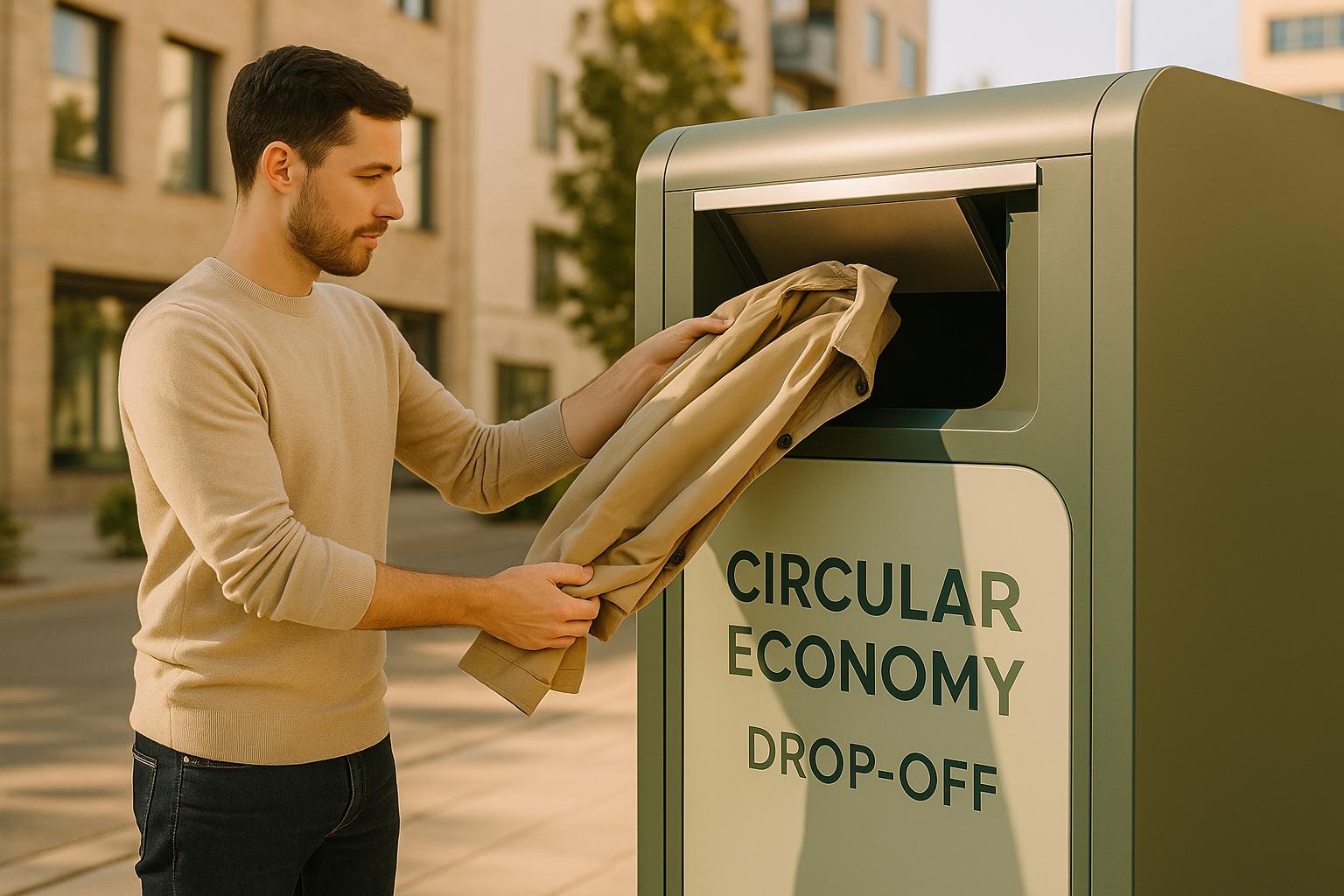
Behavioral nudges are small, subtle changes in how choices are presented, designed to guide people toward better decisions without limiting their freedom. In the context of circular economies, these nudges can encourage actions like choosing eco-friendly products, repairing instead of replacing items, and reducing waste. Unlike strict regulations, nudges work by making sustainable options easier, more appealing, and socially supported.
Key strategies include:
- Default Options: Setting sustainable choices as the default, such as green energy or repair services, can significantly shift behavior.
- Social Norm Messaging: Highlighting what others are doing, like recycling or conserving energy, motivates similar actions.
- Gamification and Incentives: Turning sustainable behavior into a rewarding experience through apps, points, or discounts.
Examples show success in areas like energy conservation, recycling, and sustainable product adoption. However, challenges like cognitive biases, limited infrastructure, and cost barriers can limit their impact. Combining nudges with systemic improvements and clear communication ensures better results. While not a standalone solution, nudges play a key role in reshaping habits toward circular practices.
Main Behavioral Nudge Strategies in Circular Economies
Choice Architecture and Default Options
Choice architecture is all about structuring options in a way that subtly guides people’s decisions, and default choices play a big role, especially in complicated scenarios. For instance, when utility companies set green energy as the default, it leads to significant reductions in carbon emissions. Similarly, organ donation rates double when people need to opt out rather than opt in. A study from the Nordic Council found that making mobile phone repair the default option boosted repair rates from 67% to 87%. Businesses can adopt this strategy by designing products with easily replaceable parts, including repair instructions as a standard, and offering multi-use products with take-back systems that reward returns. These tactics create a solid foundation for encouraging sustainable behaviors within circular economies.
Social Norm Messaging
Social norms – what people see as typical and acceptable – can strongly influence sustainable behavior. Research backs this up: a meta-analysis of 199 studies found that social norm interventions had a noticeable impact, with an average effect size of d = 0.37. A standout example is OPOWER‘s 2009 energy conservation program. Nearly 600,000 U.S. households received personalized Home Energy Report letters comparing their energy use to their neighbors’. This simple comparison led to an average 2% reduction in energy use, which is equivalent to the effect of an 11%–20% increase in electricity prices. In communities where sustainable practices, like recycling in circular economies, are visible and normalized, participation rates tend to be much higher. Companies can amplify these efforts by making sustainable actions more visible and publicly celebrating them. These strategies naturally set the stage for approaches that focus on active participation.
Gamification and Incentives
Turning sustainability into a game makes it engaging and rewarding. While 92% of consumers say they want to live sustainably, only 16% actually follow through – this is where gamification can help bridge the gap. By making sustainable choices fun and providing immediate feedback, gamification encourages consistent participation. For example, apps that track recycling habits and show users the positive environmental impact of their actions can motivate ongoing involvement. Peter Örnby, a Strategy Development and Business Transformation Expert at Ramboll Management Consulting, highlights the business potential of this approach:
"Companies can gain financially from enabling sustainable consumption, by providing circular products and services as well as helping consumers close the gap between intention and action".
The best gamification strategies combine clear progress tracking, social recognition, meaningful rewards, and educational content to emphasize the real-world impact of individual choices.
Evidence from Recent Research and Case Studies
Impact of Nudges in the Fashion Industry
The fashion industry has become a proving ground for behavioral nudges, especially among younger consumers who often voice strong environmental concerns but struggle to act on them. A detailed study of Gen Z fashion consumers in India found that verbal nudges were more effective than visual ones in encouraging sustainable fashion choices. For instance, simple verbal prompts noticeably increased Gen Z’s interest in circular fashion options like secondhand clothing and rental services. These findings suggest that similar strategies could be effective in other areas, such as recycling.
Recycling and Waste Reduction Programs
Recycling programs in the U.S. have highlighted the power of nudges. In Charleston, introducing nudges resulted in the addition of 17 more Transition® TIM recycling bins. Globally, similar initiatives have shown success. In Kristiansand, Norway, households that received letters with recycling tips increased their recycled waste share by 2 percentage points over seven months, with further advice boosting results even more.
Social norm messaging has also proven impactful. In Amsterdam, reminding residents that "most people in Amsterdam recycle" led to a 5% increase in recycling rates. Other targeted strategies have yielded impressive results too. For example, Seattle’s "Food Plus" program offered discounts on garbage bills for composting food waste, cutting food waste by 30%. Meanwhile, a mailer from Keep Indianapolis Beautiful made households 55.1% more likely to correctly dispose of bulk items.
However, nudges alone aren’t always enough. A large-scale study of over 10,000 Latvian households found that while nudges increased uptake of recycling containers, most households remained unresponsive. Researchers concluded that systemic issues must also be addressed, and a mix of internal and external motivators is essential for sustainable behavioral change. Beyond waste management, nudges have also proven useful in promoting sustainable product adoption.
Adoption of Sustainable Products
Financial incentives paired with nudges have shown strong results in encouraging the adoption of sustainable products. Germany’s Deposit Return Scheme, often considered a benchmark, achieves a 98% return rate for beverage containers. Under this program, consumers pay €0.25 (around $0.27) for single-use bottles and cans, while reusable bottles have smaller deposits of €0.08 for glass and €0.15 for plastic.
Digital nudging is another promising approach. On Alibaba’s Eleme platform, a green nudge defaulted orders to "no cutlery", offering green points as a reward. This strategy led to a staggering 648% increase in no-cutlery orders. Customers earned 16 points per order, and collecting 16,000 points allowed them to plant a tree. Women, older users, frequent customers, and wealthier individuals were particularly influenced, all while the platform’s overall performance remained steady.
Simple charges can also shift behavior. Since 2009, Hong Kong supermarkets have imposed an extra HK$1 (about $0.13) fee for plastic bags, significantly reducing their use. Doubling the fee from HK$0.5 to HK$1 further encouraged consumers to rethink their choices and raised awareness about environmental concerns.
These examples show that successful nudging in circular economies depends on understanding local contexts, designing effective incentives, and aligning efforts with broader sustainability goals. Combining approaches like financial incentives, social norms, and thoughtful choice architecture can lead to meaningful and lasting changes in behavior.
Behavioral Economics of the Circular Economy: Review of Behavioral Nudges for Sustainability
sbb-itb-593149b
Barriers and Challenges to Effective Nudging
Behavioral nudges aimed at promoting circular economies face a range of challenges that can limit their impact. These hurdles stem from cognitive biases, societal norms, and structural limitations, making it difficult to encourage widespread adoption of circular practices.
Cognitive and Social Barriers
Cognitive biases play a major role in shaping how consumers perceive circular products. Many view items made from recycled materials as less reliable or of lower quality compared to their traditional counterparts. Decades of linear consumption habits have also created a behavioral lock-in that’s tough to break . Interestingly, while about 30% of consumers express strong environmental concerns, this rarely translates into actual purchasing decisions. This disconnect, often referred to as the attitude–behavior gap, is fueled by assumptions that recycled goods are less durable .
Social influences further complicate matters. For example, Finnish consumers who used reusable take-away pizza packaging enhanced their social image, but in many other places, societal norms still favor buying new over choosing circular options. These ingrained preferences can make it harder for nudges to gain traction.
Structural and Financial Constraints
Even when consumers are motivated to make sustainable choices, systemic issues often stand in the way. In many U.S. markets, the infrastructure for circular economies is underdeveloped, making it challenging to act on behavioral nudges. Financial constraints also play a role – cheaper linear products often win out over more sustainable but costlier alternatives. Additionally, regulatory frameworks haven’t kept pace with the rise of circular practices, leaving businesses and consumers uncertain about how to proceed.
The challenges don’t stop there. Research on e-waste management highlights the lack of collaboration among stakeholders and gaps in collection and processing networks. These shortcomings can undermine even the best-designed nudges, leading to frustration and eroding consumer trust in circular systems.
Attitudes and Ethical Concerns
Ethical concerns add another layer of complexity. In the United States, where personal freedom and autonomy are highly valued, nudges that feel manipulative can trigger backlash and reduce trust in circular initiatives. Transparency is key – if consumers sense they’re being intentionally influenced, their reaction may be negative.
There’s also a disconnect between people’s stated support for environmental causes and their actual behavior, which makes achieving consistent change difficult. Critics worry that nudges often lead to temporary changes rather than addressing deeper, systemic issues. Fairness is another concern, as interventions may unintentionally disadvantage certain groups, especially those with limited access to circular economy options. Researchers emphasize that applying behavioral economics in this space requires a strong focus on transparency, fairness, and respect for individual autonomy.
Comparison of Nudge Interventions
Examining the strengths and challenges of various nudge interventions offers a clearer picture of their effectiveness and how they can be applied in practical scenarios. This understanding is crucial for businesses and policymakers aiming to encourage circular economy practices. Each type of nudge comes with its own set of advantages and limitations, which become apparent when applied to different industries and consumer behaviors.
Comparison Table of Behavioral Nudges
Research shows that choice architecture interventions have a medium effect size (Cohen’s d = 0.43 across 447 studies), indicating consistent results across different locations and demographics. Below is a summary of three key nudge strategies:
| Intervention Type | Key Strengths | Primary Limitations | US Market Examples | Cost-Effectiveness |
|---|---|---|---|---|
| Choice Architecture | Minimal consumer effort; effective across demographics; reshapes decisions more effectively than just providing information | May require infrastructure changes | Rutgers University cut paper use by 44% with default double-sided printing | High – low implementation costs |
| Social Norm Messaging | Uses natural conformity by emphasizing common behaviors; energy programs saw a 2% reduction in consumption, comparable to an 11–20% price hike | Effectiveness varies with cultural context | Utility companies use neighbor comparisons to promote energy savings | Medium – requires ongoing messaging |
| Gamification | Encourages intrinsic motivation; particularly appeals to younger audiences | Needs regular updates; long-term impact may diminish | IKEA‘s buy-back program rewards customers with points | Medium – scalable with moderate setup costs |
This comparison highlights that well-designed nudges can effectively bridge the gap between consumer intentions and sustainable actions in a circular economy. Research confirms that changing the decision-making structure has a stronger impact than relying solely on information. For instance, Patagonia’s "Worn Wear" program simplifies access to repair services and encourages customers to view their products as long-term investments.
The fashion industry provides a compelling case for the success of nudges. Responsible for 10% of global greenhouse gas emissions and losing around $400 billion annually to clothing waste, this sector benefits significantly from strategies that reshape consumer perceptions and behaviors.
However, financial and structural challenges often limit the reach of these interventions. While nudges are generally more cost-effective than traditional methods like education campaigns or financial incentives, their success frequently hinges on existing infrastructure. Many effective programs combine multiple strategies. For example, Unilever integrates social norm messaging with redesigned choice environments to encourage sustainable farming practices.
The recycling industry also illustrates varied outcomes depending on the intervention. Currently, less than 1% of used clothing is recycled into new garments in closed-loop systems. Yet, communities using default options for green services have seen notable success. Schönau, Germany, for example, achieved over 95% adoption of green electricity by making it the default option, showcasing the power of choice architecture in utility-focused circular economy initiatives.
Scalability remains a hurdle. While choice architecture interventions tend to scale well after initial implementation, they often require significant coordination upfront. Social norm messaging, on the other hand, can expand more quickly but demands ongoing investment in data and communication. Gamification, though engaging at first, may lose its impact over time as the novelty wears off.
Conclusion and Key Takeaways
Research reveals a striking disconnect: while 92% of people express a desire to live sustainably, only 16% actively follow through. This gap underscores a $4.5 trillion opportunity in circular economies by 2030. The disparity becomes even more evident when specific behaviors are analyzed, suggesting that carefully crafted nudges could play a major role in encouraging circular practices.
"Behavioral Economics in Circularity is about understanding how human decision-making impacts our ability to create and sustain a circular economy." – Sustainability Directory
The findings highlight the importance of targeting interventions at key stages of the consumer journey. The purchasing phase is particularly critical, followed by the use phase, with post-use management as a secondary focus. For instance, when The Nordic Council made repair the default option, 87% of young consumers opted to repair their phones instead of buying new ones, compared to 67% in the control group. This demonstrates the potential of such interventions to influence behavior and drive change.
For businesses, embedding sustainable practices into product design – like offering repair instructions or modular components – can significantly shift consumer behavior. Meanwhile, governments and institutions can complement these efforts by introducing incentives and campaigns that align with behavioral nudges, increasing the perceived value of eco-friendly choices and boosting the adoption of sustainable products.
The research also emphasizes the importance of internal motivators, which tend to create more enduring behavioral changes compared to external incentives. Successful circular economy strategies must address both logical factors, such as financial benefits, and emotional drivers, like ethical or moral considerations.
Currently, humanity consumes resources 50% faster than Earth can replenish, effectively living as though we have 1.8 planets at our disposal. Despite this, only 19% of research on circular economies focuses on consumption from the user’s perspective. This leaves significant opportunities for behavioral insights to bridge critical gaps in understanding and action.
For those looking to apply these insights, start by assessing your own decision-making environment. Whether you are a business owner reshaping customer experiences or an individual making everyday choices, remember that small adjustments in how options are presented can lead to meaningful change. Evidence consistently shows that altering decision-making structures is far more effective than relying solely on information or personal willpower.
Ultimately, achieving a circular economy depends on transforming consumer behavior at its core. The research is clear: sustainable choices become the norm when systems are designed to make them the easiest, most obvious, and socially supported option. This reinforces the importance of default choices and social norms, themes that have been central throughout this discussion.
FAQs
What makes behavioral nudges different from traditional regulations in supporting circular economies?
Behavioral nudges work by gently steering consumer decisions through psychological and social cues, rather than imposing strict rules or penalties. Unlike traditional regulations that depend on mandates and enforcement, nudges encourage sustainable habits in a more flexible and budget-friendly manner.
For instance, a simple nudge could involve positioning recycling bins in prominent areas or adding labels that emphasize the environmental perks of buying refurbished products. These strategies align with how people naturally make choices, making it simpler – and more attractive – for them to embrace circular economy practices without feeling forced or constrained.
What are some effective gamification techniques for promoting sustainable behavior?
Gamification has the potential to make sustainable choices more appealing and engaging. Tools like leaderboards spark friendly competition, showcasing eco-friendly actions and encouraging others to participate. Providing real-time feedback can motivate individuals to adopt green habits, like recycling or cutting down on waste, by showing immediate results of their efforts. Additionally, social challenges bring communities together, either through collaboration or lighthearted competition, creating a sense of shared purpose. These methods leverage our innate drive for accomplishment and connection, turning sustainability into a rewarding experience.
What obstacles do behavioral nudges face in encouraging circular economy practices, and how can they be addressed?
Behavioral nudges often run into hurdles such as limited awareness about circular economy ideas, reluctance to change, and systemic barriers like outdated policies or a lack of proper infrastructure. These challenges can slow down the adoption of sustainable habits by both consumers and businesses.
To tackle these problems, nudges need to be straightforward, easy to relate to, and designed to promote long-term thinking. Public education campaigns and incentives can play a key role in boosting awareness and encouraging action. On a broader level, updating regulations and investing in modern technologies are critical steps to build a supportive environment where circular economy practices can flourish.
