
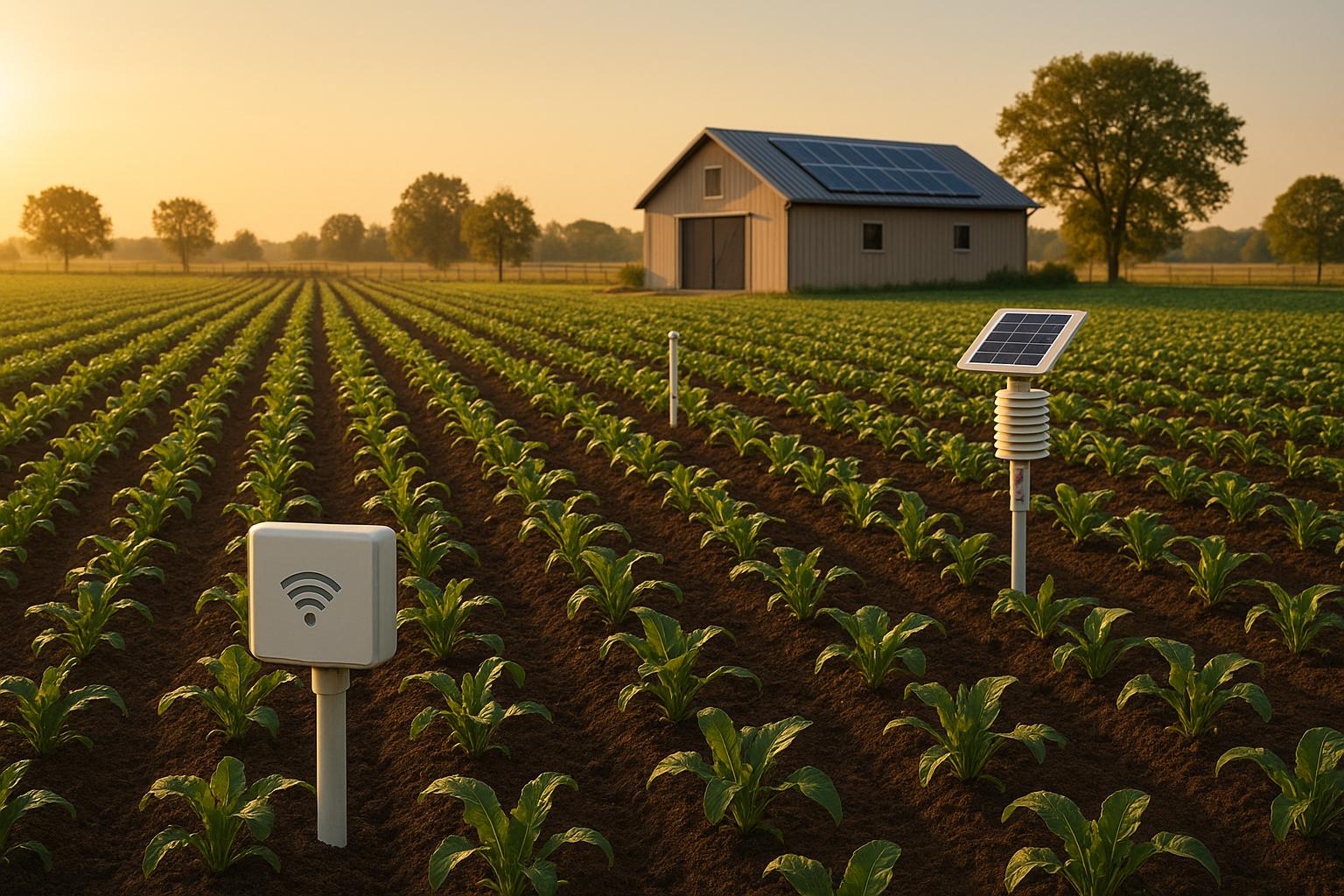
Farms are becoming more connected, with IoT devices like soil sensors, GPS-enabled tractors, and automated irrigation systems driving efficiency. But these advancements come with risks. Cyberattacks targeting agricultural systems have already caused significant disruptions, from data theft to operational shutdowns. To protect your farm, here are 10 critical practices:
- Track IoT Devices: Maintain an updated inventory of all devices, including firmware details, to quickly address vulnerabilities.
- Separate Networks: Segment IoT devices into isolated networks and secure them with firewalls.
- Control Access: Use strong passwords, multi-factor authentication, and limit permissions based on roles.
- Update Software: Regularly update firmware and software to patch security gaps.
- Encrypt Data: Protect sensitive data with encryption and secure communication protocols.
- Protect Hardware: Physically secure IoT devices to prevent tampering or theft.
- Monitor Activity: Use tools to detect unusual network behavior and set up alerts for potential threats.
- Train Employees: Educate workers on cybersecurity best practices and conduct response drills.
- Review Permissions: Audit and limit data access to reduce vulnerabilities.
- Plan for Incidents: Develop a response plan and back up data regularly to recover quickly after breaches.
These steps safeguard your farm’s systems, ensuring smooth operations and protecting sensitive data from cyber threats.
Hacking the Harvest: Securing IoT in Agriculture
1. Track and Manage Your IoT Devices
Keeping tabs on every connected device in your network is key to protecting your farm. Unmonitored devices can create weak spots that cybercriminals are all too eager to exploit.
Today’s farms often rely on dozens – sometimes hundreds – of connected devices spread out over large areas. Think soil moisture sensors buried in fields, GPS systems on tractors, weather stations on barn roofs, and automated feeders in livestock areas. Each of these serves as a potential entry point for hackers. That’s why having a clear strategy for tracking and managing these devices is essential.
1.1 Keep an Updated Device List
A well-maintained inventory of your IoT devices is more than just a list – it’s a critical tool for managing security risks. This inventory should include detailed information about each device, such as its type, location, IP address, firmware version, last update date, and network connection. Don’t forget to record manufacturer details and warranty information, as these can be vital when updates or repairs are needed.
Start by conducting a physical walkthrough of your farm. Check every barn, field, and piece of equipment for connected devices. You might be surprised by what you find – like a forgotten connectivity module in an old grain bin monitoring system or a cellular modem in an irrigation controller that’s been running on autopilot for years.
Don’t overlook mobile devices that access your IoT systems, either. These often store login credentials and can directly interact with your network.
To keep things organized, use a simple spreadsheet or database that’s easy for your team to update. Assign someone to review and refresh this inventory every month to ensure it stays accurate. A well-maintained list not only helps you stay secure but also allows for quicker responses when issues arise.
1.2 Enable Quick Updates and Response
An up-to-date device inventory is your first line of defense when it comes to managing vulnerabilities. When manufacturers release security patches or when new risks are identified, your inventory makes it easy to pinpoint which devices need attention.
Resources like the Common Vulnerabilities and Exposures (CVE) system and the National Vulnerability Database (NVD) regularly publish details on newly discovered IoT security flaws. By cross-referencing these databases with your inventory, you can quickly determine which devices might be affected and prioritize updates.
Set up automatic alerts from device manufacturers so you’re always in the loop about security updates. Keeping the manufacturer’s contact details in your inventory ensures you can get timely information about potential threats.
If a security breach occurs, your inventory becomes an essential tool for incident response. It helps you identify compromised devices, map out their network connections, and isolate affected systems. This kind of rapid response can be the difference between a minor hiccup and a major disruption to your operations.
To strengthen your response capabilities, consider forming response teams that include both IT and agricultural specialists. Cybersecurity experts recommend this approach to ensure all aspects of your farm’s operations are protected. Your inventory gives these teams a clear view of how devices interact with your systems, making their job much easier.
Finally, regular inventory reviews can help you spot outdated devices that no longer receive security updates. These older systems are often the weakest links in your network. Knowing their specifications allows you to plan for upgrades or additional safeguards to keep your farm secure.
2. Separate Networks and Install Firewalls
Keeping your IoT devices on isolated networks is a smart way to contain potential breaches and safeguard critical systems.
This is especially important for farms, where a wide variety of connected devices often operate across large areas. By segmenting these devices into dedicated network groups, you can limit the risk of malware spreading or sensitive data being accessed if one device is compromised.
The challenge? A USDA report highlights that 60% of US farmland lacks reliable internet connectivity. This often forces farmers to rely on makeshift network setups, prioritizing functionality over security. However, as one expert emphasizes:
"Segment the IoT network from other networks to minimize the potential impact of a security breach."
Here’s how separating your IoT networks can strengthen your farm’s cybersecurity.
2.1 Keep IoT Networks Separate
Network segmentation involves creating isolated pathways so that only specific devices communicate with one another. A common approach is using VLANs (Virtual Local Area Networks) to group devices by function. For example:
- One VLAN for office and administrative systems
- Another for field sensors and irrigation controls
- A third for livestock monitoring devices
In a smart irrigation system, access controls can further enhance security. For instance, only the farm manager’s office computer might have the ability to issue commands or change system settings, while field workers could be restricted to viewing data on their mobile devices. This setup ensures that even if a field device is compromised, attackers can’t manipulate irrigation schedules or harm crops.
Grouping devices that frequently interact into their own network segments also reduces unnecessary exposure. Once your networks are segmented, it’s time to secure each segment with firewalls.
2.2 Install Strong Firewalls
Firewalls serve as gatekeepers, monitoring traffic and blocking unauthorized access to your network segments. Advanced firewalls from leading providers now offer features like policy enforcement, machine learning-based threat detection, and continuous monitoring to keep IoT networks secure.
To set up an effective firewall, follow these steps:
- Update firmware regularly
- Change default passwords to strong, unique ones
- Create unique administrator accounts
- Disable unused protocols
- Configure strict Access Control Lists (ACLs) with "deny all" rules
- Conduct penetration tests and vulnerability scans to ensure proper configuration
Alex Kutsko, Co-Founder of SoftTeco, warns:
"Malevolent actors can steal personal information, inflict physical harm, or launch attacks such as distributed denial-of-service (DDoS)."
To maintain strong defenses, monitor firewall logs, perform regular vulnerability scans, and review rules periodically. Firewalls are most effective when used as part of a broader security strategy. Pairing them with intrusion detection and prevention systems (IDS/IPS) adds an extra layer of protection for your IoT networks.
3. Control Who Can Access Your Systems
Keeping your farm IoT systems secure starts with controlling who can access them. Many IoT devices come with default credentials that are easy for attackers to exploit. By using strong authentication methods and setting clear access policies, you can significantly lower the risk of unauthorized access. Here’s how to tighten control over your farm’s IoT systems.
3.1 Use Strong Passwords
Default usernames and passwords are a common weak spot in IoT devices. As soon as you set up a new device, change these credentials to something more secure.
Creating strong passwords means following a few essential rules:
| Guideline | Description |
|---|---|
| Length | Choose passwords with at least 12 characters. |
| Complexity | Include uppercase and lowercase letters, numbers, and symbols. |
| Uniqueness | Avoid reusing passwords across devices or accounts. |
| Avoid Personal Info | Steer clear of using names, birthdays, or other easily guessed details. |
| Password Manager | Use a tool to generate and securely store unique passwords. |
| Regular Updates | Update passwords periodically, especially for critical systems. |
A password manager can simplify the process of creating and managing strong, unique passwords for every device. Make it a standard practice to replace default passwords during setup and update them regularly to keep your systems secure.
3.2 Add Multi-Factor Authentication
Even with strong passwords, adding another layer of security helps keep your systems safe. Multi-factor authentication (MFA) requires users to verify their identity in multiple ways, such as entering a password and providing a one-time code sent to their phone. Despite its effectiveness, only 57% of businesses currently use MFA on their devices.
For farm IoT systems, MFA options might include:
- Passwords combined with one-time passcodes.
- Biometrics, like fingerprint scanning.
- Hardware security keys for critical systems.
For example, accessing your irrigation system could require both your password and a verification code sent to your phone. MFA is especially important for devices handling essential tasks like climate control, irrigation, or livestock monitoring. Make sure to implement MFA wherever possible and train your team on why it’s a crucial step in securing your farm’s IoT systems.
3.3 Give Minimum Required Access
Limiting access to only what’s necessary is another effective way to safeguard your systems. This idea, known as the principle of least privilege (PoLP), ensures users and devices have just enough access to do their jobs. By narrowing access, you can reduce your farm’s exposure to potential attacks.
"By restraining user privileges, businesses can reduce the risk of accidental or intentional misuse of sensitive information, decrease the impact of security breaches, and strengthen overall system security." – Fortinet
Role-Based Access Control (RBAC) is a practical way to apply PoLP. For instance, field workers might only need to view weather data and soil conditions, while managers need full access to irrigation controls and equipment settings. This approach not only limits risks but also helps prevent accidental errors.
The importance of limiting access becomes clear when you consider that IoT malware attacks surged by 400% in 2023 compared to the previous year, with nearly half of these attacks targeting consumer-grade devices found in enterprise environments. Farms often unknowingly increase their vulnerability by connecting personal devices without proper access controls.
To stay secure, regularly review user permissions and monitor access logs to ensure everyone has the appropriate level of access. Using an Identity and Access Management (IAM) system can streamline this process, making it easier to manage privileges across your farm’s connected devices.
4. Keep Software and Firmware Updated
After establishing strong device management and access controls, the next step to secure your farm’s IoT systems is ensuring all software and firmware are up to date. Keeping devices current is a key defense against potential vulnerabilities.
Outdated firmware is a major risk. A surprising 40% of users never update their devices, leaving them exposed to security threats. Regular updates are crucial – they address security gaps, as outdated systems are often targeted due to missing secure update mechanisms or failed firmware updates.
Beyond patching vulnerabilities, updates improve encryption and authentication protocols, add new security features to combat emerging threats, fix bugs, and enhance device performance. They also ensure compatibility with the latest communication standards, helping extend the lifespan of your IoT systems.
4.1 Turn On Automatic Updates
Automatic updates make life easier by ensuring your devices stay secure without needing constant attention. This feature eliminates the risk of forgetting to update and reduces human error.
To enable this, look for options like "Automatic Updates" or "Firmware Updates" in your device settings. Automatic updates are often scheduled during off-peak times to minimize disruptions. However, always prioritize network security during updates – avoid using public or untrusted networks and ensure updates come directly from the vendor’s secure, HTTPS-protected site.
It’s also smart to periodically check that updates are being applied properly. Review each device’s firmware version and the date of its last update to confirm everything is running as it should.
4.2 Watch for Vendor Updates
Not all IoT devices support automatic updates, so manual monitoring is essential for those systems. Staying alert to vendor updates ensures your devices remain secure.
Maintain a record of each device’s details – manufacturer, model, and firmware version. Regularly check for updates on the vendor’s website or through their communications. Many manufacturers now provide customer portals where you can find firmware updates tailored to your specific equipment.
Set a schedule for manual checks, such as monthly or quarterly, depending on how critical the device is. Systems managing vital operations like irrigation, climate control, or livestock monitoring may require more frequent checks.
When purchasing new equipment, prioritize vendors known for consistent and reliable firmware updates. A manufacturer with a solid track record of delivering security patches and clear update instructions will save you time and enhance the long-term security of your IoT systems.
5. Encrypt Data and Secure Communications
Once your devices are updated, the next step is safeguarding your farm’s sensitive data by encrypting communications. Encryption transforms readable data into a coded format, making it useless to anyone who intercepts it.
Farm IoT systems process critical information, such as GPS data from equipment, soil moisture levels, and livestock health metrics. If this data is sent in plain text, it becomes an easy target for hackers. In fact, nearly half of businesses reported IoT-related breaches in 2017, with smaller companies losing up to 13.4% of their revenue and larger enterprises facing losses in the hundreds of millions. For farms, a breach could expose everything from operational schedules to financial records. Encryption ensures data remains secure while it’s in transit, complementing other security measures.
5.1 Encrypt All Data
Encryption methods typically fall into two categories: symmetric encryption (like AES, which uses one key for both encryption and decryption) and asymmetric encryption (like RSA, which uses a key pair).
The Advanced Encryption Standard (AES) is widely recognized as the go-to option for farm IoT systems. It’s so reliable that the National Security Agency (NSA) uses it to protect sensitive government data and has stated that AES will remain secure for decades to come. AES is also efficient, making it perfect for IoT devices with limited resources.
For instance, a soil sensor transmitting "SP1 62.5 43.8%" can be encrypted into something like "mLgLoX5qKbn5gceFW6Lvxg==" using AES and a secret key such as "ILoveSouthDakota".
To further secure communications, implement AES alongside SSL/TLS protocols. These protocols encrypt data sent between devices and servers, preventing eavesdropping and tampering. As Cloudflare explains, "HTTPS is HTTP with TLS encryption. HTTPS uses TLS (SSL) to encrypt normal HTTP requests and responses, making it safer and more secure".
When setting up encryption, validate server certificates on your devices to block man-in-the-middle attacks. Use certificate pinning to ensure only trusted servers are accessed, and store private keys securely using tools like secure key storage or trusted execution environments. Additionally, encrypt GPS data from mobile equipment like tractors and combines to stop hackers from tracking locations or interfering with navigation systems. Don’t forget to rotate encryption keys regularly to minimize damage in case of a breach.
5.2 Turn Off Unused Services
Every active service on a device is a potential vulnerability. Disabling unnecessary features reduces these risks and strengthens your overall security.
Start by auditing each device’s active services. Many IoT devices come with "always-on" remote access features, which can be exploited if not needed. If a sensor or controller doesn’t require remote monitoring, turn off those features entirely.
Look for other potential weak points, such as unused network ports, unneeded wireless protocols (e.g., Bluetooth if only Wi-Fi is used), remote management interfaces, and default admin accounts. For network hardware like routers, disabling features that could serve as unauthorized entry points is also crucial.
For voice-activated devices, consider turning off purchase capabilities or securing them with strong passwords. By eliminating unnecessary services, you significantly reduce the chances of an attack.
sbb-itb-593149b
6. Protect Physical Hardware
While digital security often gets the spotlight, safeguarding physical hardware is just as important. Farm IoT devices, often spread across vast areas, are particularly susceptible to theft, vandalism, or tampering. A compromised device isn’t just a loss in itself – it can serve as a gateway for attackers, potentially disrupting your entire operation.
Failure to secure physical equipment can lead to stolen or manipulated data, financial setbacks, and interruptions in critical farming processes. For instance, tampering with irrigation systems could lower crop yields or impact produce quality.
6.1 Lock Down Hardware Access
The first step in protecting your devices is ensuring only authorized personnel can access them. Stationary equipment like weather stations, irrigation controllers, and gateway devices are especially vulnerable and need robust protection.
- Use tamper-resistant enclosures: Secure your sensors and control units in weatherproof, locked enclosures made of sturdy materials like steel or reinforced plastic. These enclosures should include high-quality locks to deter tampering.
- Install physical barriers: Fencing or other barriers can create a controlled perimeter around larger equipment, making unauthorized access more challenging while still allowing maintenance when needed.
- Add tamper detection sensors: Equip critical devices with tamper sensors that send instant alerts if interference is detected. These sensors are particularly useful for smart locks, cameras, or other security devices.
- Strategic placement: Mount devices at heights that deter casual interference but still allow for maintenance. Use security screws or bolts requiring special tools for removal, and avoid placing devices near public roads or other easily accessible areas.
6.2 Install Monitoring Systems
Monitoring systems serve as both a deterrent and a detection tool, offering continuous protection for your IoT setup. Security cameras and other monitoring tools not only discourage potential vandals but also help document incidents if they occur.
- Deploy security cameras: Place cameras at critical locations, such as access points and equipment clusters, and integrate them with your IoT network for centralized monitoring. Cover blind spots where tampering might otherwise go unnoticed.
- Use motion sensors: Motion sensors can trigger alerts during off-hours, flagging unauthorized access before damage is done. This is especially important given the rise in IoT-related threats. In the first half of 2023 alone, IoT malware attacks jumped by 37%, and nearly 90% of users reported that their devices had been compromised.
- Set up real-time alerts: Modern systems can notify you instantly of suspicious activity, such as unexpected movement, tamper sensor activations, or devices going offline. This rapid response capability can be the difference between a minor incident and a major disruption.
With IoT devices expected to reach 55.7 billion by 2025, generating 80 zettabytes of data, the attack surface is growing rapidly. Alarmingly, 96% of business owners report challenges in securing their IoT devices, emphasizing the need for robust physical security measures.
Combining locked enclosures, physical barriers, and advanced monitoring systems creates a layered defense against physical threats. Integrate these measures with your digital security protocols for a comprehensive approach to protecting your IoT infrastructure.
7. Monitor Activity and Detect Threats
Keeping a constant eye on your farm’s IoT network is like having an early warning system for cyber threats. Without proper monitoring, unusual activity can slip by unnoticed, giving attackers the chance to cause harm. Cybersecurity risks in agriculture are on the rise, and as security expert Jonathan Braley explains, the "Food and agriculture industry is hypothetically at risk due to increasing cyberattacks on IoT, OT and IIOT".
By 2025, IoT in agriculture could drive an annual economic impact of $50 to $200 billion. At the same time, the global smart agriculture market is expected to grow from around $15 billion in 2022 to $33 billion by 2027. This rapid growth makes it more important than ever to prioritize security.
7.1 Watch Network Activity
Network monitoring tools are crucial for keeping tabs on how devices behave and communicate. They help identify unusual patterns that could signal a problem. For example, IoT-based systems in agriculture use connected sensors to gather real-time data about environmental and crop conditions, such as soil moisture, temperature, and humidity. These tools learn what "normal" activity looks like, creating a baseline to compare against.
Your monitoring system should keep an eye out for things like unauthorized logins, strange connection attempts, unexpected spikes in data usage, or communication with unknown servers. Imagine a soil moisture sensor suddenly transmitting large amounts of data in the middle of the night – this kind of behavior should raise a red flag and be investigated immediately.
Monitoring tools can also detect when devices go offline without explanation, connect in unusual ways, or start communicating with suspicious external servers. These signs often indicate the early stages of a cyberattack. With over 30 billion IoT devices expected to be online, automated monitoring is no longer optional – it’s essential. A good monitoring system will present information like device status, network traffic, and communication logs in a clear, user-friendly dashboard.
Once real-time monitoring is in place, the next step is setting up automated alerts to ensure a rapid response to potential threats.
7.2 Set Up Automatic Alerts
Automated alerts turn passive monitoring into active defense. These alerts notify teams about potential threats in real time, cutting down the delay between identifying an issue and taking action. This speed can be the difference between a manageable situation and a major disruption.
Organizations using AI and automation can detect and contain data breaches nearly 100 days faster than those that don’t. In fact, leveraging these technologies reduced average breach costs by $2.2 million in 2024. However, alert systems need to be carefully configured. On average, security teams face 4,484 alerts daily, and 67% of these are ignored due to false positives or alert fatigue. This highlights the importance of fine-tuning alert settings.
Set up severity-based alerts to ensure that critical issues get immediate attention. For instance, a sensor going offline might trigger a low-priority alert, while unauthorized access to your main agricultural management system would demand a high-priority response. Automated tools can also group alerts into actionable incidents, making it easier to address real threats.
To strengthen your defenses, consider integrating your alert system with other security tools like firewalls and intrusion detection systems. A real-world example of how effective this can be comes from May 2024, when Darktrace‘s AI cybersecurity system stopped Fog ransomware attacks. The system autonomously isolated affected devices and blocked suspicious connections, preventing the attacks from escalating.
Darktrace’s AI cybersecurity stated, "Real-time threat detection minimizes the window of exposure by identifying and containing threats before they escalate."
Automated alerts also allow you to act proactively, addressing potential threats before they turn into major incidents. Make sure your alerts reach multiple team members through various channels – such as email, text, or app notifications – so critical warnings are never missed.
The goal is to strike the right balance: covering all bases without overwhelming your team with unnecessary alerts. By focusing on genuine threats and reducing noise, you can ensure that important warnings get the attention they deserve.
8. Train Employees on Security
After implementing strong device monitoring and threat detection, the next step is equipping your employees with the knowledge to protect against cyber threats. Your farm’s cybersecurity is only as strong as its weakest link. Even with advanced IoT security measures, one poorly chosen password or a click on a malicious email can jeopardize your entire operation.
The agricultural sector faces unique challenges in this area. Many farm workers may lack experience with digital systems, yet they’re increasingly required to use IoT devices daily. This gap in knowledge can create vulnerabilities that cybercriminals exploit.
Take AgroGloryTime, a Ukrainian agricultural holding, as an example. CEO Darya Novhorodkina highlights their proactive stance:
"In the face of increasing cyber threats, we have prioritized the security of our digital infrastructure to safeguard our data and ensure the seamless functioning of our supply chain."
AgroGloryTime has implemented a mix of regular security assessments, employee training, and advanced cybersecurity tools to protect their operations.
8.1 Provide Regular Training
Effective cybersecurity training isn’t a one-and-done event – it requires ongoing effort. Regularly updating and reviewing training programs can make all the difference.
Ellie Thompson, Head of Customer Success, advises tailoring training to your team’s needs:
"As a baseline there should be quarterly training for all employees. However, companies who have a workforce less confident in cyber security, monthly is best to ensure there’s an increase in understanding and actioning best practises."
For most employees, quarterly training is sufficient, but those in higher-risk roles may benefit from monthly sessions. These sessions should focus on recognizing threats like phishing, ransomware, and malware, as well as best practices for data security and device management.
To make the training stick, use engaging methods like videos, quizzes, gamification, and phishing simulations. Research shows that microlearning – short, focused modules – can boost retention rates by at least 80%. For instance, global agricultural company Tiryaki trained 1,100 employees worldwide and achieved an 89% success rate in identifying phishing attempts within a year.
Thompson underscores the importance of hands-on learning:
"To see the most significant change in behaviour which protects companies from cyber threats is to use the simulations as a training / educational tool. So employees can put into practise the key skills their awareness training teaches them. Remedial training is targeted, specific and much more powerful to insight change in behaviour."
Tailor your training content to match each employee’s role. A farm manager handling financial systems will need different guidance than a field worker operating soil sensors. Higher-risk users should receive more frequent, detailed training, while others may require less frequent sessions.
Theo Zafirakos, CISO at Terranova Security, recommends blending different approaches:
"Many organizations employing a comprehensive cyber security awareness program combine quarterly awareness training activities with monthly touch points featuring short activities, games, and cyber challenges to effectively educate their users about the evolving landscape of cyber security risks."
With over 60% of small businesses unable to recover after a major breach, investing in training is not optional – it’s essential for your farm’s survival.
8.2 Practice Response Drills
Training alone isn’t enough. Practical drills are necessary to ensure employees can act swiftly and effectively in the face of a cyber incident. Without practice, even the most well-trained team can falter under pressure.
Response drills help identify weaknesses in your plans and improve team coordination. They reveal gaps in communication, unclear responsibilities, and procedural bottlenecks that could slow your reaction during real threats.
Every team member should know their role during a security incident – from spotting unusual activity to taking the right steps to mitigate the breach. Simulate realistic scenarios tailored to your farm’s IoT systems. For example, drills might include a compromised irrigation controller, unusual behavior from livestock sensors, or unauthorized access to farm management software. The combination of cyber and physical components in Ag-IoT systems demands a coordinated and specialized response.
Establish secure and reliable communication channels for use during incidents. Keep backup systems ready, as your primary communication tools might be compromised. Pre-prepared notification templates can also speed up information sharing when time is critical.
Using an Incident Command System (ICS) can streamline communication and decision-making during emergencies. Clearly define roles and responsibilities within this system to avoid confusion and maintain order.
During drills, practice documenting every detail of the incident – time, date, system status, and recent operations. This habit ensures accurate records, which are vital for resolving issues and learning from them. After each drill, hold debriefing sessions to pinpoint areas for improvement. Update your security protocols, software, and hardware based on what you learn.
Incident response training should be treated as a core skill, not an afterthought. The goal is to build muscle memory so your team can act decisively when every second counts. This preparation could be the difference between a minor disruption and a catastrophic breach.
9. Review Permissions and Limit Data
Strengthening your farm’s IoT security means not just training your team but also carefully managing permissions and reducing unnecessary data storage. These steps can significantly lower risks and simplify system management.
By limiting what data is collected and who can access it, you reduce vulnerabilities in your IoT ecosystem. Many farms inadvertently create security gaps by allowing excessive permissions or holding onto unneeded data. Adopting clear access policies and data minimization strategies can make a big difference.
9.1 Check Permissions Regularly
Over time, IoT devices and applications can accumulate outdated or excessive permissions, creating security risks. Regular security audits are essential for identifying and addressing these vulnerabilities. These audits should include penetration testing, vulnerability assessments, and compliance checks to ensure permissions are kept to a minimum.
Follow the least privilege principle by granting team members only the access they need for their specific roles. For instance, a seasonal worker managing irrigation sensors doesn’t need access to financial data, and a farm manager may only need read-only access to equipment diagnostics instead of full control over system settings.
To streamline this process, consider using tools like AWS IoT Device Defender, which helps monitor configurations, track policies, and manage expiring certificates. Automating these audits and setting up alerts for expiring certificates can prevent unexpected disruptions.
Schedule regular permission reviews – monthly for most farms, or even weekly in cases of high staff turnover or sensitive data handling. This ensures that access for former employees is revoked, temporary workers aren’t granted permanent permissions, and system accounts don’t accumulate unnecessary privileges.
Document every permission change with a clear justification. When someone requests additional access, require them to specify exactly what they need and why, rather than granting broad permissions. This practice supports future audits and ensures accountability.
Implementing role-based access control can make managing permissions easier by tying access to job functions instead of individuals. This approach simplifies access adjustments when employees change roles or leave the organization.
Lastly, carefully review data and terms of use agreements with technology providers. Understand how your data will be used and shared before agreeing to any terms.
9.2 Store Only Needed Data
Storing unnecessary data not only increases security risks but also strains resources, especially in rural areas with limited internet connectivity. Reducing data storage and traffic can improve reliability and lower costs.
Develop and enforce data retention policies based on your farm’s operational needs, regulatory requirements, and the value of the data. For example, while long-term soil moisture readings might be useful for trend analysis, they may not be necessary for day-to-day operations.
Automate data archiving and deletion processes to move older data to cost-effective storage or delete it when it’s no longer needed. This reduces risks and storage expenses while keeping you compliant with retention policies.
For sensitive information, use masking or anonymization techniques when storing or sharing data. Additionally, applying data compression can reduce the size of transmitted data, saving bandwidth and improving efficiency.
Regularly review your data collection practices to identify and eliminate unnecessary data. Many IoT devices collect excessive information by default – like constant GPS tracking on stationary equipment – when less frequent updates would suffice.
Before signing contracts with technology providers, clarify the purpose of data collection and ensure you understand their retention and sharing policies. Ask about opt-out options and set clear boundaries for how your data can be used. This proactive approach ensures better control over your farm’s information.
10. Plan for Security Incidents
Even the most secure farm IoT systems can face breaches. Having a clear incident response plan in place can limit damage and help restore operations quickly. By 2025, cybercrime is expected to cost the world $10.5 trillion annually, and in 2024, the average data breach cost reached $4.88 million – a 10% rise from the previous year. For farms, a breach could mean losing control of critical systems like irrigation or livestock monitoring, or even compromising sensitive data. Preparing in advance is key to bouncing back efficiently.
With strong device monitoring and employee training as a foundation, a well-thought-out incident response plan ensures that your farm can recover quickly when faced with a security issue. This plan also strengthens your overall IoT security strategy.
10.1 Create a Response Plan
Start by documenting an incident response plan to guide your team during a crisis. Clear roles and procedures save valuable time. Since stolen credentials account for 86% of data breaches, your plan should address these common attack scenarios.
Form a cross-functional response team with members from various areas of expertise. Key roles might include a technical expert familiar with your IoT systems, someone to manage communication with vendors and authorities, and a decision-maker authorized to take emergency actions, such as shutting down compromised equipment.
Assign specific responsibilities to each team member. For example, the technical lead should handle isolating systems and conducting forensic analysis, while the communications coordinator manages notifications and external reporting. The farm owner or manager can act as the incident commander, overseeing decisions about operations and resources.
| Role | Responsibility |
|---|---|
| Incident Commander | Leads decision-making and coordinates the overall response |
| Technical Lead | Isolates affected systems, performs forensic analysis, and applies fixes |
| Communications Coordinator | Handles notifications, vendor communication, and external reporting |
| Operations Manager | Evaluates the impact on farm activities, manages staff, and implements alternatives |
Develop playbooks for common threats like ransomware, data theft, or compromised devices. These step-by-step guides should cover everything from identifying the issue to full recovery. For instance, if irrigation sensors are hacked, your playbook might include switching to manual controls, isolating the affected network, and contacting your IoT vendor’s security team.
Keep emergency contact information for team members, vendors, cyber insurance providers, and authorities both digitally and in print. This ensures access even if electronic systems are compromised.
Regular simulations and tabletop exercises – run at least twice a year – can help identify weak points in your plan and ensure everyone knows their role during an incident. Establish clear communication protocols detailing who to notify, what information to share, and how to document the event. Strong communication can prevent a manageable problem from spiraling into a crisis.
10.2 Back Up Data Regularly
Planning alone isn’t enough – regular data backups are essential for recovery. Backups act as a safety net when incidents like ransomware attacks damage or encrypt farm data. Without them, operations could be stalled for days or weeks, delaying access to critical information like crop schedules, livestock records, or maintenance logs.
Follow the 3-2-1 backup rule: maintain three copies of your data, store them on two different types of media, and keep one copy off-site. For example, you could store one copy on a local server, another on external drives, and a third in cloud storage.
Backup frequency should align with how often your data changes. Schedule backups during off-peak hours to minimize disruptions.
Test your backups regularly to ensure they can be restored when needed. A failure to verify backups once led to a university losing 77 terabytes of research data because new backups overwrote old ones. Don’t let this happen to your farm.
Restrict backup access to authorized personnel and apply the same encryption and access controls as your primary systems. Unsecured backups can become an easy target for attackers.
Cloud storage can be a good option due to its scalability and automatic geographic distribution. Many cloud providers use multiple data centers, ensuring your backups remain intact even if one location experiences problems.
To save space and bandwidth, use data compression and deduplication techniques. These methods can reduce storage needs by 50% or more without losing data.
Document your backup procedures and test restoration processes quarterly. Make backup verification a part of your incident response plan so your team is ready to restore systems quickly when needed.
Conclusion
Protecting farm IoT systems requires a comprehensive approach, weaving together the ten best practices into a strong, unified defense. In today’s era of smart farming, safeguarding agricultural systems is not just an option – it’s a necessity. Each security measure works in tandem with the others, creating a robust barrier against the ever-evolving cyber threats that target farming operations. The consequences of inaction are too severe to ignore.
Consider this: global food demand is expected to rise by 70% by 2050, while nearly 300 million people are projected to face acute food insecurity in 2024. A single security breach could result in financial losses, disrupted farming operations, reduced crop yields, and even ripple effects across the global food supply chain.
Beyond security, these practices also unlock operational advantages. For instance, the global IoT market for sustainable agriculture, valued at $11.4 billion in 2021, is expected to grow to $18.1 billion by 2026. IoT-enabled irrigation systems can cut water use by 30–50% while boosting crop yields, and smart greenhouses have shown yield increases of up to 30% while using 40% less water compared to traditional methods.
By implementing these best practices as a cohesive strategy, farmers can confidently adopt cutting-edge technologies without compromising system security. This integrated approach not only addresses immediate challenges but also strengthens agriculture’s resilience for the future.
Investing in IoT security today is an investment in the future of farming. As industry leaders emphasize, advancing technology is key to ensuring global access to affordable and nutritious food. With solid security foundations, farms can continue to innovate, becoming more efficient, productive, and prepared for the challenges ahead.
FAQs
What steps can farmers take to keep their IoT devices secure and up to date?
To ensure IoT devices on your farm remain secure and functional, it’s a smart move to enable automatic firmware updates whenever possible. This way, your devices can receive critical security patches without requiring constant oversight. It’s also wise to check for updates regularly from the manufacturers and apply them as soon as they’re available.
When choosing IoT devices, look for ones that prioritize security and make updates and configurations straightforward. By staying on top of updates, you’ll minimize potential vulnerabilities and keep your farm’s systems better protected.
How does network segmentation improve the security of farm IoT systems, and what steps are needed to implement it effectively?
Network segmentation bolsters the security of farm IoT systems by dividing devices into distinct groups. This setup helps contain cyber-attacks, simplifies managing the network, and enables tighter security measures. For instance, if one segment is compromised, the issue stays isolated, safeguarding the rest of the network.
To put network segmentation into action, organize your IoT devices into separate segments using VLANs (Virtual Local Area Networks) or dedicated subnets. Next, configure firewalls to enforce strict communication rules between these segments, ensuring that only approved traffic moves where it’s needed. This method not only enhances security but also minimizes risks across your farm’s IoT systems.
Why is training employees important for securing farm IoT systems, and how can you ensure training is effective?
Training your employees is a critical step in protecting farm IoT systems. After all, human error is one of the biggest culprits behind security breaches. Workers need to know how to handle IoT devices securely, stick to established security protocols, and spot potential risks like phishing scams or weak passwords.
To make training stick, focus on practical, hands-on sessions that emphasize key security habits. These include creating strong passwords, using network segmentation, and staying alert to unusual activity. Keep the learning ongoing with regular updates and reminders. This consistent effort not only boosts awareness but also reinforces your system’s defenses, reducing the chances of vulnerabilities.
