
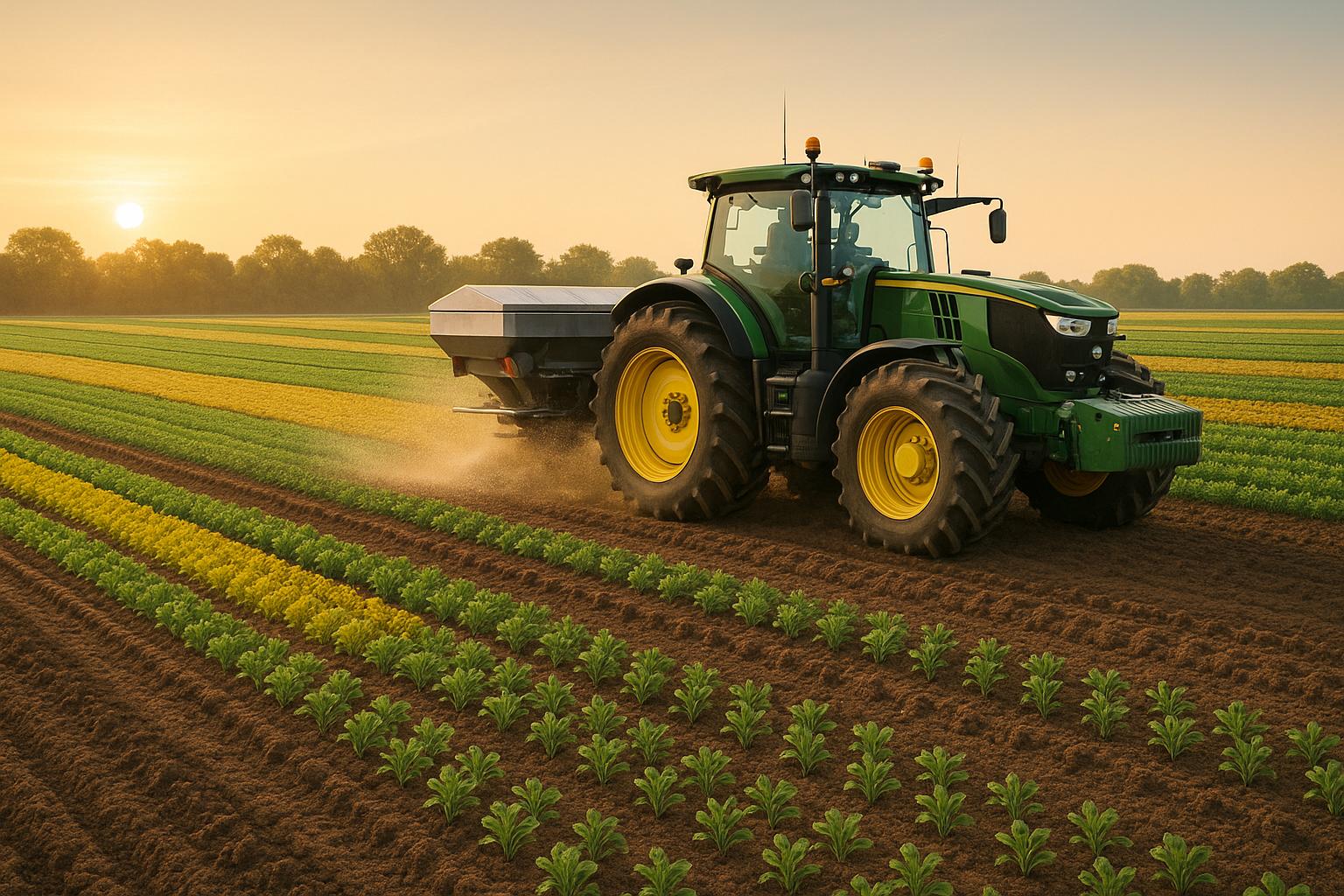
Variable Rate Technology (VRT) is changing how farming works by helping farmers apply the right amount of seeds, fertilizers, pesticides, or water to specific areas of their fields. This approach is based on data like soil health, crop conditions, and field variability. The result? Farmers save money, reduce waste, and increase yields. For example, U.S. corn farmers using VRT have saved up to $25 per acre, while an Iowa farm increased corn yield by 20% and cut fertilizer use by 15%.
Key Points:
- What is VRT? A tool that adjusts farming inputs based on field data.
- How does it work? Uses GPS, sensors, and software to create prescription maps and guide equipment for precise applications.
- Benefits: Cuts costs, boosts yields, reduces environmental impact, and optimizes resources.
- Challenges: High initial costs, technical training needs, and data management complexities.
Farmers using VRT are seeing real results, like saving on inputs, reducing environmental harm, and improving crop quality. The future of farming is smarter and more efficient with VRT.
How Ag Technology Works – Part 1: Creating Variable rate prescriptions
How Variable Rate Technology Works
Variable Rate Technology (VRT) takes raw field data and transforms it into precise applications for farming inputs. This process typically involves three key steps: gathering data, creating prescription maps, and making real-time equipment adjustments.
Data Collection and Analysis
VRT systems rely on a variety of data sources to paint a detailed picture of field conditions. For instance:
- Soil testing reveals nutrient levels, pH balance, and organic matter content across different zones.
- Yield monitoring tracks historical performance, identifying areas that consistently perform better or worse.
- Remote imagery provides insights into vegetation health.
- Field sensors measure real-time factors like soil moisture, temperature, and conductivity.
By analyzing this data, advanced algorithms can detect patterns that link soil characteristics to crop performance. Farm management software then integrates these findings, offering actionable insights that guide input decisions. These insights lay the groundwork for creating detailed prescription maps.
Creating Prescription Maps
Prescription maps act as the blueprint for applying inputs like fertilizer, seeds, or water at variable rates. These digital maps divide fields into zones based on specific factors such as soil properties, nutrient needs, and historical yield data. Each zone receives tailored recommendations to optimize resource use.
Farmers and agronomists collaborate to create these maps, using data such as soil nutrient levels, conductivity, and vegetation indices to develop zone-specific strategies.
A real-world example highlights this process: In 2022, NWFM, LLC partnered with innov8.ag and Nutrien Ag Solutions to implement soil mapping and variable rate application (VRA) prescriptions in their orchard operations. By 2023, they expanded this effort, combining innov8.ag’s expertise in soil mapping with Nutrien’s knowledge of crop inputs.
"We’re looking to reduce our petro-based inputs and to maximize the right inputs at the right place at the right time, year over year." – Keith Veselka, NWFM Orchard Operations Manager
"I’ve worked with NWFM for the last 6 years, helping them do a lot of fertilizer applications using soil data and soil samples. Taking the innov8.ag maps to come up with our prescriptions, the big benefit of this is we’re only applying fertilizer where it’s needed and not making blanket applications." – Andy Schlenker, Nutrien Ag
It’s worth noting that prescription maps are most effective when fields are divided into large, uniform zones. Farmers often use check strips or field blocks to evaluate and refine these zones, ensuring they remain accurate over time.
Real-Time Equipment Adjustments
Once the prescription maps are ready, GPS-guided tractors and smart sensors take over, adjusting input rates as equipment moves through different field zones. These adjustments can be based on the preset maps or on real-time sensor data.
Front-mounted sensors play a crucial role here, collecting real-time information about soil, crops, or weeds as the equipment moves. This data is processed instantly and sent to variable rate applicators, ensuring precise adjustments on the go.
For example, algorithms convert sensor readings into exact application rates, while control systems ensure compatibility between devices from different manufacturers. In irrigation, farmers can tweak flow rates, fertilizer concentrations, or injection timing during watering.
A fascinating example comes from Hungary, where researchers used a DJI Phantom 4 Multispectral drone to map patches of Cirsium arvense weeds. They then deployed a DJI Agras spray drone to target these patches specifically. This approach reduced herbicide use by 67.8% compared to traditional blanket applications.
Key Components of VRT Systems
Variable Rate Technology (VRT) systems are at the heart of precision agriculture, seamlessly integrating hardware and software to transform raw field data into precise, site-specific farming actions. These systems rely on two essential components: hardware for data collection and input application, and software to process this information into actionable strategies.
Hardware: Equipment and Sensors
The hardware driving VRT systems includes GPS-enabled tractors, variable-rate applicators (like seeders, sprayers, and fertilizer spreaders), and field sensors. These tools work together to ensure accurate data collection and precise input delivery.
At the core of this system is GPS technology. John Deere set the stage in 2002 with AutoTrac, its first GPS-based tractor guidance system, initially launched in North America and Australia before expanding to Europe. By 2004, their StarFire receivers, enhanced with NASA’s global ground station network and JPL software, took precision to another level.
The impact of GPS in agriculture is undeniable. John Boelts, Vice President of the Yuma County Farm Bureau, highlights its efficiency:
"By using GPS on the tractors, the entire process from leveling the field to planting the seed to irrigating the crop has been much more efficient than in the past. GPS is used in a lot of applications throughout most aspects of agriculture."
Variable-rate applicators adjust input delivery in real-time, ensuring each field zone receives the exact amount it needs. Meanwhile, field sensors measure soil moisture, temperature, conductivity, and pH, allowing for immediate adjustments.
Self-guidance systems have seen widespread adoption. By 2015, they were used on 60–70% of crop acreage in North America, 30–50% in Europe and South America, and over 90% in Australia. Terry Pickett of John Deere Intelligent Solutions Group explains their economic benefits:
"That allowed us to get machines in the field all over the world that would guide themselves with a lot less overlap, and that meant a lot to our customers."
"Self-guidance had a big impact on the cost of the product farmers were producing, the amount, and often the quality."
Software: Data Processing and Management
While hardware collects and applies data, VRT software turns this information into actionable plans. These platforms use sensor data, satellite imagery, and field measurements to create prescription maps – digital tools that guide variable-rate applications. Advanced algorithms, including geostatistics, GIS analysis, regression models, and machine learning, help define unique management zones within fields. These maps work seamlessly with farm machinery, adjusting inputs automatically.
Real-world examples showcase the software’s capabilities. In Sweden, a consultant used Solvi software to design a nitrogen prescription that reduced application rates from 80 kg/ha (71 lb/acre) to 70 kg/ha (62 lb/acre), saving $220 on a single application. The process involved creating a prescription file in Solvi, transferring it via USB, and loading it into the tractor’s GPS system.
AI-powered tools have further elevated VRT software. Solvi’s AI, for instance, can generate weed pressure maps and convert them into spot-spraying prescriptions, streamlining tasks like spring scouting.
The benefits extend beyond cost savings. An Iowa farm reported a 20% increase in corn yield and a 15% reduction in fertilizer use after adopting VRT software. Similarly, a wheat farm in Australia reduced water usage by 25% while boosting crop quality by 30%.
Farmers have also praised platforms like VRT Solutions. Scott Thompson from Broomehill noted:
"VRT Solutions has helped us over the past 3 years to save on soil and nutritional inputs without affecting production."
Rob Bell from The Plains shared a similar experience:
"Prescription maps made by VRT Solutions which were based on EM data, reduced our lime spending by 40%, a significant financial saving."
The global demand for VRT reflects its growing importance. Valued at nearly $7 billion in 2023, the market is expected to reach $25.43 billion by 2033, with hardware – such as GPS receivers, sensors, and yield monitors – leading the charge.
sbb-itb-593149b
Benefits and Challenges of Variable Rate Technology
Variable Rate Technology (VRT) offers modern farming a range of advantages, but it also comes with challenges that farmers need to address.
Benefits of VRT
Cost Savings and Higher Yields
VRT helps farmers use resources more efficiently, cutting costs and improving productivity. For example, a wheat farm in Australia reported a 25% reduction in water usage and a 30% improvement in crop quality after adopting VRT.
The financial benefits are equally compelling. A Soileos trial showed that using variable rate zinc application in wheat resulted in a 1.4 bushel per acre increase, translating to an extra $4 per acre profit after covering costs. In areas with low zinc levels, the yield boost was even more pronounced – 4.3 bushels per acre, equating to an additional $33 per acre profit after factoring in sampling and mapping expenses.
Environmental Advantages
As sustainability gains importance, VRT’s environmental benefits are becoming increasingly relevant. Vasyl Cherlinka, a scientist at EOS Data Analytics, highlights this:
"By precisely applying inputs like fertilizers and pesticides based on soil and crop conditions, farmers optimize resources and reduce environmental impact."
VRT minimizes the overuse of chemicals, reducing soil and water pollution while conserving natural resources. It also cuts down on the number of equipment passes needed, which lowers carbon emissions. Studies show that nitrate leaching can be reduced significantly, with post-harvest residual nitrate levels dropping to less than 45% of those seen with traditional fertilization methods.
Better Data Management and Traceability
VRT digitizes farm operations, enabling precise tracking of inputs like seeds, fertilizers, and pesticides. This level of traceability not only supports more sustainable practices but also helps maintain soil health and improve crop yields.
Growing Adoption Rates
The increasing adoption of VRT reflects its effectiveness. For instance, the percentage of cotton acreage using VRT rose from 5.4% in 2007 to 22.7% in 2019.
While VRT offers clear benefits in terms of efficiency and sustainability, its adoption isn’t without hurdles.
Challenges in VRT Adoption
Even with its advantages, several barriers limit the wider use of VRT.
High Initial Costs
The upfront investment in specialized equipment, training, and data management systems is often the biggest hurdle for farmers. Given that fertilizer costs can account for up to a third of a farm’s operating expenses – and are rising due to supply chain disruptions and global conflicts – farmers must carefully weigh the financial risks and rewards.
Herman Simons, Manager of Smart Ag Applied Research at Olds College, addresses this issue:
"We’re trying to help producers more easily quantify the value of VRT on their farm by expressing it in monetary value. This economic model will help determine what level of field variability is required to make investing in VRT worthwhile."
Technical Complexity and Training Needs
The complexity of VRT systems can be daunting. Farmers need training to interpret data accurately and manage the technology effectively. Without proper support, technical challenges and concerns about data privacy can discourage adoption. To address this, agricultural extension services and technology providers must offer strong support networks.
Data Management Challenges
Managing multiple data sources, such as soil samples and satellite imagery, requires new skills and systems that many farms haven’t yet developed. Establishing secure and reliable data practices is also essential to encourage participation in data-sharing initiatives.
Slower Adoption Compared to Other Technologies
VRT adoption has lagged behind other precision farming tools, such as guidance and recording technologies. For example, only 15% of Prairie growers use VRT on wheat and canola fields.
Geographic Differences
Adoption rates vary by region. North American farms are more likely to use VRT compared to European ones, reflecting differences in farm size, crop types, and economic conditions.
Despite these challenges, there’s optimism about VRT’s future. Kevin Ramm, Head of Sustainability at TELUS Agriculture & Consumer Goods, expresses this sentiment:
"With any technology, it must help solve real world problems and deliver business value. VRT is an exciting opportunity where technology-enabled improvements can have a significant impact on agriculture and our world more broadly."
The global VRT market is projected to reach $25.43 billion by 2033, growing at an annual rate of 13.85%, signaling that farmers and technology providers are finding ways to address these challenges.
The Future of Variable Rate Technology
Variable Rate Technology (VRT) is advancing rapidly, thanks to breakthroughs in artificial intelligence (AI), machine learning (ML), and improved tools that are becoming more accessible to farmers of all scales. These innovations are reshaping precision farming, making it more effective and inclusive.
AI and Machine Learning: Changing the Game
AI is revolutionizing VRT by analyzing data and providing highly accurate recommendations. For instance, AI-driven precision farming has been shown to boost crop yields by as much as 30% compared to traditional methods. The sector is also growing at a rapid pace, with the AI in agriculture market projected to expand from $1.7 billion in 2023 to $4.7 billion by 2028.
Machine learning, in particular, is proving to be a highly reliable tool. Yield prediction models powered by ML now achieve accuracy rates between 75% and 85% for major grain crops. Additionally, ML-driven irrigation systems can cut water usage by 20–30%, while optimized fertilizer applications can reduce costs by 15–25%.
AI-powered computer vision is another game-changer. These systems can pinpoint weeds, pests, and diseases with precision, allowing farmers to apply treatments only where necessary. Furthermore, AI algorithms can analyze soil samples to detect nutrient deficiencies or even predict crop diseases before any visible signs emerge. These capabilities are already making a tangible difference on farms around the world.
Real-World Success Stories
The impact of advanced VRT systems is evident in real-world applications. For example, Arable Farms in the United Kingdom adopted ML-driven VRT across their cereal operations. By leveraging soil mapping and predictive analytics, they increased wheat yields by 12.5% while cutting input costs by 8%.
In Australia, The Wine Farm utilized ML-based disease prediction models to analyze microclimate data in their vineyard. By focusing preventive treatments only on high-risk areas, they reduced fungicide use by 30% while maintaining top-notch grape quality.
Making Technology Accessible
One of the most exciting trends in VRT is its growing accessibility. Scalable solutions are now available for small and medium-sized farms, eliminating the need for hefty upfront investments. This democratization of technology is opening the door for more farmers to adopt precision agriculture.
At the same time, industry-wide standards for data formats and communication protocols are making it easier to combine equipment and software from different manufacturers. Cloud-based platforms are also playing a key role by integrating data from various sources into unified dashboards, offering farmers powerful decision-making tools.
Tackling Global Challenges
VRT isn’t just about improving efficiency – it’s also addressing big-picture issues like climate change and resource conservation. Farms using ML-guided precision techniques have reduced their environmental impact by an average of 35%, all while increasing yields by 10–15%. This dual benefit of boosting productivity while protecting the environment positions VRT as a cornerstone of sustainable agriculture.
The Role of Robotics and Automation
AI and ML aren’t the only technologies shaping the future of farming – robotics is also stepping into the spotlight. Autonomous farm machines are becoming more advanced, capable of handling increasingly complex tasks. These next-generation robots will integrate seamlessly with VRT systems, delivering precise applications across fields and further enhancing efficiency.
As these technologies continue to evolve, they’re setting the stage for a future where farming is not only more precise but also more sustainable and profitable. VRT is poised to play a critical role in meeting the growing global demand for food while safeguarding natural resources. The future of farming is here, and it’s smarter than ever.
FAQs
What are the upfront costs of Variable Rate Technology, and how can farmers ensure it’s a worthwhile investment?
The upfront cost of adopting Variable Rate Technology (VRT) typically falls between $150,000 and $250,000. This price tag includes specialized equipment like seed drills and sprayers. While the initial expense might feel steep, the long-term advantages can make it worthwhile.
VRT allows farmers to apply seeds, fertilizers, and pesticides with precision, using real-time data to guide decisions. This targeted approach minimizes waste, boosts crop yields, and streamlines operations. Over time, the savings and improved profitability can balance out the initial investment, making VRT a valuable tool for modern farming.
How does Variable Rate Technology (VRT) help make farming more environmentally sustainable?
Variable Rate Technology (VRT) and Environmental Benefits
Variable Rate Technology (VRT) plays a key role in reducing farming’s environmental footprint by fine-tuning the use of essential resources like fertilizers, pesticides, and water. Instead of applying these inputs uniformly across fields, VRT ensures they’re used precisely where they’re needed and in just the right amounts. This approach cuts down on waste and helps prevent issues like nutrient runoff, which can pollute nearby water sources.
By focusing on precision, VRT doesn’t just save resources – it also reduces farming’s overall environmental impact. For instance, it can limit the use of chemicals and save water by directing irrigation only to areas within a field that truly need it. These practices not only protect surrounding ecosystems but also promote more sustainable farming methods, all while maintaining – or even boosting – crop yields.
What training and support are available for farmers adopting Variable Rate Technology (VRT)?
Farmers looking to get started with Variable Rate Technology (VRT) have access to a range of training and support resources designed to simplify the transition:
- Educational Programs: Colleges and technical schools often run courses on precision agriculture, offering a solid foundation in VRT and guidance on using the equipment properly.
- Workshops and Seminars: Local agricultural groups frequently organize hands-on workshops that showcase VRT tools and practical techniques.
- Manufacturer Support: Many equipment manufacturers provide tailored training sessions and ongoing technical assistance to help farmers get the most out of their VRT systems.
Farmers can also benefit from connecting with peer networks or joining mentorship programs. These connections allow them to exchange experiences and pick up practical tips for using VRT effectively. With these resources, integrating VRT into everyday farming becomes much more manageable and rewarding.