
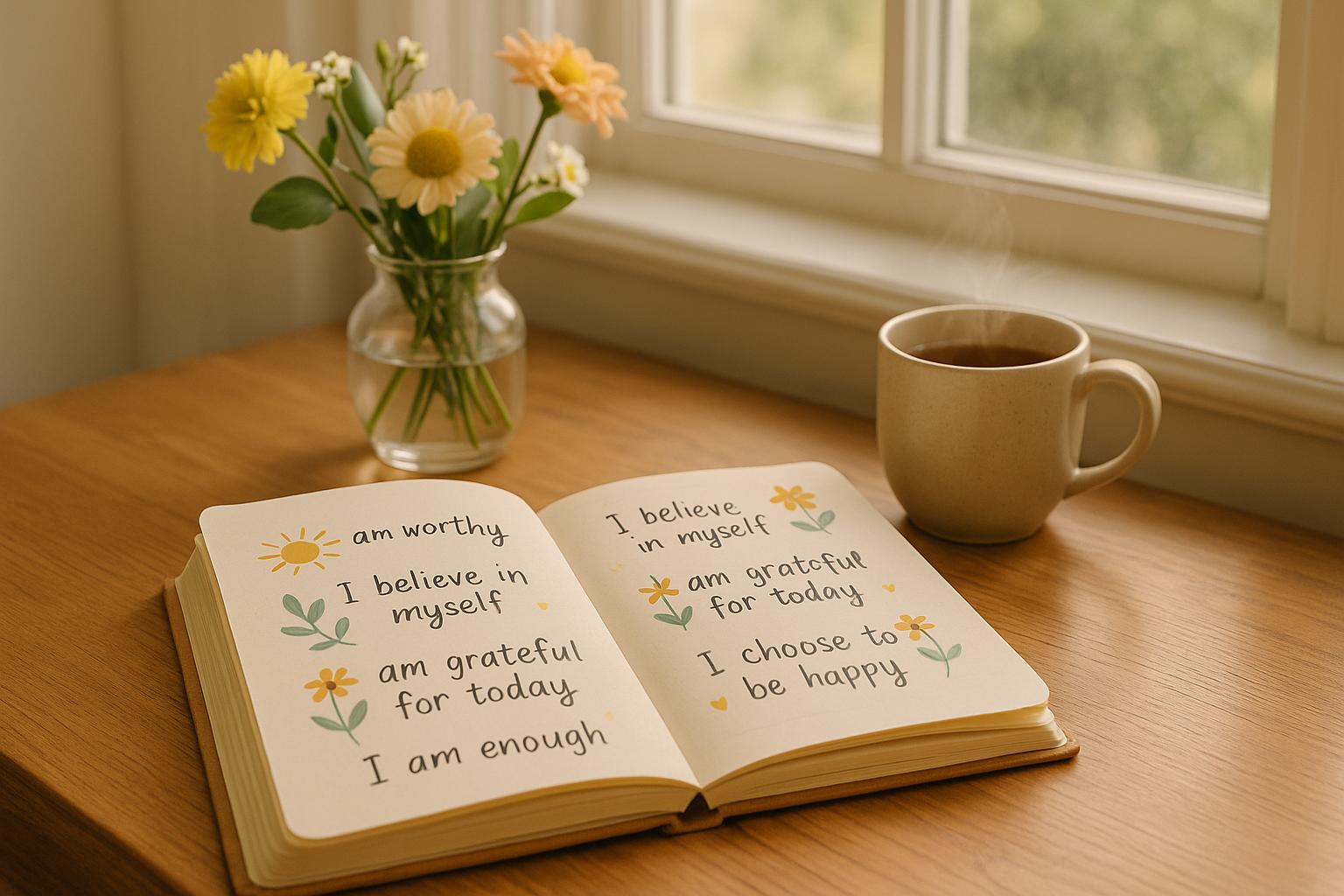
Positive thinking journaling helps you focus on the good in life, improve mental health, and build emotional resilience. This guide simplifies the process with actionable tips for beginners and experienced journalers alike.
Key Takeaways:
- What It Is: A journaling practice that highlights positive emotions, gratitude, and personal growth.
- Why It Matters: Boosts happiness, reduces stress, and even improves physical health like sleep and immunity.
- How to Start:
- Choose a journal (physical or digital).
- Create a consistent daily routine (e.g., pair it with your morning coffee).
- Use prompts like gratitude lists, affirmations, and reframing negative thoughts.
- Benefits: Enhances mental clarity, emotional well-being, relationships, and even physical health.
Start small – write down three things you’re grateful for today or a positive moment from your day. By focusing on positivity, you can shift your mindset and improve overall well-being.
A Science-Supported Journaling Protocol to Improve Mental & Physical Health
Benefits of Positive Thinking Journaling
Daily positive thinking journaling isn’t just about jotting down thoughts – it’s a practice backed by science that can genuinely enhance your mental, emotional, and physical well-being. Let’s dive into how this simple habit impacts different areas of health.
Mental Health Benefits
Positive thinking journaling is a powerful tool for improving mental health. It helps reduce mental distress, supports better emotional processing, and regulates emotions, which can lessen symptoms of depression and make coping with stress more manageable. Considering that anxiety disorders affect 18.1% of adults in the U.S., this practice becomes even more relevant.
Research backs these claims. A 2018 study revealed that emotion-focused journaling significantly decreased anxiety, depressive symptoms, and overall distress. Similarly, a 2021 study on individuals with advanced cancer found that mindful gratitude journaling helped lower psychological distress and improved their quality of life. For those struggling with anxiety, journaling organizes thoughts, encourages new ways to approach challenges, and allows people to acknowledge their feelings without judgment.
Emotional and Social Benefits
Beyond mental clarity, positive thinking journaling can strengthen emotional resilience and improve relationships. By processing feelings and reducing stress, this habit naturally boosts emotional well-being.
Expressive writing offers an emotional outlet, helping to externalize thoughts and gain perspective. It also builds self-confidence and self-awareness by challenging negative thinking patterns. In fact, studies show that individuals practicing positive affect journaling experienced better mental health and increased happiness, with some improvements noticeable within just a month.
Journaling also enhances communication and self-expression, which can lead to stronger interpersonal relationships and better conflict resolution skills. Reflecting on personal experiences fosters empathy and a deeper understanding of others’ emotions, encouraging more compassionate interactions. This approach not only nurtures personal emotional growth but also contributes to overall psychological health.
Physical Benefits
The stress-relief effects of journaling extend to physical health, offering benefits like better sleep, a stronger immune system, and reduced inflammation. Research even suggests that writing for 15–20 minutes a day, a few times a week over several months, can lower blood pressure and enhance liver function.
Journaling has also been linked to improved lung and liver function, faster healing from injuries, and better physical functioning in medical settings. These benefits largely stem from the way journaling reduces chronic stress. Regularly processing emotions through writing can help your body recover more effectively and improve sleep quality. Incorporating journaling into a bedtime routine is especially helpful for unwinding and easing tension.
The mental, emotional, and physical advantages of positive thinking journaling make it a well-rounded wellness practice. With research supporting its benefits, this simple habit proves to be an impactful tool for improving overall health.
How to Start Positive Thinking Journaling
Starting a positive thinking journaling practice doesn’t require fancy tools or complex methods. With the right mindset, a few simple tools, and some thoughtful planning, you can establish a habit that can shift your perspective and improve your overall well-being.
Choosing the Right Tools and Format
The first step is to pick a journaling format that feels comfortable for you. A basic notebook is more than enough to start reflecting and organizing your thoughts – something many therapists suggest for self-reflection and mindfulness. Whether you prefer the feel of pen on paper or the convenience of a digital platform, the key is to choose what feels most natural to you.
- Physical journals offer a hands-on experience that many find grounding. Any blank notebook paired with a pen works perfectly for this practice.
- Digital options are ideal if you like having access across devices. Many digital tools also provide templates with prompts to guide your writing.
Decide whether you’d prefer structured prompts or blank pages. Some journals come with exercises and questions to help guide your thoughts, which can be especially helpful if you’re just starting out. On the other hand, blank pages offer the freedom to express yourself however you like.
Once you’ve chosen your journal, the next step is to make it a regular part of your day.
Setting Up a Daily Routine
Having the right tools is only part of the equation – building a consistent routine is what solidifies the habit. Regular journaling helps reinforce a positive mindset, and research backs this up. Dr. Gail Matthews found that people are 42% more likely to achieve their goals simply by writing them down.
One effective strategy is habit stacking – pairing journaling with an activity you already do daily, like drinking your morning coffee or winding down after a shower. As Tim Ferriss famously said:
"I do believe that if you win the morning, you win the day".
Start small to keep things manageable. Just a few minutes a day is enough to make a difference without feeling overwhelming. Psychologist Barbara Markway highlights the benefits of this approach:
"One of the most useful things you can do to combat stress and anxiety is to keep a running record of your thoughts on paper. There’s simply no better way to learn about your thought processes than to write them down".
Keep your journal and pen in a visible spot as a reminder to stick with your practice. Stay connected to your reasons for journaling – whether it’s reducing stress, improving your relationships, or gaining self-awareness. And remember, it’s okay to miss a day. The goal is progress, not perfection.
Combining journaling with other self-care activities can also make the process more enjoyable and effective.
Creating a Good Environment for Journaling
The space where you journal can have a big impact on how focused and inspired you feel. A calm, personalized environment can help you stay consistent and make the experience more enjoyable. Think about factors like your preferred time of day, how much noise you can tolerate, and how much control you have over the space.
Minimize distractions by turning off phone notifications and keeping devices out of sight. If noise is an issue, consider using noise-canceling headphones to create a little bubble of peace for yourself. Writing coach Gaelen Foley offers this advice:
"Fill your writing environment with small pleasures to remind you that this is supposed to be fun, and it’s all about inspiration – getting from jaw-clenched discipline to joyous creative flow".
Add personal touches to your space to make it inviting and inspiring. This could mean adding plants, artwork, photos, or even a cozy blanket. If natural light isn’t an option, pictures of nature can help create a soothing atmosphere.
Make sure your setup is comfortable and practical. Good lighting is essential to avoid eye strain – natural light is ideal, but a mix of ambient and task lighting works just as well. Use a supportive chair and organize your materials to promote a healthy posture and easy access.
A tidy, personalized space not only boosts focus but also enhances the emotional benefits of journaling. With a thoughtful setup, you’ll have the perfect foundation for your positive thinking practice.
sbb-itb-593149b
Techniques for Positive Thinking Journaling
Now that you’ve established a journaling routine, it’s time to explore techniques that help shift your mindset toward positivity and lasting growth. Here are three effective methods to elevate your journaling practice.
Gratitude Journaling
Gratitude journaling is all about focusing on what you have rather than what’s missing. By regularly jotting down things you’re thankful for, you can cultivate a mindset of abundance and appreciation. Research highlights that this practice not only reduces negative emotions but also promotes feelings of contentment and joy. In fact, studies suggest it can decrease loneliness and increase happiness.
Martin Seligman, a leading figure in positive psychology, explains the power of gratitude:
"When we take time to notice the things that go right – it means we’re getting a lot of little rewards throughout the day".
Similarly, Robert Emmons, a psychology professor at the University of California, Davis, notes that:
"Practicing gratitude magnifies positive feelings more than it reduces negative feelings".
To deepen your gratitude journaling, aim for specificity. Instead of writing, "I’m grateful for my family", try something like, "I’m grateful for how my sister supported me yesterday when I was feeling overwhelmed." Focus on fewer items but explore them in greater depth. Reflect on how certain people or experiences have shaped your life positively, and try the subtraction method – imagine how different your life would be without them. Keep it fresh by noting unexpected moments of gratitude and varying your entries. Interestingly, research suggests that writing a few times per week might be more impactful than doing it daily.
Once you’ve embraced gratitude, consider adding affirmations to your journaling routine.
Affirmation Journaling
Affirmation journaling involves writing positive statements to challenge negative thoughts, boost self-confidence, and nurture emotional well-being. These affirmations encourage you to focus on your strengths and the positive aspects of your life. Studies show that repeating affirmations can reshape neural pathways, fostering a more optimistic mindset. MRI studies even reveal that self-affirmation exercises activate specific neural regions and help reduce stress.
To get started, create affirmations that are personal, present-tense, and emotionally resonant. For example, write statements like, "I am capable of handling challenges", or "I am worthy of love and respect." Start with 3–5 affirmations each day, and ensure your actions align with these positive messages. Over time, track how your mood, confidence, or behaviors shift. Consistency is crucial – practicing affirmations at the same time daily can solidify this habit.
Finally, learn how to reframe negative thoughts to cultivate a more balanced perspective.
Reframing Negative Thoughts
Reframing negative thoughts is about recognizing harmful thinking patterns and consciously replacing them with more constructive or balanced views. This technique helps you become more aware of automatic negative thoughts as they arise. When you catch a negative thought, pause and examine its validity. Is it based on facts, or is it an assumption or exaggeration?
Use Socratic questioning to challenge these thoughts. Ask yourself, "What evidence supports this thought? What evidence contradicts it? How would I advise a friend in this situation?" These questions can help you shift to a more balanced perspective. For example, if your boss seems short with you, instead of thinking, "They must dislike my work", consider, "Maybe they’re stressed about something unrelated", or "They might be preoccupied with other tasks".
Write down your negative thoughts and immediately follow them with a more balanced or positive reframe. With practice, this process becomes second nature, improving your mental resilience and overall well-being.
Prompts for Positive Thinking Journaling
Journaling becomes a powerful tool when guided by prompts that steer your thoughts toward positivity and self-awareness. Whether you’re new to journaling or looking to refresh your approach, these prompts encourage thoughtful reflection and help nurture a more optimistic mindset. The categories below build on earlier techniques, reinforcing the positive habits discussed in previous sections.
Gratitude Prompts
Shifting your focus to gratitude can work wonders for your mood and mental well-being. The key is to be specific. Instead of writing, "I’m grateful for my health", dive deeper into what that means today.
Here are a few prompts to get started:
- What three specific moments from today brought me joy?
This helps you notice and appreciate small, often overlooked pleasures. - Who in my life deserves recognition for their kindness, and what exactly did they do?
Reflecting on the kindness of others strengthens your relationships and gratitude.
For deeper introspection, try these:
- What challenge from my past has helped me grow stronger?
This allows you to find purpose in difficult experiences. - What simple pleasure did I take for granted until recently?
Acknowledging everyday joys, like a warm cup of coffee or a favorite song, can deepen your gratitude practice.
Additional prompts to explore include:
- What skill or ability do I possess that makes my life easier?
- Which memory from this week still makes me smile?
- What aspect of my home brings me comfort?
"Thanks are the highest form of thought, and gratitude is happiness doubled by wonder." – G.K. Chesterton
Once you’ve grounded yourself in gratitude, turn your focus toward the future with goal-oriented prompts.
Future-Focused Prompts
Future-focused prompts help you visualize positive outcomes and set meaningful goals. They can inspire optimism and make your aspirations feel more achievable.
Start with a letter to your future self, outlining your hopes, dreams, and goals.
Here are some additional prompts to guide your thinking:
- What would I attempt if I knew I couldn’t fail?
This encourages you to dream big and consider goals you may have been hesitant to pursue. - How do I want to feel at the end of next month, and what steps can I take to get there?
This helps you plan actionable steps to achieve your desired state. - What’s one small action I can take tomorrow that aligns with my biggest dream?
Breaking down large goals into smaller steps makes them feel more manageable. - What would someone who loves me unconditionally want for my future?
Viewing your goals through the lens of self-compassion can be a powerful motivator.
For further reflection, consider:
- What legacy do I want to leave behind?
- How will achieving my current goal change how I feel about myself?
- What would my ideal day look like one year from now?
Using SMART goals (Specific, Measurable, Achievable, Relevant, and Time-bound) can make these aspirations even more actionable. Now, shift your focus inward with self-awareness prompts.
Self-Awareness Prompts
Self-awareness prompts help you uncover patterns, understand your triggers, and gain insight into your emotional responses. They create a clearer picture of your inner world.
Begin with these foundational questions:
- What negative thoughts keep recurring in my mind, and when do they typically appear?
Identifying patterns in your thoughts can help you understand their triggers. - How do I physically experience these negative thoughts?
Pinpointing physical reactions, like tension or fatigue, can deepen your understanding of how emotions affect your body. - What evidence supports or contradicts this negative thought?
This encourages an objective evaluation of your thoughts using a Socratic approach.
Dive deeper into personal growth with these prompts:
- What self-limiting belief is holding me back right now, and how can I challenge it?
- When do I feel most energized and alive?
- What environments help me thrive?
These questions help you identify the conditions that bring out your best self.
For a more compassionate perspective, consider:
- What’s a negative thought I’ve been holding onto, and how might I reframe it more compassionately?
This helps you replace harsh self-criticism with kindness. - What positive action can I take today regarding a negative thought that’s been bothering me?
This encourages a shift from rumination to constructive action.
Conclusion: Start Your Positive Thinking Journaling Journey
You’re ready to shift your mindset with positive thinking journaling. With the strategies and insights shared here, you can begin this practice with confidence and purpose.
Research highlights how a positive outlook can transform both mental and physical health. For example, a 2018 study revealed that maintaining a positive mental attitude was associated with lower mortality rates over a 35-year period. Even simple daily gratitude exercises have been shown to enhance overall well-being.
Getting started is easier than you might think. Choose a journal that excites you – whether it’s a classic notebook or a digital app. And keep in mind the wise words of Hannah Hinchman:
"The best time to begin keeping a journal is whenever you decide to."
Tie your journaling habit to something you already do, like sipping your morning coffee, and place your journal somewhere you’ll see it every day as a gentle reminder. If you miss a day, don’t sweat it – just pick up where you left off.
The benefits grow with time. Regularly practicing gratitude can train your brain to notice the positives in life. And journaling about your inner thoughts and emotions has even been linked to fewer sick days. By incorporating gratitude, affirmations, and reframing techniques into your entries, you’ll continue to nurture a positive mindset that supports your mental health and deepens your relationships.
Start with just one entry. Whether you write about something you’re grateful for, a positive affirmation, or a single good moment from your day, you’re already moving toward a brighter perspective.
Your tools are in place, and the techniques are clear – it’s time to begin your positive journaling journey.
FAQs
How can I make positive thinking journaling a simple and stress-free part of my daily routine?
To make journaling for positive thinking an easy and enjoyable habit, start small and keep it straightforward. Dedicate just a few minutes each day – ideally at the same time, like in the morning to kick off your day on a positive note or at night to reflect and unwind. Simply jot down 2-3 things you’re grateful for or a positive moment from your day. You could also add one thing you’re excited about for tomorrow.
If you’re unsure where to start, prompts can help guide you. Consider questions like, “What made me smile today?” or “What’s one thing I appreciate about myself?” These prompts steer your thoughts toward positivity and take the stress out of thinking up ideas. By keeping your journaling short and meaningful, it becomes a habit that uplifts your mindset without feeling like a task.
What are some examples of affirmations I can use in my positive thinking journal to build self-confidence?
Affirmations can be a great way to build self-confidence and nurture a more positive outlook on life. If you’re looking to incorporate them into your journaling routine, here are a few examples to inspire you:
- I am strong and capable.
- I believe in myself and my abilities.
- I am worthy of love and respect.
- I can handle any challenge that comes my way.
- I radiate positivity and confidence.
You can jot these down in your journal daily or come up with your own affirmations that feel more personal to you. The key is consistency – repeating them often can help reshape your thoughts and gradually enhance your self-esteem.
How does positive thinking journaling improve physical health, and what scientific evidence supports this?
Positive thinking journaling can have a meaningful impact on your physical health by easing stress and supporting emotional well-being – both of which play a big role in better health. Research highlights that writing about positive experiences can strengthen your immune system, lower blood pressure, and ease symptoms of anxiety and depression. For instance, studies show that expressive writing can enhance immune function and even reduce how often you get sick.
On top of that, journaling helps you become more aware of your emotions and can lift your mood. This emotional clarity and improved outlook can reduce stress, which in turn supports heart health. By encouraging a more optimistic mindset, journaling not only boosts mental health but also plays a role in improving your overall physical well-being.
