
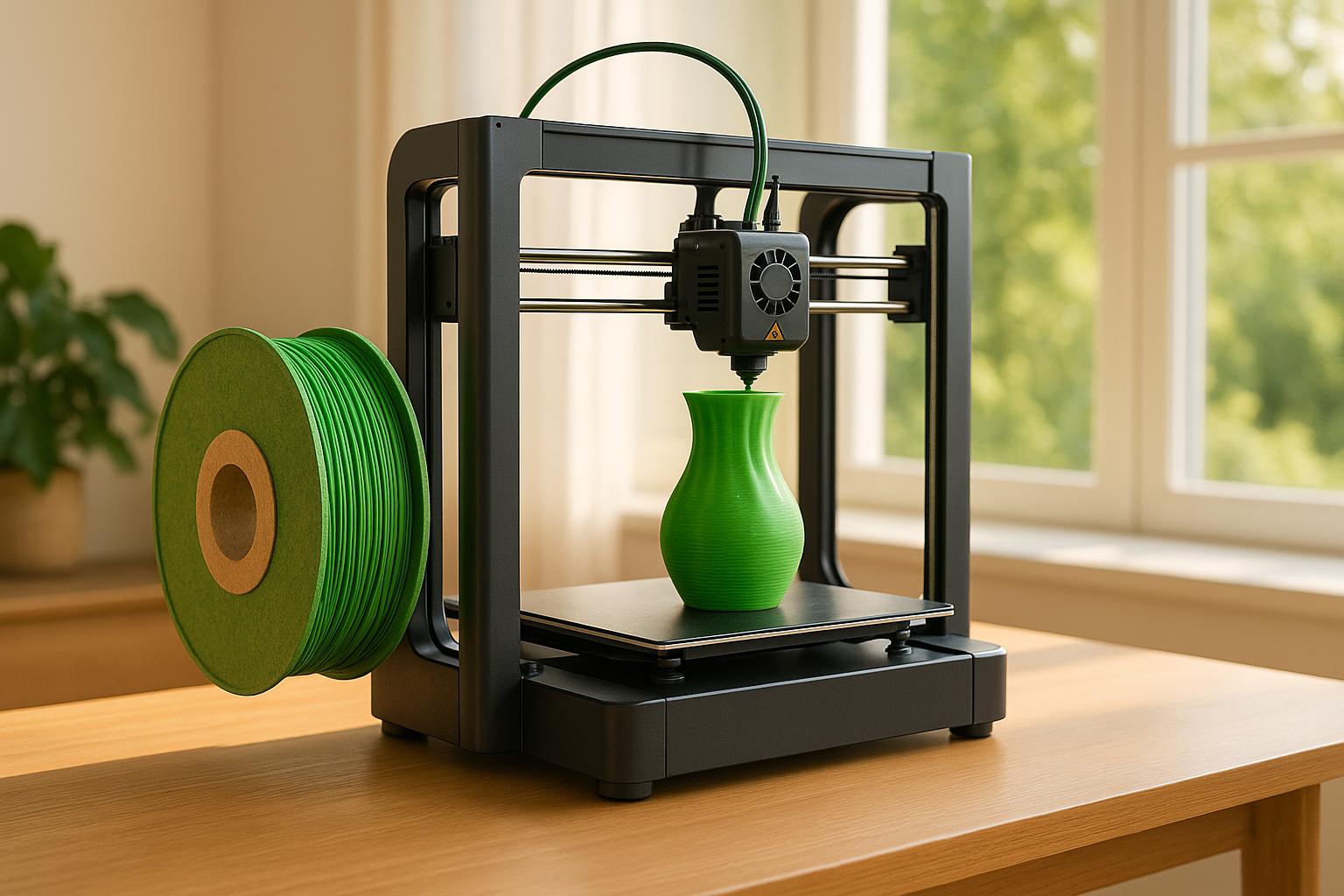
Green 3D printing combines advanced manufacturing with eco-friendly practices to reduce waste, lower emissions, and use sustainable materials. Here’s what you need to know:
- What it is: Green 3D printing minimizes waste by building objects layer by layer, often using recycled or biodegradable materials.
- Why it matters: Traditional manufacturing produces 19% of global greenhouse gas emissions and generates 1.3 billion tons of waste annually. 3D printing can cut material use by up to 90% and reduce transportation emissions through local production.
- Challenges: Some 3D printers consume more energy than traditional methods and release harmful substances like VOCs.
- Solutions: Use energy-efficient printers, optimize settings (e.g., lower infill density), and choose eco-friendly materials like PLA or recycled PETG.
Quick Comparison of 3D Printing Technologies
| Technology | Energy Use (kWh) | Material Efficiency | Best Applications |
|---|---|---|---|
| FDM (Fused Deposition) | 0.05–0.25 | High | Prototyping, consumer products |
| SLA (Stereolithography) | 0.1–1.0 | Limited | Precision parts, medical use |
| SLS (Selective Laser) | 1.0–5.0 | 80–90% powder reuse | Aerospace, functional parts |
| Binder Jetting | 0.5–2.0 | Good | Metal parts, molds |
Green 3D printing is transforming industries like construction, transportation, and fashion, offering sustainable solutions without sacrificing performance. Read on to learn how you can make your 3D printing practices more eco-friendly.
Massive 3D printer shows future of green manufacturing | REUTERS

How to Make 3D Printing More Energy Efficient
Cutting back on energy use is a critical step toward creating greener, more sustainable 3D printing practices. By fine-tuning print settings, upgrading hardware, and making smarter production choices, it’s possible to significantly lower energy consumption without sacrificing quality. Here’s a closer look at where energy is often wasted and how targeted changes can make a difference.
Ways to Save Energy in 3D Printing
Heated components, like the heated bed and extruder, are the biggest energy guzzlers in most 3D printers. In fact, they account for about 72.9% of a printer’s total power consumption.
One effective solution is upgrading insulation. Research conducted in April 2023 on Ender series 3D printers from Shenzhen Creality 3D Technology Co. found that insulating heated components and refining extruder setups could slash energy use by up to 38%. Even better, these changes also reduced material usage by over 55%.
Adjusting print settings is another straightforward way to save power. For non-structural parts, reducing infill density to 20% and increasing layer thickness can shorten print times and lower energy use . Additionally, opting for PLA over ABS helps, as PLA doesn’t require the high bed temperatures that ABS does. Switching to lightning infill instead of traditional support structures can cut material use by up to 51%, and reducing support line widths from 0.6 mm to 0.4 mm can save around 31–32% of material.
The type of 3D printing technology you use also plays a role in energy consumption. Here’s a quick comparison:
| Technology | Typical Energy Consumption (kWh) |
|---|---|
| FDM | 0.05 – 0.25 |
| SLA | 0.1 – 1.0 |
| SLS | 1.0 – 5.0 |
| Binder Jetting | 0.5 – 2.0 |
| Directed Energy Deposition (DED) | 5.0 – 20.0 |
FDM printers are generally more energy-efficient compared to SLA, while DED and SLS printers tend to consume the most power.
Simple habits can also make a big difference. Keep the printer door closed during operation and enable auto energy-saving modes to cut down on idle energy waste. For industrial printers, turning off the bed vacuum system after printing is complete can prevent unnecessary power draw.
"When you design a 3D printed part, consider how that design will impact the overall print time… Leveraging 3D printing’s design freedom to consider various options can positively affect how much energy the printer uses." – Stratasys
Benefits of Local 3D Printing Production
Beyond printer-specific adjustments, local production can further enhance energy efficiency by eliminating the need for long-haul transportation. Transportation emissions are a major environmental challenge, with the sector contributing about 2.5% of global carbon emissions.
By enabling production closer to the point of use, 3D printing significantly reduces transportation-related emissions and packaging waste. Instead of shipping physical products, companies can distribute digital files and print items locally.
Authentica’s platform has shown just how effective this approach can be, achieving a 40% reduction in CO₂ emissions across land, sea, and air logistics, and cutting overall transportation needs by 90%. For example, a major automotive supplier in Australia reduced lead times by 97% and slashed transportation requirements by 90% using this model. Similarly, Toyota Angola now prints spare parts directly at dealerships, cutting wait times from six months to under 72 hours. John Deere has also adopted a distributed manufacturing system, allowing local sites to download designs and print products on demand, which reduces both material waste and shipping distances.
Local production doesn’t just benefit the environment – it also boosts local economies by creating well-paying jobs, decreasing reliance on overseas manufacturing, and encouraging innovation. Plus, it strengthens resilience against supply chain disruptions, as demonstrated during recent global shipping challenges.
"3D printing technology is set to transform the traditional supply chain model as we know it. It could potentially allow parts to be produced at the point and time of use rather than manufactured and shipped in advance." – Professor Jan Godsell, WMG at the University of Warwick
This shift toward localized production isn’t just about saving energy; it’s about rethinking how products move from design to consumer. The result? A more efficient, environmentally conscious manufacturing system.
Eco-Friendly Materials for 3D Printing
Choosing eco-friendly materials is a smart step toward making 3D printing more sustainable. While traditional plastics have been the go-to for years, new materials sourced from renewable resources like corn starch, algae, or wood fibers are making waves. These alternatives not only reduce environmental harm but can also be cost-effective. Understanding what makes these materials environmentally friendly and how they perform is key to making smart choices.
What Makes 3D Printing Materials Eco-Friendly
Eco-friendly 3D printing materials are designed with sustainability in mind. They align with principles like using renewable resources, promoting recyclability, and minimizing environmental harm.
Several factors make a material environmentally friendly. First, its origin matters – a bio-based source, such as corn starch or algae, is far better than petroleum-based plastics. Recyclability is another big factor; materials that can be reused without losing quality are a win for both the planet and your wallet.
Compostability is also a game-changer. Materials that break down naturally or in industrial composting facilities eliminate long-term waste. Safe handling and disposal further ensure they don’t harm users or the environment.
Transparency in sourcing adds credibility. Materials with traceable supply chains and low-impact production processes give users confidence in their sustainability.
Interestingly, improving material reuse rates can significantly cut down on waste. For instance, increasing the reuse rate of powder from 50% to 80% can shrink a printed part’s carbon footprint by 70%. Plus, recycled materials already make up as much as 95% of some 3D printing inputs, and projections suggest that 40–60% of printed items could be recycled.
These criteria set the foundation for exploring the growing range of sustainable materials.
Types of Green 3D Printing Materials
The world of eco-friendly 3D printing materials is expanding rapidly, offering options for nearly every application. Each material has its strengths and limitations when it comes to performance and environmental impact.
PLA (Polylactic Acid) is a standout in the bio-based category. Made from renewable resources like corn starch, it prints at lower temperatures, produces fewer emissions, and is biodegradable under industrial composting conditions. However, it isn’t as durable or heat-resistant as petroleum-based plastics.
Recycled PETG strikes a balance between sustainability and performance. It offers better mechanical properties than PLA while reducing the need for new plastic. Using recycled PETG can lower carbon emissions by 30–80% compared to virgin materials. Filamentive, for example, produces recycled PETG from pre-consumer waste, including discarded plastics from manufacturers.
Plant-based polymers like PA11 are premium options that boast a smaller carbon footprint compared to fossil-based materials. Nylon PA12, for instance, has achieved a 49% reduction in its carbon footprint thanks to renewable energy in production.
Recycled specialty materials tackle specific environmental issues. Fishy Filaments, for example, creates 3D printer filaments from recycled fishing nets, addressing ocean plastic pollution directly.
TPU (Thermoplastic Polyurethane) is another eco-friendly option. Its low energy consumption during printing, combined with its flexibility and durability, helps extend product life and reduce waste.
Here’s a quick comparison of popular materials:
| Material | Bio-based | Recyclable | Biodegradable | Energy Required | Post-processing Impact |
|---|---|---|---|---|---|
| PLA | ✔️ | ♻️ (limited) | ✔️ (industrial) | 🔋 low | ⚠️ moderate (paints/coatings) |
| Recycled PETG | ✖️ | ✔️ | ✖️ | 🔋 medium | ✅ low |
| Recycled PA12 (SLS) | ✖️ | ♻️ (powder reuse) | ✖️ | 🔋 high | ✅ low |
| Wood/Hemp Composite | ⚠️ partial | ✔️ | ⚠️ depends on base polymer | 🔋 low/medium | ⚠️ moderate |
| Bio-derived Resin | ✔️ | ✖️ | ✖️ | 🔋 medium/high | ⚠️ needs curing solvents |
| ABS (for contrast) | ✖️ | ✖️ | ✖️ | 🔋 medium | ⚠️ fumes, high post-impact |
Bio-composites, which mix natural fibers like wood or hemp with polymers, are another interesting option. While they might not always biodegrade fully, they reduce the overall use of synthetic materials, making them a more sustainable choice.
Cost is also becoming less of a barrier. Recycled filaments are often cheaper than their virgin counterparts. Plus, additive manufacturing could reduce raw material needs by up to 90% by 2050, according to the European Commission. For instance, recycled HDPE filament production uses only 38.29 MJ/kg of energy compared to 79.67 MJ/kg for virgin HDPE.
These materials are already proving their worth in real-world applications. From biodegradable medical implants to recycled automotive prototypes and sustainable consumer products, the possibilities are growing. Companies like Markforged and Greentown Labs are driving innovation in this space, while new materials like algae-based filaments and carbon-neutral polymers continue to emerge.
The key to success lies in matching the material to the application and fine-tuning printer settings to get the best results. This ensures that sustainability goals don’t come at the cost of performance.
sbb-itb-593149b
Green 3D Printing Technologies and Methods
The 3D printing industry is advancing quickly, blending high performance with a focus on environmental responsibility. New methods are emerging that cut energy use, minimize waste, and make sustainable production more attainable. From smarter heating systems to AI-driven tools that reduce print failures, these innovations are helping to make 3D printing more efficient and eco-friendly.
Energy-Saving 3D Printing Technologies
Several cutting-edge technologies are driving energy efficiency in 3D printing:
- Zonal print bed heating: By heating only the specific areas needed for printing, this method can lower energy use by 15–20% in standard FDM operations.
- AI-powered optimization: AI tools predict and prevent print failures, cutting material waste. Companies using these systems report 30–50% fewer failed prints and better printer efficiency.
- Solar-powered 3D printing systems: These systems use solar energy to reduce carbon emissions by up to 70% compared to traditional grid electricity. They are ideal for off-grid or eco-conscious applications.
- Branch Technology‘s C-Fab process: This method, used in a U.S. Army project, produced insulation panels for a 6,250 sq ft structure. It improved energy efficiency by 50% and significantly lowered energy costs and emissions.
- Pellet-fed large-format printers: These systems offer more material flexibility and lower costs than filament-based printers. They also handle recycled materials better, reducing the energy needed to produce filaments.
- Parameter optimization: Adjusting printing settings can save energy. For example, lowering the extrusion temperature from 392°F to 356°F and increasing layer height from 0.2 mm to 0.3 mm can cut energy use by 15% and 20%, respectively.
- Decentralized production: Local manufacturing hubs reduce emissions from transportation by leveraging distributed printing networks.
Comparing Different Green 3D Printing Methods
Here’s how various 3D printing methods compare in terms of energy use, material efficiency, and environmental benefits:
| Technology | Energy Consumption (Wh) | Material Efficiency | Environmental Benefits | Best Green Applications |
|---|---|---|---|---|
| FDM | 50–200 | High compatibility with recycled/bio materials | Works with PLA, recycled PETG, bio-composites | Prototyping, consumer products, education |
| SLA | 20–100 | Limited to photopolymers | Low energy use but chemical waste challenges | Precision parts, dental/medical applications |
| SLS | 100–500 | 80–90% powder reuse rate | High powder recyclability, minimal support waste | Functional parts, aerospace components |
| Binder Jetting | 50–200 | Good material utilization | Recycled metal powders are compatible | Metal parts, sand casting molds |
- FDM (Fused Deposition Modeling): Known for its compatibility with eco-friendly materials like PLA and recycled polymers, FDM is a cost-efficient option for sustainable production. While it uses more energy than SLA or SLS systems, its simpler design and lower operating temperatures help offset this.
- SLS (Selective Laser Sintering): With an 80–90% powder reuse rate, SLS excels in material efficiency. Using recycled aluminum in SLS can cut energy use by 50% compared to new aluminum. However, the high upfront costs for machinery and materials can be a barrier.
- SLA (Stereolithography): SLA consumes the least energy – just 20–100 Wh – but its reliance on photopolymers limits sustainable material options. Additionally, handling resin waste and cleaning solvents requires care.
3D printing as a whole is far less wasteful than traditional manufacturing. Additive manufacturing can reduce production scrap by 70–90%, and in construction, it can cut waste by up to 95%.
Material-specific considerations include:
- Ceramic printing: Recycles about 70% of powder but requires energy-intensive sintering (1.5 kWh/kg).
- Polymer printing: Bio-based materials like PLA degrade within 2–3 months under industrial composting, while ABS retains over 80% recyclability.
- Metal printing: Achieves 80–90% powder reuse but involves high costs and energy demands (5 kWh/kg).
Software advancements are also driving sustainability. Tools like Magics and nTop streamline file processing, cutting design times from days to seconds, as shown in DMG MORI‘s 2024 program. Raplas and Materialise have also launched a Next-Generation Build Processor for resin-based systems, improving print speeds by 30–40%, enhancing quality, and reducing post-processing needs.
Real-World Uses of Green 3D Printing
Building on the sustainable materials and energy-efficient methods already discussed, green 3D printing is making waves in real-world applications. From solar-powered vehicles to biodegradable packaging, companies and designers are proving that sustainable manufacturing can lead to products that are both inventive and environmentally conscious. These examples highlight how green 3D printing is being applied across various industries.
Eco-Friendly Products Made with 3D Printing
In the renewable energy sector, green 3D printing is helping create more efficient components. For instance, the Agoria Solar Team used a solar car featuring a 3D-printed battery casing developed with Materialise to win a cross-country race. This shows how additive manufacturing can produce lightweight yet durable structures for renewable energy projects.
The transportation industry has also embraced these advancements. Designer James Novak created a 3D-printed bike frame tailored to individual body measurements, while the footwear industry saw innovations like Stephan Henrich’s Cryptide Sneaker, made from flexible TPE material, and Weaver+ shoes, crafted with elastic TPU and a flexible knitted design.
In construction, UCLA engineers are working on a 3D-printed concrete alternative that reuses CO₂, offering a lighter and stronger material with a reduced carbon footprint. Japanese engineers took this further in March 2025, 3D printing an entire train station in just three hours using a mix of mortar, concrete, and steel reinforcement.
The fashion world is also exploring zero-waste production through 3D printing. Designer Julia Daviy creates clothing using organic materials and recyclable filaments, including a zero-waste, custom-made skirt produced with her patented 3D printing process. As Daviy explains:
"We’ll have succeeded when beautiful, comfortable, ethically manufactured, and environmentally friendly clothes are the standard." – Julia Daviy, Designer
Jewelry is another area seeing sustainable innovation. Mango introduced a collection made with 90% sustainable materials, incorporating bio-based and biodegradable polymers mixed with natural elements like birch, terracotta, wood, and ceramics.
In packaging, Carlo Ratti Associati developed a machine that blends orange peels with PLA to 3D print cups for fresh orange juice. Similarly, Notpla uses biodegradable materials to create eco-friendly packaging with 3D printing. Everyday items are also getting a sustainable twist, such as Chris Martin’s Blizzflosser – a reusable 3D-printed dental flosser – and the Otrivin Air Lab’s use of microalgae to produce bioplastics for biodegradable products like vases and stools.
Beyond creating innovative products, green 3D printing is driving circular economy practices by turning waste into valuable resources.
How 3D Printing Reduces Waste Through Reuse
3D printing is making strides in recycling and reuse, aligning with circular economy principles. Manufacturing service provider JawsTec, for instance, uses Nexa3D‘s QLS selective laser sintering technology to recycle over two tons of powder annually. By blending new and recycled powder from older SLS and MJF platforms, they achieve 100% powder utilization.
"The QLS 230 printers give us the ability to use end-of-life powder from other SLS and MJF machines to produce high-quality parts while eliminating powder waste. On top of the operational sustainability, the smaller build volume of the QLS 230 allows for a much shorter build cycle and cooling cycle with zero negative effect on part accuracy or surface quality." – Oscar Klassen, Co-Founder & CEO, JawsTec
Large-format 3D printing is also turning plastic waste into functional items. For example, Print your City! transforms discarded plastics into street furniture, with each bench incorporating about 110 pounds of plastic – the equivalent of the annual waste generated by two people. Uido Design repurposes plastic waste from 3D prototyping to create hand boards, while the Polyformer machine converts PET bottles into new 3D printing filaments.
In the automotive and aerospace industries, on-demand 3D printing is reducing inventory waste. Automotive companies use it to produce parts as needed, while aerospace giants like Airbus and General Electric manufacture lightweight, fuel-efficient components that lower overall carbon emissions. R3D, an engineering service, used Nexa3D’s NXE 400 printer to produce 18,000 parts for 1,000 police cars in just one year, eliminating the need for large inventories.
Architecture is another area benefiting from green 3D printing. The Institute for Advanced Architecture of Catalonia (IAAC) developed a 100 m² (approximately 1,076 ft²) low-carbon building prototype using local soil and natural materials. Their 3D Printed Earth Forest Campus in Barcelona serves as a hub for sustainable building research. Similarly, WASP and Mario Cucinella Architects collaborated on TECLA, a housing prototype made entirely from locally sourced raw earth in Massa Lombarda, Italy.
These examples demonstrate how green 3D printing is reshaping the way products are designed, manufactured, and consumed. By enabling localized production, minimizing waste, and creating recyclable or reusable items, this technology is paving the way for a more sustainable future across numerous industries.
Conclusion
Green 3D printing blends sustainable materials, energy-efficient processes, and forward-thinking applications to tackle some of the biggest environmental challenges in manufacturing today. By combining these elements, it offers a more environmentally conscious approach to production, focusing on reducing waste and conserving resources.
One standout advantage is how it supports local production, cutting down on the emissions tied to transportation. For instance, Vestas utilizes 3D printing to store over 2,000 digital part files in the cloud, enabling the on-demand creation of wind turbine components globally while minimizing shipping requirements. Similarly, BMW‘s pledge to use 100% recycled materials in vehicle production by 2040 demonstrates how major companies are integrating sustainable 3D printing into their long-term plans.
Transportation emissions, which contribute about 2.5% of global carbon emissions, can be significantly reduced through localized production. When combined with the ability to customize products and avoid overproduction, green 3D printing promotes a circular and resource-efficient manufacturing system. This shift also reduces reliance on petroleum-based plastics, as renewable and recycled materials become more prominent. Plus, energy-efficient printing technologies, particularly when paired with renewable energy sources, further amplify the environmental benefits.
Key Takeaways
Here’s what green 3D printing brings to the table:
- Waste Reduction: By producing only what’s needed, overproduction and material waste are minimized.
- Energy Efficiency: Advanced printers and renewable energy integration lower energy consumption.
- Circular Economy: Recycled and biodegradable materials support resource conservation and reduce reliance on virgin resources.
For manufacturers and designers aiming to embrace sustainable practices, the roadmap includes using energy-efficient printers, opting for eco-friendly materials, and fine-tuning printing settings to save energy. Proper equipment maintenance and renewable energy adoption can further enhance these benefits.
Real-world examples underscore the potential: Vestas’ wind turbine components, General Electric’s fuel-efficient jet engine parts, and Airbus’ lightweight aircraft components all demonstrate that sustainable manufacturing can deliver high-quality results while staying environmentally responsible.
By 2025, green 3D printing could lower industrial energy demand by approximately 5% and cut CO₂ emissions by at least 130 megatons. Its ability to combine reduced waste, lower energy use, and localized production creates a model for eco-friendly manufacturing that’s both practical and economically sound.
As industries continue to evolve, green 3D printing is leading the way, proving that sustainability and technological innovation can go hand in hand to shape a more environmentally responsible future for manufacturing.
FAQs
What are the most energy-efficient 3D printing methods, and how do they promote sustainable manufacturing?
Some of the most energy-conscious 3D printing methods are Selective Laser Sintering (SLS) and material extrusion techniques designed to use minimal energy. These approaches achieve this by carefully managing heat and laser application, all while delivering high-quality production results.
By using energy-efficient 3D printing, manufacturers can take a step toward greener production. These methods help cut down on material waste, use less power, and decrease carbon emissions. This means businesses can produce more environmentally responsible products while promoting cleaner industrial practices.
How does 3D printing reduce transportation emissions, and can you share some practical examples?
3D printing offers a smart way to cut down on transportation emissions by enabling products to be made closer to where they’re needed, reducing the need for long-distance shipping. Take the example of footwear: using 3D printing to produce shoes locally can slash transportation-related emissions from approximately 30%-35% to just 5%. Similarly, in the automotive sector, intricate parts can be printed directly on-site, eliminating the need for overseas shipping and significantly lowering the carbon footprint.
By keeping production local, 3D printing not only trims emissions but also simplifies supply chains, enabling quicker and more environmentally friendly manufacturing processes.
What are the pros and cons of using eco-friendly materials like PLA and recycled PETG in 3D printing?
Eco-friendly materials like PLA and recycled PETG bring real benefits to the table when it comes to reducing environmental impact. PLA, for instance, is made from renewable resources like cornstarch and is biodegradable, breaking down more easily in the environment. It’s a low-impact option for disposal, making it a popular choice for those prioritizing sustainability. On the other hand, recycled PETG gives new life to plastic waste by repurposing materials and remains recyclable, making it a solid pick for environmentally conscious projects.
That said, these materials aren’t without their drawbacks. PLA isn’t particularly durable and struggles with heat, which means it’s not ideal for outdoor or functional parts. Recycled PETG is stronger, but it demands higher processing temperatures and is sensitive to moisture – factors that can complicate the 3D printing process. Even with these hurdles, when used with care, both materials can play a meaningful role in creating more sustainable solutions.
