
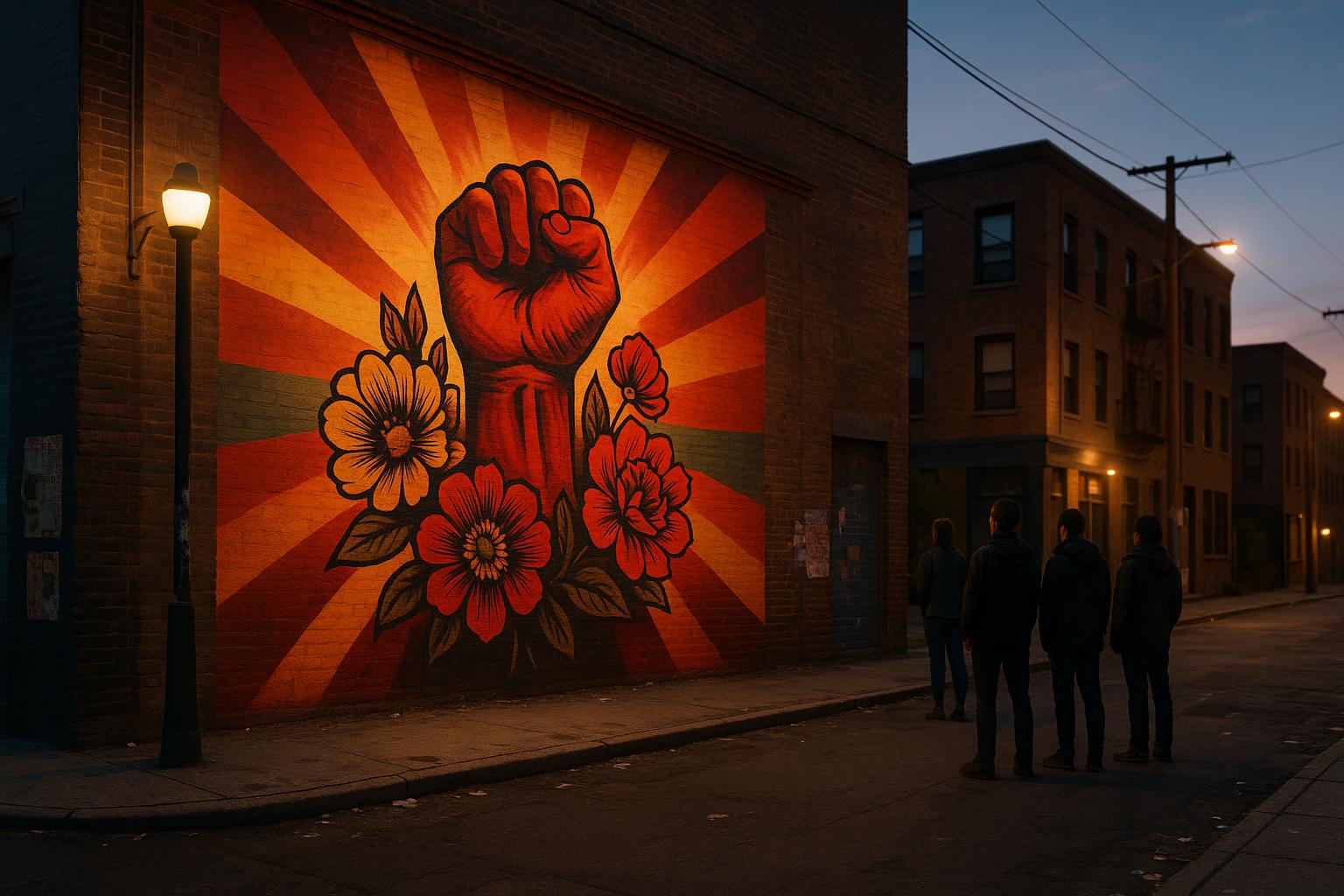
Street art isn’t just vandalism; it’s a tool for political expression. From ancient Roman graffiti to modern-day murals, street art amplifies marginalized voices and challenges power structures. Here’s what you need to know:
- Origins: Starting with graffiti in the 1960s, street art evolved into a platform for social commentary, especially during the 1970s in New York City.
- Protest Movements: It played key roles in events like the Paris 1968 revolts, Anti-Apartheid campaigns, and the Arab Spring.
- Techniques: Artists use stencils, wheat pasting, digital projections, and large murals to quickly spread messages or create lasting impressions.
- Modern Impact: Movements like Black Lives Matter and LGBTQ+ rights have used street art to drive awareness and unity.
- Challenges: Legal restrictions, gentrification, and institutional bias threaten its impact, but community programs and digital tools are helping preserve its legacy.
Street art remains a powerful, direct way to speak truth to power and inspire change.
Street Art’s Political Past
Beyond Vandalism
Street art has traveled a long road from being dismissed as vandalism to becoming a respected form of political expression. Its roots can be traced back to the 1st century BCE when Romans used brick walls to voice dissent against their rulers. The word "vandalism" itself emerged during the French Revolution, as rebels defaced elite art to protest societal hierarchies.
Fast forward to the late 1970s, New York City’s subway cars became a turning point for street art. Over 100,000 subway cars served as rolling canvases, transforming graffiti from simple territorial markings into a form of artistic expression. These subway "galleries" not only boosted the visibility of street artists but also began to shift public attitudes, lending legitimacy to their work.
Artists like Jean-Michel Basquiat epitomized this transformation by successfully transitioning from painting on subway walls to showcasing his work in prestigious galleries. His journey challenged the rigid boundaries of the traditional art world and sparked critical discussions about street art’s place in contemporary culture. This evolution solidified street art as a powerful medium for political protests.
"Many people are too quick to view street art through the lens of vandalism. They mistakenly believe that the artists are taking beautiful buildings and defacing them. And yet, most street artists work in neglected neighborhoods and place their work on ‘forgotten’ buildings. They look for the rundown building with paint chipped off, with weeds growing out of the sidewalk. Their motivation is to beautify these buildings and create something truly special. They believe that the art adds something to the city, creating an energy that enhances eroding buildings." – Marc and Sara Schiller
These shifts laid the groundwork for street art to play a central role in global protest movements.
Major Protest Moments
History is filled with examples of street art being used as a tool for political resistance. One of the most striking moments occurred during the May 1968 Paris student and worker revolts. The movement’s creative energy was unmatched, with the Atelier Populaire, a student-run poster workshop, producing 350–500 unique designs and printing 120,000–150,000 posters in just two months.
Other iconic examples of protest art include:
| Period | Movement | Impact |
|---|---|---|
| Late 1970s | Nicaraguan Revolution | The pinta and Augusto Sandino’s cowboy hat became symbols of resistance |
| Early 1980s | Anti-Apartheid Movement | "Free Mandela" stencils and portraits covered South African streets |
| 2001–2004 | Argentine Economic Crisis | Community groups used stencils and slogans to voice public dissent |
Beyond these moments, the Berlin Wall and the Arab Spring stand as landmarks in the history of street art as political expression. The Berlin Wall became a canvas for resistance, with its western side covered in vibrant murals while the eastern side remained bare – a stark reminder of the divide between free expression and authoritarian control.
"As press censorship increases, the writing on the wall has become required reading." – Sue Williamson
During the Arab Spring, walls became powerful platforms for political caricatures and memorials. These creations united communities, giving voice to their shared struggles and calls for change.
Egyptian street artist Ganzeer – Arab Spring 10 years on – BBC World Service
Message Delivery Methods
Street artists have developed various techniques to ensure their messages resonate politically while navigating the challenges of public spaces and legal boundaries. These methods focus on speed, visibility, and creating lasting impressions.
Quick-spread Methods
In fast-paced protests, street artists often rely on rapid techniques to deliver their messages effectively. Stenciling is a popular choice due to its efficiency and precision. It allows artists to produce detailed and reproducible images in a short amount of time. For example, Banksy has famously used stencils to address themes like consumerism, poverty, government surveillance, and human rights issues .
Wheat pasting is another go-to method, enabling artists to quickly put up large, pre-made images. This technique is particularly useful in dynamic political climates, as the temporary nature of the work allows for updates or replacements as events evolve.
Digital projection offers a modern twist, creating striking visuals on buildings or monuments without leaving a permanent mark. This method is especially effective at night, making it possible to deliver large-scale messages instantly and without physical traces.
| Technique | Advantages | Common Applications |
|---|---|---|
| Stenciling | Fast, reproducible, precise | Political slogans, iconic symbols |
| Wheat pasting | Quick installation, temporary, scalable | Protest posters, photo displays |
| Digital projection | No physical trace, immediate impact | Building-sized visuals, memorials |
Large-scale Impact
While quick methods ignite immediate reactions, large-scale works aim to create lasting impressions. Murals, for instance, often become powerful symbols of protest and serve as community gathering points. These works not only leave a visual mark but also gain extended reach through social media platforms like Instagram and Twitter, where they are shared widely, ensuring their influence persists even if the physical pieces are removed.
Public spaces are transformed into arenas for political discourse through large-scale art. JR’s “Inside Out” campaign is a prime example, using massive portrait installations to highlight themes of community identity and shared values .
Social media has amplified the reach of such works, turning them into global statements. The use of hashtags and online sharing preserves the impact of street art, allowing it to transcend its physical location.
Artists like Saype have taken large-scale art to new dimensions with projects like "Beyond Walls", which features interconnected hands painted using biodegradable materials. By extending street art beyond urban settings, these works make bold statements about social justice and unity.
Success Stories in Protest Art
These stories show how street art can turn public spaces into powerful platforms for political expression.
Black Lives Matter Art
Street art has played a crucial role in amplifying the message of the Black Lives Matter movement across the U.S. During the summer of 2020, as over 21 million adults joined protests against police brutality, artists transformed urban landscapes into vivid calls for racial justice.
On June 20, 2020, in Cleveland, artists Stamy Paul and Ricky Smith created a Black Lives Matter mural that combined imagery of unity and empowerment, including the poignant message, "Black women are beautiful".
"It was important for me to be a part in it, because it was me being heard, instead of being spoken for by someone else… I’m here to speak about the issues and truth of it." – Yoga, graffiti artist
In South Minneapolis, the Cup Foods convenience store became a site of remembrance through art. Artist Melodee Strong’s piece, "Mama," which portrays grieving Black mothers, captures the deep emotional impact of the movement.
| Location | Artist(s) | Impact |
|---|---|---|
| Cleveland, OH | Stamy Paul & Ricky Smith | Community-led mural promoting unity and empowerment |
| Richmond, VA | Meme & Community | Turned barriers around the Robert E. Lee statue into art |
| Palo Alto, CA | 16 Local Artists | Created a 245-foot-long BLM street mural |
| Minneapolis, MN | Melodee Strong | Memorial artwork at Cup Foods honoring the movement |
Street art’s influence extends beyond racial justice, serving as a voice for gender equality and LGBTQ+ rights.
Gender and LGBTQ+ Rights
Street art also takes a stand for gender equality and LGBTQ+ rights, creating space for conversations and challenging societal norms. The UN Women’s Mural Artivism Initiative brought together artists from around the globe to tackle gender stereotypes and advocate for equality.
In France, street artist Kashink’s "50 cakes of gay" project responded to anti-LGBTQ+ protests with murals that celebrated diversity and inclusion.
"Streets are my gallery. It is a form of therapy, and I am leaving a message for a better world." – Goran Kostovski-Indog
Since 2008, Jeremy Novy has been creating queer street art in cities like Milwaukee, Chicago, and San Francisco. His works, which include rainbow-colored Care Bears and stencils of drag icon Divine, aim to increase LGBTQ+ visibility.
"Gay imagery has a deeper conceptual meaning and when it’s created, it hopefully makes people ask themselves, ‘what is this?’ Hopefully it creates a discussion." – Jeremy Novy
From Gilbert Baker’s iconic rainbow flag at San Francisco’s 1978 Gay Freedom Day Parade to today’s murals advocating for equality, street art continues to inspire social change and bring communities together.
sbb-itb-593149b
Barriers and Solutions
Street artists often face a host of legal and systemic challenges that can stifle their creativity and impact. Finding ways to navigate these hurdles is key to ensuring the movement’s influence continues to grow.
Current Obstacles
One of the biggest issues is legal restrictions. In the U.S., any unauthorized artwork on public or private property is classified as vandalism, which can lead to fines or even jail time. For example, Los Angeles spends a staggering $7.5 million every year removing graffiti. In 2015 alone, the city cleared over 30 million square feet of graffiti from more than 600,000 locations.
Institutional bias is another significant challenge. A staggering 85.4% of museum staff and collections are dominated by White male artists. This lack of diversity makes it even harder for politically charged or socially conscious works to gain recognition or preservation.
Economic factors also play a role. Gentrification and corporate interests often lead to the erasure of political murals, replacing them with narratives that align more with commercial agendas.
"Unfortunately, art and artists have no special prerogatives from the perspective of law and law enforcement, which emanates from that portion of social consciousness that for the most part is insensible to aesthetic values." – J. T. Serra
| Barrier Type | Impact | Current Statistics |
|---|---|---|
| Legal | Fines and imprisonment risk | Varies by state/city jurisdiction |
| Institutional | Limited representation | 85.4% White curators and archivists |
| Economic | Gentrification-driven erasure | $7.5M spent annually on graffiti removal in LA |
Tackling these barriers is critical to preserving the voice and purpose of street art.
Moving Forward
To keep street art impactful and relevant, creative strategies are emerging to counter these challenges.
For instance, studies reveal that sanctioned murals can reduce vandalism by up to 95% while boosting nearby business revenues by 5–10%. Digital tools like augmented reality (AR) and online platforms are also stepping in to preserve and share political street art, ensuring its messages reach wider audiences even if the physical pieces are removed.
Community engagement programs are another game-changer. In San Francisco, what started as a small parking space art installation flourished into a citywide public art movement. This kind of collaboration between artists and property owners shows how systemic change can take root.
"The singular power of murals is to engage a community, defined geographically or through a common experience, to come together to find meaning and shared purpose, including action for social change." – Tebes et al
Conclusion
Street art has become a powerful tool in political protest movements, breaking down barriers and giving a platform to voices that might otherwise go unheard. By sidestepping traditional channels of communication, it has proven to be an effective way to spotlight marginalized communities and tackle urgent societal challenges.
Projects that push the boundaries of what street art can achieve continue to emerge. For instance, in 2019, Italian architect Carlo Ratti introduced a groundbreaking initiative in Turin: the world’s first crowdsourced graffiti created by drones. This project turned the city into a dynamic space for public dialogue. These technological innovations are extending the reach of street art while staying true to its mission of driving social change.
What makes street art so impactful is its ability to spark immediate conversations. Programs like MuralsDC have shown how partnerships between artists, local businesses, and neighborhoods can transform contentious areas into meaningful spaces for dialogue and reflection.
"Street art allows political messages to reach wide audiences… it bypasses traditional gatekeepers of information such as the media or political establishment. This democratic aspect of street art makes it a potent platform for political activism and participation."
Thanks to digital platforms and environmentally conscious initiatives, street art now transcends physical spaces, expanding its influence in new and exciting ways. Despite ongoing legal challenges and institutional pushback, street art remains a crucial avenue for political expression, continuing a long tradition of questioning authority.
The future of protest art will depend on its ability to evolve and continue amplifying underrepresented voices while addressing injustice. Artist Rose Jaffe captures this spirit perfectly:
"Art helps push the needle forward. And I think that art, in the form of social justice, is such a powerful way for people to express themselves about what’s going on and respond. It’s especially important that artists really show up and speak out about any number of topics that are happening right now."
FAQs
How has street art been used in political protests, and what are some key examples?
Street art has served as a dynamic platform for political expression, offering a voice to movements and individuals often sidelined by mainstream channels. It has consistently been a medium to confront injustices, ignite discussions, and push for societal change. In the United States, graffiti and murals gained momentum in the 1960s and 1970s, particularly during the anti-Vietnam War protests, where public spaces became vibrant backdrops for resistance and dissent.
Some striking examples of street art’s impact include Banksy’s evocative works, such as his mural on the West Bank barrier, shedding light on the struggles faced by Palestinians. Similarly, the wave of murals and graffiti that emerged worldwide after George Floyd’s death in 2020 underscored the urgency of addressing systemic racism and advancing social justice. These instances highlight how street art continues to provoke thought and inspire meaningful conversations about pressing issues.
What legal and institutional challenges do street artists face today, and how are they addressing these issues?
Street artists face tough hurdles, including strict anti-graffiti laws that can lead to fines, arrests, or even the removal of their creations. Cities like Los Angeles pour millions of dollars each year into graffiti removal efforts, making it even harder for artists to feel encouraged to produce public art. On top of that, the lack of legal protections leaves their work vulnerable to being destroyed or taken down without their consent.
In response to these challenges, many artists are seeking out legal pathways to continue their work. Some are applying for permits to create murals or teaming up on community art projects backed by local governments. These approaches not only give artists a legitimate space to showcase their talents but also help build public appreciation for street art. Others are using platforms like social media and grassroots campaigns to advocate for legal changes that would treat street art as a respected and protected form of expression.
How do technology and social media amplify the influence of street art in political protests?
The Role of Technology and Social Media in Amplifying Street Art’s Impact
Modern technology and social media have completely transformed how street art influences political movements. Platforms like Instagram and TikTok allow artists to share their creations instantly with a global audience, turning what might have been a local mural or graffiti piece into a worldwide statement. This instant accessibility enables both up-and-coming and well-known artists to connect, collaborate, and push their messages far beyond their immediate surroundings.
But social media isn’t just about showcasing art – it’s a powerful tool for organizing and inspiring action. Artists use these platforms to spark real-time conversations about social justice, rallying people around critical issues. Hashtags and viral campaigns amplify their work, creating a ripple effect that unites communities and fuels grassroots activism. This synergy between street art and technology ensures that important messages reach more people, helping to drive awareness and encourage collective change.