
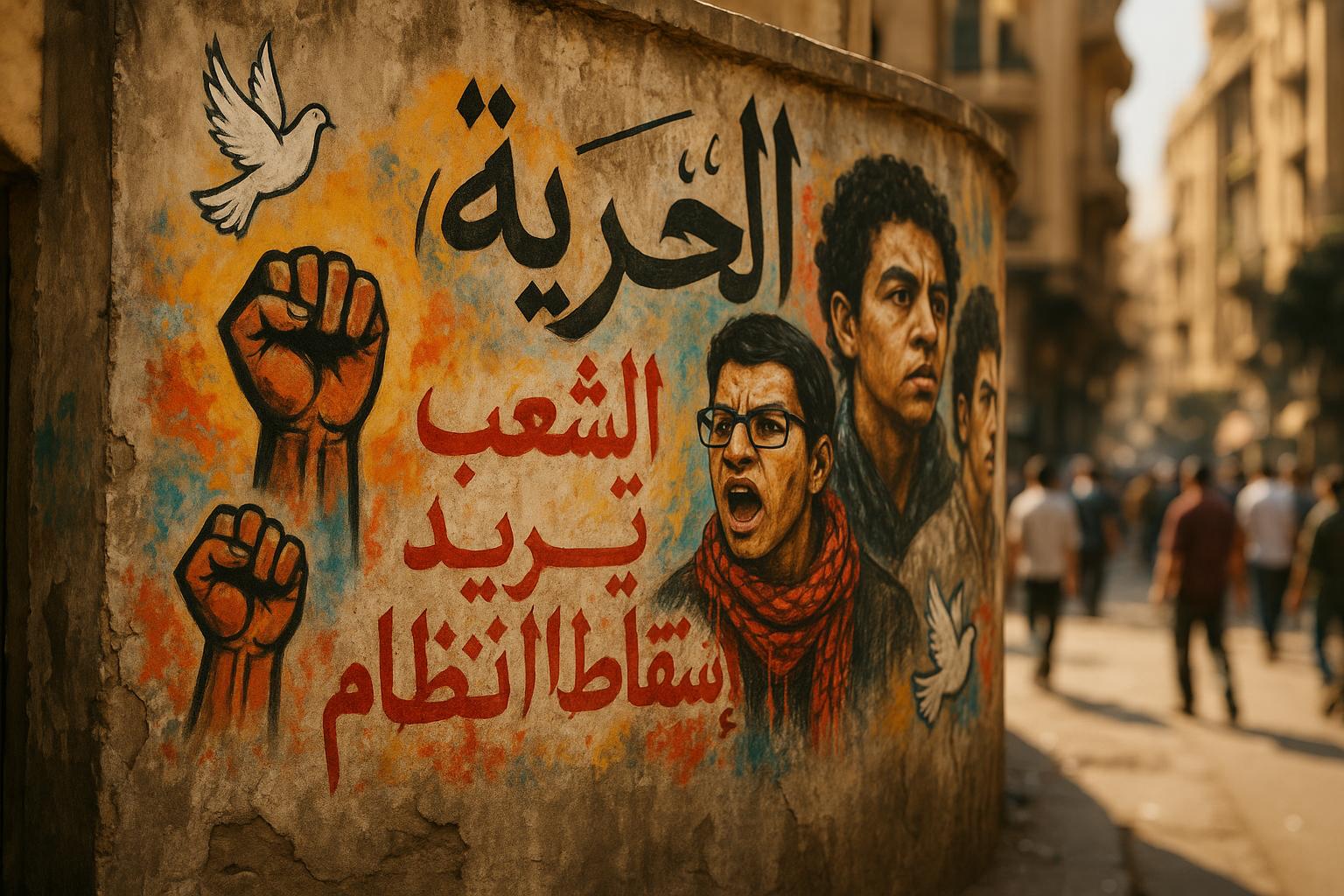
Graffiti became a powerful tool of resistance during Egypt’s 2011 uprising. It turned ordinary walls into platforms for defiance, documenting the revolution and uniting people in their fight for freedom. Here’s a quick summary of its impact:
- Voicing Protest: Graffiti bypassed censorship, allowing Egyptians to openly criticize the regime. It tackled issues like police brutality, corruption, and societal divisions.
- Honoring Martyrs: Murals commemorated those who lost their lives, preserving the revolution’s memory against government narratives.
- Rallying Support: Slogans and imagery boosted morale, encouraged collective action, and inspired solidarity across the Arab world.
- Key Artworks: Iconic pieces like Ganzeer’s "Tank Versus Bicycle" and Bahia Shehab’s "No" campaign became enduring symbols of resistance.
- Government Crackdown: Authorities erased revolutionary graffiti, replaced it with state-approved art, and criminalized street art to suppress dissent.
This street art movement didn’t just document history – it shaped it, proving that graffiti can be a powerful weapon in the fight for justice and freedom.
Bahia Shehab: A thousand times no
How Graffiti Served the 2011 Egyptian Uprising
During Egypt’s 2011 revolution, graffiti emerged as a bold and unfiltered form of resistance. Ordinary walls became canvases for political defiance and social commentary, giving voice to a nation demanding change.
Graffiti Gave Citizens a Voice
For decades, censorship stifled open expression in Egypt. But during the revolution, street art shattered those barriers, offering citizens a raw, unmediated way to challenge authority. Messages like "I want to see another president B4 I die" and the image of Oum Koulthoum on Boustan Street spoke directly to the regime, unmasking the frustrations of the people. Ganzeer, a prominent artist, captured this transformation:
"In general, what was interesting about Cairo was that the walls were becoming more and more alive and you started to see the conversation that was happening in society being almost reflected on the walls."
Graffiti also tackled deeply rooted social issues. One powerful stencil on Mohamed Mahmoud Street depicted three women – one unveiled, one wearing a headscarf, and one in a niqab – accompanied by the words "Don’t categorise me." This piece not only defied government oppression but also challenged societal divisions. The immediacy of these messages fueled collective action, creating a shared space for dialogue and protest.
Remembering Martyrs and Key Events
As the revolution unfolded, graffiti became a living memorial, honoring those who gave their lives for freedom. These murals documented events in real time, creating a "people’s history" that stood in stark contrast to official narratives. Sarah Awad, co-author of Street Art of Resistance, reflected on this phenomenon:
"Finally, these images today serve as a document for those times, from the voice of those who witnessed them, thus they form now part of the collective memory of the revolution that fights to persist in opposition to alternative official narratives."
Artists also used graffiti to call out oppressors by name. On Mohamed Mahmoud Street, a stencil depicted a police officer infamous for sexually assaulting female detainees, with the caption "Rapist of our daughters’ honour". This blend of commemoration and accountability made street art a powerful tool for both remembrance and resistance.
Using Graffiti to Rally Support
Graffiti wasn’t just about reflection – it was a rallying cry. Slogans like "Hold your head up, Egyptian" and "The people overthrew the regime. We won" appeared across Cairo, lifting spirits and reinforcing the revolution’s energy during uncertain times. The movement extended beyond Egypt’s borders, as artists used their work to express solidarity with uprisings across the Arab world.
In response to government crackdowns, graffiti became a creative weapon. After the infamous incident where a woman was publicly stripped during a protest, stencils of blue bras with the phrase "No to stripping the people" appeared, uniting citizens in outrage. When security forces erected walls to block streets in March 2012, artists launched the "ma-fish gudran" ("no walls") project, painting murals of open landscapes on the barriers to make them "disappear". Artist Ammar Abo Bakr highlighted the inclusive nature of this art form:
"… it is art with no rules, and it is available for everyone, unlike a private exhibition. And that is what is beautiful about it, you cannot target a certain audience or put expectations on what they will think of it."
This democratic approach allowed graffiti to reach all corners of society, bridging divides between street vendors, university professors, and everyone in between. It created a shared language of resistance that united a nation in its fight for freedom.
Key Locations and Artworks
During Egypt’s revolution, graffiti turned into a powerful medium of expression, with certain locations becoming iconic hubs for this art form. These spots not only showcased the creativity of the uprising but also captured the raw emotions and defiance of the people. They became living galleries, documenting the revolution’s story and embodying its enduring spirit.
Mohamed Mahmoud Street: A Stage for Resistance
Mohamed Mahmoud Street, connecting Tahrir Square to the Interior Ministry, became one of the most significant sites of the revolution. Its location made it a constant flashpoint for clashes between protesters and security forces, especially during the violent confrontations of November 2011. Over 90 lives were lost during these events, with countless others injured. The street came to symbolize both the pain of these tragedies and the resilience of the revolution.
One of the most poignant symbols to emerge from this period was the eye patch, representing defiance against state violence. Following the fall of Mubarak, activists transformed the street into an open-air gallery. The walls of nearby buildings, including the American University in Cairo, became canvases for bold artwork addressing issues like police brutality and the military’s trials of civilians.
As Hassiba Hadj Sahraoui from Amnesty International noted:
"The concrete barriers along Mohammed Mahmoud Street were meant to block freedom of assembly. Today, they serve as a whole new outlet for freedom of expression – the creative criticism of the authorities."
Art critic Soraya Morayef highlighted the street’s significance:
"This wall is the last standing evidence that a revolution took place."
Ganzeer’s "Tank Versus Bicycle": A Striking Symbol
Among the revolutionary artwork, Ganzeer’s "Tank Versus Bicycle" mural stood out as a powerful image of resistance. The mural depicted a man on a bicycle facing a tank, symbolizing the stark contrast between the military’s power and the people’s determination. In some versions, the cyclist is shown carrying the weight of the city on his head, adding layers of meaning to the struggle. This artwork directly challenged the military council’s authority, offering a counterpoint to the official slogan, "the people and the army are one hand".
Located in Zamalek, Central Cairo, the mural endured repeated attempts to erase it, yet its message persisted. Ganzeer himself captured the essence of his mission:
"Our only hope right now is to destroy the military council using the weapon of art."
The mural’s impact extended far beyond its physical presence, resonating through photographs, social media, and global news coverage.
Bahia Shehab’s "No" Campaign: Protest Through Calligraphy
Bahia Shehab brought classical Arabic calligraphy into the heart of the revolution with her "No" campaign. Using stencils of the word "No" in various styles, she protested against injustices with messages like "no to burning books", "no to a new pharaoh", "no to stripping the people", and "no to killing men of religion". Her work bridged centuries-old artistic traditions with urgent political commentary.
Shehab’s campaign inspired others to create stencils and symbols of resistance, showing how individual artistic efforts could spark broader movements. Reflecting on the fleeting nature of graffiti, she observed:
"The wall is no less than a documentation of the revolution… But many of us are just moving on and doing things elsewhere. Graffiti is always an ongoing story, I don’t see it as the end of anything. I think what is happening is a purely practical measure."
These key locations and artworks not only documented the revolution but also became lasting symbols of its ideals, ensuring that the spirit of resistance could not be silenced.
sbb-itb-593149b
Government Response to Revolutionary Graffiti
The Egyptian government’s swift removal of revolutionary graffiti highlighted its political significance and revealed the regime’s fear of losing control over the nation’s narrative.
Removing and Censoring Graffiti
Authorities launched an aggressive effort to wipe revolutionary graffiti from Cairo’s streets. Artist Salma described witnessing this systematic erasure:
"They are literally erasing all traces of the revolution. We have to keep the story because they are systematically erasing everything. It’s an agenda. Collective amnesia."
Graffiti artists also faced direct threats. When KZ was confronted by authorities, they warned:
"You are part of the graffiti people vandalizing the country, if we see you here again you will not get away with this."
The crackdown extended beyond intimidation. By 2015, a draft law targeted "abusive graffiti art", threatening artists with up to four years in prison or fines of 100,000 Egyptian pounds (roughly $3,200).
While silencing dissent through erasure was one strategy, the government also sought to replace revolutionary art with state-approved imagery.
Government-Sponsored Street Art
In addition to removing revolutionary graffiti, the regime actively worked to reshape public spaces with its own narrative. Downtown Cairo facades were repainted, politically charged walls were whitewashed, and a monument was installed in Tahrir Square under CCTV surveillance. The 2013 anti-demonstration law further escalated this effort, leading to mass arrests and forcing prominent artists like Ganzeer to flee after being targeted by defamation campaigns. Nationalist rhetoric amplified these actions, framing criticism as unpatriotic and bolstering the regime’s control over public perception.
Sociologist Mona Abaza reflected on the transformation:
"The cleanup of downtown is about giving a sense of order in post-January 2011 Cairo… All of us are in denial. Tahrir is over, and the graffiti is part of it. We had four years of trauma – killings and euphoria – but humans need normalcy. And the normalcy is this order."
Despite the government’s efforts to erase and co-opt revolutionary art, resistance persisted. In May 2011, Ganzeer initiated the first Med Graffiti Week to protest censorship and military trials of civilians. Other movements, such as the "Mafish Gudran" (No Walls) project, continued to challenge the imposed order. Graffiti artist KZ summed up this defiance:
"Of course they fear graffiti, because if they didn’t find it powerful they would have left it. It makes me proud that a whole government is nervous about my work."
Long-term Impact of Political Graffiti
The revolutionary graffiti of 2011 left a lasting impression that went far beyond Egypt’s borders. It redefined street art as both a tool for political resistance and a way to preserve collective memory.
Keeping the Revolution Alive Through Art
In Egypt, graffiti became more than just protest art – it turned fleeting demonstrations into a permanent record of revolutionary history. After the destruction of critical historical archives in December 2011, street artists stepped up as unofficial historians, capturing the spirit of the revolution on Cairo’s walls.
One powerful moment came in the fall of 2012, when 2,000 protesters repainted the whitewashed walls of Mohamed Mahmoud Street. This act of defiance was a public commitment to preserving the revolution’s memory. Religious Studies researcher Giulia Giubergia highlighted the significance of this art:
"Through examining this kind of material, you can shed light on the multifaceted and at times conflicting narratives about the uprising that were produced and reproduced on the walls, streets and squares of Downtown Cairo."
Mural artist Hanaa Degham drew a connection between Egypt’s ancient history and its modern struggles:
"When you walk into an Ancient Egyptian tomb, it is a place where you would feel relief . . . And you would feel it was as if that was the real home of the Ancient Egyptian."
Artists like Alaa Awad used their work to merge Egypt’s past and present. In February 2012, Awad painted a mural mourning the deaths of over 70 people in a soccer match riot, blending contemporary tragedy with imagery inspired by pharaonic traditions.
But this movement wasn’t just about preserving local history. Egyptian revolutionary graffiti gained international recognition, becoming a symbol of resistance worldwide.
International Recognition of Egyptian Street Art
The visual power of Egyptian street art allowed it to transcend language barriers and resonate globally. As street art researcher Caram Kapp explained:
"Street art served as an easily shareable site for opinions within Egypt, but its visual nature allowed it to become an understandable source of information for those following events outside the country. It created symbols that were used in human rights campaigns and gave the cause a continuing relevance."
The influence of Egypt’s revolutionary graffiti spread across the Arab world, inspiring protests in Libya, Syria, and beyond. Political scientist Lina Khatib emphasized Egypt’s pivotal role:
"The 25 January revolution was distinct not only because of Egypt’s importance in the politics of the Arab world, but also because it foregrounded forms of political expression that had an impact on political protests across the region."
Certain symbols gained iconic status. For instance, the "blue bra" stencil – created in response to a woman being beaten by police – became a powerful emblem of the Arab Spring and appeared widely across Cairo. Artist Basma Hamdy reflected on the impact of this art:
"Street art raised awareness. It asked difficult questions and exposed truths, becoming a key tool for empowering citizens. The insistence by artists to remain in the street for days and months on end to communicate their message is what I found remarkable."
Egyptian artists like Ganzeer also gained global attention. His mural of a tank facing off against a bicycle became a striking symbol of resistance, though Ganzeer maintained his focus on his local audience:
"The work I did was in Egypt for Egyptians."
Revolutionary graffiti didn’t just stop at political messages. It opened up space for conversations about previously taboo topics, such as gender issues and sexual harassment. Artist Bahia Shehab captured the sense of empowerment this movement brought:
"The streets were literally covered with our marks, and it gave us agency, and it gave us a feeling of belonging – and it made us feel as though the city was ours for a change." [21]
Even as some of the original artwork has been lost, its influence continues to inspire activists worldwide. Reflecting on this legacy, a blogger noted:
"What we have lost was a beautiful work of art; what we have gained is fresh fury and ignited debate."
Conclusion
The graffiti born out of Egypt’s 2011 uprising was far more than mere vandalism – it became a bold declaration of the transformative power of art in times of social and political upheaval. From the vivid murals on Mohamed Mahmoud Street to the stenciled messages scattered across Cairo, these works of art gave voice to a revolution that refused to be silenced.
This revolutionary graffiti shattered societal barriers, opening channels of dialogue that transcended literacy. It gave everyday citizens a new way to protest – one that bypassed the limitations of traditional communication methods. The streets turned into a living canvas, reflecting the people’s frustrations with the Mubarak regime and their aspirations for a democratic future. Yet, this surge of creativity and defiance was met with an intense government crackdown.
The regime’s response, including the 2015 draft law threatening up to four years in prison for graffiti, revealed just how powerful these visual messages had become. The fear they inspired in officials underscored the undeniable strength of street art as a form of resistance.
Graffiti in Egypt served a dual purpose: it was both a weapon of immediate resistance during the uprising and a witness to history, preserving moments that might otherwise have been erased from collective memory. The murals that still adorn Cairo’s streets stand as enduring reminders of this period, proving that art can be a lasting tool for political expression and historical documentation.
The impact of Egypt’s graffiti revolution reaches far beyond the walls of Cairo. It demonstrates how art can reclaim public spaces, unite diverse groups, and preserve the legacy of social movements for future generations. At a time when governments increasingly dominate traditional media, these artworks transformed the streets into an unfiltered newsroom, where citizens shared their truths.
For those seeking to understand the essence of grassroots resistance, Egypt’s 2011 graffiti offers a compelling lesson. From the murals on Mohamed Mahmoud Street to the unforgettable "Tank Versus Bicycle" image, these creations captured the spirit of a revolution. They remind us that some of the most powerful political statements don’t come from parliaments or podiums but from the fearless act of painting dissent onto a wall.
FAQs
How did graffiti play a role in giving Egyptians a voice during the 2011 uprising?
During Egypt’s 2011 uprising, graffiti emerged as a powerful tool for political expression, cutting through government censorship and giving a voice to everyday people. Public spaces became vibrant platforms for dissent as artists used murals and street art to challenge state propaganda and bring attention to the struggles of the revolution. One particularly striking mural depicted a tank facing off against a boy on a bicycle – a haunting image that captured the regime’s violent oppression.
Beyond individual acts of expression, graffiti played a key role in uniting communities. It honored the martyrs, articulated demands for change, and conveyed messages in both Arabic and English, ensuring they resonated with both local and international audiences. This grassroots art movement didn’t just chronicle the revolution; it fostered a sense of solidarity among protesters, transforming the streets into a vivid canvas of resistance and hope.
How did graffiti honor martyrs and highlight key moments during Egypt’s 2011 revolution?
Graffiti played a striking role in Egypt’s 2011 revolution, becoming a vivid medium of both remembrance and resistance. Streets like Mohammad Mahmoud Street turned into open-air galleries, where murals brought the faces and stories of martyrs to life. These pieces didn’t just honor those who gave their lives – they also kept the memory of key events alive, creating a shared narrative that united citizens in their fight for change.
Through this street art, the raw emotions of the revolution were etched onto public walls, giving a voice to the collective call for justice. These walls became living records of history, ensuring the sacrifices and messages of the uprising stayed visible and resonant long after the protests had ended.
How did the Egyptian government react to political graffiti during the 2011 revolution, and what effect did this have on the movement?
During Egypt’s 2011 revolution, political graffiti became a powerful voice for freedom and resistance, spreading across Cairo’s walls with messages aimed squarely at the Mubarak regime. At first, the government seemed to turn a blind eye, allowing these bold expressions to flourish. But after Mubarak was ousted, the tide turned. Authorities began targeting graffiti, criminalizing it, issuing fines, and even erasing iconic murals that had come to symbolize the revolution. Many saw this as an attempt to wipe away the memory of the uprising.
This crackdown had a profound effect on the movement. Graffiti, once a vivid emblem of hope and defiance, was silenced, leaving many feeling as though a vital connection to the revolution’s spirit had been severed.
