
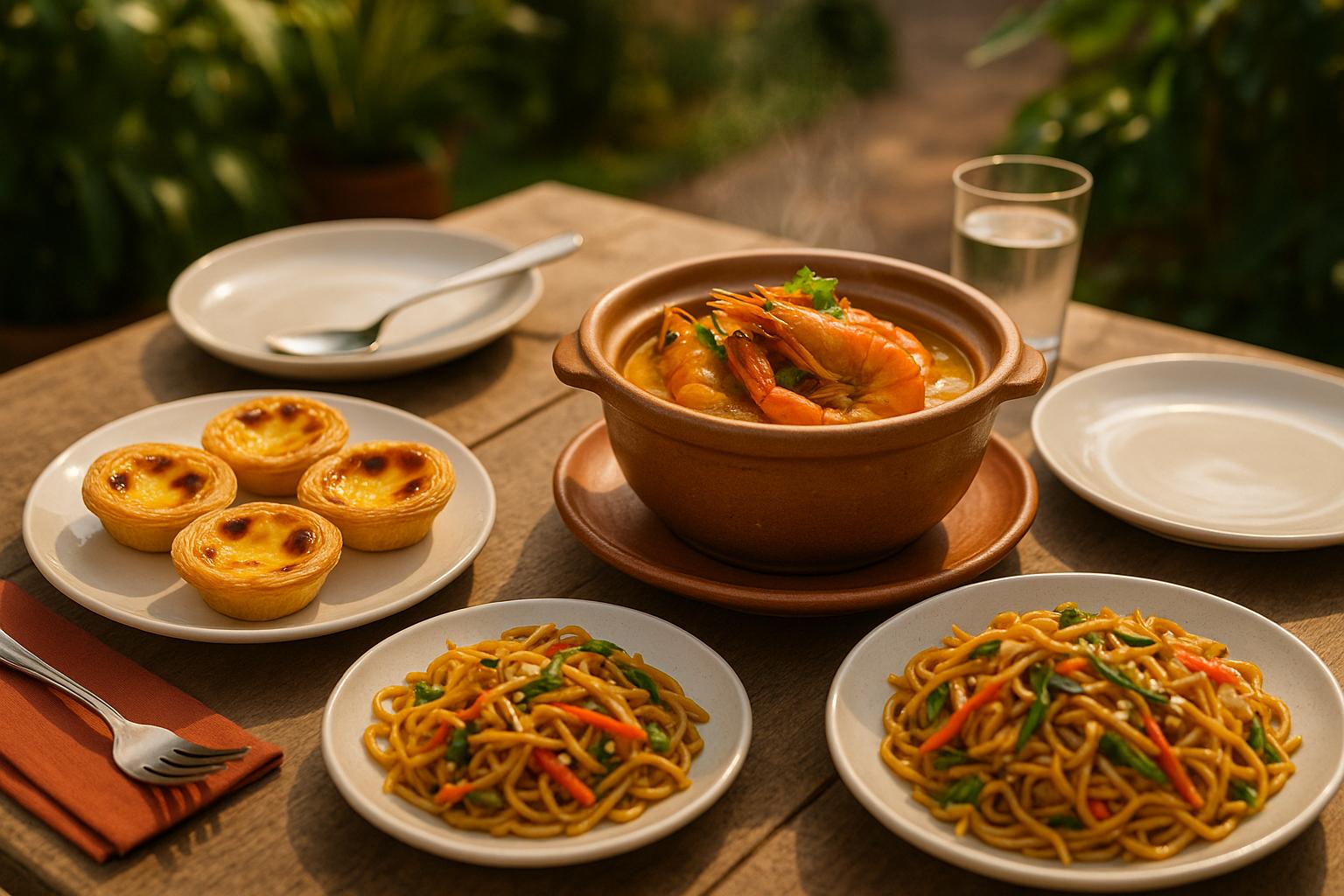
Macanese cuisine is a blend of Portuguese and Chinese culinary traditions, dating back to the 16th century when Portuguese settlers adapted their recipes using local Chinese ingredients in Macau. Recognized by UNESCO as the world’s first fusion cuisine, it combines Portuguese staples like olive oil and salted cod with Chinese soy sauce, shrimp paste, and cooking techniques.
Quick Highlights:
- Origins: Began in 1557 when Macau became a Portuguese trading post.
- Key Ingredients: Portuguese olive oil, Chinese soy sauce, Indian turmeric, South American chilies, and Malaysian coconut milk.
- Cooking Techniques: Mix of Portuguese roasting and Chinese wok-frying.
- Signature Dishes: Minchi (minced meat stir-fry), African Chicken (spiced, coconut-flavored chicken), and Macau Egg Tarts (custard-filled pastries).
Macanese food is a testament to cultural exchange, blending global spices and techniques into dishes that balance tradition with creativity. It’s not just food – it’s history on a plate.
This Asian City is Home to the World’s First Fusion Food | City Bites Macau Edition Ep1
How Macanese Cuisine Started
Macanese cuisine traces its roots back to the 16th century, born out of necessity at a bustling trading post. When Portugal established control over Macau in 1557, they unknowingly sparked the creation of what many now regard as the world’s first fusion cuisine. This unique culinary tradition emerged from the blending of Portuguese and Chinese food cultures.
Portuguese Settlers in Macau
The Portuguese settlers brought with them not only their seafaring spirit but also essential food preservation techniques and staple ingredients like fish, seafood, pork, salt, bread, sugar, and vinegar. These items became the backbone of early Macanese cooking.
A pivotal factor in this fusion was the intermarriage between Portuguese sailors and local women from Macau and nearby trading regions. As Noreen Sousa explains:
"Many of these [Portuguese] sailors intermarried with Chinese women from Macao, as well as Goan, Malay, and Southeast Asian women. The wives would cook their own dishes but also to try to please their husbands. They would make do with what they had to replicate the dishes their husbands were used to."
This blending of culinary traditions wasn’t rigid. The Portuguese adapted readily to local practices, embracing the need to work with available ingredients. This openness laid the groundwork for the inventive and resourceful cooking that defines Macanese cuisine.
Chinese Cooking Methods
While Portuguese flavors provided the foundation, it was Chinese cooking methods that transformed these recipes into something entirely new. Cantonese techniques and local ingredients played a vital role in shaping the cuisine. Chinese cooks didn’t merely swap ingredients – they reimagined Portuguese recipes through their own culinary lens.
Soy sauce became a defining element of Macanese food, alongside native additions like shrimp paste, Shaoxing wine, star anise, and lap cheong. Cooking techniques such as steaming and wok-frying were seamlessly integrated, resulting in dishes like chau-chau.
As the Michelin Guide notes:
"The hallmark of Macanese cuisine is its rich blend of ingredients, a testament to Portugal’s vast maritime reach… Absent from traditional Cantonese fare, these ingredients, in conjunction with local ingenuity, underwent an artful fusion with Cantonese culinary techniques."
This creative interplay gave rise to dishes like Tacho, a Macanese spin on the Portuguese cozido à portuguesa. This stew combines northern Portuguese boiled meats and sausages with Southern Chinese cured meats, local vegetables, and balichão, a uniquely Macanese shrimp paste.
Spices from Maritime Trade
The Portuguese maritime trade brought an array of global spices that elevated Macanese cuisine. Ingredients from across the world – Mediterranean bay leaves, Indonesian coconut milk, Indian turmeric and tamarind, South American chilies, tomatoes, and potatoes – found their way into local kitchens via Portuguese trade routes.
One standout example of this spice-driven creativity is African Chicken. This dish combines Indian spices, Malaysian and Indonesian coconut, Portuguese bay leaves and rosemary, Cantonese five-spice, and fiery chilies from the Americas. The Portuguese, as the first Europeans to grasp the culinary potential of Asian spices, played a key role in introducing these flavors to European and Macanese kitchens alike.
Preservation techniques developed for sea voyages – like drying, salting, and sugaring – were also adapted to local ingredients and Chinese cooking methods. The result was a cuisine that masterfully blended Portuguese traditions, Chinese techniques, and international flavors into something entirely its own. Macanese cuisine is a vivid example of how cultures can come together to create something extraordinary.
What Makes Macanese Cuisine Different
Macanese cuisine is a fascinating blend of Portuguese, Chinese, and Southeast Asian culinary traditions, making it widely recognized as one of the world’s earliest examples of fusion food. This unique combination of cultures influences every aspect of the cuisine, from the choice of ingredients to the final touches of seasoning. While some might mistakenly label it as a variation of Cantonese cooking, Macanese dishes actually share closer ties with Peranakan cuisine from Southeast Asia.
Main Ingredients
The foundation of Macanese cooking lies in its seamless mix of Portuguese staples, Chinese essentials, and ingredients introduced through Portugal’s maritime history. In a Macanese kitchen, you’ll find Portuguese olive oil and bacalhau (salted cod) sitting alongside Chinese soy sauce. But the true magic happens when these familiar elements are combined with more exotic flavors.
Take balichão, for instance – a signature shrimp paste crafted from dried shrimp, salt, lemon zest, black pepper, dried chili, and whisky. This ingredient is a hallmark of Macanese cuisine. Other spices and ingredients reflect Portugal’s global explorations: turmeric and tamarind from India add earthy and tangy notes, while coconut milk from Malaysia and Indonesia provides a rich, creamy texture. South America also left its mark, introducing chili peppers, tomatoes, and potatoes to Asian cooking as early as the 16th century. Even sausages tell a story – Portuguese chouriço meets Chinese lap cheong, resulting in flavor combinations that are uniquely Macanese.
Cooking Methods
Macanese cuisine is as much about technique as it is about ingredients. It combines European methods like roasting, grilling, and slow braising with Chinese techniques such as stir-frying, steaming, and wok cooking. Chef Luciano Lam captures this fusion perfectly:
"Macanese cuisine uses both Portuguese and Cantonese techniques, for example we use the wok for cooking Portuguese ingredients."
This blending of methods creates dishes that wouldn’t be possible within a single culinary tradition.
Spices and Sauces
The influence of Portuguese maritime exploration is especially evident in Macanese spice blends, as highlighted by the Michelin Guide. Turmeric adds color and warmth, while coconut milk introduces a creamy richness that sets it apart from traditional Cantonese cooking. Spices like cinnamon, saffron, coriander, cumin, cloves, curry powder, and fenugreek build intricate layers of flavor. Meanwhile, soy sauce acts as a bridge between Portuguese and Chinese elements, and shrimp paste delivers an essential umami punch.
What makes Macanese seasoning stand out is its balance and subtlety. By using locally available ingredients to recreate familiar flavors, this cuisine manages to honor its diverse roots while forging something entirely its own. This harmonious interplay of spices and techniques defines Macanese cuisine and gives rise to its signature dishes.
sbb-itb-593149b
Famous Macanese Dishes
Macanese cuisine is a vibrant tapestry of flavors, shaped by centuries of cultural exchange. Its signature dishes tell the story of Portuguese settlers, Chinese cooks, and global traders who contributed to a culinary tradition that has thrived for over 400 years. Often hailed as the world’s first fusion cuisine, Macanese food captures this unique blend beautifully. Let’s take a closer look at some of its most iconic dishes.
Minchi
Minchi is often referred to as the heart and soul of Macanese cooking, a dish so beloved that it’s considered Macau’s national treasure. The name "minchi" is thought to come from the English word "mince", a nod to the international influences that permeate Macau’s culinary lexicon. This humble yet flavorful stir-fry combines minced meat, potatoes, onions, and a medley of seasonings like Worcestershire sauce, molasses, and soy sauce. Add a fried egg on top, and it transforms into "minchi chow dan", a comforting meal that’s both simple and satisfying.
What sets minchi apart is its deep-rooted place in everyday life. As Manuel António de Jesus from Cozinha Aida shares:
"When I was little, mothers made it daily because it was simple and boneless. There’s no season for this dish; it’s our everyday food."
At Cozinha Aida, the dish is prepared exclusively with pork, reflecting local preferences, as pork is often favored over beef in Macau. Some culinary experts even trace minchi’s origins to Goan beef mince, adding another layer of history to this cherished recipe.
African Chicken
African Chicken, or "galinha à Africana", is a shining example of Macanese fusion at its finest. This dish brings together Portuguese cooking techniques, African spices, and Chinese flavor profiles to create something entirely unique. It was first developed in the 1940s by Macanese chef Américo Ângelo at the Pousada de Macau hotel after a trip to Mozambique. According to Manuela Sales da Silva Ferreira, owner of Restaurante Litoral:
"Américo Ângelo created the sauce because a lot of people in Macau at that time did not like barbecued chicken to be dry."
The star of the dish is its rich piri-piri sauce, a bold glaze made with a mix of African spices, garlic, peanut butter, coconut milk, tomato, peppers, and wine. The result is a barbecued chicken that’s juicy, flavorful, and perfectly balanced for both Portuguese and Chinese palates.
Macau Egg Tarts
Macau’s egg tarts are perhaps the most recognizable symbol of its culinary ingenuity. These custard-filled pastries, inspired by both English and Portuguese traditions, have been reimagined in Macau to suit local tastes. The journey began in 1989 when British pharmacist Andrew Stow and his wife Margaret Wong opened Lord Stow’s Bakery in Coloane Village. Their version of the Portuguese pastel de nata was tailored to appeal to Cantonese preferences, resulting in a smoother, creamier custard .
Locals soon nicknamed them p’ou tát ("Portuguese egg tarts") to differentiate them from other Chinese pastries. Unlike the Portuguese original, which often features hints of cinnamon and lemon, Macau’s egg tarts focus on the pure flavors of custard and pastry. Lord Stow’s also uses margarine instead of butter to achieve a crispier texture, with a signature caramelized top that sets them apart .
These egg tarts have earned a spot on Macau’s inventory of protected Intangible Cultural Heritage elements, highlighting their importance to the region’s identity. Each bite not only delivers a burst of flavor but also carries the story of Macanese history and its enduring legacy.
Macanese Cuisine Today
Macanese cuisine finds itself at an interesting juncture, balancing the preservation of its rich heritage with the demands of modern dining. This unique culinary tradition is navigating its way through contemporary trends while striving to stay true to its roots.
Modern Restaurant Versions
Once confined to family kitchens, Macanese cuisine is now making its mark in professional restaurants, bringing its distinctive flavors to a wider audience. Historically, these dishes were lovingly prepared at home, passed down through generations. Today, chefs are reimagining these recipes for modern diners, ensuring that the essence of the cuisine remains intact.
In 2019, Chef Antonieta Fernandes Manhão, affectionately called Chef Neta, partnered with The Manor at the St. Regis Macao hotel to craft a special chá gordo menu. This collaboration introduced the traditional Macanese afternoon tea experience to an upscale international setting, giving visitors a chance to savor authentic Macanese flavors they might not have encountered otherwise. Beyond her work in restaurants, Chef Neta also conducts cooking classes in Macao, sharing her knowledge with both locals and tourists, keeping the culinary tradition alive and accessible.
The year 2024 saw further strides in modern Macanese dining. Casa Maquista opened its doors in Taipa, offering traditional dishes in a beautifully restored heritage home. Chefs Pedro and Mauro Almeida have made it their mission to honor traditional cooking techniques in this unique space. Around the same time, Florita Alves introduced a dedicated Macanese menu at her family’s restaurant, La Famiglia, located in Taipa Village. Through her menu, Alves reaffirms her dedication to preserving her cultural heritage through food.
However, adapting these traditional recipes for modern kitchens isn’t without challenges. Ingredients like balichão (fermented shrimp paste) and tamarind are becoming harder to source, forcing chefs to find substitutes that stay true to the original flavors. Additionally, the intricate and time-consuming preparation of many Macanese dishes can be difficult to replicate in commercial kitchens.
"We don’t want the cuisine to disappear in the future. If we do nothing, in 10 years it will be gone. Tourists come to Macao and eat Portuguese food and think they have tried Macanese food – but it’s not the same. We need to educate them on the real Macanese food."
Despite these hurdles, Macanese cuisine continues to evolve while staying rooted in its rich history. These modern interpretations not only keep the tradition alive but also highlight its lasting impact on global culinary trends.
Impact on Other Fusion Foods
As Macanese cuisine experiences a revival, its influence on global fusion food becomes even clearer. Widely recognized as the world’s first documented fusion cuisine, dating back to the 16th century, it set the standard for blending diverse ingredients and techniques. This timeless approach continues to inspire chefs around the world.
What makes Macanese cuisine a standout in the fusion food landscape is its authenticity, which stems from necessity. Born from the intermarriage of Portuguese settlers and local Chinese women, the cuisine emerged as a way to cater to diverse tastes using locally available ingredients.
Take Macau’s egg tarts, for example. In 1989, Andrew Stow reimagined the Portuguese pastel de nata, tweaking the recipe to suit local preferences. The result? A dessert that became a global sensation, showcasing how fusion cuisine can respect tradition while appealing to new audiences.
Today, chefs working in fusion cuisine aim to strike a balance between innovation and respect for traditional flavors. Macanese cuisine serves as a powerful example of how thoughtful blending of ingredients, combined with a deep understanding of cultural history, can create something truly memorable. It’s not just about the food – it’s about preserving the stories and traditions behind it.
With a population of just 1,000 in a city of over 663,400, the Macanese community exemplifies how minority food cultures can maintain their identity while influencing broader culinary trends. As Florita Alves puts it:
"When you are in a minority, you will find that you need to find a way to stand out to let the people know that you still exist. We need to have something to identify us and I hope it’s our food. Otherwise we will just disappear."
Conclusion: A Timeless Fusion
Macanese cuisine stands as a living testament to centuries of cultural exchange and culinary creativity. With roots stretching back over 450 years to the 16th century, it earned recognition from UNESCO as a fusion cuisine long before the term became part of our everyday vocabulary.
What makes Macanese food so special is its organic evolution. It all began in 1557 when Portuguese recipes were adapted to fit local tastes and ingredients, giving birth to a cuisine that was neither purely Portuguese nor entirely Cantonese. This wasn’t just a simple merging of two culinary styles – it was the creation of something entirely new. Over time, Macanese food grew into a true Creole cuisine, shaped by the spices and influences brought in through Portuguese maritime trade. The result? Dishes that often feel closer to Peranakan cuisine than traditional Cantonese fare.
Even today, Macanese cuisine remains a vibrant symbol of cultural identity and resilience, despite the small size of its community. As Florita Alves, a passionate Macanese cook, so eloquently explains:
"When you are in a minority, you will find that you need to find a way to stand out to let the people know that you still exist. We need to have something to identify us and I hope it’s our food. Otherwise we will just disappear."
What makes Macanese cuisine truly inspiring is the lesson it offers to modern fusion cooking. It shows that authentic fusion requires more than just mixing ingredients – it demands time, shared experiences, and a genuine exchange of cultures. Its evolution, born out of necessity and adaptation, respects tradition while embracing innovation.
For anyone passionate about fusion cuisine, Macanese food serves as a guiding light. It reminds us that when tradition and creativity are balanced, the result can be a culinary legacy that not only delights the palate but also preserves a rich cultural heritage for generations to come.
FAQs
How did Portuguese settlers and local Chinese communities shape Macanese cuisine?
Macanese cuisine, often hailed as the world’s first fusion food, emerged from the blending of Portuguese settlers’ culinary traditions with local Chinese influences. A significant factor in this culinary evolution was the intermarriage between Portuguese settlers and local women. These women creatively adapted Portuguese recipes by incorporating locally available ingredients and Chinese cooking techniques.
This exchange of culinary traditions gave rise to a distinct food culture. Macanese dishes are known for their bold use of Portuguese spices like cinnamon and turmeric, combined with Chinese staples such as soy sauce and rice. The result is a cuisine that tells the story of Macau’s unique history, offering a flavorful blend of East and West on every plate.
What challenges do chefs face when trying to preserve traditional Macanese cuisine?
Chefs working to keep traditional Macanese cuisine alive face a host of modern challenges. One major hurdle is finding authentic ingredients. Over time, changes in farming practices and global supply chains have made some key components rare or even unavailable, making it tough to capture the original flavors that define these dishes.
Another issue is the labor-intensive nature of traditional cooking techniques. Many younger chefs are opting for faster, more modern methods, which risks the gradual disappearance of the skills and knowledge essential for preparing these time-honored recipes. This shift between generations threatens the continuity of Macanese culinary traditions.
Still, there’s a growing effort to honor and preserve this unique fusion of Portuguese and Chinese influences, ensuring that its rich legacy is passed down to future generations.
What makes Macanese cuisine unique compared to other fusion cuisines like Peranakan or Cantonese food?
Macanese cuisine is a fascinating blend of Portuguese and Chinese culinary traditions, deeply influenced by Cantonese flavors. What sets it apart from something like Peranakan cuisine – known for combining Chinese and Malay influences with Southeast Asian staples like lemongrass and galangal – is its use of ingredients tied to Portugal’s global trade routes. Think turmeric, coconut milk, and an array of spices from former Portuguese colonies, all contributing to a flavor profile that proudly showcases its Portuguese roots.
While Cantonese cuisine is celebrated for its focus on fresh ingredients and straightforward cooking methods, Macanese cooking leans into techniques like baking and roasting, which bring out richer, more layered flavors. A perfect example of this is Macanese minchi, a comforting dish of ground meat seasoned with soy sauce and spices. It’s a delicious snapshot of how Portuguese and Chinese culinary elements come together seamlessly in this unique cuisine.