
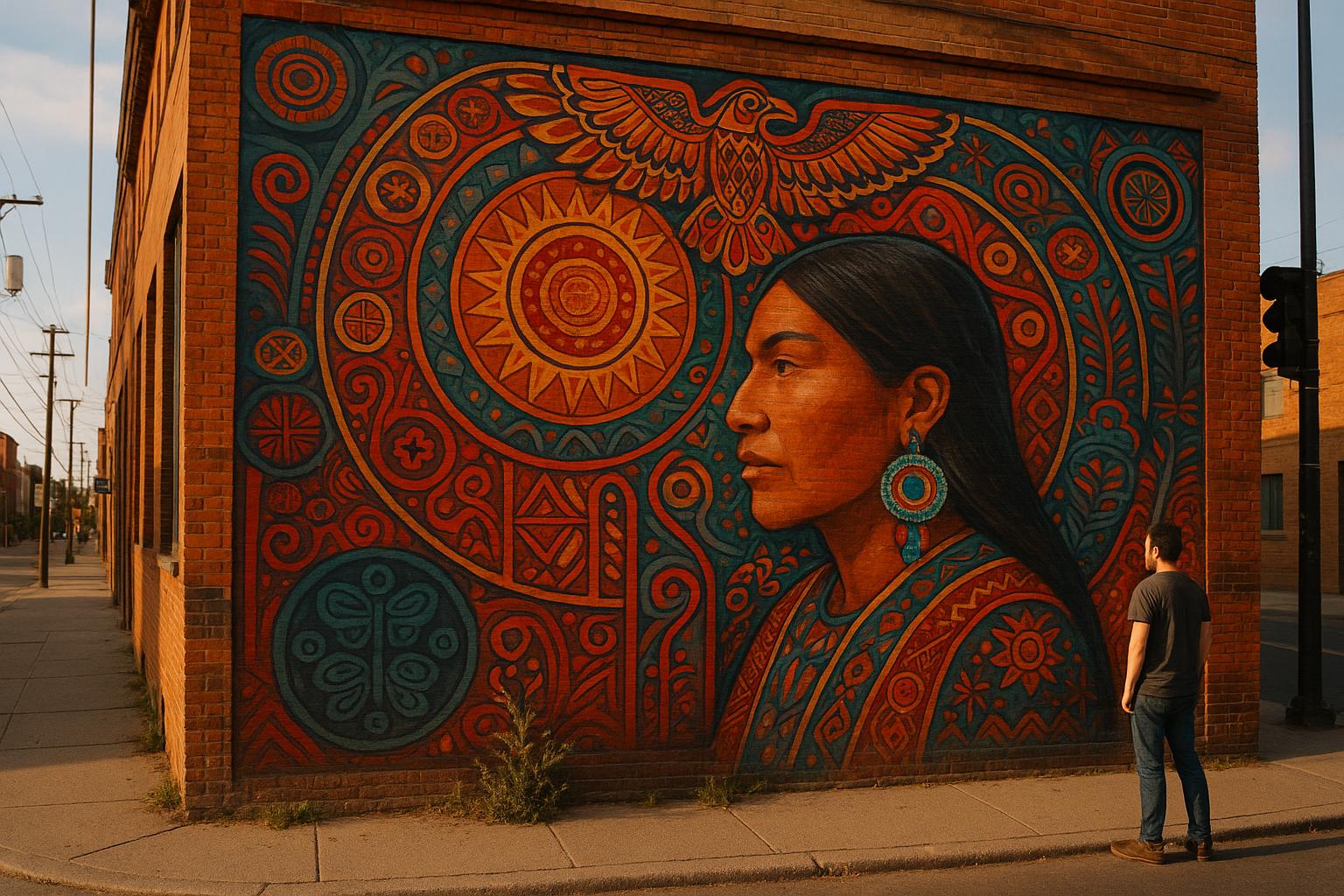
Indigenous street art is more than just murals – it’s a form of reclaiming space, telling stories, and challenging colonial narratives. Artists transform urban walls into messages of resilience, cultural identity, and activism. Here’s what you need to know:
- Purpose: Indigenous street art reclaims public spaces and asserts sovereignty.
- Themes: It highlights ancestral knowledge, environmental justice, and social issues.
- Methods: Artists blend ancient symbols with modern techniques, creating a bridge between past and present.
- Impact: It raises awareness, fosters community pride, and challenges systemic erasure.
This art form isn’t confined to galleries – it’s a movement that makes Indigenous voices visible in the streets, sparking conversations about history, identity, and justice.
Origins of Indigenous Street Art
Traditional Art Forms and Symbols
Indigenous street art finds its roots in ancient traditions that stretch back tens of thousands of years. Aboriginal culture, one of the oldest continuous cultures in the world, is thought to date back 60,000 years, with rock art creations spanning over 20,000 years. These traditional art forms often use symbols as a way to tell stories, conveying survival knowledge, cultural identity, and a profound relationship with the land. These symbols carry layered meanings, understood across generations, from the youngest to the oldest members of the community.
Contemporary Indigenous street artists, like Reko Rennie, who is of Kamilaroi descent, blend these ancient traditions with modern mediums such as graffiti. Rennie incorporates traditional patterns into his urban art, creating a unique dialogue between the past and present. As he explains:
"It is exhilarating to be able to share some imagery from my culture, imagery that’s so old, through such a contemporary medium".
This fusion of old and new challenges the stereotype that Indigenous art belongs solely to the past. Margo Smith, curator at the Kluge-Ruhe Museum, addresses this misconception:
"A lot of what we teach people about Aboriginal art is confronting the ideas [audiences] come in here with – that it is only an ancient practice. But Aboriginal art is contemporary, sophisticated and urban".
Incorporating traditional motifs like the Rainbow Serpent or the Southern Cross into street art brings these symbols to life in new ways, resonating with both Indigenous communities and broader urban audiences. As with desert art, context is key – artists often provide the background needed to interpret these symbols accurately. This blending of tradition and modernity lays the groundwork for understanding how colonial history has shaped the resilience seen in Indigenous street art today.
Colonial Suppression and Resilience
The evolution of Indigenous street art is deeply tied to the history of colonial suppression. For centuries, colonial powers sought to erase Indigenous artistic practices, which were integral to passing down ancestral knowledge and preserving cultural identity. As Matthew Ryan Smith explains:
"In this chapter, I propose that indigenous graffiti and street art are interconnected with the political mobilization of indigenous groups who actively oppose the structural and systemic histories of violence suffered by indigenous people under settler colonialism".
This history of oppression has ignited a powerful movement to reclaim space and narrative through art. Indigenous graffiti and street art have become platforms for resistance and visibility. Georgia Mokak, a Djugun woman from the Yawuru community, highlights the importance of this shift:
"Defying the usual grounds of the white walled galleries of major art institutions, the streets offer an inclusive and accessible space for the public to freely engage with contemporary Indigenous art and promote discussion about past and current Indigenous issues".
Today’s Indigenous street artists are reclaiming urban spaces while reinterpreting ancient symbols in ways that respond to colonial histories. Artists like Vernon Ah Kee and Tony Albert use their work to address racism, cultural stereotyping, and the enduring presence of Indigenous peoples.
This reclamation is not just about personal expression – it carries a spiritual and cultural legacy. Danielle SeeWalker captures this sentiment beautifully:
"I find a lot of inspiration in my practice from my culture, my identity and the idea of decolonizing the way I think and put myself out there. One thing lately that I’ve been really thinking about is this idea that the word ‘art’ is not a word found in my language. The word ‘šičúŋ’ is the closest thing that we have to describe the act of creating art and it loosely translates to ‘leaving your spirit or your influence someplace’. Art is leaving a piece of your spirit or influence behind when your physical body is not present. I think about this a lot and how artists’ spirits transverse through time and leave behind a piece of them for the future."
Through this lens, Indigenous street art becomes a bridge that connects ancestral wisdom with modern urban life, ensuring that traditional knowledge and cultural identity endure for generations to come.
Youth in Action: Indigenous Street Art | Juventud en acción: Arte callejero indígena
Street Art as Decolonization
Indigenous street art transforms cityscapes into powerful statements of cultural identity and resistance. These vibrant works challenge colonial narratives while reclaiming public spaces that were historically taken from Indigenous communities.
Reclaiming Public Spaces
When Indigenous artists bring their work to urban streets, they turn these spaces into platforms for cultural expression and historical truth. Their art reclaims and redefines environments, pushing back against colonial erasure.
Take, for example, Kamilaroi artist Reko Rennie’s collaboration with young artists in the Redfern community in 2013. Together, they created "Welcome to Redfern" as part of the Eora Journey in Sydney, Australia. Painted with the bold colors of the Aboriginal flag on a terrace, the piece honors Redfern’s history, activism, and culture – a poignant reminder in a neighborhood deeply affected by gentrification.
In Melbourne’s Fitzroy area, Gunnai/Wiradjuri artist Robert Young joined forces with Heesko and Makatron to create a mural that intertwines past and present Indigenous stories. Featuring Bunjil the eagle, the creator figure for the Kulin nation, the mural connects the site’s history as a former bank turned Aboriginal community health center.
These works exemplify how Indigenous artists challenge dominant narratives and reclaim their stories. In Canada, this approach has gained momentum through formal collaborations. Starting in 2016, the City of Vancouver partnered with the Vancouver Mural Festival, resulting in over 150 murals, including many by Indigenous and female-identifying artists. Similarly, in the District of Saanich, Carey Newman (Hayalthkin’geme) created three large Earth Drums, designed to engage viewers in truth and reconciliation while fostering a deeper respect for the land.
Through these projects, Indigenous street art not only reclaims physical spaces but also creates a platform for addressing broader social and environmental challenges.
Social and Environmental Justice Themes
Indigenous street art often weaves together themes of climate justice, land sovereignty, and cultural preservation. These works resist colonial exploitation while advocating for environmental and social justice.
The NDN Collective’s Creative Resistance team highlights this intersection of art and activism. In March 2024, they collaborated with Amy Juan (Tohono O’odham) at the San Xavier Co-op Farm in Tucson, Arizona, to create wheatpasted murals on water tanks. These murals tell stories of food sovereignty and community connection, underscoring the importance of sustainable practices.
Nick Tilsen, Founder and CEO of the NDN Collective, captures the essence of this work:
"Artists are the linkage and interpreters of the past, present and future. The work of creative resistance brings our movements to life and these movements have a direct impact on the lives of our people and Mother Earth".
In Philadelphia, Mural Arts Philadelphia’s Climate Justice Initiative produced a striking 300-foot mural that blends Indigenous culture with themes of environmental destruction and hope. The piece references "Turtle Island" and Lakota prophecy, offering a vision of climate justice rooted in Indigenous wisdom. Beyond environmental themes, Indigenous street art also tackles gender justice, addressing violence against Indigenous women and girls while celebrating their resilience and strength.
Far from being mere decoration, these works serve as enduring tools for empowerment, cultural preservation, and advocacy. They turn public spaces into arenas for storytelling, resistance, and hope.
Symbols and Themes in Indigenous Street Art
Indigenous street art goes beyond beautifying urban spaces – it’s a vibrant declaration of identity, resistance, and advocacy. By blending age-old traditions with modern struggles, these artists turn walls into powerful storytelling tools, championing cultural integrity and addressing social and environmental issues.
Cultural Symbols and Sovereignty
Through their work, Indigenous street artists assert cultural sovereignty and challenge dominant narratives. Every motif they choose carries a purpose, often rooted in tradition but reimagined for contemporary contexts.
Take Haida artist Corey Bulpitt’s piece, Old School/New School. He stencils a school of salmon in traditional formline style over a black background, combining the precision of Banksy-like stencils with the freehand energy of classic graffiti techniques. This dynamic mix bridges traditional Haida art with modern street art forms. Kwiaahwah Jones, curator at the Bill Reid Gallery, highlights this natural synergy:
"Graffiti and Haida design share many of the same artistic values: continuous flow that expands and compresses, balance in design, color, positive and negative, and narrative which is reflective of society and social status".
Similarly, Anishinaabe artist Larissa Healey incorporates traditional designs into her street art, creating a dialogue between heritage and modernity. Political messages also emerge through cultural imagery. For instance, the Sami adaptation of the iconic "We Can Do It!" poster transforms it into a symbol of Sami feminism and self-determination. The phrase "Suohpangiehta", referencing the arm used to lasso reindeer, underscores resilience and cultural pride.
These visual narratives often extend into the deeply personal realm of body art, connecting individual identity with public expression.
Body Art Traditions in Urban Art
Indigenous body art traditions, rich with meaning and history, find a new canvas in urban murals. Maori artist George Nuku’s installation Waharoa/Portal: Te Ao Marama – The World of Light reflects the essence of tā moko, a tattooing tradition that embodies personal lineage and identity. Nuku describes the intimate connection between artist and art:
"I carve poles, but the poles also carve me into what I am now. My work is me".
By translating these personal forms of expression onto public walls, artists not only educate broader audiences about their traditions but also reaffirm their cultural identity. As Henry F. Skerritt poignantly states:
"You might outlaw our culture, you might repress our imagery, but like the salmon we will return against the tide; our traditions are permanent".
These personal and cultural narratives often intersect with broader issues, such as environmental justice, adding another layer of urgency to their art.
Environmental Justice Messages
Indigenous street art also serves as a call to action against ecological destruction. A striking example is the Climate Justice Initiative’s 300-foot mural in Philadelphia, which depicts a Great Turtle, a symbol of "Turtle Island" for many Indigenous peoples. The mural vividly illustrates environmental harm: the turtle’s shell bears scars from industrial damage, and a snake-like oil pipeline coils around it, referencing the Lakota prophecy of a "black snake" that would devastate the land. Yet, amidst these grim images, the mural also offers hope, showcasing scenes of renewable energy, urban farming, and youth-led climate protests.
Eurhi Jones, an artist involved in the project, underscores the importance of Indigenous leadership in addressing climate issues:
"With the climate movement worldwide, we have to look at Indigenous leadership and climate science leadership. Especially Indigenous leadership about shifting our worldview if we’re to survive, and looking to the knowledge that already exists to care for the Earth that we’re given".
Sámi activist artist Jenni Laiti ties cultural preservation directly to environmental protection:
"We defend our country and our climate by saying no to an industrial track that would spoil our country, destroy the conditions of life in the Sámi region and accelerate climate change".
Similarly, the graphic arts collective Amapolay uses their work to spotlight these connections. Posters like Pueblos Originarios en Resistance draw from traditional aesthetics to highlight pressing community issues. As collective member Fernando Castro explains:
"Our work uses traditional color palette and methods, but we have expanded our themes. We use our folk-art tradition to raise awareness of issues affecting our communities".
Through their art, Indigenous creators not only celebrate their heritage but also inspire collective action for a more just and sustainable future.
sbb-itb-593149b
Challenges Facing Indigenous Street Artists
Indigenous street art serves as a dynamic form of cultural expression and resistance, but the artists behind it face numerous challenges that threaten their communities and the authenticity of their work. From economic pressures to legal disputes, these obstacles create a complex landscape for artists striving to preserve their cultural and artistic identity.
Gentrification and Community Displacement
Street art often revitalizes neighborhoods, but this attention can come at a cost for Indigenous communities. The rising property values that follow artistic development frequently lead to the displacement of local residents, disrupting the cultural fabric of historically significant areas.
Take Redfern, Sydney, as an example. Since 1972, the Aboriginal Housing Company (AHC) has worked to establish an Aboriginal community settlement on a 10,000-square-meter block. However, since 2004, the AHC has faced criticism for demolitions and redevelopment projects that many say have displaced the community it aimed to serve. Critics argue that gentrification has pushed Aboriginal families to the outskirts, weakening community cohesion and self-determination.
The numbers tell a striking story. About 70% of Indigenous Australians now live in urban areas, with the urban Aboriginal and Torres Strait Islander population growing at a rate of 2.6%, outpacing the overall urban growth rate of 1.7%. Yet, in areas like Redfern, the Indigenous population has dwindled – 2016 census data recorded only around 284 Indigenous residents.
Cultural Ownership and Copyright Issues
Legal battles over cultural ownership present another significant hurdle. Indigenous artists often clash with Western copyright laws, which protect works for the creator’s lifetime plus 70 years (or 120 years for corporate works). Many Indigenous communities, however, view their cultural expressions as collective heritage that should be safeguarded indefinitely.
This tension has led to high-profile disputes. For instance, in the Navajo Nation v. Urban Outfitters case (2012–2016), the Navajo Nation sued the retailer for using the "Navajo" name and traditional designs without permission. The case ended with a settlement in which Urban Outfitters acknowledged the Navajo Nation’s trademark rights and agreed to a licensing deal for authentic Native products.
Another example is the Sealaska Heritage Institute v. Neiman Marcus Group case (2020–2021). The institute alleged that Neiman Marcus infringed on Clarissa Rizal’s copyright with a $2,500 "Ravenstail Knitted Coat." The case, which also invoked the Indian Arts and Crafts Act, was settled in 2021.
In Milpurrurru v. Indofurn Pty Ltd, a company imported and sold carpets featuring unauthorized reproductions of Aboriginal art. The court ordered the company to surrender all unsold carpets and awarded approximately $188,640 in damages to the artists. Aboriginal artist Banduk Marika highlighted the cultural significance of her work in this case:
My artwork, which has been reproduced on carpets by the respondents herein, is known as the ‘Djanda Sacred Waterhole.’ The image is an image [that] belongs to my clan, the Rirratjingu, and forms part of the mythology of the Djangkawu creation story. The image is of great importance to my clan and also has importance to clans in neighboring areas, which have rights in this image.
Commercialization of Resistance Art
The growing commercial appeal of Indigenous art introduces yet another layer of complexity. While Indigenous art generates an estimated $400 million in tourism revenue and boosts local businesses by 15–50%, commercialization can dilute its deeper cultural and countercultural messages.
For many Indigenous artists, the commodification of their work risks stripping it of its original meaning. Market forces often impose Western aesthetics on traditional art, compromising its authenticity. As one researcher put it:
The art of painting for the Indigenous people is not just the commercial thing [even though it is destined for sale]. But is also an act of cultural maintenance. If people didn’t paint those paintings, they will lose their stories.
Some institutions are working to address these challenges by respecting Indigenous cultural rights. For example, the Kluge-Ruhe Aboriginal Art Collection at the University of Virginia seeks permission to use Indigenous designs, themes, and stories – even when the works are legally in the public domain – recognizing that Indigenous cultural rights endure beyond legal definitions.
The tension between economic opportunities and cultural preservation remains a central issue for Indigenous street artists. Despite these challenges, they continue to navigate this complex terrain with determination, finding ways to protect their heritage while participating in the broader art world.
Conclusion: Impact of Indigenous Street Art
Indigenous street art has become a powerful force, reshaping urban landscapes, preserving cultural heritage, and giving voice to stories that have long been marginalized. Through bold murals, intricate symbols, and compelling storytelling, Indigenous communities are reclaiming their narratives and challenging the lingering legacies of colonialism.
What sets this movement apart is its accessibility. Unlike traditional galleries that can feel exclusive, street art brings these stories directly to the public. It creates a shared space where contemporary Indigenous art sparks conversations about identity, history, and pressing social issues. In doing so, it not only transforms physical spaces but also strengthens community identity.
Collaborative efforts within local communities play a key role in this movement. These projects celebrate heritage while reclaiming urban narratives, weaving ancestral knowledge into the fabric of cityscapes. Through visual storytelling, they foster pride, belonging, and cultural resilience, while also serving as powerful tools for activism – advocating for Indigenous rights and land sovereignty.
The deeper meaning of this art form is beautifully captured by artist Danielle SeeWalker, who describes it as "leaving your spirit or your influence someplace" even when "your physical body is not present". This perspective elevates street art to an act of spiritual and cultural continuity. Similarly, Kaplan Bunce reflects on the timeless nature of this practice:
"I see unity in the community and have found that by continuously practicing my indigenousness throughout these spaces I am continuing a pathway made by those who have been making marks on walls for all of time. We are making marks on walls to tell the world ‘I was here, and I made this.’ This human endeavor is beautiful and a source of evolution towards unity."
For scholars, Indigenous storytelling through street art serves as a counter-narrative to colonization. It disrupts the traditional dynamics of public spaces, challenges entrenched power structures, and becomes a platform for truth-telling. In doing so, it educates and fosters empathy across cultural divides.
Despite challenges like gentrification, disputes over cultural ownership, and commercialization, Indigenous street artists remain steadfast. They continue to transform urban spaces into vibrant arenas of cultural celebration and resistance. These efforts ensure that Indigenous voices are not only heard but also celebrated, standing as a testament to resilience and creativity.
This movement is more than just art; it’s a living act of decolonization. Every mural, every symbol, leaves a legacy – imprinting the spirit of a community for future generations to discover, learn from, and carry forward.
FAQs
What role does Indigenous street art play in reclaiming urban spaces and challenging colonial narratives?
Indigenous Street Art: Reclaiming Spaces and Narratives
Indigenous street art has emerged as a dynamic way to reclaim urban spaces while challenging colonial histories. By turning walls and public areas into striking visual stories, these artists spotlight themes of cultural strength, historical struggles, and ongoing resistance. Each piece becomes a celebration of Indigenous identity, weaving in important conversations about land rights, environmental protection, and the safeguarding of cultural heritage.
With bold visuals and rich symbolism, this art form does more than just decorate a space – it amplifies voices that often go unheard and sparks a sense of pride within communities. It also creates a meaningful connection between ancestral traditions and the rhythms of modern urban life, opening up a dialogue that encourages both introspection and action.
What themes and symbols are commonly found in Indigenous street art, and what do they signify?
Indigenous street art dives into themes like identity, resistance, and storytelling, blending bold symbols and imagery to communicate powerful messages. You’ll often see animals, ancestral figures, and traditional patterns woven into these pieces, each representing a strong bond to the land, cultural heritage, and the enduring spirit of Indigenous communities.
These artistic expressions do more than beautify urban spaces – they reclaim them. They tell historical stories, affirm Indigenous rights, and make a bold statement about presence and resilience. For example, clenched fists stand for solidarity and defiance, while rivers and mountains emphasize the deep-rooted connection to nature. Through this vibrant visual language, Indigenous artists not only celebrate their culture but also confront colonial narratives with striking creativity and purpose.
What obstacles do Indigenous street artists face in preserving the cultural integrity and meaning of their art?
Indigenous street artists often navigate a tough path to preserve the integrity and meaning of their work. One of the biggest hurdles they face is the risk of cultural appropriation. Too often, elements of their art are taken out of context or commercialized without proper credit, stripping away the deeper meaning tied to their heritage. On top of that, many artists struggle with limited access to resources, spaces, or funding, making it even harder to create or share their work in a way that truly reflects their stories.
There’s also the challenge of societal and institutional barriers that often silence or marginalize Indigenous voices. For instance, their art might be misinterpreted as vandalism rather than being seen for what it truly is – a powerful form of storytelling and resistance. Yet, despite these obstacles, Indigenous street art remains a vital force. It’s a way to preserve traditions, spark conversations about post-colonial identities, and shine a light on issues that are often overlooked.
