
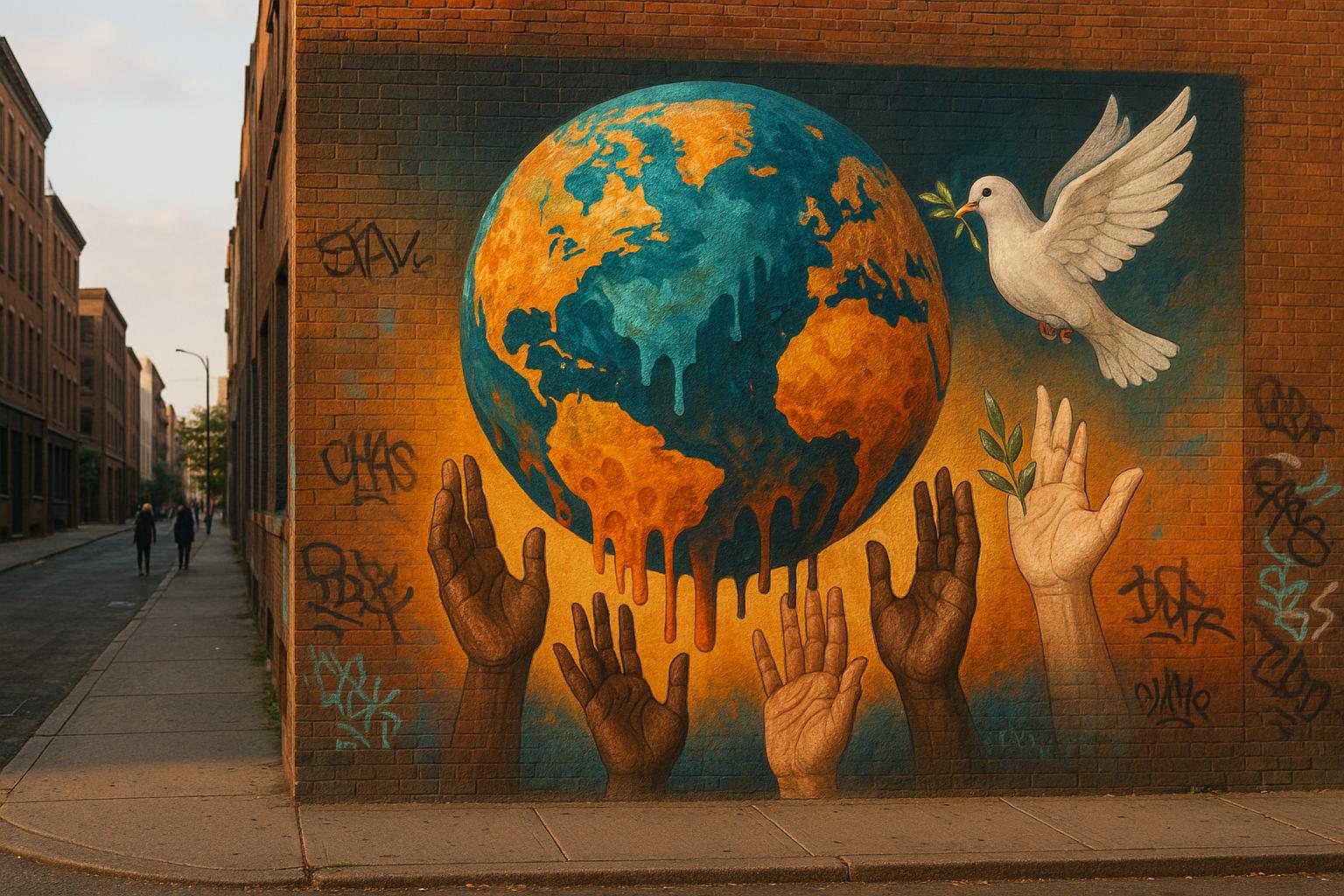
Street art turns public spaces into powerful platforms, addressing global crises like climate change, pandemics, and social justice. It raises awareness, amplifies marginalized voices, and inspires action in ways traditional media can’t. Here’s how:
- Climate Change: Artists like Bordalo II use recycled materials to highlight environmental harm, while murals like Cardiff’s "Grangetown Whale" warn about rising sea levels.
- Pandemics: During COVID-19, tributes to healthcare workers (e.g., Banksy’s "Game Changer") and safety-themed murals spread messages of hope and resilience.
- Social Justice: Movements like Black Lives Matter use murals to memorialize victims and demand accountability, as seen in Washington, D.C., and Minneapolis.
- Refugee Stories: Projects like the Za’atari Camp murals give refugees a voice, turning their struggles into powerful visual narratives.
Street art thrives on accessibility, breaking barriers of galleries and museums to reach everyone, everywhere. It’s a raw, immediate response to crises, blending activism and art to inspire change.
Challenging The Status Quo With Street Art | Blanco | TEDxCoeurdalene
How Street Art Became Crisis Commentary
Street art has come a long way from its rebellious roots, evolving into a powerful voice for addressing crises. Over the decades, it has transformed to reflect societal concerns, shifting from local struggles to tackling global issues.
Early History of Protest Art
Street art’s origins are firmly rooted in the 1960s and 1970s, when graffiti emerged as a raw form of rebellion and self-expression in urban America. What many dismissed as vandalism at the time was actually a way for marginalized communities to make their voices heard in spaces that often ignored them. Simple tags on walls became symbols of resistance, offering visibility to those who felt invisible.
During this time, graffiti was accessible to anyone with a spray can, making it a democratic medium for expressing frustration with social and economic hardships. By the 1970s, graffiti artists began to organize, further solidifying its role as a tool for community expression.
The 1980s marked a turning point when artists like Keith Haring and Jean-Michel Basquiat brought street art into the mainstream art world. They proved that street art could carry deep, meaningful messages while staying true to its grassroots origins.
Even before street art became a global phenomenon, historical figures like Emory Douglas and John Heartfield showcased the power of art as a form of resistance. Douglas, as the Minister of Culture for the Black Panther Party, used his work to fuel the civil rights movement. Meanwhile, Heartfield’s photomontages in the 1930s stood as a bold visual opposition to fascism, so much so that he became a target of the Gestapo. Both artists demonstrated how visual art could challenge oppression and inspire change.
From Local Issues to Global Problems
What began as a response to local struggles gradually expanded to address global concerns. Murals, once reflections of community spirit, began tackling broader themes like environmental issues, human rights, and personal stories that resonated globally.
The rise of social media played a huge role in this shift. A mural painted in one city could now reach audiences worldwide within days, sparking similar works in other corners of the globe. This instant connection turned street art into a global conversation, breaking down geographic and cultural barriers.
Street art’s accessibility became one of its most important strengths. Unlike traditional galleries and museums, which often come with socioeconomic barriers, street art exists in public spaces, open to all. This inclusivity was especially evident during the COVID-19 pandemic, when artists across the world created murals honoring healthcare workers and promoting public health initiatives.
The importance of this accessibility is underscored by stark statistics: 85.4% of works in major US museums are by White artists, and 87.4% are by men. Street art offers a platform for marginalized voices to speak on global issues without the gatekeeping found in traditional art spaces.
These early movements, born out of local struggles, laid the foundation for street art as a form of social activism. Today, it stands as a global force, uniting voices and challenging societal norms on an international scale.
Street Art’s Response to Climate Change
Climate change is one of the most urgent challenges we face, and street artists around the globe are stepping up to confront it head-on. With bold visuals and striking statements, they transform complex environmental issues into messages that resonate deeply with everyday people. Street art serves as a powerful tool for activism, bringing environmental concerns directly into public spaces where they can’t be ignored. By portraying the destruction of nature in vivid, relatable ways, these works spark conversations and inspire action.
Showing Environmental Destruction
Street artists are using walls and urban spaces to showcase the beauty of nature and the threats it faces from climate change. Many of these works highlight the consequences of pollution and waste, often using recycled materials to underscore the environmental damage caused by human activity.
One standout example is Bordalo II’s Big Trash Animals series. In 2017, he created Seal Pup in Paris, a piece entirely crafted from discarded materials like damaged bumpers, old tires, burnt garbage cans, and broken appliances. Over the years, his series has grown to include 182 installations across 24 countries, repurposing an estimated 74 tons of waste.
"The idea is to depict nature itself, in this case, animals, out of materials that are responsible for its destruction." – Bordalo II
For World Oceans Day in 2021, Vegan Flava unveiled Blue Desert in Stockholm. This mural, featuring a harbor porpoise, highlighted critical issues like overfishing, industrial fishing, ecosystem destruction, and water pollution in the Baltic Sea. The artist took the message further by sending a canvas version of the mural and a petition with 120,000 signatures to the EU Commissioner for the Environment, Oceans and Fisheries. It’s a prime example of how art can connect grassroots activism with policy-making.
"Every lost species is a poorer, less functioning and more destabilized world." – Vegan Flava
In Cardiff, Spike Clark created the Grangetown Whale mural in 2021, commissioned by organizations such as Greenpeace and Extinction Rebellion. The mural depicted a street submerged in water, paired with the chilling message, "No ice caps, No Cardiff", reminding viewers of the local and global consequences of rising sea levels. These pieces, though rooted in specific locations, carry a universal message about the urgent need to address climate change.
Climate Action Through Murals
Beyond showcasing environmental destruction, large-scale murals have become powerful calls to action. Prominent artists use their work not just to highlight the challenges we face but also to inspire sustainable practices and push for policy changes.
Eduardo Kobra’s We Are All One, created for the Rio de Janeiro Olympics, is a prime example. This massive mural, the largest graffiti artwork in the world at the time, celebrated indigenous cultures through depictions of traditional clothing and headdresses. It also tied into the United Nations Sustainable Development Goal of Peace, Justice, and Strong Institutions.
"The message is about the planet we hand over to our next generations. How are we taking care of our planet? Because the future is now. The future has already begun, and we are all responsible for it." – Eduardo Kobra
Street artists also take aim at corporate greenwashing, exposing the gap between companies’ environmental promises and their actual practices. While lawsuits and investigations can take years, street art delivers an immediate and public critique, holding corporations accountable in real time.
What makes environmental street art so impactful is its ability to turn abstract issues into something tangible and emotional. Through compelling visuals and narratives, these works encourage people to connect with environmental challenges on a personal level, fostering hope and inspiring change.
Pandemics and Public Health in Street Art
The COVID-19 pandemic disrupted life worldwide, and street artists quickly turned public spaces into canvases of hope, critique, and connection. Their work captured the isolation and resilience that defined this global crisis, while also spreading critical safety messages and fostering a sense of community during times of separation. Anthropologist and curator Rafael Schacter remarked:
"The very concept of ‘the public,’ both in terms of people and in terms of space, is really being stretched right now… Graffiti is a space where dissent can be articulated and discourse can be pronounced."
From tributes to healthcare workers to sharp commentaries on public health policies, street art became a powerful voice during the pandemic.
Tributes to Healthcare Workers
In keeping with its history of reflecting societal events, street art paid heartfelt homage to healthcare workers. Across the globe, artists created murals celebrating these frontline heroes. One standout example is Banksy’s "Game Changer", a stencil showing a boy playing with a nurse superhero toy, while Batman and Spiderman lay discarded in a trash bin. Unveiled at Southampton General Hospital, the piece later raised funds for the NHS through auction.
"Thanks for all you’re doing. I hope this brightens the place up a bit, even if it’s only black and white." – Banksy
In Amsterdam, FAKE created "Super Nurse!" – a mural of a nurse wearing a face mask with the Superman logo. This work was also projected in cities like London and New York, spreading its message of gratitude far and wide. In Los Angeles, Samir Evol’s "You Bring Hope", commissioned by Barco Uniforms and Beautify Earth, honored healthcare workers with a vibrant mural in Santa Monica. Other notable tributes included Rebel Bear’s depiction of a nurse forming a heart with her hands in Glasgow, Lapo Fatai’s massive mural of a nurse giving a thumbs-up in Milan, and Osian Gwent’s "The Big Thank You Mural" in Llanidloes, Wales. These artworks served as a collective thank-you, resonating deeply with communities.
Commentary on Public Health Measures
While many pieces celebrated frontline workers, others critiqued or reflected on public health measures. Masks, social distancing, and other symbols of the pandemic became recurring themes in street art. In Los Angeles, Corie Mattie’s "Hope Dealer" series featured a masked figure revealing the word "HOPE" alongside the caption, "Cancel Plans. Not Humanity". Some works addressed the absurdities of the crisis, like Berlin artist EME Freethinker’s mural of Gollum worshipping a roll of toilet paper – a nod to the panic buying that marked the early days of the pandemic.
As restrictions limited movement, traditional ways of experiencing art became less accessible. In response, communities turned to digital platforms to document and share pandemic-inspired street art. New York City even launched a campaign featuring digitally rendered public service announcements and messages of hope, showing how street art adapted to maintain its role as a unifying force during challenging times.
sbb-itb-593149b
Street Art and Social Justice Movements
Street art has become a dynamic way to amplify messages of social justice, especially during times of crisis. When traditional media fails to fully capture the depth of community struggles or when institutional responses fall short, artists step in – turning walls, streets, and public spaces into platforms for voices that demand to be heard. This form of expression often reflects raw, unfiltered community reactions to injustice.
One of the most impactful aspects of street art is its accessibility. It empowers marginalized groups to reclaim unused spaces, transforming them into areas for expression, education, and collective healing.
Black Lives Matter and Community Art
The Black Lives Matter (BLM) movement sparked an outpouring of street art across the U.S., with murals and public installations becoming tools for communities to process grief, demand accountability, and build solidarity. According to Urban Art Mapping, nearly 150 BLM murals remain visible across the country.
These murals serve more than an artistic purpose. They memorialize Black lives lost to racism and police violence while acting as symbols of the movement’s ongoing fight for justice. Their collaborative nature has also brought communities together in ways that go beyond traditional protests.
In Washington, D.C., Mayor Muriel Bowser commissioned a BLM street mural to stand in solidarity against police brutality and systemic racism. Although the mural was removed in March 2025 due to political pressures, its message left a lasting impression. Meanwhile, in Hobson City, Alabama, residents painted "Black Towns Matter" on Martin Luther King Boulevard, celebrating the town’s legacy as Alabama’s first self-governed all-Black municipality, established in 1899.
In Minneapolis, Minnesota, 16 artists collaborated to create massive 24-foot-high "Black Lives Matter" letters outside the Minnesota African American Heritage Museum. Similarly, Dallas, Texas, saw six murals emerge in 2020, with private funding secured to preserve them for a decade. In Seattle, Washington, the city and the Vivid Matter Collective annually repaint a permanent mural in Capitol Hill, with another mural installed outside City Hall in 2021.
Artists like Sophia Dawson, who contributed to a New York City mural, noted the community’s enthusiasm:
"Many of the hundreds of people who volunteer to help with installing the murals may not even know how to paint, but they’re showing up to leave their mark."
Keyonna Jones, one of seven artists who painted Black Lives Matter Plaza in Washington, D.C., reflected on the global influence of the movement:
"To see it replicated all over the world within 24 hours, I think is what really speaks to the power of art and so that is my favorite part about the whole experience."
Art Highlighting Refugee Stories
Street art also plays a critical role in documenting refugee experiences, giving a voice to individuals often reduced to statistics. With over 60 million refugees worldwide, this medium humanizes their struggles and preserves their stories.
The Za’atari Project, launched in 2015, is a prime example. Artist Joel Artista, in collaboration with organizations like UNICEF and Mercy Corps, has worked with Syrian refugees at the Za’atari camp. Through workshops, children create murals, paint wheelbarrows, and make kites, expressing their dreams, memories, and hopes for the future.
In Afghanistan, ArtLords, a street art group, has painted over 2,200 murals. Their work often intertwines art with activism, addressing issues like women’s rights under the Taliban. In April 2025, they partnered with Georgetown University’s No Lost Generation club to host an exhibit showcasing their "I Stand with You" campaign. Rania Najih, founder of Parla Arte, highlighted art’s therapeutic value:
"Through the medium of art, refugees can convey their personal and unique experiences. Art is important because not everyone has access to therapy. For many people, art heals inner wounds."
In Palestinian refugee camps in Lebanon, murals serve as acts of resistance, depicting symbols like the Al-Aqsa mosque and Palestinian flags to highlight the ongoing struggle for identity and rights [26]. Palestinian artist Abdul Rahman Katanani emphasizes the medium’s importance:
"Art is very powerful. It is one of the strongest weapons for Palestinians to affirm their rights." [26]
A transformative project took place in Shiraz, Iran, in 2016, where Iranians and Afghan refugees collaborated to replace hate-filled graffiti with vibrant murals. Over 60 volunteers participated, fostering a sense of unity and community. One Afghan orphan, Mohammad, even earned free enrollment at an art institute due to his talent.
In Athens, Greece, over 180 refugee and migrant children joined artists in creating a mural symbolizing peace and friendship at the Skaramagkas Open Accommodation Site in 2018. The mural depicted children facing a wall, representing their individuality and voices.
Lima Halima-Khalil, co-founder of ArtLords, beautifully summarized the role of refugee art:
"I think art is a tool or a medium that cannot be stopped…to give voice to the voiceless."
These examples show how street art bridges divides, offering refugees a way to reclaim their narratives while fostering understanding between displaced and host communities.
Techniques and Tools for Crisis Messaging
Street art has long been a medium for immediate social commentary, and its ability to adapt makes it a powerful tool for addressing global crises. By using a mix of traditional and modern techniques, street artists transform public spaces into platforms for urgent communication, delivering impactful messages with speed and creativity.
Street art spans a wide range of methods, including classic approaches like spray painting, stenciling, and freehand drawing, as well as modern innovations such as light sculptures, video projections, and even knitted installations. Its transient and non-commercial nature allows for rapid deployment and a wide-reaching visual impact. Below are some of the key techniques that make this possible.
Stencil Art for Quick Communication
Stencil art is one of the most effective tools for spreading messages quickly and broadly, especially during crises. Artists can pre-design intricate stencils and deploy them rapidly, enabling consistent and powerful imagery to appear across multiple locations in a short time. This method allows for a coordinated visual campaign that delivers strong political or social messages citywide.
A great example of this is the work of Praxis, an anonymous artist from New York City. Praxis uses stencils and posters to advocate for animal rights, reaching tens of thousands of people in a single day. On one Mother’s Day, Praxis launched a campaign featuring stenciled images of baby calves being separated from their mothers, paired with the phrases "Got Milk?" and "I don’t." The campaign strategically placed these visuals in high-traffic areas, reaching hundreds of thousands of New Yorkers.
"You can create a powerful message with just one image."
- Jaune, Stencil Artist
"Something I really like about my art is that it puts a smile on people’s faces. With everything that is going on in the world, it is really revolutionary to make people smile. It is an act of resistance."
- Jaune, Stencil Artist
Projections and Temporary Installations
Modern technology has expanded the possibilities for street art, especially in crisis messaging. Projection art, for instance, uses images, animations, or videos displayed on buildings and other surfaces to create a dynamic and attention-grabbing effect. These temporary installations are particularly useful for addressing sensitive issues, as they leave no permanent mark while still making a strong visual statement.
During Myanmar’s coup, activists projected peace symbols onto public buildings. In New York, when Edward Snowden’s bust was censored, activists responded by projecting his image onto smoke where the statue once stood. Similarly, the British group Led By Donkeys projected the phrase "Your Majesty, your new prime minister is a LIAR" onto Buckingham Palace to make a bold political statement.
Digital tools have further amplified the reach of such projects. Augmented reality (AR) installations in street art increased by 300% between 2020 and 2023, with 68% of street artists under 30 now integrating digital elements into their work. This has led to a 150% rise in community engagement. On TikTok, the hashtag #DigitalStreetArt has garnered 1.2 billion views, showcasing how digital techniques can extend the impact of street art far beyond its physical location.
"Projection mapping allows us to create art that’s temporary yet impactful. It challenges how people interact with urban environments."
- Torsten Posselt, URBANSCREEN co-founder
"It’s like having a GPS for your art. You see exactly where your lines need to go – no more guesswork, no more stencils. It’s a game-changer."
- ESPO (Steve Powers), Graffiti Artist
Challenges and Ethics in Crisis-Focused Street Art
Crisis-focused street art operates in a space where urgency and impermanence collide, bringing both unique opportunities and significant challenges. Legal hurdles, fleeting existence, and navigating sensitive social issues are all part of the equation for this form of expression.
Street art often walks a fine line between rebellion and recognition. In fact, the financial burden of graffiti removal is staggering, costing U.S. cities between $8–12 billion annually, while agencies in the UK spend millions addressing the same issue. These costs add another layer of complexity to preserving and legitimizing this art form.
The Fleeting Nature of Street Art
The temporary lifespan of street art poses a major obstacle when it comes to preserving works tied to global crises. Unlike pieces displayed in museums, street art is exposed to the elements, vandalism, and removal by authorities. This transience makes it difficult to document pivotal moments in history. While tools like high-resolution photography and 3D scanning help capture these works, they can’t fully replicate the original context. A striking example is Blu’s 2016 decision to erase his murals in Bologna, which highlighted the tension between preserving art and respecting the artist’s intent for impermanence.
"The ethical issues surrounding street art preservation include the potential appropriation of the artwork, the promotion of illegal activities, and the alteration of the artwork’s original context and meaning."
Digital platforms now play a key role in archiving street art, ensuring its legacy survives online. Some conservators argue for preserving the "material integrity and legibility" of these works, at least for the generation that created them. Achieving this, however, requires collaboration between artists, curators, and conservators from the moment the art is created.
The challenges of preservation often overlap with ethical concerns, especially when artistic freedom clashes with legal boundaries.
Ethical Dilemmas in Activist Art
Crisis-driven street art brings a host of ethical questions to the forefront, including issues of permission, cultural representation, and accountability. Artists must strike a balance between delivering urgent messages and respecting property rights and community values. The legal risks are real – unauthorized works can lead to arrests, as seen in São Paulo in 2011, where eleven graffiti artists were detained for their work. Interestingly, this incident spurred the creation of the "Open Museum of Urban Art", a space that legitimized street art in the city.
"Graffiti disrespects private property and official notions of order and aesthetics." – Lachmann
Authenticity is another critical consideration. Artists must tread carefully to avoid cultural appropriation or tokenism, especially when addressing marginalized communities. Genuine collaboration with these groups ensures the art resonates deeply and avoids misrepresentation.
In today’s surveillance-heavy world, digital vulnerabilities add another layer of risk, particularly for those tackling politically sensitive topics. Many artists now use pseudonyms, encryption tools, and symbolic imagery to protect themselves.
"The great thing about art, in general, is that it can break through pre-dispositions by impacting people emotionally; then their intellectual side wants to justify their emotional response." – Shepard Fairey
As crisis-focused street art gains visibility, there’s also the danger of it being commercialized in ways that undermine its original purpose. To navigate these challenges, artists are building community networks and educating themselves on their legal rights, ensuring their work remains impactful and true to its mission.
Conclusion: Street Art as a Tool for Unity and Change
Street art has proven to be an extraordinary way to reflect on and respond to global challenges, transforming ordinary urban spaces into vibrant canvases of hope and connection. Whether it’s highlighting environmental issues or sparking social justice movements, artists around the world have shown that public spaces can serve as powerful platforms for driving meaningful change.
This art form goes beyond personal expression. In Pachuca, Mexico, an artist collective revitalized the Las Palmitas neighborhood with a series of colorful murals that brought the community together. Similarly, the Welling Court Mural Project in Queens, New York, turned a neglected area into a thriving outdoor gallery, showcasing the potential of street art to uplift entire communities.
Street art’s accessibility makes it a vital tool for amplifying voices that often go unheard. After pivotal moments in recent history, murals have emerged not just in Minneapolis but across the globe – from Berlin’s Mauerpark to countless street corners – becoming shared spaces for reflection, protest, and solidarity.
Research backs up the benefits of public art. Studies reveal that 84% of participants in public art projects report feeling better overall, while initiatives like asphalt art installations have led to a 50% reduction in pedestrian crashes and a 37% drop in injury-related accidents. These numbers highlight how art can influence both emotional well-being and physical safety.
During the COVID-19 pandemic, street artists adapted quickly, using their work to support public health campaigns and honor local heroes. From large-scale murals to smaller tributes, these pieces became a way to address urgent needs and foster a sense of community.
Street art also serves as an informal archive, preserving stories and perspectives that might otherwise fade away or be suppressed. South African artist Sue Williamson captures this idea perfectly:
"As press censorship increases, the writing on the wall has become required reading".
Looking ahead, street art’s ability to inspire collective action remains one of its most impactful qualities. Projects like Saype’s "Beyond Walls", featuring interconnected hands symbolizing global unity, and Banksy’s recent works in Ukraine demonstrate how public spaces continue to evolve into hubs for solidarity and dialogue.
Time and again, street art has shown its ability to unite communities and spark change. Whether addressing environmental crises, social injustices, or public health emergencies, it transforms observers into active participants and urban spaces into powerful agents of change. By bringing people together, street art turns moments of crisis into opportunities for collective empowerment.
At Inspiretopics, we celebrate street art’s enduring ability to connect people and spark action when it’s needed most.
FAQs
How does street art amplify marginalized voices during global crises?
Street art serves as a powerful voice for marginalized communities, offering a unique way to share their stories and perspectives – especially during challenging global events. By turning public spaces into massive, open canvases, artists bring attention to pressing issues like racial inequality, economic disparities, and environmental challenges.
Through bold murals and thought-provoking graffiti, street art does more than just catch the eye – it sparks conversations and strengthens community bonds. For instance, during movements like Black Lives Matter, street art became a symbol of both resistance and healing, amplifying voices that are often ignored by mainstream media. This art form not only invites public interaction but also inspires communities to rally for real change.
How does social media influence the global reach and impact of street art during crises?
Social media has revolutionized how street art is shared and perceived, especially in times of global crises. Platforms like Instagram and TikTok make it possible for artists to showcase their creations instantly to audiences around the world. What was once a local expression is now part of a global conversation, giving both new and seasoned artists a chance to connect with diverse communities and gain widespread recognition.
Beyond just sharing art, social media has become a powerful tool for spreading awareness about social and political issues. It creates opportunities for collaboration between artists, activists, and audiences, fostering a sense of unity and shared purpose. This interconnected network allows street art to go beyond being a form of self-expression – it becomes a driving force for dialogue and meaningful change on a global scale.
How do street artists convey powerful messages while addressing ethical and legal challenges?
Street artists tread a delicate path, balancing their creative expression with ethical and legal considerations. Their art often sheds light on pressing global issues and raises social awareness, yet they must also weigh the effects their work has on local communities and property owners. Many artists address these challenges by engaging with residents, obtaining permissions when possible, and thoughtfully selecting locations to ensure their creations are impactful without causing offense or harm.
Another challenge is maintaining authenticity while facing external pressures like censorship or commercialization. Artists work hard to stay true to their messages, finding inventive ways to address societal topics while preserving the essence of their vision. By keeping these factors in mind, street artists can produce meaningful work that connects with audiences without crossing ethical or legal boundaries.
