
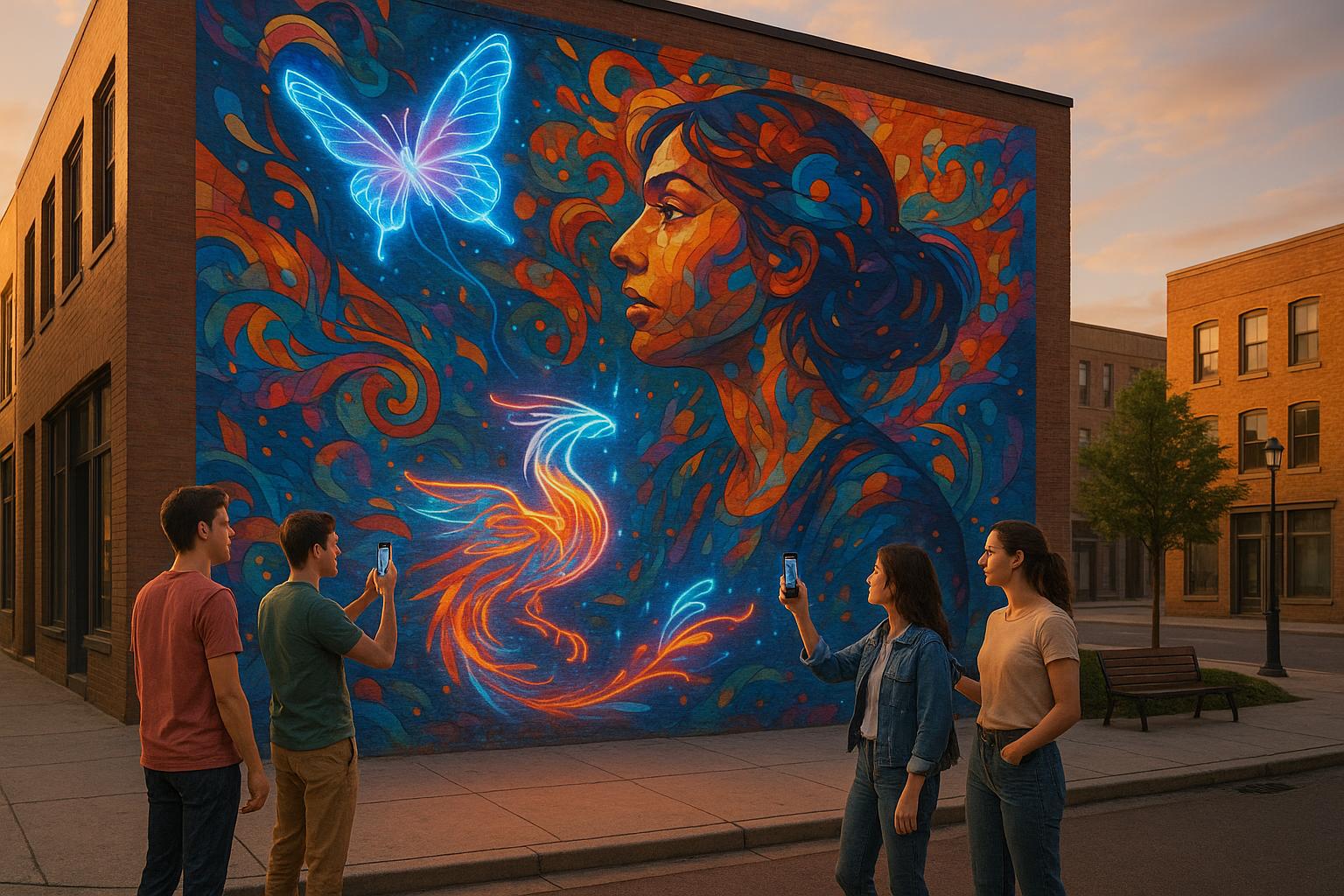
Augmented Reality (AR) is changing how we experience street art. Static murals on walls now come to life with animations, sounds, and interactivity when viewed through devices like smartphones or AR glasses. This blend of physical art and digital technology creates immersive experiences, turning city streets into dynamic galleries.
Key Benefits of AR in Street Art:
- Interactivity: Viewers can engage with moving characters, soundscapes, or hidden stories.
- Increased Engagement: AR art boosts interaction times by 75 seconds and social sharing by 300%.
- Preservation: Digital layers ensure artworks remain accessible even if physical pieces are removed.
- Community Involvement: Audiences can contribute to or interact with the art, creating shared experiences.
Tools to Get Started:
- Platforms: Artivive, Google Geospatial Creator, Adobe Aero, and Spark AR.
- Hardware: Smartphones, tablets, or PCs with graphics capabilities.
- Software: Unity, Unreal Engine, or Blender for 3D designs.
Challenges:
- Accessibility: Requires devices and AR knowledge.
- Maintenance: Digital content needs updates over time.
- Privacy: Data collection in public spaces raises concerns.
AR doesn’t replace traditional street art – it enhances it. By combining physical murals with AR layers, artists can tell richer stories, engage broader audiences, and preserve their work digitally. Whether you’re an artist or a viewer, AR offers a new way to experience and create urban art.
AR-Step-by-Step Guide: How to create Augmented Reality Art
Tools and Platforms for AR Street Art
Bringing AR-enhanced street art to life is all about using the right mix of platforms and tools. Whether you’re a beginner or a seasoned artist, the current AR landscape offers something for everyone. Here’s a closer look at some of the top platforms and hardware that can help you create immersive AR street art.
Top AR Platforms and Apps
Several platforms have become go-to choices for AR street art, each offering distinct features to suit different creative needs. Artivive is a popular option for blending traditional art with AR. It’s straightforward to use, requiring no coding skills, and comes with an AR scanning app that allows artists to add animations. With a community of over 600,000 creators, it’s a great starting point for many artists.
For those looking to anchor AR content to real-world locations, Google’s Geospatial Creator is a standout. Built on ARCore and Google Maps Platform, it enables artists to create 3D digital art tied to specific physical locations with impressive accuracy. The platform uses the same 3D mapping data as Google Earth, ensuring photorealistic visuals. In May 2023, this tool gained attention when Google Arts & Culture partnered with Global Street Art and artists like Camille Walala, Edgar Saner, and Tristan Eaton to create groundbreaking AR experiences across cities like London, Mexico City, and Los Angeles:
"In 2023 most people experience art through their phones, so why not make that experience absolutely amazing? This project unleashes that potential of augmented reality while rooting the experience in public art, which is what I care about most." – Tristan Eaton
Another notable platform is Acute Art, which focuses on collaborating with leading artists to produce curated AR experiences through its app. Unlike user-generated platforms, it prioritizes high-quality, exclusive content.
For those on a budget, many platforms offer free versions or trials. Artivive and Spark AR Studio are free and beginner-friendly. BlippAR provides a free trial but charges $10 to publish a project. Advanced tools like Zapworks Studio and 8th Wall come with higher price tags – $135 and $99 per month, respectively, after their trial periods.
Choosing the right platform often comes down to balancing ease of use and feature complexity. For instance, Artivive is perfect for simple animations, while BlippAR supports advanced features like 3D models and gamification. Adobe Aero offers a middle ground, combining ease of use with integration into Adobe’s suite, making it ideal for artists already familiar with Photoshop or Illustrator.
Hardware and Software Requirements
The tools you use go beyond platforms – hardware and software choices also play a big role in creating professional AR art. The right setup depends on the complexity of your project and your artistic vision.
For building detailed, interactive AR experiences, Unity and Unreal Engine are excellent options, though they do require some coding knowledge. If you need to create 3D assets, Blender is a fantastic open-source tool that supports AR-compatible formats.
On the other hand, if coding isn’t your thing, tools like Adobe Aero or Spark AR let you prototype AR projects without diving into programming. For advanced tracking features like SLAM (Simultaneous Localization and Mapping) or markerless tracking, platforms such as 8th Wall or Lens Studio are highly effective.
When it comes to hardware, a good smartphone or tablet is often enough for viewing AR content. However, more complex projects may require a powerful PC with a dedicated graphics card. While smart glasses are seen as the future of AR, they’re not essential for creating AR street art today. That said, companies like Boeing have already shown their potential by using AR glasses to streamline tasks like wiring schematics, cutting assembly time by 25% and minimizing errors.
Your choice of tools should align with your goals, technical skills, and how you want your audience to interact with your art. For example, web-based AR is often more accessible since it doesn’t require users to download a separate app.
Experiment with free trials and entry-level versions before committing to a platform. With the right combination of tools, software, and hardware, you can turn your vision for AR street art into a reality.
How to Create AR-Enhanced Street Art
AR-enhanced street art blends traditional artistry with digital technology, creating an interactive experience that bridges the physical and virtual worlds. It’s more than just painting a mural – it’s about crafting an experience that viewers can explore with their smartphones.
Designing Physical Art with AR Triggers
When creating AR-enhanced murals, the physical artwork should stand out on its own while also serving as a gateway to digital content. This dual purpose requires thoughtful design.
The most common method for triggering AR experiences is image recognition. To make this work seamlessly, certain parts of your mural should have distinct patterns, contrasting colors, or clear geometric shapes that AR software can easily detect and track. Simplicity is key – overly complex designs can reduce recognition reliability.
Another option is QR codes, though they can feel less integrated compared to image-based triggers. If you choose QR codes, consider embedding them into the mural’s design in a creative way. For instance, some artists incorporate them into geometric patterns or abstract elements to make them less intrusive.
Marker-based tracking – using visual markers like QR codes or printed images – is another approach, but many modern AR apps now prefer markerless tracking. This method uses advanced algorithms, such as Simultaneous Localization and Mapping (SLAM), to scan surfaces and detect depth without relying on predefined images.
To ensure accurate AR integration, photograph your mural from multiple high-resolution angles. These images play a critical role in how well the AR experience functions in real-world settings.
Building Digital Layers
Once your mural is complete, the next step is to develop its digital layers. These layers should complement your artwork, enhancing its story or message without overshadowing it.
Key digital elements include 3D models, animations, and soundscapes. These additions can extend the narrative or amplify the emotional impact of your mural. British artist INSA, known for his "GIF-iti" work, captures this idea perfectly:
"The physical wall is just the beginning. We’re creating layers of reality that viewers can explore and interact with."
This shift toward digital integration has transformed how street artists approach their work. Los Angeles-based artist RUBEN describes the change:
"I spend as much time coding as I do painting now. That’s just where street art is headed."
A standout example is The Journey AR Mural in Columbus, Ohio, created by Eric Skotnes and Ryan Safarti for The Short North Arts District. This project uses AR to turn a static mural into a dynamic storytelling experience, with different sections revealing new layers of the narrative as viewers interact through their devices.
When designing digital layers, think about adding value beyond visuals. You could include historical details, artist interviews, behind-the-scenes videos, or even interactive games tied to the mural’s theme.
Audio elements also play a crucial role but can be tricky in noisy urban environments. Design soundscapes that can cut through background noise, and consider pairing audio with visual cues to ensure your message is clear.
Testing and Refining AR Art in Public Spaces
Testing your AR-enhanced mural in real-world settings is essential. Unlike controlled gallery environments, street art must perform reliably across different lighting conditions, weather, and user behaviors.
Start by testing under various lighting and weather scenarios. Bright sunlight can make screens hard to read, while streetlights might create distracting shadows. Your mural should work consistently in all these conditions.
User testing is equally important. Observe how people interact with your mural – where they struggle, how they position themselves, and how long they engage with the AR features. This feedback helps refine the user experience.
Smooth performance is critical. Ensure your AR content loads quickly and runs without glitches. If it takes too long to activate or appears choppy, viewers might lose interest before seeing your full vision.
Test for device compatibility across a range of smartphones and tablets. Not everyone has the latest model, so make sure your AR experience works on older devices with varying screen resolutions, processing power, and sensors.
Finally, consider how viewers physically engage with your mural. Test from different distances and angles to identify the best spots for AR activation. If needed, subtly mark these areas or design your mural to naturally guide viewers to optimal positions.
Incorporating testing early in your project helps you address potential issues before launch. By fine-tuning your AR experience in advance, you’ll ensure a smooth public debut and set the stage for the broader impact of AR in street art.
sbb-itb-593149b
How AR Changes Urban Street Art
Augmented reality (AR) is reshaping urban street art, opening up new ways for communities to connect with art while presenting unique challenges.
Reaching New Audiences
AR-infused street art has the power to draw in audiences beyond the typical art enthusiasts by blending physical and digital experiences. A great example is the Electrifly Detroit festival, where an AR app turned the city into an interactive gallery. One standout piece, "Steel Magnolias", revealed powerful quotes and narratives through the app, creating a deeper connection with viewers.
The numbers back up AR’s ability to captivate. Studies show that nearly 70% of people take action after engaging with interactive AR ads, and retailers using AR storefronts see engagement rates up to 11 times higher than static displays. As artist Tristan Eaton puts it, AR allows art to become more accessible through mobile devices, enhancing public interaction and appreciation.
But AR isn’t just about reaching more people – it also amplifies the storytelling potential of street art.
AR as a Tool for Storytelling and Activism
AR transforms street art from static visuals into interactive narratives that can tackle complex themes and champion social causes. Take Tamiko Thiel’s work on the 2012 "Mi Querido Barrio" project, for instance. Collaborating with the Caribbean Cultural Center and African Diaspora Institute, Thiel used AR to spotlight East Harlem’s art, culture, and history. Residents contributed handwritten responses to the question, "What makes El Barrio feel like home?" These responses were transformed into golden words that appeared to swirl around the CCCADI building when viewed through AR.
This approach makes art more engaging and socially meaningful. Anne Wichmann highlights this idea:
"The beautiful thing about digital art is that it can travel so easily. You only need a smartphone. We curate digital art that can be shown at different places and provoke a conversation through that medium. You can look at the art piece from different perspectives, walk around it, interact with it and have fun, while it is also socially relevant."
Another compelling example is Sergiu Ardelean’s 2017 project, "ARLines of the City." As murals in São Paulo were being erased, Ardelean used AR to preserve these works, digitally relocating them to cities like Vienna, Boston, and Chicago. He explained:
"Augmented reality can be a tool for the creation, relocation, subversion, and preservation of artworks spread across the cityscape."
Artists like Vince Fraser, known for the We Rise Above project, also see AR as a driver for societal change. Fraser notes:
"The real value of art is how it illuminates the margins and drives societal change."
AR even enables community-driven narratives. Platforms can allow residents to upload personal stories or photos that become part of the artwork’s evolving narrative. This creates living, dynamic pieces that reflect and grow with the community.
While AR enriches storytelling and engagement, it also introduces challenges that artists must navigate.
Challenges of AR Street Art
Despite its potential, AR street art faces hurdles that can’t be ignored. Technical issues like connectivity, user-friendly interfaces, device compatibility, and battery drain are common barriers.
Accessibility is another concern. Not everyone owns a smartphone or knows how to use AR features, which can unintentionally exclude people. To address this, artists should ensure that the physical artwork retains its impact, even without digital enhancements.
Sustainability is a long-term challenge as well. Maintaining and updating digital content requires ongoing resources, and AR platforms may become outdated over time. Physical elements like QR codes or NFC tags also need to withstand outdoor conditions, adding to the complexity.
Privacy and security raise additional questions. AR apps often collect user data in public spaces, which can lead to concerns about surveillance. Artists and organizations must be transparent about data usage and find a balance between personalization and privacy.
Intellectual property protection is another tricky area. As one analysis points out, "it is objectively difficult for street artists to discover and react to misappropriation, as the digital landscape is so diverse". The hidden nature of AR makes it easier for others to use or alter artworks without permission. Artists can address this by negotiating clear agreements with museums and organizations about how AR enhancements can be used.
Still, there’s optimism about the future. Gene Kogan captures this sentiment:
"The most interesting art being made today exists at the intersection of different fields, where the tools of one discipline are applied to the concepts of another."
Overcoming these challenges will require collaboration between artists, technologists, communities, and local governments to ensure that AR enhances street art without losing its essence. By working together, they can create a balance between innovation and authenticity.
Standard vs. AR-Enhanced Street Art
Looking at traditional street art alongside its AR-enhanced counterpart shows how each brings unique advantages to the table for artists and their communities.
Comparison Table: Standard vs. AR Street Art
| Aspect | Standard Street Art | AR-Enhanced Street Art |
|---|---|---|
| Interactivity | Static visual experience | Interactive digital elements that respond to viewer actions |
| Audience Engagement | Passive observation | Active participation where viewers become co-creators |
| Accessibility | Limited to a specific physical location | Viewable on smartphones and tablets, expanding its reach |
| Permanence | Temporary and subject to weather and removal | "Permanent" in the digital realm, preserved indefinitely |
| Creation Process | Direct physical application to surfaces | Combines physical art with a digital layer |
| Viewing Requirements | No special equipment needed | Requires a smartphone or tablet equipped with an AR app |
| Content Delivery | One-way message delivery | Interactive, two-way communication |
| Documentation | Often ephemeral and difficult to preserve | Easily documented and cataloged digitally |
| Community Involvement | Limited to the viewing experience | Enables ongoing community contributions and storytelling |
| Cost Factors | Costs of materials and physical execution | Additional investment in app development, digital content creation, and technical maintenance |
This breakdown highlights the key differences between traditional and AR-enhanced street art.
Key Takeaways from the Comparison
AR technology brings a new dimension to street art by transforming static visuals into interactive experiences. While traditional street art offers immediate visual appeal and is accessible to anyone passing by, AR-enhanced pieces allow for deeper engagement and storytelling that evolves over time.
Both forms play distinct roles in urban spaces. Traditional street art is rooted in the physical world, delivering an instant, tangible impact. AR, on the other hand, extends the reach of street art beyond its physical location, making it accessible through devices like smartphones and tablets. However, this digital layer can create a barrier for those without access to the required technology. To address this, many artists design their physical works to stand strong on their own, ensuring the art remains inclusive.
One of AR’s standout features is its ability to preserve works digitally. For example, the AR Street Art project in London’s Shoreditch allows users to view virtual murals through a smartphone app, even if the original physical artwork has been altered or removed. Similarly, New Zealand artist Enoch Oddie uses AR to showcase digital versions of his murals in various locations, enabling viewers to interact with the art and add their own creative touches.
AR also provides artists with valuable data on how audiences engage with their work. Metrics like time spent viewing and social sharing patterns offer insights that can shape future projects.
From a cost perspective, traditional street art involves expenses like materials and permits, while AR requires additional investment in app development and technical upkeep. Despite these higher costs, the ability of AR to reach a broader audience and foster deeper interaction often justifies the investment.
Ultimately, both traditional and AR-enhanced street art enrich the urban art scene in their own ways. Traditional pieces offer universal appeal and immediate connection, while AR adds layers of personalization and interactivity for those equipped to engage with it. Many artists are now blending these approaches, creating physical works that are enhanced with optional digital experiences, striking a balance between the two worlds.
Conclusion
Augmented reality (AR) has reshaped the way we experience street art, turning static murals into interactive, immersive journeys. By blending the physical and digital, AR allows artists to layer meaning, context, and stories onto their creations, giving viewers the freedom to explore art in entirely new ways.
Take Sacramento’s "Broadway Augmented" project from 2014, for example. This initiative transformed an entire street into a virtual gallery, featuring 16 site-specific digital works by 11 artists. The project not only engaged the public with local landmarks but also celebrated the area’s cultural heritage. Similarly, AR-powered storefront displays have seen engagement rates soar – up to 11 times higher than traditional static setups.
But AR’s impact goes far beyond the technology itself. It redefines how audiences interact with art, shifting them from passive onlookers to active participants. Artists like New Zealand’s Enoch Oddie are already embracing this shift, using AR to place digital versions of their murals in multiple locations. These virtual works invite viewers to interact and even contribute their own creative touches.
Final Thoughts on AR in Street Art
AR has opened up new possibilities for street art, as seen in the examples and ideas discussed earlier. It empowers artists to connect more deeply with their audiences and communities. For those looking to get started, simple AR techniques – like photo and video overlays – can be a great entry point. Collaborating with multimedia experts or using traditional art as AR markers are also effective strategies.
Importantly, AR also addresses some of the challenges that have long plagued traditional street art. In cities where physical murals face legal hurdles or require permits, AR offers a workaround. Virtual murals bypass these restrictions, allowing artists to engage with pressing issues – whether social, environmental, or political – while fostering collaborations with local businesses and institutions.
As Will Brown, CEO of InterApp, puts it:
"AR enables an artist to truly utilize mixed media and add emphasis, context and utility to any static art piece. Unlocking an AR experience with an art piece draws users in and can immerse them in a visual experience that elevates the art to new heights."
Street art has always been about breaking down barriers and making art accessible to everyone. AR builds on this tradition by preserving works digitally, extending their reach, and creating new ways for communities to engage with public art. It’s not just a tool – it’s a canvas for storytelling, connection, and creativity, offering artists endless opportunities to reimagine their craft.
FAQs
How does augmented reality bring street art to life?
Augmented reality (AR) is changing the game for street art, bringing it to life with animations, soundscapes, and 3D visuals. What was once a static mural can now transform into an immersive experience, drawing viewers in and making the art feel alive. It’s a way for artists to share evolving stories that go far beyond the paint on the wall, leaving a lasting impression on anyone who interacts with it.
By merging the physical and digital, AR adds a whole new layer to street art. It creates interactive narratives that can grow and change over time, offering audiences a fresh way to engage with urban creativity. This blend of tech and art makes street art more dynamic, exciting, and accessible to everyone.
What challenges do artists face when using AR in street art, and how can they address them?
Artists face a unique set of challenges when trying to blend augmented reality (AR) with street art. For one, technical hurdles come into play – viewers need smartphones or other AR-enabled devices to experience the work. Then there are health concerns, like potential eye strain or discomfort from using AR for extended periods. On top of that, crafting AR experiences that are both captivating and widely accessible adds another layer of complexity.
To navigate these obstacles, artists can prioritize creating intuitive AR experiences that function seamlessly across different devices. Keeping interactions brief and reducing reliance on screens or headsets can also help address concerns about prolonged usage. Partnering with developers and tapping into evolving AR technologies can further streamline the process, making it easier to integrate AR into street art in a way that resonates with diverse audiences.
What are some beginner-friendly tools for creating AR street art?
If you’re just stepping into the world of AR street art, Artivive and Adobe Aero are fantastic tools to get you started. These platforms are designed with ease of use in mind and don’t require any coding skills. Artivive offers straightforward tools tailored for artists who want to add an AR dimension to their creations, while Adobe Aero simplifies the process of building and sharing immersive AR experiences.
Another solid choice is Blippbuilder by Blippar. This platform lets you design AR projects quickly and effortlessly, even if you have no technical background. These tools are ideal for beginners eager to dive into the creative potential of AR in street art.
