
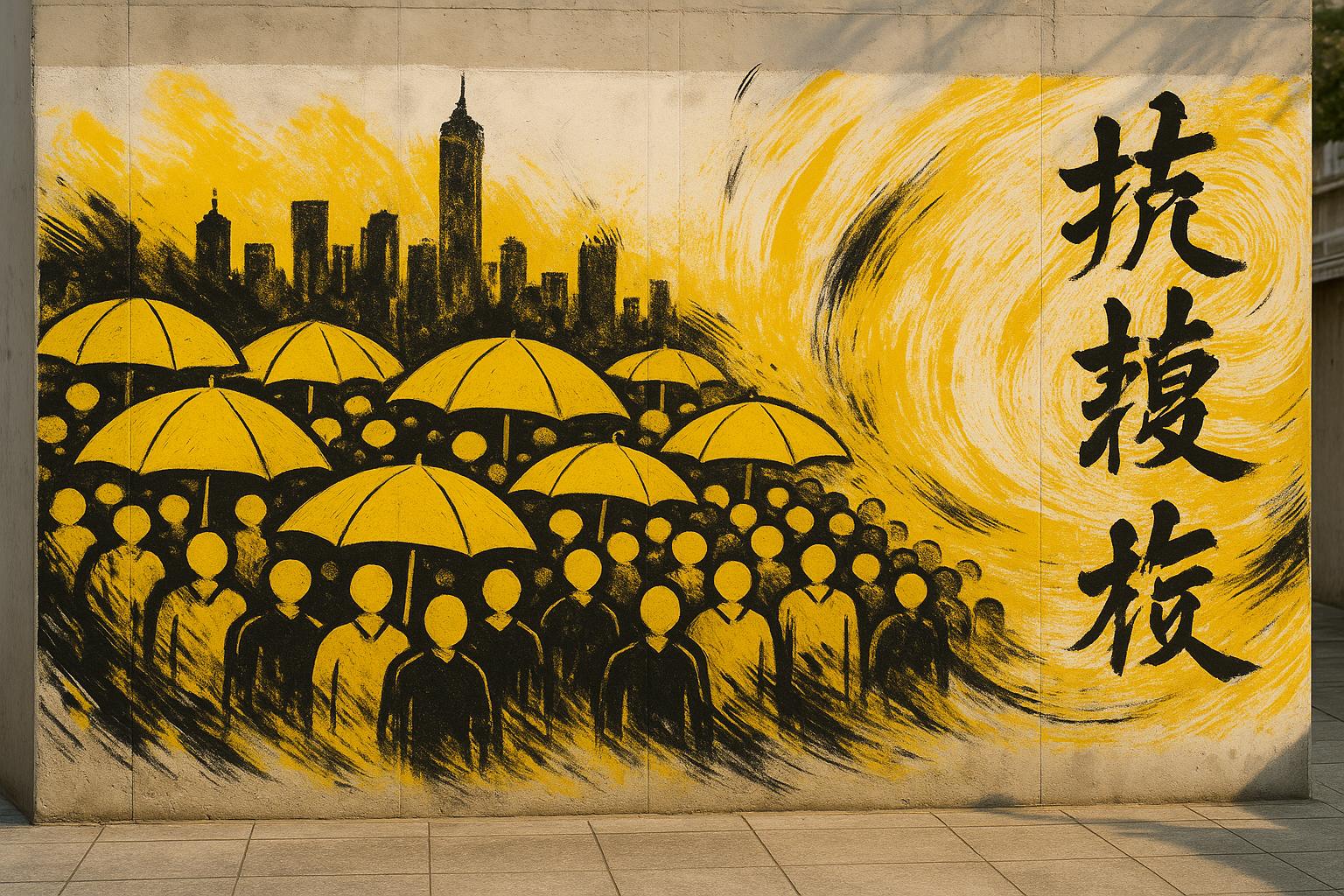
Hong Kong protest art turned walls into powerful platforms for democracy. It combined local culture, global influences, and creative techniques to share messages of resistance during the 2019 protests and beyond. Here’s what you need to know:
- Key Symbols: Yellow umbrellas (hope), Lady Liberty Hong Kong (aspirations), and reimagined Pepe the Frog (mascot).
- Art Styles: Influences from Japanese anime, classical art, and local Hong Kong culture.
- Methods: Stencil art, projection art, Lennon Walls, and guerrilla installations allowed artists to work under strict surveillance.
- Digital Reach: Social media and encrypted apps helped spread the art globally, overcoming censorship.
- Colors & Text: Black (mourning), yellow (solidarity), and white space (hope) were paired with bilingual wordplay to amplify messages.
This movement not only documented the protests but also built a global identity for Hong Kong’s fight for freedom.
The article dives deeper into how this art evolved, its impact, and the resilience of its creators under increasing restrictions.
The Visual Language of the Hong Kong Protests – Suhanya …
Background of Hong Kong Protest Art
Hong Kong protest art combines political resistance with local cultural elements, gaining prominence during the Umbrella Movement and the 2019 protests.
Political Environment
Democratic struggles against government control set the stage for this art form. The 2019 extradition bill controversy sparked creative responses, allowing artists to critique policies while minimizing legal risks. Colette Gaiter from the University of Delaware noted that the movement showcased an "elevated aesthetic sensibility", surpassing earlier Occupy movements by incorporating professional design elements.
Anonymous artist groups and encrypted platforms, like a Telegram group with 90,000 subscribers, played a major role in securely sharing artwork. These tools also shaped the stylistic evolution of protest art.
Art Style Sources
Hong Kong protest art reflects a mix of influences that shaped its visual identity:
| Influence | Visual Elements | Impact |
|---|---|---|
| Japanese Anime | Dystopian themes, manga-style characters | Resonated with younger protesters |
| Classical Art | Reimagined works like Liberty Leading the People | Brought historical depth to the visuals |
| Local Culture | Parodies of MTR subway signs, Cantonese wordplay | Rooted the art in Hong Kong’s identity |
This mix of styles created a distinct and powerful symbolic language for the movement.
Key Movement Symbols
Justin Wong’s "Symbols of Hong Kong 2019" series documented 80 unique protest icons, tracking how the movement evolved over time.
Some of the most recognizable symbols include:
- The yellow umbrella: Originally from 2014, it became a symbol of protection and democratic hope. A striking example was the 100-umbrella canopy installation at Admiralty.
- Lady Liberty Hong Kong: A statue embodying the aspirations of protesters.
- Pepe the Frog: Once an internet meme, it was reimagined as a pro-democracy mascot.
Traditional Chinese elements also played a role, such as altered hell money featuring officials’ faces and almanac-style protest calendars. Artists often used "guerrilla exhibitions", briefly displaying works to avoid censorship and government interference. These tactics allowed the art to thrive despite restrictions.
Public Spaces as Art Platforms
Public spaces in Hong Kong have played a crucial role in artistic expression and preserving collective memory, especially when other communication channels were limited.
Lennon Walls
Lennon Walls have become powerful symbols of Hong Kong’s fight for democracy. These shared spaces feature hand-drawn art, slogans in multiple languages, and images from key events. Found in bustling transit hubs, schools, and residential areas, they reflect the shifting emotions of the community and document protest stories. Street artists also turned to flexible, mobile approaches to work around restrictions, expanding the impact of these walls beyond their physical locations.
Street Art Methods
Under strict surveillance, street artists adopted creative techniques to stay mobile and ensure their safety. Here are some of the most common methods:
| Method | Description | Why It Works |
|---|---|---|
| Projection Art | Portable projectors display artwork on buildings | Creates bold, temporary visuals |
| Stencil Art | Quick, repeatable designs for fast application | Easily spread across multiple spots |
| Chalk Art | Temporary messages that can be erased quickly | Reduces legal risks due to its short-lived nature |
| Guerrilla Installations | Pop-up art in busy areas | Leaves a strong impression in a short time |
These methods allowed artists to adapt to challenges, spark conversations within the community, and keep protest stories alive. They also laid the groundwork for digital platforms to amplify these messages even further.
Digital Distribution Methods
As physical spaces became limited, protest artists in Hong Kong turned to digital platforms to spread their message far and wide.
Online tools have helped take protest art beyond the city’s streets, reaching audiences around the world. Protesters have relied on social media and secure communication apps to share their work. Even when access to certain apps was blocked, they quickly switched to other platforms, ensuring their art and messages continued to circulate.
Social Media Sharing
Social media has revolutionized the way protest art finds its audience. By using messaging apps and social networks, artists can share their creations while safeguarding their identities. This ensures their work remains accessible, even in the face of restrictions.
International Response
Art institutions, collectors, and digital archivists have stepped in to document and preserve these works. By doing so, they highlight the importance of this art in representing the movement and its ideals. Digital platforms have not only kept the conversation about democracy alive but also safeguarded the artistic legacy of the protests.
sbb-itb-593149b
Art Techniques and Meanings
Protest art has evolved not just in its reach but in how it conveys resistance. Artists have refined their methods, using visual and textual elements to communicate powerful messages, even under growing restrictions.
Common Symbols
Symbols played a key role in protest art, with some becoming instantly recognizable. The yellow umbrella, originally a practical tool during the Umbrella Movement, transformed into a lasting symbol of peaceful resistance. This was exemplified by the 13-foot Lady Liberty Hong Kong statue.
Gas masks also became a central image, especially as tear gas use by police increased. These masks were featured in works like the "Be Water" poster series, where they symbolized both survival and defiance.
Colors carried deep meaning in the movement:
- Black: Represented mourning and unity, often seen in "Black Bauhinia" flag designs.
- Yellow: Signified solidarity, frequently used in clothing and umbrella imagery.
- White space: Used in Lennon Wall installations to symbolize hope and amplify citizen voices.
"These colors amplified emotional resonance", explained Dr. Li Wing-sze, a color psychologist.
Text and Messages
Protest artists skillfully combined Cantonese wordplay with global appeal. For instance, the slogan "Hong Kong Withstand" (香港加油) carried a dual meaning – literally translating to "add oil" but also encouraging perseverance. This multilingual approach resonated widely, with some messages gaining over 500,000 social media shares in just 72 hours.
Several text-based techniques enhanced their communication:
| Technique | Purpose | Example |
|---|---|---|
| Bilingual Wordplay | Broader accessibility | MTR parody signs like "Mind the Thug" |
| Cultural Adaptation | Local resonance | Chinese almanac designs featuring protest dates |
| Code-switching | Layered messaging | English-Cantonese hybrid phrases |
Artists also embraced the "elder meme" format, using bright floral backgrounds – popular among senior citizens online – to share protest information. This clever approach reached diverse audiences and avoided censorship.
As restrictions tightened post-2020, artists turned to "ephemeral graffiti" made with temporary materials. They also encoded messages in seemingly innocent forms, like the "Paper Crane Project", which hid protest messages inside origami folds. These adaptive strategies highlighted the resilience and creativity of the movement.
Art Under Restrictions
Official Art Removal
Authorities have tightened control over protest art by deploying rapid response teams, increasing surveillance, and requiring pre-approval for public displays. These measures have significantly reduced unapproved art installations in urban areas.
How Artists Are Responding
Artists are finding creative ways to work around these restrictions. They’re using temporary materials like chalk and water-soluble markers, blending digital and physical mediums (like murals with QR codes), and creating short-lived works such as flash mobs or artworks that appear at dawn. These approaches allow them to keep urban spaces alive with expressions of dissent, even under stricter controls.
Conclusion
Hong Kong protest art has reshaped how urban dissent is expressed, leaving a lasting impact. The scope of this artistic movement is vast, from the 20,000 handwritten notes on Lennon Walls to the 721 protest-themed postcards in Luke Ching’s Liquefied Sunshine installation, and the anthem Glory to Hong Kong, which has amassed 5 million views on YouTube.
Interestingly, 78% of protest art first appeared on encrypted platforms before reaching the streets. Whether through the Lennon Walls or digital campaigns, the movement’s ability to adapt has been a key factor in its success.
Abby Chen and other academics highlight how protest art has helped shape a global Hong Kong identity. This is further supported by the movement’s massive online reach, generating 15.4 million social media engagements during the 2019 Anti-ELAB protests.
The evolution of artistic expression in the protests can be broken into three distinct phases:
| Period | Key Approach | Preservation Rate |
|---|---|---|
| 2014 Umbrella Movement | Focus on preserving physical artwork (150+ pieces) | 68% archived |
| 2019 Anti-ELAB Protests | Blend of digital and physical distribution | 41% preserved |
| 2020 National Security Law | Encrypted digital sharing | 12% documented |
This progression highlights how creative expression has adapted alongside the challenges faced by activists. With contributions from over 5,000 individuals and 200 designers, Hong Kong’s decentralized artistic approach has inspired movements worldwide. From bloodstained bauhinia flowers to anime-inspired designs, the art not only preserves memories but also finds ways to bypass censorship.
Hong Kong’s protest art continues to stand as a powerful testament to resilience, unity, and the enduring fight for freedom.
FAQs
How has Hong Kong protest art overcome censorship to share its message with the world?
Hong Kong protest art has skillfully bypassed censorship by utilizing public walls, streets, and other urban spaces as canvases for expression. These artworks often feature powerful imagery, slogans, and symbols that resonate with both local and global audiences. Through photographs, social media, and news coverage, these creations have been widely shared, ensuring their message reaches beyond Hong Kong despite efforts to suppress them.
This form of art not only preserves the narratives of the protests but also serves as a testament to the resilience and creativity of those advocating for change.
What are the main symbols used in Hong Kong protest art, and what do they mean?
Hong Kong protest art is rich with symbols that convey powerful messages of resistance and unity. The umbrella, for instance, became an iconic emblem during the 2014 Umbrella Movement, symbolizing protection and peaceful defiance. Post-it notes, often seen on ‘Lennon Walls,’ represent collective voices and solidarity, as individuals share messages of hope, dissent, and support. The black bauhinia, a reimagined version of Hong Kong’s official flower, signifies mourning and resistance against perceived oppression.
These symbols, painted on walls, streets, and public spaces, serve as a visual narrative of the protests, preserving the emotions and stories of those who participated. Each artwork reflects the resilience and creativity of the movement, making these symbols resonate deeply with the people of Hong Kong and beyond.
How are artists continuing to express dissent in Hong Kong despite stricter government restrictions?
Artists in Hong Kong have found innovative ways to adapt their work under increasing restrictions. Many have turned to subtle symbolism, abstract imagery, and coded messages to convey their dissent while avoiding direct confrontation. Others use temporary or easily removable mediums, such as post-it notes or chalk, to minimize risks.
Public spaces remain a powerful canvas, with artists often working anonymously to protect their identities. By blending creativity with caution, they ensure that their voices are heard while preserving the protest’s narratives for future generations.
