
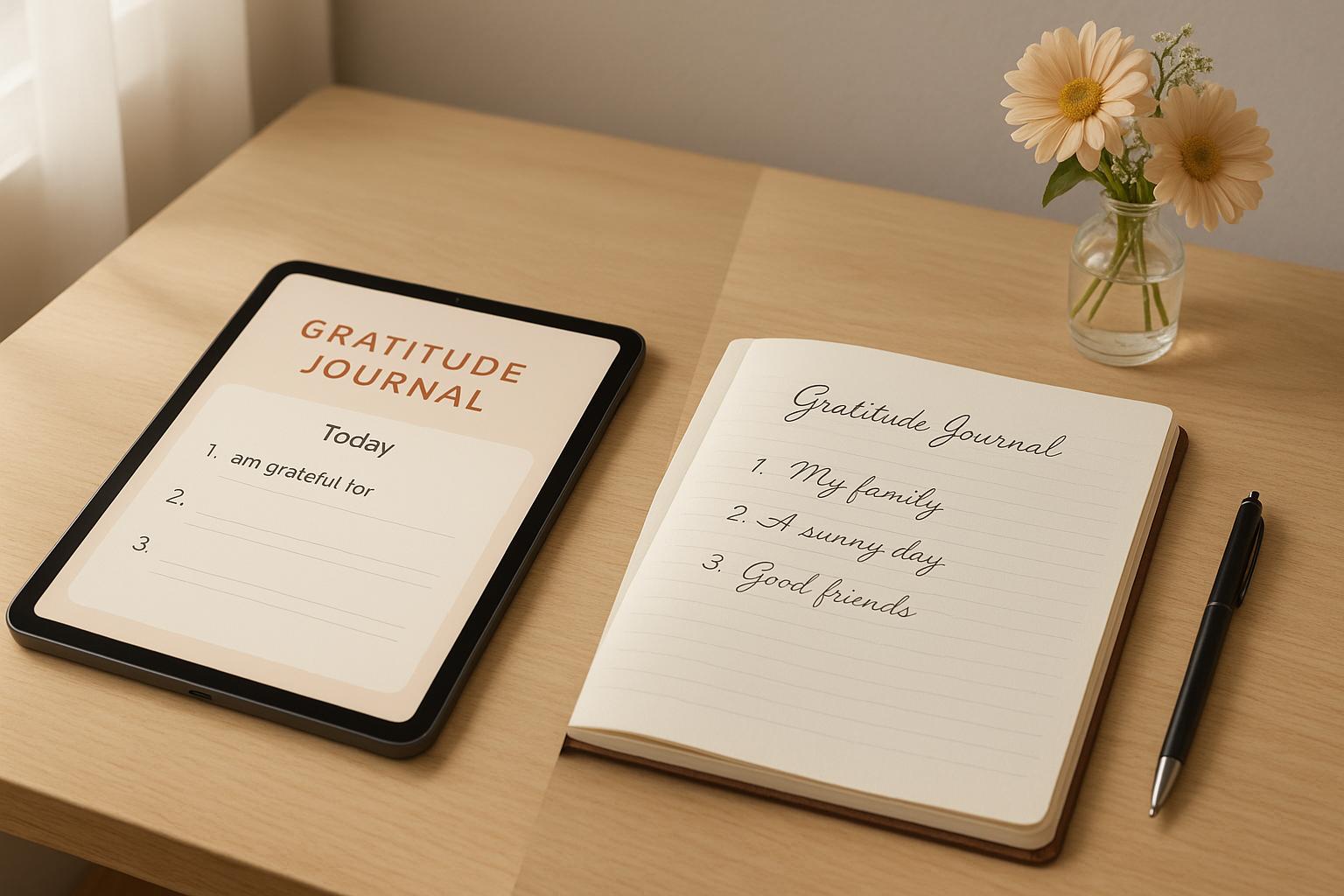
Choosing between a digital or paper gratitude journal? Here’s a quick guide:
- Digital Journals: Accessible anywhere via devices, offer features like reminders, multimedia integration, and keyword search. Great for convenience, habit-building, and security with password protection.
- Paper Journals: Provide a tactile, mindful experience. Writing by hand can deepen emotional connection and memory retention. Ideal for personalization and distraction-free reflection.
Quick Comparison
| Aspect | Digital Journals | Paper Journals |
|---|---|---|
| Accessibility | Available on multiple devices, cloud sync | No power or internet needed |
| Portability | Always on hand via smartphone | May be bulky, but pocket-sized options exist |
| Search Function | Instant keyword search | Requires flipping through pages manually |
| Writing Experience | Fast typing, structured prompts | Slower, more intentional handwriting |
| Privacy | Password-protected, encryption available | Naturally private unless physically accessed |
| Habit Support | Automated reminders | Relies on self-discipline |
The best choice depends on your lifestyle and preferences. Want convenience? Go digital. Crave mindfulness? Stick to paper. Or, try a hybrid approach for the best of both worlds.
The Best Digital Gratitude Journal 2021 | Bold Visionary Self Care Journal | Goodnotes PDF Journal
Main Differences Between Digital and Paper Gratitude Journals
When it comes to gratitude journaling, the choice between digital and paper formats can shape how you engage with the practice. Each option has its own strengths and challenges, influencing both the practicality and emotional depth of your experience.
Accessibility and Convenience
Digital journals shine when it comes to convenience. With a smartphone, tablet, or laptop, you can jot down your thoughts anytime – whether you’re on a commute or taking a quick break. Thanks to cloud synchronization, your entries are accessible across multiple devices, making it easy to keep your journal up to date. Plus, features like keyword search, automated reminders, and mood tracking can simplify and enhance your routine.
On the other hand, paper journals don’t rely on power or internet access. While larger hardbound versions may not be as portable, there are plenty of pocket-sized options for those who enjoy the tactile experience of putting pen to paper.
These practical differences also influence how each medium impacts your mental and emotional engagement.
Mental and Emotional Impact
The format you choose can shape how deeply you connect with your reflections. Writing by hand activates deeper neural pathways, which can enhance emotional processing and memory retention. The slower, more intentional act of handwriting can make each entry feel more meaningful.
Digital apps, however, are particularly helpful for beginners. Many offer prompts and reminders to guide your practice. For instance, a study on the "Be Grateful" app highlighted its ease of use, with participants giving it an impressive System Usability Scale (SUS) score of 83.93 – well above average. Notifications from digital platforms can also help you build and maintain a consistent journaling habit.
Here’s a quick comparison of the practical differences between digital and paper gratitude journals:
| Aspect | Digital Journals | Paper Journals |
|---|---|---|
| Accessibility | Available across devices with cloud sync | No need for power or internet |
| Portability | Always on hand via smartphone | May be bulky, though pocket-sized options exist |
| Search Function | Instant keyword search | Requires flipping through pages manually |
| Writing Experience | Fast typing with structured prompts | Slower, more intentional handwriting |
| Privacy | Risk of on-screen exposure | Naturally private unless physically accessed |
| Habit Support | Automated reminders and notifications | Relies on self-discipline |
Ultimately, the decision between digital and paper journaling comes down to what fits best with your lifestyle and personal preferences. Both formats offer unique ways to deepen your gratitude practice.
Customization and Personal Options
Personalizing your gratitude journal can turn a simple habit into something that feels deeply personal and meaningful. Whether you prefer the high-tech versatility of digital journals or the hands-on creativity of paper journals, both formats offer unique opportunities to tailor your experience. Let’s dive into how each option brings something special to the table.
Digital Journals: Multimedia and Versatility
Digital gratitude journals shine when it comes to integrating multimedia and offering flexibility. Apps like Day One and ThinkUp allow you to enrich your entries with photos, videos, and even audio recordings. They can automatically log details like your location, adding an extra layer of context to your reflections.
These platforms often come with customizable templates, hyperlinks for easy navigation, and interactive features like daily prompts or affirmation trackers. Some even let you mix handwritten notes and sketches with typed text, blending traditional and modern journaling styles. Plus, digital journals are practically limitless – you can duplicate pages, add sections, or reorganize entries as your needs evolve.
Paper Journals: Hands-On Creativity
Paper journals, on the other hand, offer a tactile and creative experience that’s hard to replicate digitally. The act of personalizing a physical journal – whether by adding stickers, washi tape, or doodles – can become a meaningful part of your gratitude practice.
You can also customize the cover to reflect your personality, choosing designs, favorite quotes, or inspiring artwork that resonate with you. Inside, the layout is entirely up to you. Arrange your writing and drawings in a way that feels natural and supportive of your creative process. This hands-on approach can deepen your connection to the practice and help you stick with it over time.
While digital journals offer cutting-edge features and boundless flexibility, paper journals provide a more intimate, creative outlet. Choosing between the two comes down to what aligns better with your preferences – whether you value the tech-driven convenience of digital tools or the tactile joy of crafting something by hand.
sbb-itb-593149b
Mental Health and Habit-Building Effects
Gratitude journaling has a powerful impact on mental well-being and can help build lasting habits. Whether you prefer digital tools or a traditional paper journal, both formats can effectively lower stress and encourage consistent practice. Let’s dive into how each method helps reduce stress and supports habit formation.
Stress Reduction Benefits
Gratitude journaling is known to enhance mental health by boosting happiness, lowering stress, and acting as a buffer against depression. But how does each format contribute to stress relief?
Paper journaling offers some unique advantages. Writing by hand engages areas of the brain connected to visual and spatial processing, which can enhance mindfulness and reduce stress. Professor Audrey van der Meer of the Norwegian University of Science and Technology highlights this phenomenon:
"We show that when writing by hand, brain connectivity patterns are far more elaborate than when typewriting on a keyboard… Such widespread brain connectivity is known to be crucial for memory formation and for encoding new information and, therefore, is beneficial for learning."
This heightened brain activity might explain why handwriting promotes mindfulness, which is key to stress relief. Research also links regular journaling to lower inflammation, improved immune function, reduced blood pressure, and fewer stress-related doctor visits. Just 20 minutes of journaling, 3–5 times a week, can make a measurable difference.
On the other hand, digital journaling shines in its convenience and accessibility. It allows you to capture stressful moments on the go and reframe them in real time. Psychotherapist Kathryn Kupillas explains:
"Gratitude practice counteracts negativity bias by reorienting the mind to the present."
This immediacy makes digital journaling a practical tool for managing stress in today’s fast-paced world.
Long-Term Habit Formation
Gratitude journaling isn’t just about short-term benefits – it’s also a practice that can lead to lasting habits.
Digital journals help reinforce routines through features like reminders and notifications. A 2015 study found that online journaling was as effective as paper journaling for reducing stress and enhancing life meaning, particularly among older adults. Apps like GET.On Gratitude have shown promising results, with users reporting less anxiety, depression, and insomnia after three months of use. Digital tools also overcome practical barriers, such as forgetting to carry a physical journal. A 2018 study noted that some participants preferred gratitude apps for their ease and accessibility.
Meanwhile, paper journals encourage habit formation through their tactile and mindful nature. The act of writing by hand can turn journaling into a meaningful daily ritual. Laura Rubin, founder of Allswell, explains:
"A consistent gratitude journaling practice can actually help rewire your brain, changing your baseline settings over time."
To keep the practice engaging, research suggests mixing things up – try new prompts or even switch between paper and digital formats occasionally. As Britt Greaves, a nurse and community manager, puts it:
"Gratitude is definitely an attitude. You have to put it on every day. You have to actively work at it every day."
Both paper and digital journaling can build sustainable habits that not only reduce stress but also contribute to long-term mental well-being. Each method offers unique strengths, so finding what works best for you is key to maintaining a fulfilling gratitude practice.
Practical and Impact Considerations
When deciding between paper and digital journals, it’s essential to weigh their environmental impact and long-term practicality. These factors can help you choose an option that aligns with your values and lifestyle. Let’s take a closer look at each format’s environmental footprint and data security.
Sustainability and Longevity
Both paper and digital journals come with distinct environmental considerations.
Paper journals have seen improvements in their environmental impact over the years. For instance, between 1990 and 2019, the paper industry cut its carbon emissions by 48%. Additionally, the paper, pulp, and print sector now accounts for just 0.8% of European emissions, and 71.4% of European paper and paperboard was recycled in 2022.
That said, paper production still consumes significant resources. Producing a single ton of paper requires approximately 7,000 gallons of water and the loss of about 24 trees.
Digital journals, on the other hand, eliminate the need for paper but are not without their environmental costs. The digital sector contributes to 4% of global greenhouse gas emissions, with data centers alone accounting for 2.5–3.7% of all human-induced CO₂ emissions. Using a laptop for journaling generates roughly 50 grams of CO₂ per hour, while smartphones produce about 20 grams per hour.
The environmental impact of digital journaling depends heavily on usage. As Mike Berners-Lee, a sustainability professor at Lancaster Environment Centre, explains:
"If you buy an e-reader and you read loads and loads of books on it, then it’s the lowest carbon thing to do."
E-readers have a carbon footprint of around 80 pounds, and their environmental benefits are realized after reading about 36 small paperback books. For those who journal frequently or revisit their entries often, digital formats may become a more resource-efficient option over time.
When it comes to longevity, paper journals made with acid-free or archival paper can last for decades. For example, a gratitude journal from 2004 was still in use in 2019. However, paper journals are susceptible to physical damage, theft, or loss.
Digital journals, by contrast, benefit from cloud storage and automatic backups, safeguarding entries from physical harm. Still, they contribute to e-waste, with only 17.4% of global electronic waste currently being recycled.
While sustainability focuses on ecological impact, security and privacy are equally important when considering how to protect your personal reflections.
Security and Privacy
The security of your journal – whether digital or paper – depends on the format you choose, with each offering distinct advantages and vulnerabilities.
Digital journals provide robust security features like password protection, biometric authentication, and encryption. A digital journaling expert notes:
"With digital journaling platforms, you have the option to safeguard your entries using passwords, biometric authentication like face detection, or encryption methods, providing an additional layer of protection against unauthorized access."
Many digital journaling apps store data locally on your device, giving you control over where your entries are saved. For instance, Notability keeps all notes on your device unless you enable syncing with cloud services like iCloud or Google Drive.
However, digital journals are not without risks. Data breaches, hacking attempts, and concerns over cloud storage privacy remain valid concerns.
Paper journals, by nature, offer complete offline privacy. They eliminate worries about hacking, data breaches, or corporate data mining, keeping your thoughts entirely under your control. Yet, physical journals are vulnerable to being lost, stolen, or damaged, and there’s no backup if something happens to your notebook.
CJ Chilvers highlights the digital security advantage:
"Journaling is an offshoot of meditation – a type of introspection where a record of events is welcome. It doesn’t have to mean the record is permanent. In fact, it’s probably better as ephemeral – permanently locked behind a password. But, the fact that it exists is a comfort in itself."
For those seeking a balance, a hybrid approach can work well. Some individuals use digital journals for their convenience and security features while occasionally printing important entries to create physical backups. As DayOneApp suggests:
"Printing your digital journal provides an opportunity to preserve a physical copy of your memories and reflections, making it a valuable keepsake to look back on in years to come."
Ultimately, both paper and digital journals can safeguard your privacy if used thoughtfully. The choice boils down to whether you prioritize protection against digital threats or physical vulnerabilities.
Conclusion: Choosing the Right Gratitude Journal for You
Deciding between digital and paper gratitude journals comes down to your personal lifestyle, preferences, and goals. Each option has its own perks, so it’s all about finding the fit that works best for you.
Paper journals are ideal if you enjoy the tactile experience of writing and want to avoid digital distractions. Research suggests that "writing in a paper journal can help you focus better, spark your creativity and even bring a sense of calm". Plus, they’re great for personalizing and don’t rely on technology to stay accessible. As one study pointed out, "Unlike digital journal files that can get lost in the abyss of old devices or obsolete tech, a paper journal is always there for you". If you love the idea of a physical keepsake and a distraction-free experience, this might be your go-to option.
On the other hand, digital journals offer convenience and practicality. They’re perfect for jotting down thoughts on the go, setting automated reminders, and keeping everything neatly organized. Security is another big plus: "Digital journaling provides us with the option of adding encryption to keep our private reflections to ourselves, ready to be shared only once we choose to". For frequent travelers or those who value portability and cloud backups, digital journals make a lot of sense.
If neither option feels like a perfect fit, you’re not alone. Many people find that a hybrid approach works best. For example, you could use a digital journal for quick daily notes and save your paper journal for more reflective, handwritten entries. Combining the strengths of both formats can help you build a more flexible and fulfilling gratitude practice.
FAQs
What are the benefits of combining digital and paper gratitude journaling, and how can I get started?
Using both digital and paper gratitude journals brings together the best of both worlds. This hybrid method combines the tactile joy of handwriting with the ease and adaptability of digital tools. By blending these approaches, you can stay consistent, reflect more deeply, and make gratitude a more engaging part of your daily life.
Start by using a digital app to quickly capture moments of gratitude or set reminders throughout the day. Then, in the evening, expand on those brief notes in a physical journal. For instance, you might jot down a quick note on your phone during a hectic day, like appreciating a kind gesture or a beautiful sunset. Later, you can use your paper journal to dive deeper, adding thoughtful reflections or even creative touches like sketches. This mix of practicality and reflection can make your gratitude practice feel both manageable and meaningful.
What are the environmental impacts of digital and paper gratitude journals, and how can I choose the more eco-friendly option?
The environmental impact of gratitude journals – whether digital or paper – hinges on several factors. Paper journals, for instance, contribute to deforestation and release carbon emissions during their production and disposal. Meanwhile, digital journals impact the environment through energy consumption, including the electricity needed to power devices and data centers.
Choosing the more eco-conscious option often comes down to how you use the journal. If you plan to use a digital journal extensively over time, it might be a greener choice since it eliminates paper waste. That said, the environmental toll of producing and disposing of electronic devices, including the growing issue of e-waste, cannot be ignored. Ultimately, your decision should align with your habits and how you intend to use the journal.
How can I keep my digital gratitude journal private and secure?
To keep your digital gratitude journal secure, start with the basics: use strong, unique passwords and enable two-factor authentication if it’s an option. Opt for platforms that provide end-to-end encryption to keep your entries private. If privacy is your top concern, avoid syncing your journal to the cloud and consider sticking to offline journaling. Always write on devices you personally own and control, and be mindful not to leave your journal open or share it in public spaces. For added security, update your passwords regularly and consider using a password manager to keep everything organized and protected.
