
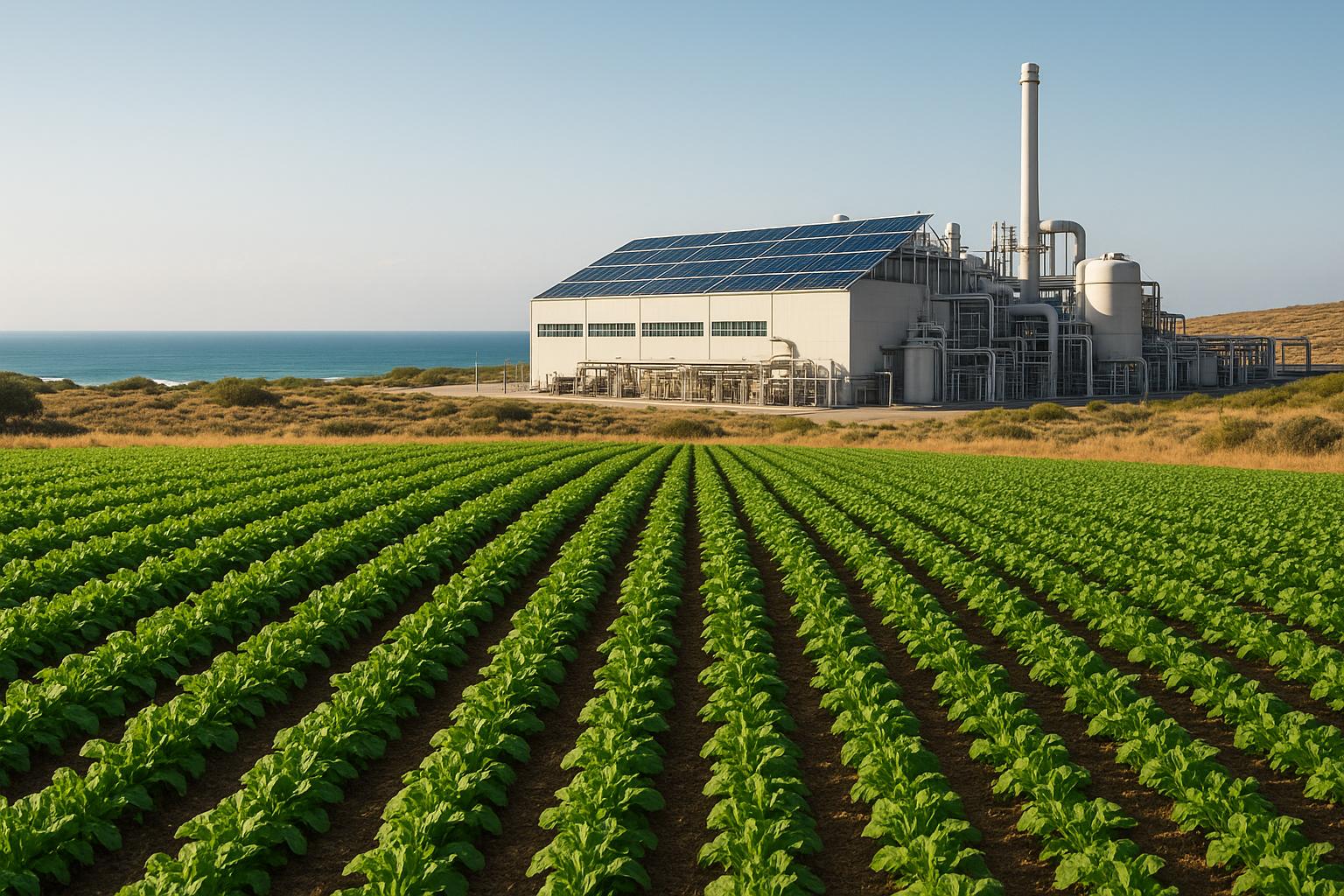
Agriculture uses 70% of the world’s freshwater, but by 2030, freshwater resources will fall short by 40%. Desalination is emerging as a solution, turning seawater and brackish water into freshwater for farming. It helps restore soil health, supports high-value crops, and provides a steady water supply, even in arid regions. However, it comes with challenges like high energy costs and brine waste.
Key Insights:
- Renewable Energy Integration: Solar-powered desalination is reducing costs in countries like Saudi Arabia and Australia.
- Global Success Stories:
- Saudi Arabia: Solar desalination supports large-scale farming.
- Spain: Reverse osmosis boosts greenhouse agriculture.
- Israel: Tailored water quality improves crop yields.
- United States: Brackish water desalination aids drought-prone areas.
- Main Challenges:
- High energy consumption (40–70% of costs).
- Brine waste harming ecosystems.
- Solutions:
- Renewable energy (solar, wind) to cut costs.
- Advanced technologies like electrodialysis and self-cleaning membranes.
- Government support and public-private partnerships.
Quick Comparison:
| Country | Approach | Key Benefits | Challenges |
|---|---|---|---|
| Saudi Arabia | Solar-powered desalination | Sustainable water for large farms | High initial costs |
| Spain | Reverse osmosis in greenhouses | Boosted yields, efficient water use | Higher fertigation costs |
| Australia | Solar desalination for hydroponics | Water-efficient farming in remote areas | Limited scalability |
| Israel | Tailored water quality | High-value crop production | Boron removal costs |
| United States | Brackish water desalination | Reliable water during droughts | Expensive infrastructure |
Desalination is transforming agriculture worldwide. With renewable energy, better waste management, and government support, it can address water scarcity while improving food security.
A new era of desalination | FT Food Revolution
Global Case Studies: How Different Countries Use Desalination in Farming
Around the globe, countries are adopting desalination to tackle agricultural water shortages, tailoring the technology to their specific needs. These examples highlight how different regions are leveraging desalination to transform farming in water-scarce areas. Let’s start with Saudi Arabia, where solar energy and desalination are being combined to reshape agriculture.
Saudi Arabia: Solar-Powered Desalination for Large-Scale Farming
Saudi Arabia is at the forefront of merging solar power with desalination to create sustainable farming solutions in one of the driest places on Earth. The country uses about 300,000 barrels of oil daily for desalination, with 70% of its drinking water now coming from desalination plants. By 2025, capacity is expected to hit 8.5 million cubic meters per day, making Saudi Arabia and its Gulf Cooperation Council (GCC) neighbors responsible for roughly 60% of the world’s desalination output.
A standout example of this innovation is the Al-Khafji project. Launched in 2015, this solar-powered desalination plant, developed by Abengoa and AWT, produces 60,000 cubic meters of water daily using reverse osmosis technology powered by solar photovoltaic systems. The desalinated water supports modern farming techniques like pivot irrigation and hydroponics, which use up to 90% less water than traditional methods. These hydroponic systems also accelerate crop growth by 30–50% compared to conventional soil farming. Saudi Arabia is also shifting from energy-heavy thermal desalination to more efficient reverse osmosis systems, while increasingly relying on renewable energy.
Spain: Reverse Osmosis for Greenhouse Agriculture
In Spain, reverse osmosis desalination is a cornerstone of agricultural success, especially in the water-scarce southeastern regions. Almería province, home to over 32,000 hectares of greenhouses, produces more than 3.4 million tons of crops annually. This thriving industry generates €1.3 billion in revenue and employs 5,500 people.
Farmers in Spain have observed significant benefits from desalinated water. In traditional soil farming, crop yields improve by 15%, while soilless cultivation sees a 46% boost compared to using lower-quality water. However, desalinated water requires adjustments to fertigation systems, increasing fertilization costs by 20% for soilless methods and 33% for soil-based farming. Despite these costs, the financial return is strong, with investments in reverse osmosis systems often recouped within three years. The cost of desalinated water ranges from €2.51 to €3.69 per cubic meter.
Spain has also prioritized environmental protection. For instance, in 1997, the Spanish Environment Ministry implemented a pipe network in Campo de Cartagena (Murcia) to collect brine from desalination plants, preventing it from polluting the protected Mar Menor area. This brine, along with agricultural runoff, is treated at a desalination plant and returned to irrigation systems.
Australia: Solar Desalination for Hydroponic Farming
Australia has embraced solar-powered desalination to support hydroponic farming, particularly in remote and arid regions. These decentralized systems, combining solar panels with reverse osmosis units, operate independently of traditional power grids. The result is a renewable water supply ideal for hydroponic setups, which maximize water efficiency and enable year-round crop production regardless of seasonal changes. This approach has been especially effective for high-value crops like tomatoes, cucumbers, and leafy greens, where premium market prices can offset the higher costs of water production.
Israel: Improving Water Quality for Better Crops
Israel has developed cutting-edge desalination systems that focus on producing high-quality water tailored for agriculture. Beyond removing salt, these systems address specific contaminants, such as boron, which can harm sensitive crops even at low levels. By delivering water with precise mineral content, Israel’s desalination plants enable farmers to grow high-value crops that might not thrive with lower-quality water.
This consistent water quality supports advanced fertigation programs, boosting yields while minimizing fertilizer waste. Additionally, the predictable chemistry of desalinated water ensures the efficient operation of modern irrigation technologies like drip systems and micro-sprinklers. These innovations showcase how desalination can be fine-tuned to meet the unique challenges of agricultural water management.
United States: Using Brackish Water Desalination During Droughts
In the U.S., brackish water desalination is becoming a vital tool for managing drought, particularly in the arid Western and Southwestern states. El Paso, Texas, is home to the Kay Bailey Hutchison Desalination Plant, the world’s largest inland desalination facility. This plant produces up to 27.5 million gallons of fresh water daily from brackish groundwater, with plans to expand capacity to 42 million gallons per day.
Economic factors are key to its adoption. Desalting an acre-foot of brackish groundwater costs about $800, compared to $300 for treating and distributing Rio Grande water. Lisa Rosendorf, spokesperson for El Paso Water, highlights the importance of preparation:
"We have to prepare for the year that there is no river water, because that year will come."
Pilot projects are also advancing desalination’s role in agriculture. For example, West Texas farmer Ralph Loya is testing a solar-powered reverse osmosis system that produces seven gallons of fresh water per minute during peak sunlight, achieving a 90–95% freshwater recovery rate. Meanwhile, the Brackish Groundwater National Desalination Research Facility in New Mexico provides researchers with diverse testing conditions. Studies show that with proper soil amendments, crops irrigated with a mix of desalinated and brackish water can achieve yields comparable to those grown with pure freshwater.
Texas alone holds over 3 billion acre-feet of brackish groundwater. The 2022 State Water Plan has nearly doubled its desalination strategies compared to 2017, underscoring the growing importance of this technology in addressing water scarcity in agriculture.
Main Problems and Solutions in Agricultural Desalination
Agricultural desalination comes with its fair share of challenges, and these issues can significantly impact its practicality over time. To make desalination a viable option for farmers and policymakers, addressing these hurdles with proven strategies is a must.
Energy Costs and the Role of Renewable Energy
Energy consumption is one of the biggest expenses in agricultural desalination, making up 40–70% of total production costs. Many traditional desalination plants rely heavily on fossil fuels, which not only drive up costs but also contribute to greenhouse gas emissions. For instance, in the Middle East, thermal desalination powered by fossil fuels accounts for 75% of seawater desalination, while only 25% comes from more efficient membrane-based systems. By 2016, renewable energy sources made up just 1% of desalination in the region.
Switching to renewable energy could change the game. Research from Portugal’s Algarve region and Porto Santo Island in the Madeira Archipelago shows that using photovoltaic solar systems can cut desalinated water production costs by about 33%. However, renewable energy sources like solar and wind often produce power intermittently, which doesn’t always match the steady energy needs of desalination processes. Hybrid systems that combine solar, wind, and battery storage are emerging as a solution. These systems ensure a consistent power supply, protecting sensitive reverse osmosis membranes from energy fluctuations and enabling uninterrupted water production.
But energy isn’t the only challenge – managing the waste from desalination is equally pressing.
Brine Waste and Its Environmental Impact
Desalination doesn’t just produce fresh water; it also generates large amounts of concentrated brine. Globally, nearly 16,000 desalination plants produce over 100 billion liters of water every day, along with a comparable volume of brine. Recent studies suggest that the actual brine output is about 50% higher than earlier estimates, highlighting the scale of this issue.
In regions like the Middle East and North Africa, which account for nearly half of global desalination capacity, the recovery ratio can be as low as 0.25 – meaning 75% of the processed water turns into brine. Improper disposal of this brine can harm marine ecosystems, including seagrass meadows and fish populations. Effective brine management is critical. As John Lienhard, a mechanical engineering professor at MIT, points out:
"Environmentally safe discharge of brine is manageable with current technology, but it’s much better to recover resources from the brine and reduce the amount of brine released."
Some countries are already taking action. Spain, for example, has set a salinity threshold of 38.5 practical salinity units to protect seagrass meadows. Kuwait has incorporated brine management into its environmental regulations, setting specific salinity limits. Similarly, Abu Dhabi has issued detailed guidelines on handling brine, raising awareness among stakeholders. Companies are also stepping in with technologies to extract salts and metals from brine, turning waste into potential revenue streams.
Costs and the Role of Government Support
Beyond energy and waste, the economic side of desalination remains a barrier. While costs have dropped over the years, desalination is still more expensive than traditional water sources. This is where government intervention becomes crucial, offering financial support and policy frameworks to make desalination more accessible.
Spain’s AGUA (Actions for Water Management and Use) Program is a standout example. Launched in 2004 and aligned with the European Union’s Water Framework Directive, this program made desalination a cornerstone of Spain’s water strategy. By 2012, around 22% of the country’s desalinated water was used for agriculture.
International efforts have also helped push innovation. From 2014 to 2016, the USAID DESAL Prize attracted over 60 teams from 29 countries, with nearly 90% of participants applying for USAID funding for the first time. This initiative awarded $1 million from USAID and an additional $500,000 from the U.S. Bureau of Reclamation for project funding.
When agriculture struggles with water scarcity, government programs can bridge the gap. By combining direct funding, technical assistance, and long-term policies, these initiatives enable pilot projects to prove their effectiveness before scaling up to larger investments.
sbb-itb-593149b
New Technology Making Agricultural Desalination Better
Recent breakthroughs in technology are reshaping how desalination is used in agriculture, making it more efficient and less expensive. These advancements address key challenges like high energy demands, environmental impact, and operational difficulties, offering new possibilities for managing water in farming.
Electrodialysis and Low-Energy Methods
Although reverse osmosis (RO) still leads the desalination market, electrodialysis (ED) is gaining attention for agricultural purposes. This method uses an electric field to move ions through specialized membranes and currently accounts for about 4% of global desalination capacity. ED is particularly effective for treating medium-salinity water, such as brackish groundwater, which is commonly used in farming.
One of ED’s standout features is its energy efficiency:
| Technology Type | Energy Consumption Range (kWh/m³) |
|---|---|
| Electrodialysis (EDM) | 0.6–5.1 |
| Reverse Osmosis (RO) | 2–6 |
Laboratory tests reveal that incorporating pulsed electric fields (PEF) into the ED process can slash energy use by up to 30% and lower total dissolved solids by 80%, reducing salinity from 50,000 ppm to approximately 9,900 ppm.
Researchers are also exploring ways to pair solar energy with desalination techniques. Systems like solar electrochemical distillation (SED) and solar capacitive deionization (SCDI) are emerging as promising options. For instance, a solar water evaporator made with CuxS achieved a water evaporation rate of 1.96 kg/m²/hour with an impressive 94.5% energy efficiency. These advancements hint at a future where renewable energy plays a larger role in agricultural water management.
Better Membrane Technology
Thin-film composite (TFC) membranes are central to modern desalination, and ongoing improvements are making them even more effective for agriculture. In one study, a TFC reverse osmosis membrane achieved a 98.6% salt rejection rate with a water flux of 19.1 L/m²/hour by fine-tuning monomer concentrations.
A major milestone came in April 2025, when researchers at the University of Michigan introduced new electrodialysis membranes that are ten times more conductive than existing options. These high-charge-density membranes can handle highly concentrated brine, enabling both effective desalination and the recovery of valuable minerals.
"Our technology could help desalination plants be more sustainable by reducing waste while using less energy", said Jovan Kamcev, assistant professor of chemical engineering at the University of Michigan.
Self-cleaning membranes are another game-changer for agriculture, addressing the persistent issue of fouling. In September 2023, researchers at NYU Abu Dhabi developed a hybrid membrane using a unique gating process that increased desalinated water flow by over 43% and extended the membrane’s lifespan through osmotic distillation.
"There is an urgent need for energy-efficient membranes capable of water desalination and other separation technologies that eliminate fouling issues without utilizing harsh chemicals as cleaners", said Professor Panče Naumov.
These innovations translate to lower maintenance costs and better water availability, directly supporting higher agricultural productivity.
Methods to Reduce Salt Water Waste
For every liter of fresh water produced, desalination generates about 1.5 liters of brine. However, Zero Liquid Discharge (ZLD) systems are becoming more feasible, with some achieving water recovery rates as high as 95%. These systems significantly cut down on the amount of brine needing disposal. Using low-temperature technologies further enhances energy efficiency compared to traditional high-temperature evaporation methods.
Advanced electrodialysis systems, including the high-charge-density membranes developed at the University of Michigan, show promise in concentrating brine to the point where salts crystallize. This not only reduces liquid waste but also allows for the extraction of valuable minerals.
"Not every membrane suits all purposes; our study shows a range of viable options. Water is such an important resource, so it would be amazing to help to make desalination a sustainable solution to our global water crisis", explained David Kitto, postdoctoral fellow in chemical engineering.
Other innovations include electrodialysis with bipolar membranes, which can split water molecules into acids and bases for cleaning purposes, reducing both waste and operational costs. A large-scale example of effective waste reduction is the South Bay Water Recycling Program in California. Completed in 1997, it delivers 21 million gallons of recycled water daily for irrigation and industrial use.
These technological strides are making desalination more practical for agriculture. By cutting energy use, enhancing membrane performance, and improving waste management, farmers can access reliable water supplies even in challenging conditions.
Conclusion: What We Learned and Next Steps
Global examples highlight that successful agricultural desalination projects share three key components: renewable energy integration, customized water treatment solutions, and effective waste management. These elements provide a clear framework for regions exploring desalination as a way to tackle agricultural water shortages, offering practical insights for future strategies.
Renewable energy is a game-changer. Spain’s solar-powered greenhouses and Australia’s solar hydroponic systems show how renewable energy can slash desalination costs by up to 24%. For areas with abundant sunlight but limited water, solar power turns this challenge into an opportunity, making water solutions more affordable and sustainable.
A crop-specific approach is crucial for economic success. In Abu Dhabi, recycled water costs AED 1.7 per cubic meter – about half the price of subsidized desalinated water used in agriculture. Additionally, hydroponic systems, which use up to 90% less water than traditional farming methods, make desalinated water a practical option, even for smaller farms.
Waste management is evolving into an opportunity. The UAE aims to reuse 95% of treated water by 2036, while Dubai is targeting 100% wastewater recycling by 2030. Egypt’s New Delta Wastewater Treatment Plant processes over seven million cubic meters daily, recovering valuable nutrients like phosphorus and nitrogen to create sustainable fertilizers. These examples show how waste management can drive both environmental and economic benefits.
Looking ahead, there are five actionable steps for regions planning agricultural desalination projects:
- Analyze water chemistry: Understanding salinity levels and scaling potential is critical before selecting technology.
- Pursue public-private partnerships: Sharing costs through collaboration has proven effective in many countries.
- Integrate with national water policies: Projects should align with broader water management goals rather than operate in isolation.
- Engage local communities early: Transparent planning and addressing community concerns from the start can secure local support.
- Adopt modular system designs: Standardized, scalable systems reduce capital costs and simplify implementation.
Economic trends are increasingly favorable for agricultural desalination. Advances in technology have made smaller, distributed desalination systems more cost-effective for farming needs. Peter Fiske, executive director of NAWI, emphasizes this progress:
"NAWI is driving breakthrough research to reduce the price, energy costs, and greenhouse gas emissions of new water technologies".
The next frontier involves maximizing resource recovery. Jordan’s As-Samra Wastewater Treatment Plant demonstrates this potential by meeting up to 80% of its energy needs through biogas from organic sludge. This approach shows how agricultural desalination can become energy-neutral – or even energy-positive.
The shift toward smaller, farm-focused desalination plants signals a move away from large-scale industrial systems to solutions tailored to agricultural needs. With global desalination demand expected to double by the end of the decade, regions that invest now in well-planned, renewable-powered systems will gain a competitive edge in food production and water security.
Ultimately, success lies in treating desalination as part of a broader water management strategy. By integrating energy recovery, waste reduction, and community involvement, agricultural desalination can achieve both environmental and economic goals. Case studies from Saudi Arabia to Spain demonstrate that when these elements align, desalination becomes a sustainable and practical solution for modern agriculture.
FAQs
How do renewable energy sources like solar and wind affect the cost and efficiency of using desalination in agriculture?
Harnessing renewable energy sources like solar and wind can cut desalination costs for agriculture by as much as 24%, according to studies. These energy options not only slash expenses but also improve the performance of desalination systems, ensuring a more efficient way to produce clean water for farming.
Switching from conventional energy to renewables also significantly reduces carbon emissions. This dual benefit – lower costs and reduced environmental impact – positions renewable-powered desalination as a smart, forward-thinking solution to tackle water scarcity and support sustainable farming practices.
What are the environmental impacts of brine waste from desalination, and how are countries addressing this issue?
Desalination plants produce brine waste that can pose serious risks to marine ecosystems. This concentrated mix of salt and chemicals can harm aquatic life, raise salinity levels, and lower oxygen in the water, which may disrupt local biodiversity.
To tackle these challenges, several countries are turning to creative solutions. Advanced technologies are being used to treat and dilute brine before it’s released, reducing its environmental footprint. Others are finding ways to repurpose brine by extracting minerals or converting it into useful byproducts. In some regions, strict regulations are in place to ensure brine discharge has minimal impact. These efforts aim to make desalination a more environmentally conscious process.
How do government support and public-private partnerships help make desalination a practical solution for agricultural water scarcity?
Government support and public-private partnerships (PPPs) are critical in making desalination a viable option to combat water scarcity in agriculture. By pooling funding, expertise, and resources, these partnerships help address the steep costs and challenges tied to desalination projects. Take Egypt, for instance – through PPPs, the country has pledged $8.5 billion to construct 47 desalination plants by 2050. This commitment demonstrates how collaboration can drive large-scale infrastructure projects.
In the United States, the Carlsbad Desalination Plant in California stands as a shining example of public and private sector cooperation. Using creative financing strategies, the plant delivers a dependable and cost-efficient water supply, meeting both agricultural and municipal demands. These cases underscore the importance of teamwork between governments and private entities in addressing the pressing issue of water scarcity in agriculture.