
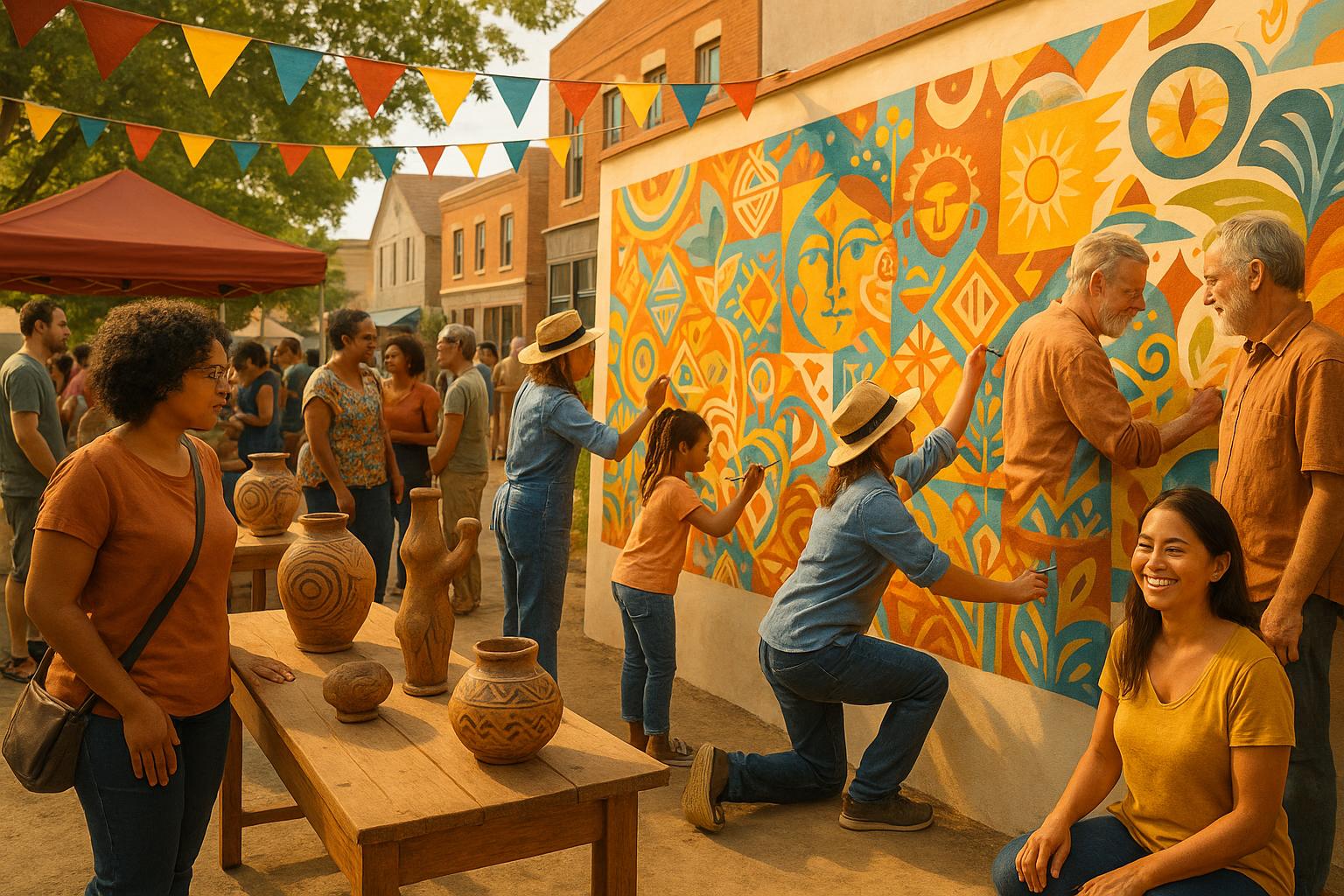
Art revival isn’t just about preserving old traditions – it’s about transforming communities. Reviving forgotten art forms can boost local economies, strengthen social bonds, and celebrate shared heritage. From murals in Chicago to paper-cutting in China, these efforts prove that art can drive meaningful change.
Key Takeaways:
- Economic Impact: Arts contribute $763.6 billion annually to the U.S. economy.
- Social Benefits: Communities with art programs see 18% fewer serious crimes and 14% fewer child abuse cases.
- Global Examples:
- China: Paper-cutting revival creates jobs and preserves heritage.
- Greater Manchester: Urban renewal integrates art with housing and community spaces.
- Student-Artisan Projects: Bridge generational gaps while modernizing traditional crafts.
Art revival connects the past with the present, empowering communities to thrive while preserving their identity. Let’s explore how these initiatives are making a difference worldwide.
This Community Art Project Changed EVERYTHING #arthistory #contemporaryart #shorts
What Drives Art Revival
Communities often turn to traditional art forms to reconnect with their roots and preserve their identity. By understanding what fuels these movements, we can see how they gain traction and create enduring change.
Keeping Culture and Identity Alive
At the core of any art revival is the recognition that traditional art forms hold the essence of a community’s history, values, and identity. When these practices fade, it’s not just techniques that are lost – it’s the stories, wisdom, and connections that define a people.
Preserving cultural heritage is a powerful motivator. Traditional crafts carry generations of knowledge, passed down and refined over centuries. Take the Pattachitra paintings from Odisha, India, for example. These intricate works are not just visually stunning but also serve as a living record of cultural history. As one advocate put it:
"By reviving these art forms, we preserve a vital link to our heritage, ensuring that the wisdom and skills of our ancestors are not lost to time."
This kind of preservation becomes even more critical in communities grappling with rapid modernization or displacement. The Aboriginal art movement in Australia is a prime example. Artists like Emily Kame Kngwarreye brought traditional dot painting techniques to global audiences, blending ancient methods with contemporary relevance.
Reviving traditional arts doesn’t just honor the past – it also bridges the gap to the present. It fosters a sense of identity and connection for younger generations who might feel detached from their heritage. This preservation lays the groundwork for broader artistic and community-driven initiatives.
How Artists and Organizations Help
While cultural pride inspires revival efforts, artists and organizations provide the practical support to make them a reality. These efforts thrive on collaboration between artists, local governments, and civic groups.
Programs like Artists At Work (AAW) show how structured support can drive art revival. AAW offers artists W2 employment, health benefits, and retirement plans, with salaries of $40,000 annually and total gross earnings of $60,000 for 24 artists over an 18-month period. This financial stability allows artists to focus on community engagement rather than just making ends meet, strengthening cultural ties in the process.
Partnerships further demonstrate how collaboration can bring traditional arts back to life. For instance, the Southwest Folklife Alliance worked with AAW artists like Harrison Preston and Katrina Kerstetter through its Loom Market program. Preston collaborated with a local Tohono O’Odham Pottery Collective, while Kerstetter partnered with the Iskashitaa Refugee Network on their Refugee Garden Art Program. These collaborations directly connect artists with their communities, ensuring that traditional skills remain relevant and accessible.
Local governments also play a vital role by involving communities in public art initiatives. The city of Bellingham, for example, boasts a collection of over 84 outdoor artworks and actively commissions new pieces through public calls for artists. This approach not only beautifies public spaces but also celebrates the community’s identity.
"The FreshGrass Foundation is thrilled to be expanding Artists At Work, a program driven by the belief that artists are essential to healthy local communities."
Programs like Artists on Main Street have supported over 300 artist-led projects in the past four years, helping rural communities build stronger local economies and connections. One standout example comes from Willmar, Minnesota, where a quilting club at a Presbyterian church invited Somali mothers to sew and learn together. What began as an art project blossomed into a network of mutual support, with participants forming lasting relationships. This illustrates how art revival can foster meaningful social bonds.
Government initiatives also provide vital backing. India’s "Kala Raksha" initiative helps traditional artisans sustain their crafts while expanding to new markets. Similarly, creative district designations, like the one in Port Townsend, offer communities additional resources and a supportive environment for cultural efforts. These programs ensure that economic growth goes hand-in-hand with cultural preservation.
The success of these efforts hinges on involving local artists from diverse backgrounds and tapping into community strengths. This inclusive approach ensures that revival movements truly reflect the rich identities of the communities they aim to uplift.
Case Studies of Revived Art Changing Communities
Examples from around the world show how reviving traditional art forms can breathe new life into communities. These stories highlight the power of art to strengthen social bonds, boost local economies, and preserve heritage. From Asia to Europe, these cases demonstrate the real-world impact of art revival.
Paper-Cutting Revival in China
The resurgence of traditional Chinese paper-cutting in Ningxia, China, is a testament to how one family’s passion can uplift an entire community. It all started in 1997 when Fu Zhao’e began sharing her paper-cutting craft at the Zhenbeibu film studio. What began as a simple demonstration quickly turned into a movement. Over the years, Fu created around 100,000 paper-cut portraits for visitors, each completed in just three minutes. Her work not only kept an ancient tradition alive but also provided her with a steady source of income.
"Making paper cuttings allows me to express the things I see and the thoughts in my heart."
- Fu Zhao’e
The story took a new turn when Fu’s daughter, Li Jian, returned home after university. Instead of pursuing a career in the city, Li decided to expand her mother’s efforts by launching a cultural studio. She blended traditional paper-cutting techniques with modern products like wall calendars and silk scrolls, turning the craft into a thriving business. Her studio now generates millions of yuan annually and has trained over 1,000 rural women, equipping them with valuable skills.
"My mother’s generation stuck to craftsmanship, creating many meaningful works. As inheritors of the craft, our generation has the duty to preserve it, pass it down and carry it forward."
- Li Jian
This revival of paper-cutting, recognized by UNESCO in 2009 as part of the Intangible Cultural Heritage of Humanity, has become a cornerstone for cultural preservation and economic empowerment. It’s a shining example of how traditional art can bring communities closer while creating sustainable opportunities.
City Renewal Through Art in Greater Manchester
In Greater Manchester, art has become a driving force for urban transformation. The Wythenshawe Civic Project, a £500 million regeneration initiative, places creativity at its heart. Announced in July 2024, the plan includes converting a former Co-op department store into a vibrant cultural hub. This space will feature studios, performance areas, event venues, and a cinema, in collaboration with Manchester Arts Centre HOME.
The project is backed by significant public funding, including a £20 million Levelling Up fund grant and nearly £12 million from Manchester City Council. In addition to cultural facilities, the initiative will develop over 1,700 homes and new community spaces.
Bev Craig, Leader of Manchester City Council, highlighted the potential of Wythenshawe and the importance of addressing community needs, such as housing, alongside cultural growth.
This approach demonstrates how art can serve as a practical tool for urban renewal. By combining creative spaces with housing and retail, the project fosters both social connection and economic progress.
Student-Artisan Craft Projects for Social Change
Collaborations between students and artisans offer an innovative way to preserve traditional crafts while introducing modern ideas. These partnerships bridge generational divides, combining the creativity of students with the expertise of seasoned craftsmen. Together, they create products that honor traditional techniques while appealing to contemporary tastes, inspiring younger generations to engage with these art forms.
Such projects also open up new economic opportunities, particularly in rural or underserved areas, by modernizing how traditional crafts are marketed and sold. One standout example is Esporao winery in Portugal. For over two decades, the winery has worked closely with nearby communities and local artisans, building strong ties that support both cultural heritage and economic stability.
These collaborations show how art revival can evolve to meet modern demands while staying true to its roots. By blending heritage with innovation, these projects not only preserve traditional knowledge but also drive meaningful social and economic change.
sbb-itb-593149b
Social and Community Results of Art Revivals
Art revival initiatives do more than just breathe life into forgotten traditions – they strengthen communities and create a ripple effect of positive change. These efforts touch everything from social connections to economic resilience, proving that art has a transformative power far beyond its aesthetic value.
Main Benefits
Building Stronger Community Connections
Art programs often bring people together in ways that few other activities can. In fact, research shows that 79% of individuals believe participating in the arts improves their personal well-being. What’s more, people involved in the arts are more than twice as likely to volunteer in their communities. This heightened engagement fosters a sense of belonging and encourages active participation in local life.
Lower Crime Rates and Better Outcomes for Youth
Communities with robust cultural resources tend to experience lower crime rates and better outcomes for children. For instance, neighborhoods with such resources report 14% fewer cases of child abuse and an 18% drop in serious crimes. A standout example is Urban Artworks, a program that involves justice-involved youth in creating public murals. By offering job training and life skills, the initiative has helped 83% of participants avoid reoffending.
Celebrating Heritage and Community Pride
Reviving art forms often means celebrating a community’s heritage and shared identity. In Philadelphia, the FrankfordStyle Community Arts Organization has brought local history to life through its outdoor mural program. As Martha Kearns, the organization’s executive director, puts it:
"All great art transforms the individual, transforms the relationship of individuals, and transforms the relationships of the individual to his/her society."
Another example comes from the Village of the Arts and Humanities in Philadelphia’s Fairhill neighborhood, where artist Lily Yeh uses art to foster healing and connection. As Yeh explains:
"My work aims to reconnect people, to comfort, and to heal… My goal is to establish this ‘dustless’ place in the community art that I create."
Economic Growth Without Displacement
Programs like Path with Art show how art can bridge divides while supporting vulnerable populations. Each year, this initiative engages 750 homeless or formerly homeless adults through art and music, proving that economic development can coexist with compassion.
Promoting Environmental Awareness
Art can also shine a spotlight on pressing environmental issues. In Uganda, the Rwenzori Founders use sculptures of endangered species to raise awareness about deforestation. Their efforts have helped replant over 20,000 trees and increased the number of local bird species from 50 to 203. These achievements demonstrate how art can inspire both action and awareness.
Challenges in Keeping Programs Going
Overcoming the Perception Gap
While many recognize the personal benefits of art, fewer see its broader community impact. Only 28% of people acknowledge the community-wide benefits of art programs, despite 79% reporting personal gains. This disconnect can make it harder to rally widespread support for these initiatives.
Dependence on Partnerships and Funding
Many art revival programs rely heavily on partnerships outside the arts sector. In fact, over four in five arts organizations report such collaborations. However, this reliance creates vulnerabilities, especially when economic conditions shift or partner priorities change. The COVID-19 pandemic highlighted these risks, as many organizations struggled to stay afloat. One arts leader advised:
"Figure out what aspects make your organization unique, and narrow that list to the aspects people care about."
Balancing Growth with Community Needs
While art revival efforts can drive economic and cultural benefits, they must be carefully managed to avoid unintended harm. Revitalization projects can sometimes displace long-standing communities. For example, the Black Cultural Zone in East Oakland was created to protect Black residents and businesses while celebrating Black arts and culture within a broader community development strategy.
Sustaining Long-Term Impact
Keeping these programs impactful over time requires a clear focus and strategic planning. Donors, for instance, are often more motivated by the causes an organization supports than by the organization itself. As Steven Nardizzi puts it:
"Donors support not just organizations but the causes they champion. Mission impact, not organizational identity, drives their contributions."
Successful initiatives stay grounded in the needs of their communities. They invest in public spaces, collaborate with private sectors, and creatively repurpose underused areas. By involving artists, staff, and board members in forward-thinking strategies, these programs can maintain equity and inclusion while navigating challenges tied to funding and growth.
Comparing the Case Studies
Looking at examples like paper-cutting in China and urban art in Greater Manchester, we can identify shared factors that contribute to success and common hurdles these programs face. A closer review of art revival initiatives reveals recurring themes in how they engage communities and leave a lasting cultural imprint. While each project encountered its own set of challenges, the underlying strategies for fostering community involvement and cultural relevance were strikingly similar. This analysis sheds light on how community engagement and cultural connections influence the outcomes of such programs.
Community Engagement Strategies
The most impactful programs began by actively involving the community. Instead of introducing artistic concepts from an outside perspective, these initiatives worked closely with local residents. Through public meetings, workshops, and surveys, they ensured the art aligned with local culture and values. This inclusive approach not only strengthened the programs but also sparked broader civic participation, creating a ripple effect of engagement.
Cultural Significance and Local Impact
Building on these engagement efforts, the depth of cultural connection played a pivotal role. Tradition-based projects, in particular, enhanced community pride and even improved safety. Chris Murray, a cultural planner in the UK, highlighted this dual role of culture:
"Provision for cultural needs helps to develop and sustain communities, but local communities also have a function in sustaining and developing the culture of societies as a whole. It is at the margins that innovation often occurs: the blending of culture, the expression of individual identity, alternative lifestyles."
These programs also delivered measurable benefits. For instance, areas with strong cultural resources reported 18% fewer serious crimes and 14% fewer cases of abuse and neglect compared to areas without such initiatives. This demonstrates how deeply rooted cultural projects can positively affect both social cohesion and safety.
Sustainability Challenges and Solutions
One of the most persistent challenges across these case studies was maintaining momentum – both in funding and community interest – once the initial excitement faded. The Castlemaine State Festival in Australia serves as a cautionary tale. After Executive Director Glyn Roberts stepped down in early 2023, the lack of a structured patron communication strategy led to declining audiences and eventually forced the festival into voluntary administration. This highlights the importance of systematic donor engagement rather than relying solely on individual leadership. As Sarah Weber from the Association of California Symphony Orchestras put it:
"It’s literally about training your donors to expect to hear from you."
Addressing Common Obstacles
Collaboration among government bodies, local artists, and NGOs emerged as a key strategy for overcoming sustainability challenges. Early cooperation among these groups helped close funding gaps and avoid over-commercializing the projects. The most effective programs prioritized respecting local culture, ensuring fairness, and keeping the community actively involved. This careful balance between preserving cultural heritage and adapting to modern needs proved essential for long-term success.
Measurable Outcomes Across Programs
Despite the diversity in artistic focus, successful programs consistently delivered similar results. Locations that implemented placemaking strategies effectively saw a 50% increase in time spent at the site, a 53% improvement in how people perceived the environment, and a 77% rise in the likelihood of individuals sharing information about the location. Whether the art form involved traditional crafts or contemporary murals, the community-building impact remained consistent when programs emphasized engagement and sustainability.
Conclusion: Revived Art as a Driver for Change
Revived art forms have a unique way of sparking meaningful social change. Take WaterFire in Providence, Rhode Island, for example. This event has transformed the city, drawing crowds of up to 100,000 people and giving the local economy a major boost. Or consider Kathmandu Valley in Nepal, where urban murals and traditional Buddhist dances played a pivotal role in post-earthquake recovery – restoring heritage and bringing communities closer together. These examples highlight how art can heal, inspire, and reconnect people.
Yet, there’s a disconnect in how the public views art’s potential. While 79% of people recognize the arts as beneficial for personal well-being, only 28% see them as tools for broader social change. The numbers tell a compelling story: low-income neighborhoods with strong cultural resources experience 18% fewer serious crimes and 14% fewer child abuse cases. Clearly, there’s untapped potential for using art to create safer, more connected communities.
What stands out in successful art revival programs is their ability to weave together cultural identity, economic opportunity, and community history. These initiatives not only preserve traditions but also foster intergenerational relationships and ensure that ancestral knowledge continues to thrive.
Sara Parker, a visual methodologies researcher, captures this sentiment beautifully:
"I think art – and art that is inspired by and connects to local culture – plays a really important role in connecting people. Generally, I think that art and co-creating art in particular has an important role to play in developing community cohesion."
The future of art revival lies in blending the old with the new. Digital platforms, modern reinterpretations, and programs like India’s "Kala Raksha" are breathing fresh life into ancient skills. Through this initiative, traditional artisans gain access to wider markets, ensuring their crafts remain relevant in today’s world.
At its core, art revival is about human connection. Whether it’s the HEAL Community Natchez festival in Mississippi, which amplifies African American stories, or Tamaqua, Pennsylvania’s community-led festival that renews hope in a struggling town, the common thread is the bond created through shared creativity.
The takeaway is clear: revived art forms don’t just honor the past – they shape the future. They build stronger, more resilient communities where cultural identity flourishes and social ties grow deeper.
FAQs
How do art revival projects benefit local communities and economies?
Art revival projects play a key role in breathing new life into local communities while giving a boost to their economies. By preserving and showcasing traditional art forms, these efforts create employment opportunities, draw in tourists, and give local businesses a much-needed lift. On top of that, they help residents feel a stronger connection to their roots, instilling pride and strengthening community ties.
Studies also highlight how weaving arts into community development can positively impact overall well-being. People often report a better quality of life, tighter social connections, and greater resilience within their neighborhoods. These initiatives don’t just rejuvenate art – they energize the communities they reach, making them livelier and more connected.
How have traditional art forms been successfully revived to bring communities closer together?
Reviving traditional art forms has shown to be a meaningful way to bring communities closer together. For instance, projects that reintroduce folk arts such as weaving, carving, or mural painting often inspire collaboration and shared experiences, creating a deeper sense of pride in cultural heritage and fostering unity.
In many cases, local artisans have combined age-old techniques with contemporary designs, resulting in distinctive crafts that preserve traditions while boosting local economies. These initiatives not only honor cultural legacies but also strengthen community ties by involving people in creative and purposeful activities.
What are the main challenges art revival programs face in staying impactful, and how can they address them?
Art revival programs often run into obstacles such as tight budgets, inadequate infrastructure, and the challenge of maintaining long-term community involvement. These hurdles can make it tough for these initiatives to create lasting change.
To overcome these issues, programs can explore ways to work more efficiently, form strong alliances with local groups, and stay adaptable to shifting social and environmental conditions. Integrating art into broader community development projects and aligning efforts with sustainability goals can also attract ongoing support and create more enduring outcomes.
By emphasizing teamwork and fresh ideas, art revival programs have the potential to energize and unite communities while safeguarding cultural traditions.
