
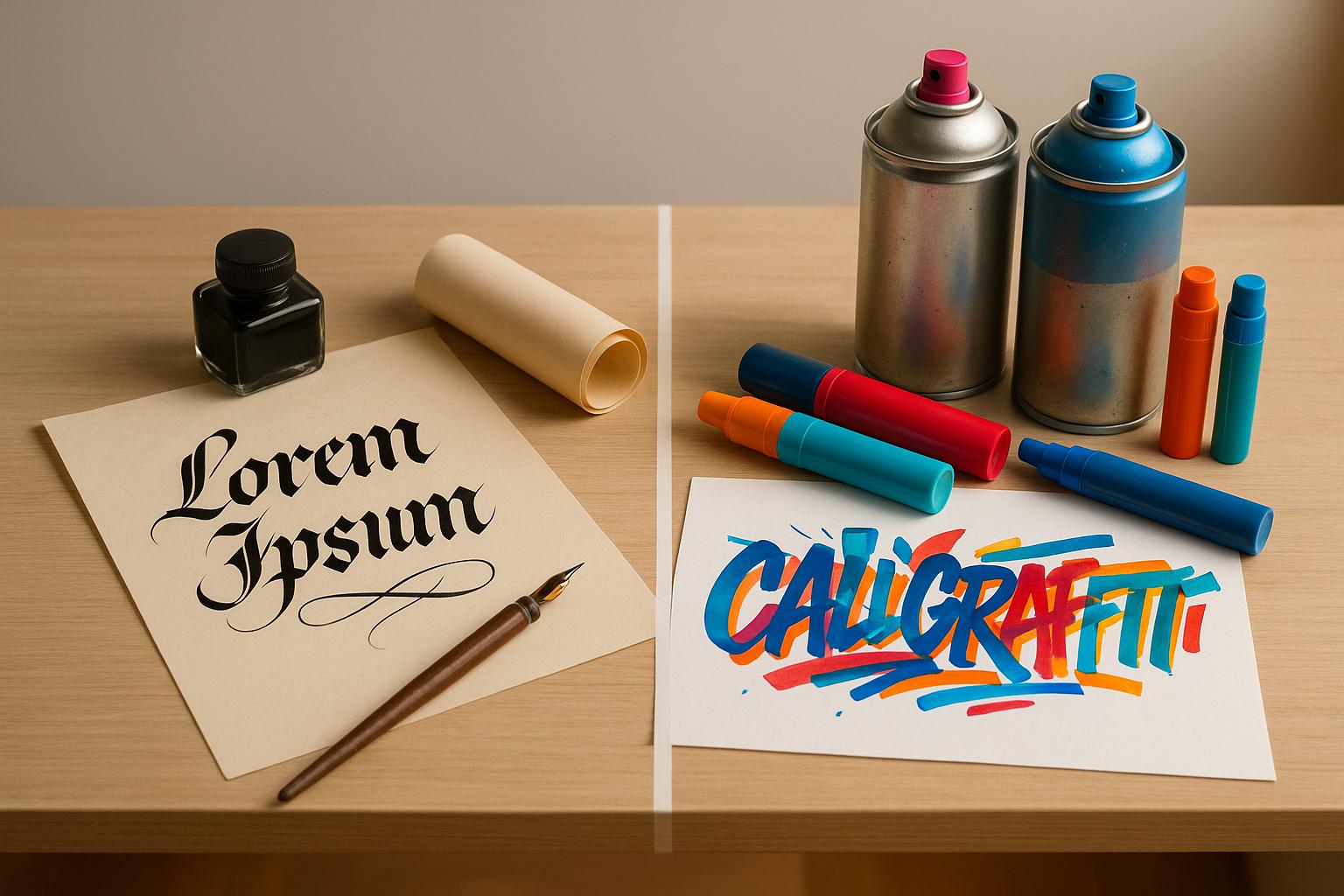
Calligraphy and calligraffiti both celebrate the beauty of writing, but they serve different purposes and follow distinct styles. Here’s a quick breakdown:
- Calligraphy is precise and rule-based, focusing on creating beautiful, structured lettering. It’s deeply tied to heritage, often used for sacred texts or formal art.
- Calligraffiti is bold, experimental, and thrives on breaking rules. It blends calligraphy with graffiti, turning urban spaces into canvases for self-expression and social commentary.
Key Differences:
- Style: Calligraphy is structured; calligraffiti is freeform.
- Tools: Calligraphy uses pens, ink, and paper; calligraffiti uses spray paint, markers, and walls.
- Purpose: Calligraphy preserves history; calligraffiti addresses modern issues.
- Training: Calligraphy requires years of practice; calligraffiti encourages spontaneity.
Quick Comparison Table:
| Aspect | Calligraphy | Calligraffiti |
|---|---|---|
| Style | Structured, rule-based | Bold, free, experimental |
| Tools | Pens, ink, paper | Spray paint, markers, walls |
| Purpose | Preserve heritage | Express modern ideas |
| Training | Formal, years of practice | Informal, open to all |
| Location | Indoors, controlled settings | Outdoors, urban spaces |
Both forms highlight the power of letters to connect history and modern life, but they do so in very different ways. Keep reading to explore their origins, tools, and cultural roles in detail.
Historical Background
The Origins of Traditional Calligraphy
Calligraphy has roots as deep as the history of writing itself, dating back to the fourth millennium BCE. Ancient Mesopotamia, China, and Egypt each independently developed writing systems that evolved into their unique calligraphic traditions.
In Ancient Egypt, scribes were highly respected, often inheriting their roles through family lines. They worked on various materials like stone, papyrus, and parchment. Egyptian hieroglyphics began as pictorial representations but gradually transformed into more abstract and stylized forms, paving the way for decorative writing.
Chinese calligraphy, on the other hand, originated from symbols carved into bones and tortoise shells. A pivotal moment came around 220 BCE, when Emperor Qin Shi Huang introduced character unification, standardizing 3,300 small seal characters. Later, Zhong You (151–230) refined the traditional regular script. Esteemed as the pinnacle of visual arts, Chinese calligraphy also intertwined with Buddhist practices, adding a spiritual dimension to the craft.
In the Islamic world, calligraphy emerged after the 7th and 8th-century Muslim conquests. By the 7th century CE, Arabic calligraphy began to flourish, often featuring Quranic verses. This art form became deeply intertwined with Islamic culture and spirituality.
Western calligraphy, rooted in the Roman alphabet, gained prominence with the rise of Christianity. Early examples date back to the 4th century CE, and the art experienced a revival in the late 19th century, thanks to William Morris and the Arts and Crafts movement.
These ancient traditions laid the groundwork for the evolution of written art, setting the stage for a more modern reinterpretation.
How Calligraffiti Started
Calligraffiti emerged as a contemporary fusion of traditional calligraphy and urban graffiti, reshaping the art of writing for the modern world. Its roots trace back to the Middle East and North Africa during the 1950s. Unlike its ancient predecessors, calligraffiti reflects the challenges and social dynamics of urban life.
The exact origin of the term “calligraffiti” is unclear, but it was in use before Niels Shoe Meulman’s contributions. Brion Gysin referenced it in 1986, and it appeared in H.L. Hix’s 1995 book on post-modernism. However, the movement gained significant traction in the early 21st century.
Around this time, Middle Eastern street artists began using public spaces as canvases for calligraffiti, often to voice political or provocative messages. The Arab Spring uprisings (2010–2013) brought this art form to global attention, as walls became platforms for powerful social commentary.
Two major 20th-century artistic movements in the Middle East influenced calligraffiti: the Hurufiyya movement in the Arab world and the Saqqa Khaneh movement in Iran. These movements bridged the gap between traditional calligraphy and modern abstract art, inspiring a new generation of artists.
Renowned artist Hassan Massoudy eloquently describes the connection between traditional calligraphy and graffiti:
"Two daughters of the same parents" because of their interrelationship. He notes that "Obviously [calligraphy and graffiti] both are about the use of letters and their alphabets, and their center of gravity is the beauty of writing. For both, a letter is more than just a letter and they fill them with emotions. The use of empty space and composition within this space is something else they have in common."
This blend of artistic expression and activism gave calligraffiti its unique character. It allowed artists to reclaim urban spaces while staying deeply rooted in their cultural heritage.
What Is Calligraffiti? – Inside Museum Walls
Style and Technique Differences
Traditional calligraphy is rooted in strict, time-honored rules, while calligraffiti thrives on boundless creativity and modern experimentation.
Traditional Calligraphy’s Structure and Rules
Traditional calligraphy operates within a framework of rules that have been refined over centuries. Every stroke, angle, and proportion is carefully guided by ancient principles.
In Islamic calligraphy, these rules are particularly stringent. Artists follow precise guidelines for letter proportions, stroke angles, and spacing between characters. Styles like Kufic and Naskh are defined by these meticulous standards, with each letter’s dimensions carefully measured.
Traditional calligraphers typically use a kalam – a pen made from dried reed or bamboo – alongside specific inks and papers that have been staples of the craft for generations. The discipline is highly respected, and students often spend years replicating historical works before developing their own voice within these established boundaries. Furthermore, Islamic calligraphy imposes restrictions on depicting human forms in manuscripts, further narrowing the artistic choices available to practitioners.
In contrast, calligraffiti breaks away from these rigid conventions to embrace unrestrained creativity.
Calligraffiti’s Bold and Free Style
Calligraffiti dismisses traditional rules, creating a space for innovative and personal artistic expression. Jordanian artist and art historian Wijdan Ali explains that calligraffiti stands apart because "it has no rules and artists require no formal training".
This freedom allows artists to push boundaries in ways unimaginable in traditional calligraphy. Calligraffiti practitioners often go beyond recognizable letters, inventing entirely new symbols or languages. They blend letters, shapes, and figures into dynamic compositions, even breaking traditional prohibitions against certain representations.
Niels Shoe Meulman, a pioneer of calligraffiti, describes his craft as achieving "directness in the whole, finesse in the details. An even balance between seeing and reading word and image. … letters, writing and language itself becomes an image or abstraction. On the other hand, basic shapes and splats become language". He also characterizes calligraffiti as "traditional handwriting with a metropolitan attitude".
Unlike traditional calligraphy, which relies on tools like reed pens, calligraffiti embraces a wide range of materials – brushes, spray cans, or virtually any tool that can leave a mark on any surface. El Seed, a prominent calligraffiti artist, exemplifies this freedom. He avoids identifying as a calligrapher because he doesn’t adhere to the many rules of traditional calligraphy. Instead, his work reflects what Wijdan Ali calls "a script of ordinary writing where the work is composed of the artist’s personalized handwriting within a modern composition".
Janet Kozak, an artist and activist, highlights this unique blend of old and new, describing calligraffiti artists as "not bound by the shackles of tradition, yet still indebted to it." She notes that they combine "traditional scripts and design mixed with modern materials and techniques". This flexibility enables calligraffiti to explore socio-political themes and personal narratives, moving beyond the religious texts and classical literature often associated with traditional calligraphy. The art form thrives on spontaneity and abstraction, channeling the rebellious energy of street art while maintaining a connection to its calligraphic roots.
As Niels Shoe Meulman puts it, "a word is an image and writing is painting".
Tools and Materials
The tools and materials used in traditional calligraphy and calligraffiti highlight their contrasting styles, environments, and artistic philosophies. Traditional calligraphy leans on precision and time-honored instruments, while calligraffiti thrives on versatile, bold tools suited for urban expression. Let’s take a closer look at the distinct tools that define these two art forms.
Traditional Calligraphy: Pens, Inks, and Paper
Traditional calligraphy revolves around three main components: the writing instrument, ink, and the surface.
Nib pens are the backbone of traditional calligraphy. Broad-edged nibs create the characteristic thick and thin strokes, while pointed nibs allow for intricate details and flourishes. These nibs are attached to specialized pen holders designed for balance and comfort, making them ideal for long writing sessions.
The choice of ink is just as important. India ink and Sumi ink are popular for their smooth flow and lasting quality. Many calligraphers also use colored inks, carefully selecting types that complement their paper and retain their vibrancy over time. The ink must glide effortlessly from the nib while delivering the rich density needed for sharp, clean lines.
Paper selection plays a critical role, as the texture, absorbency, and durability of the surface directly affect the outcome. Options like watercolor paper, cartridge paper, vellum, and parchment each bring unique qualities that influence how the ink interacts with the surface and the final appearance of the piece.
Heather Child, in The Calligrapher’s Handbook, captures the essence of traditional calligraphy tools:
"Calligraphy is a craft requiring singularly few tools – the writing instrument, the ink and the writing surface are the only essentials. The art of calligraphy depends on the scribe having an understanding of the proper use of all three, on his knowledge of letterforms and on his skill and freedom in their use."
While these tools are perfect for controlled, indoor settings, they’re not suited for outdoor or urban environments. This is where the tools of calligraffiti take center stage.
Calligraffiti’s Street Tools
Calligraffiti embraces a completely different toolkit, built for versatility and resilience in urban settings. This art form’s street roots demand tools that can handle rough surfaces like concrete and metal, as well as unpredictable outdoor conditions.
Spray paint is a staple for many calligraffiti artists. It provides bold coverage and allows for large-scale works, enabling sweeping gestures and vibrant color application that traditional nib pens can’t achieve.
Wide-tipped paint markers are another favorite. Tools like Molotow CoversAll Paint Markers with 60mm tips are widely used for creating on surfaces like concrete, metal, and plastic. These markers strike a balance between precision and the broad strokes needed for impactful street art.
In keeping with the improvisational spirit of calligraffiti, artists often use unconventional tools like brooms, transforming everyday objects into creative instruments. This adaptability allows them to work on virtually any surface or under any condition, reflecting the dynamic nature of the art form.
The philosophy behind these tools goes beyond practicality. Traditional calligraphy tools are tailored for precision and stability in controlled environments, while calligraffiti tools are designed for speed, durability, and versatility in unpredictable urban landscapes.
Ultimately, the tools themselves reflect the values of each art form: traditional calligraphy’s focus on precision, heritage, and structure versus calligraffiti’s embrace of flexibility, boldness, and urban energy. These instruments are more than just tools – they embody the essence of each approach to lettering and artistic expression.
Cultural Meaning and Symbolism
The art of traditional calligraphy and calligraffiti represents two distinct yet deeply meaningful approaches to creativity and connection. Traditional calligraphy acts as a preserver of heritage and spiritual practice, while calligraffiti emerges as a contemporary voice of resistance and cultural renewal.
While the former safeguards historical identity, the latter reimagines these traditions, using them to comment on modern society.
Traditional Calligraphy’s Role in Heritage
Traditional calligraphy has long been celebrated as a visual embodiment of heritage and inner character. Its significance spans cultures, from ancient China, where emperors engraved decrees, to medieval Europe, where monastic scribes meticulously transcribed sacred texts. This art form’s history is deeply intertwined with its cultural and aesthetic authority.
In China, Shufa (Chinese calligraphy) is more than an art – it’s a path to self-cultivation and moral discipline. Each brushstroke is thought to convey the artist’s energy, reflecting their character and intentions.
In the Islamic world, calligraphy holds a sacred status due to its central role in transcribing the Quran. The revelation of the Quran inspired the evolution of Arabic calligraphy, where calligraphers were seen as vessels for divine expression. Their work was not just a craft but a form of prayer and meditation, adorning everything from architecture to coins and daily objects.
Medieval Europe also embraced the power of calligraphy. Scripts like Uncial and Carolingian minuscule, crafted by monastic scribes, were used to preserve biblical texts. The clarity of Carolingian minuscule even influenced the modern Latin alphabet, showcasing calligraphy’s lasting impact on communication.
UNESCO has recognized the profound cultural role of calligraphy, stating it "offers an important channel for the appreciation of traditional culture and for arts education. It is also a source of pride and pleasure for the Chinese people and embodies important aspects of the country’s intellectual and artistic heritage".
In contrast, the modern world finds new meaning in the rebellious spirit of calligraffiti.
Calligraffiti as Modern Expression
Though both art forms revolve around the beauty of letters, calligraffiti takes a bold, contemporary approach by transforming them into tools for societal dialogue. This movement gained momentum during the Arab Spring uprisings (2010–2013), where it became a powerful medium for political and social commentary. Calligraffiti breaks free from traditional constraints, allowing artists to reconstruct and reinterpret letters in striking ways.
Urban spaces become the canvas for calligraffiti, where artists address issues like political oppression and struggles with identity. Tunisian-French artist eL Seed is a leading figure in this movement, creating large-scale murals that blend Arabic calligraphy with messages of cultural pride and social awareness. Others take a more direct approach. Askar, for instance, explains: "I protest in colors, my activism consists of bringing art to the streets and allowing the public to express themselves". Artist Rana Jarbou succinctly captures the movement’s essence with her statement: "Words are weapons".
Tunisian artist Inkman’s USINA Project highlights calligraffiti’s role in preserving forgotten histories. By decorating the walls of an abandoned limestone factory in Boukornine, Tunisia, he honored the struggles of those who once worked there, using art to revive lost memories.
Saudi artist Ahmed Al-Sulaimani adds another layer to the art form’s global reach. By blending traditional scripts with modern design, he explores themes of heritage and contemporary identity, demonstrating how calligraffiti has grown from a regional expression into a global phenomenon. This international adoption underscores its ability to connect diverse cultures while addressing shared challenges.
The core distinction between these art forms lies in their purpose. Traditional calligraphy preserves and passes down ancestral wisdom, serving as a bridge between eras. Calligraffiti, on the other hand, critiques the present, using cultural elements to challenge societal norms and advocate for change. As one observer notes, calligraffiti artists are "not bound by the shackles of tradition, yet still indebted to it".
Both forms share an understanding of letters as more than mere symbols. As artist Hassan Massoudy puts it: "Obviously [calligraphy and graffiti] both are about the use of letters and their alphabets, and their center of gravity is the beauty of writing. For both, a letter is more than just a letter and they fill them with emotions".
sbb-itb-593149b
Side-by-Side Comparison: Traditional Calligraphy vs. Calligraffiti
Traditional calligraphy and calligraffiti may share a deep appreciation for the beauty of letterforms, but they serve vastly different purposes and thrive in contrasting environments. Traditional calligraphy is rooted in discipline and adherence to centuries-old rules, while calligraffiti thrives on spontaneity and creative freedom. Below is a detailed comparison of these two art forms.
Comparison Table
| Aspect | Traditional Calligraphy | Calligraffiti |
|---|---|---|
| Style & Approach | Structured and rule-based, requiring formal training and years of practice | Bold and free, with no set rules, embracing spontaneity and self-expression |
| Tools & Materials | Dip pens, ink brushes, water-based inks, specialty papers, and parchment | Pilot Parallel pens, chisel-tip markers, spray paint, watercolors, brushes, and any available surface |
| Cultural Purpose | To preserve sacred texts, maintain heritage, and serve as a spiritual practice | To express socio-political ideas, reclaim public spaces, and challenge societal norms |
| Artistic Status | Highly respected; considered a high art form deeply tied to tradition | Seen as urban art and sometimes gallery art, often used for activism and public commentary |
| Creative Freedom | Bound by established letterforms and traditional techniques | Artists are free to invent new languages and break away from conventional letterforms |
| Surface & Location | Typically created on paper, parchment, or within religious texts | Found on walls, urban surfaces, galleries, and other public spaces |
The tools used by each art form reflect their philosophies. Traditional calligraphers rely on precise, time-honored instruments like dip pens and specialty papers, emphasizing refinement and tradition. Calligraffiti artists, on the other hand, embrace versatility, using spray paint, markers, and unconventional surfaces to bring their art to life in dynamic, often public settings. These differences highlight how each medium approaches art and its role in society.
The cultural roles of these art forms also reveal a stark contrast. Traditional calligraphy is often seen as a spiritual practice, preserving history and heritage. It embodies the sentiment of the ancient Arabic saying: "Purity of writing is purity of the soul". Meanwhile, calligraffiti is a modern voice for activism. Artist Askar captures this sentiment perfectly, stating:
"I protest in colors, my activism consists of bringing art to the streets and allowing the public to express themselves" .
Ultimately, while both art forms share a common ancestry, they have grown into distinct expressions of creativity. Traditional calligraphy is a vessel for preserving culture and spirituality, while calligraffiti transforms urban landscapes into vibrant platforms for social and political commentary. Together, they demonstrate the enduring power of art to connect the past with the present in meaningful ways.
The Future of Calligraphy and Calligraffiti
Both traditional calligraphy and calligraffiti are evolving as artists explore new possibilities with digital technology and modern tools. The digital age is bringing fresh energy to these art forms, merging age-old traditions with contemporary styles and techniques.
Digital Tools and Technology
Digital illustration tools like Procreate for iPad have become a favorite among calligraphers, allowing them to experiment and share their creations widely on social media. Back in 2008, Evan Roth from the Graffiti Research Lab showcased looping black-and-white graffiti tags at Berlin’s first Media Facades Festival. This project, featuring live projections using Public Art Lab’s "The Infl3ctor", marked an early example of digital calligraffiti.
Mang, an artist and collaborator with Public Art Lab, explained the importance of this innovation:
"My contribution, along with Hamza, was to create the system for live projecting the calligraffiti as it’s being drawn. My challenge was to create a system that could take a centuries old tradition that spans many cultures and redefine it for modern urban spaces."
Today’s digital tools go far beyond simple projections, enabling animated designs, 3D creations, and interactive installations. Even NFTs are offering traditional artists, like UAE-based calligrapher Diaa Allam, new ways to share their work with a broader audience. These advancements honor the rich history of calligraphy while steering it into exciting new directions.
With these innovations, the line between traditional techniques and digital creativity is becoming increasingly seamless.
Blending Old and New Styles
Modern artists are finding unique ways to merge classical calligraphy with contemporary aesthetics, creating fresh opportunities for expression. For instance, Saudi artist Ahmed Al-Sulaimani designed a stunning 40-meter Arabic script installation for the 2022 FIFA World Cup in Qatar, incorporating Qur’anic phrases in a vibrant, modern context. His work highlights how cultural heritage can be reimagined for today’s world.
Similarly, Tunisian-French artist eL Seed has redefined the use of traditional Arabic script by integrating it into large-scale murals that transform urban spaces while addressing social and political themes. Speaking about his work, he shared:
"The organic shape of the letters reaches your soul before it touches your eyes, and that’s why it’s just a means, it’s just a tool, a medium. I’m not here to claim Arab identity. I’m here to say the same way you have English writing in India or Subway in South Korea – how could it bother anybody to have something in Arabic in America or in South America or in Europe. For me, this is about highlighting this connection that we have as humans."
The experimental spirit of the Hurufiyya movement, which introduced abstract elements into traditional calligraphy, continues to inspire artists today. This influence can be seen in techniques like light calligraphy, 3D installations, and unconventional applications ranging from street art to fashion.
Looking ahead, technologies like virtual reality, AI-powered design tools, and personalized learning platforms are set to make calligraphy and calligraffiti even more accessible. As traditional methods blend with digital innovation, the boundaries of these art forms will continue to expand, unlocking new ways for artists to express themselves.
Conclusion: Understanding Both Art Forms
Traditional calligraphy and calligraffiti each carve out their own space in the world of artistic expression, showcasing the beauty of writing in unique ways. While they differ in style and purpose, both forms contribute to a broader appreciation of how art can reflect and shape our shared experiences.
Traditional calligraphy stands as a protector of heritage, meticulously preserving cultural identity through its refined techniques. Its influence stretches far beyond religious art, leaving its mark on significant artistic traditions like East Asia’s ink and wash painting.
Calligraffiti, on the other hand, thrives on breaking boundaries. Rooted in history yet boldly modern, it transforms public spaces into canvases for social and political commentary. By addressing contemporary issues and reclaiming urban landscapes, calligraffiti invites conversation and challenges perceptions. As one artist put it, the goal is to "write the stories of the city, on its own walls – creating a memory for the city".
Rather than seeing these art forms as opposing forces, it’s more meaningful to view them as complementary. Traditional calligraphy offers a sense of continuity and spiritual depth, while calligraffiti brings urgency and relevance, reaching audiences in unexpected ways. Together, they form a dynamic visual language that connects the past with the present, blending the sacred with the everyday, and the formal with the rebellious.
These two art forms remind us that letters are more than mere symbols – they carry beauty, meaning, and the power to inspire. Whether showcased in a gallery or spray-painted on a city wall, traditional calligraphy and calligraffiti demonstrate the enduring impact of the written word, bridging history and modern life in ways that resonate deeply.
FAQs
What is calligraffiti, and how does it combine traditional calligraphy with modern graffiti?
Calligraffiti: A Blend of Tradition and Urban Energy
Calligraffiti is an art form that merges the elegant precision of traditional calligraphy with the raw, vibrant energy of graffiti. The result? Eye-catching works that celebrate the beauty of lettering while embracing bold colors and the unmistakable edge of urban art.
What sets calligraffiti apart is its deep appreciation for the artistry of letters. While many types of street art lean toward abstract visuals or social messages, calligraffiti focuses on the craft of writing itself. It creates a unique connection between the historical roots of calligraphy and the modern, expressive world of graffiti. This art form becomes a powerful tool for self-expression, often exploring themes like identity and cultural heritage, all while captivating the viewer with its stunning visual impact.
What is the cultural significance of traditional calligraphy, and how does it influence modern art styles like calligraffiti?
Traditional calligraphy holds immense significance across various regions, serving as a window into history, philosophy, and cultural identity. In East Asia, it’s revered as an art form that embodies harmony, intellect, and spiritual ideas rooted in traditions like Confucianism and Zen. Meanwhile, in the Islamic world, calligraphy plays a central role in religious and cultural expression, prominently featured in sacred texts and intricate architectural designs.
Today, modern art forms like calligraffiti build on this rich heritage by merging the precision and grace of traditional calligraphy with the bold, dynamic energy of urban art. This blend not only bridges the gap between past and present but also highlights how age-old techniques continue to inspire fresh, contemporary artistic expressions.
How are digital tools and technology shaping the future of traditional calligraphy and calligraffiti?
The Role of Digital Tools in Modern Calligraphy and Calligraffiti
Digital tools and technology are reshaping the world of calligraphy and calligraffiti, opening up new creative avenues and making these art forms more approachable for a wider audience. With software like Procreate and Adobe Illustrator, artists can blend timeless techniques with modern aesthetics. These tools allow for experimentation with intricate letterforms, vibrant colors, and dynamic effects that would be challenging – if not impossible – to achieve through traditional methods.
Social media platforms and the growing popularity of digital art trends, such as NFTs, have also made it easier for artists to share their creations with audiences around the globe. This has fostered a thriving community that embraces both the old and the new, ensuring these art forms stay relevant while adapting to contemporary tastes. Digital technology isn’t just preserving the essence of calligraphy and calligraffiti – it’s pushing them into bold, uncharted territory.
