
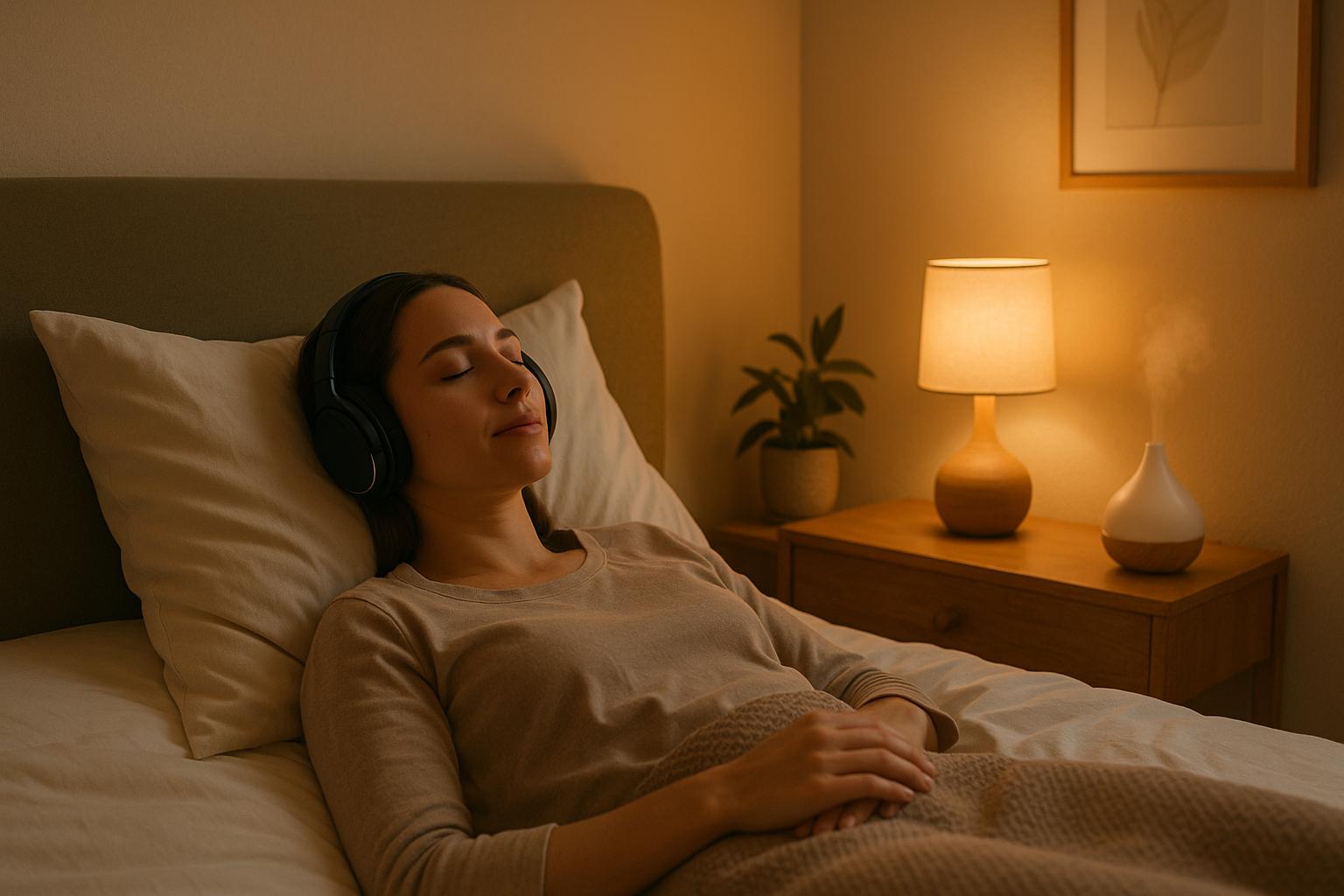
Binaural beats can help reduce stress, improve sleep, and enhance relaxation – all by aligning your brainwaves to specific frequencies. Here’s a quick breakdown of the benefits:
- Deep Relaxation: Promotes meditation and mental calm with theta and delta frequencies.
- Lower Stress Hormones: Reduces cortisol and improves hormonal balance.
- Better Sleep: Encourages deep, restorative sleep with delta frequencies.
- Reduced Anxiety: Eases worry and promotes a balanced mental state.
- Improved Mood: Boosts emotional well-being and reduces fatigue.
Quick Tips:
- Use stereo headphones for the best results.
- Start with 15–30 minutes daily in a quiet space.
- Match the frequency to your goal: Theta (4–8 Hz) for relaxation, Delta (1–4 Hz) for sleep, and Alpha (8–13 Hz) for anxiety relief.
Binaural beats are simple to use and can be a powerful tool for managing stress and improving your overall well-being. Keep reading to learn how to incorporate them into your routine.
Deep Relaxation, Serotonin Release, Binaural Beats, Stress And Anxiety Relief
1. Deep Meditation and Mental Calm
Binaural beats can help you achieve a meditative state and mental calm by aligning your brainwaves with patterns associated with deep relaxation. In fact, a 2005 study found that binaural beats could lower anxiety levels by up to 50%.
"The frequency you use really matters. If you’re looking to boost cognitive performance – like focus or working memory – higher frequencies like beta or gamma tend to be more effective. For relaxation or anxiety, lower frequencies like theta or delta might work better. Since there’s little to no risk, I’d encourage people to experiment and see what works best for them."
– Anastasiia Melnichuk, Neuroscience Researcher at The University of Texas at Austin
Different frequencies can target specific aspects of meditation. Here’s a quick guide:
| Brain Wave | Frequency (Hz) | Benefits for Meditation |
|---|---|---|
| Delta | 1–4 | Promotes deep sleep, healing, and pain relief |
| Theta | 4–8 | Encourages deep relaxation, creativity, and meditation |
| Alpha | 8–14 | Supports relaxation, stress reduction, and positive thinking |
These frequencies provide a starting point for customizing your meditation practice. For example, research suggests that just 10 minutes of exposure to a 6 Hz frequency can create a brain state similar to meditation.
To get the most out of binaural beats, choose a quiet space and use stereo headphones for an immersive experience. Start with a daily 30-minute session. Some studies even suggest pairing alpha binaural beats with virtual reality for enhanced relaxation.
"Try combining your favorite relaxation technique with binaural beats."
– Elizabeth W. Krasnoff, PhD
2. Lower Stress Hormone Levels
Binaural beats don’t just calm the mind – they also help regulate stress hormones. By reducing cortisol (the stress hormone) and promoting relaxation hormones, they create a more balanced physiological state.
Research backs this up. A 2022 study revealed that participants who listened to 16-Hz binaural beats experienced a 44% drop in alpha amylase levels, a well-known stress biomarker.
This effect goes beyond just cortisol. Binaural beats can also increase melatonin levels, amplifying their stress-relief impact. For example, patients preparing for cataract surgery who listened to binaural beats had noticeably lower anxiety levels and blood pressure compared to those exposed to regular music or silence. Similarly, military personnel dealing with post-deployment stress saw reduced cardiovascular stress responses when listening to theta wave binaural beats embedded in music.
To get the most out of binaural beats, try 30-minute sessions in a quiet environment using stereo headphones. Keep in mind, though, that individuals with epilepsy should consult a healthcare professional before trying this technique.
This hormonal balancing act ties directly into the enhanced relaxation benefits covered in the next section.
3. Better Sleep Through Sound
Getting quality sleep is one of the best ways to combat stress, and binaural beats can play a key role in improving your rest. By using specific sound frequencies, these beats help prepare your mind for sleep and improve the overall quality of your slumber. For instance, delta frequency binaural beats (around 3 Hz) are known to enhance stage three sleep, the deepest and most restorative phase. Research has shown that these frequencies can successfully trigger delta brain activity, leading to longer periods of deep, refreshing sleep.
One study conducted with professional soccer players found that listening to binaural beats in the 2–8 Hz range improved their sleep quality, reduced daytime drowsiness, and made waking up in the morning easier. This points to practical benefits for anyone dealing with sleep disturbances. Additionally, alpha frequency beats have been found to reduce nighttime pain and improve sleep quality in fibromyalgia patients when compared to listening to ambient sounds.
"When we introduce more ambient and nature-oriented sounds, there’s a natural calming effect because these types of sounds are not attempting to influence you in the same way that other music does", says Nate Martinez, a sound therapy practitioner and founder of NTM Sound.
If you want to maximize the sleep-enhancing effects of binaural beats, here are some tips:
- Choose theta (4–8 Hz) or delta (1–4 Hz) frequencies for optimal sleep benefits.
- Listen for 15–30 minutes before going to bed.
- Use stereo headphones to ensure the distinct frequencies are properly delivered.
A 2022 study highlighted that delta binaural beats could be a cost-effective alternative to traditional sleep treatments. The research showed improvements in several areas, including fewer nighttime awakenings and better overall sleep quality.
Incorporating binaural beats into your nightly routine not only improves sleep but also supports a broader strategy for managing stress and enhancing well-being.
sbb-itb-593149b
4. Less Anxiety and Worry
Binaural beats have been shown to ease anxiety by helping the brain synchronize its neural activity in areas linked to emotions. By aligning brain waves to specific frequencies, they create a calmer and more balanced mental state.
In a 2005 study led by Padmanabhan and colleagues, surgical patients who listened to binaural beats experienced a 26.3% reduction in pre-operative anxiety, compared to only 11.1% for those listening to regular music and 3.6% for patients exposed to no audio at all. These numbers highlight the potential of binaural beats as a tool for reducing stress.
Here are the frequency ranges commonly used for anxiety relief and their specific effects:
| Anxiety-Reducing Frequency Ranges | Specific Benefits |
|---|---|
| Alpha (8–13 Hz) | Helps with immediate anxiety relief |
| Theta (4–8 Hz) | Eases racing, intrusive thoughts |
| Delta (1–4 Hz) | Reduces chronic, lingering anxiety |
In fact, a 2007 study found that 60 days of listening to delta binaural beats not only reduced anxiety but also improved overall quality of life. The key to success lies in regular and consistent use.
"Results vary, but binaural beats can be effective for stress and anxiety."
– Nicole Arzt, LMFT
To get the most out of binaural beats:
- Set up a quiet, distraction-free space.
- Use high-quality stereo headphones for proper sound delivery.
- Start with sessions of about 30 minutes.
Some researchers have explored combining binaural beats with other relaxation techniques for even better results. Sound therapy expert Karen Newell explains:
"We think it’s getting the attention of the brainstem and creating this monotonous sort of attention that brings attention away from the neocortex where all the thinking is going on… So it really slows things down and quiets the thinking mind so you can get into this expanded state of awareness that’s associated with meditation."
A 2019 review of 22 studies reinforced these findings, showing that extended sessions with binaural beats can significantly lower anxiety levels. By quieting the mind and reducing stress, binaural beats not only alleviate worry but also set the stage for a more positive and balanced mood – a topic we’ll explore in the next section.
5. Improved Mood and Mental State
Binaural beats do more than just ease anxiety – they can actively uplift your mood and emotional well-being by influencing brain wave activity. Research shows that regular exposure to these beats can help reduce feelings of tension, confusion, fatigue, and overall emotional disturbance, leading to a noticeable improvement in quality of life.
Interestingly, during deep meditation, skilled practitioners have been observed to produce gamma frequencies as high as 80 Hz in their brain waves. This suggests a strong link between these frequencies and a heightened mental state.
Neuroscientists emphasize that choosing the right frequencies is crucial for boosting mood.
For the best results, try these tips:
- Find a quiet space free from distractions
- Listen for about 30 minutes each day
- If you experience headaches, reduce your listening time
While binaural beats can significantly enhance emotional well-being, they aren’t suitable for everyone. People with certain medical conditions – like seizures, heart issues, or those with pacemakers – should consult their healthcare provider before using them. Ongoing research continues to reveal how these frequencies influence brain wave patterns, helping to regulate emotions and build emotional resilience.
Conclusion
Binaural beats provide a science-backed way to help manage stress effectively. They work by enhancing meditation, improving sleep quality, reducing anxiety, and lifting your mood.
Here’s a quick guide to selecting the right frequencies for your needs:
- Theta (4–8 Hz): Ideal for relaxation and calming the mind.
- Alpha (8–13 Hz): Great for easing anxiety and promoting a sense of peace.
- Delta (1–4 Hz): Perfect for deep, restorative sleep.
To get the most out of binaural beats, keep these tips in mind:
- Use high-quality stereo headphones for the best experience.
- Find a quiet, comfortable space to fully immerse yourself.
- Start with short sessions (15–30 minutes) and build up gradually.
- Pair the beats with meditation or deep breathing exercises for added benefits.
"Binaural beats and sound frequencies are powerful tools for boosting mental clarity, relaxation, and overall well-being." – Loic Narbonne
Research backs up these claims. For instance, a 2007 study found that participants who listened to delta binaural beats daily for 60 days experienced noticeable reductions in anxiety and reported an improved quality of life. This highlights the long-term value of making binaural beats a part of your daily routine.
If you’re just starting out, try using alpha tones during the day to manage stress and delta tones at night to improve sleep. With consistent practice, you’ll build mental resilience and enjoy greater stress relief over time.
For more tips and resources on managing stress, check out the wellness section on Inspiretopics.
FAQs
How do binaural beats help the brain reduce stress and anxiety?
Binaural beats work by delivering two slightly different sound frequencies to each ear. The brain processes these frequencies and perceives a single tone that matches the difference between them. This phenomenon, known as the frequency-following response, encourages the brain to synchronize its activity with the beat, potentially guiding it into states linked to relaxation or focus.
For instance, binaural beats in the theta range (4–8 Hz) are associated with deep relaxation and stress reduction, while those in the alpha range (8–12 Hz) are connected to a calm yet alert mental state. Studies indicate that listening to these beats may help reduce anxiety, offering a straightforward way to ease stress.
Are there any risks or precautions to consider when using binaural beats for stress relief?
Binaural beats are considered safe for most people, but there are some exceptions where caution is advised. For instance, individuals with epilepsy or a history of seizures should steer clear of binaural beats, as they might increase the risk of triggering a seizure. Similarly, pregnant women and those dealing with certain mental health conditions are encouraged to consult a healthcare professional before trying them, as the effects can vary depending on individual health circumstances.
There’s also research indicating that binaural beats might temporarily impact cognitive performance, especially when engaging in tasks that demand high levels of concentration. While they can serve as an effective tool for relaxation and stress relief, it’s essential to use them thoughtfully. If you have any concerns, seeking advice from a medical professional is always a smart move.
Can binaural beats be used with other relaxation techniques to reduce stress?
Yes, you can pair binaural beats with other relaxation techniques to boost stress relief. Activities like meditation, yoga, deep breathing, or progressive muscle relaxation work well alongside binaural beats, as the rhythmic tones can help you focus more deeply and encourage a sense of calm.
For instance, using binaural beats during yoga may help you stay in the moment, while combining them with guided meditation can enhance feelings of peace and relaxation. Incorporating binaural beats into your routine allows you to create a more tailored and effective way to unwind based on your personal preferences.