
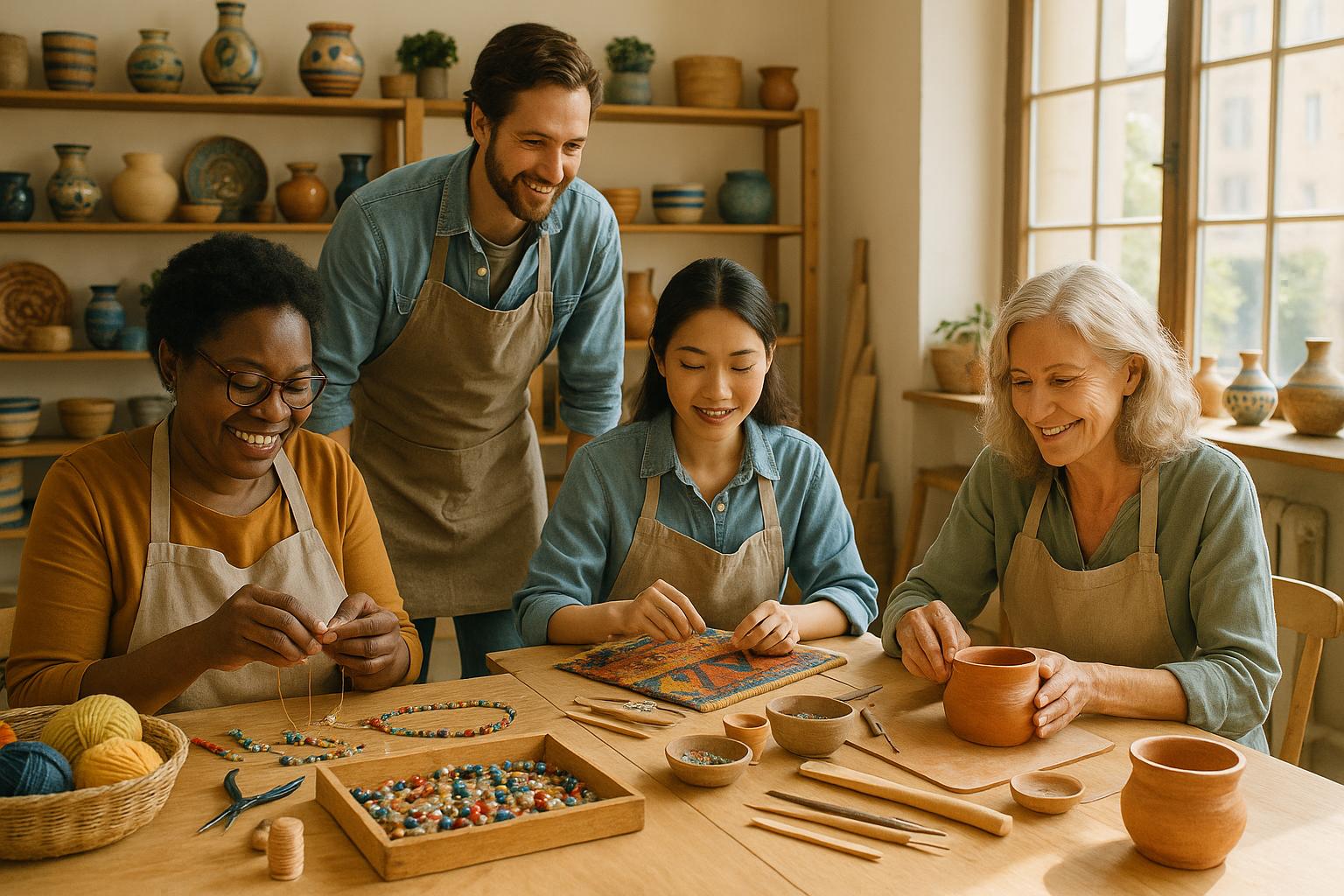
Artisan empowerment projects are initiatives that give craftspeople the tools, training, and market access they need to succeed as entrepreneurs while preserving their craft. These efforts create economic opportunities and help safeguard heritage practices. Programs like cooperatives, design collaborations, and NGO support are driving this change globally.
Here’s what you need to know:
- Economic Impact: The artisan market is valued at $32 billion, with organizations like Nest Inc. supporting over 345,000 entrepreneurs globally by June 2025.
- Key Approaches: Successful models include craft cooperatives (e.g., UPA in Mexico), design collaborations (e.g., Himalayan Naari), and NGO partnerships (e.g., NOVICA’s e-commerce platform).
- Heritage Preservation: These projects help revive and maintain age-old techniques, such as weaving in Peru and pottery in Japan.
- Challenges: Artisans face barriers like limited market access, competition from mass production, and digital illiteracy. Programs addressing these gaps have seen measurable success, such as increased incomes and skill improvement.
This article highlights global success stories, including Indego Africa in Rwanda, GAI in Kenya, and WIPO’s IP education in Spain, showcasing how these initiatives transform lives while preserving heritage.
How is RAAHA Empowering Skilled INDIAN ARTISANS | Radhika Gupta | TBCY
Key Models Driving Artisan Empowerment
Around the world, three main approaches have proven effective in helping artisans thrive. These models tackle the challenges of market access and business growth, each offering its own way to empower artisans and sustain their craft.
Craft Cooperatives
Craft cooperatives bring artisans together to share resources, expertise, and access to markets. These groups focus on the well-being of their members, with all decisions made collectively.
Take the Union Progresista Artesanal (UPA) in Taxco, Mexico, for example. Established in 1986, this cooperative unites 26 jewelry makers who work together to strengthen their market presence. By pooling resources, they secure better deals on raw materials, cut production costs, and handle larger orders more efficiently.
Another success story is the Women’s Cooperative of Weavers in Guatemala, which not only boosts income for its members but also preserves traditional weaving techniques. Through training in business management and marketing, this cooperative has expanded its influence and improved the lives of its members. Similarly, in India, the Handicraft Cooperative of Rural Artisans collaborates with NGOs to improve product quality and introduce design innovations. This has helped secure fair prices for their work while promoting community development.
While cooperatives focus on collective strength, design collaborations offer a different way to connect artisans with the global market.
Design Collaborations
Design collaborations pair traditional artisans with modern designers, creating products that are both culturally meaningful and appealing to contemporary consumers.
A great example is Himalayan Naari, a network of women artisans in the Indian Himalayan region. Since its launch in 2013, the initiative has combined traditional weaving techniques with modern designs to produce wool products for global markets. By 2019, over 100 artisans were part of this network, gaining new economic opportunities.
The personal impact of these collaborations can be life-changing. Basanti Karki, a Himalayan Naari artisan, shared her experience:
"Since joining [the network] I have grown in my self-confidence and can work very hard now. Naari is a breakthrough for women’s empowerment and I hope it will thrive in the future."
Support from organizations like the Himalayan Education Foundation (HEF) has been crucial, ensuring artisans have access to quality materials like wool. Successful collaborations also depend on designers taking the time to understand the cultural significance of the techniques they work with, building trust and respect along the way.
In addition to cooperatives and collaborations, NGOs and international agencies play a critical role in supporting artisans.
Support from NGOs and International Agencies
NGOs and international organizations provide far more than just funding – they offer training, infrastructure, and access to global markets, creating a solid foundation for artisans to succeed.
For instance, NOVICA partnered with the International Trade Centre (ITC) in 2021 to onboard hundreds of small businesses and artisans onto NOVICA’s e-commerce platform. This partnership includes technical training in areas like marketing and inventory management. The first artisans to benefit were part of ITC’s project aimed at connecting Central American women entrepreneurs with global markets.
Armenia Nercessian, co-founder of NOVICA, highlighted their mission:
"Supporting artisans is at the heart of what we do at NOVICA. We could not be more ecstatic to team up with the International Trade Centre, whose dedication to leveraging technology to empower artisans has allowed the safeguards of Central American culture to flourish, even in turbulent times."
In Haiti, Caribbean Craft has been a game-changer. Founded in 1990, it became a leading provider of handmade goods for tourist shops. After transitioning to female ownership in 2006, the organization expanded its reach, securing partnerships with major retailers like HomeGoods and Anthropologie. Following Haiti’s devastating earthquake in 2010, Caribbean Craft provided meals for artisans and launched a literacy program that achieved 100% literacy among its members by 2014.
India’s Khadi and Village Industries Commission (KVIC) is another example of a comprehensive support system. By offering training, raw materials, and market connections, KVIC has helped artisans preserve traditional crafts while achieving financial independence.
Long-term commitments from organizations like Aid Through Trade and Altiplano also make a difference. Aid Through Trade has supported women artisans in Nepal for over 25 years, employing more than 200 artisans. Similarly, Altiplano has provided fair wages and employment in Guatemala for over two decades, working with cooperative groups and small family businesses.
These models – cooperatives, design collaborations, and NGO support – often work hand in hand, creating a well-rounded system to address the many challenges artisans face. The best initiatives combine elements of all three, ensuring artisans benefit from collective strength, modern market appeal, and essential resources.
Success Stories from Around the World
Real-world projects are making a difference in communities across the globe. Each success story reflects the impact of the frameworks discussed earlier.
Indego Africa: Supporting Women Artisans in Rwanda and Ghana

Since 2007, Indego Africa has been working with over 23 artisan-owned businesses across Rwanda, Ghana, and refugee camps. Their mission? To build sustainable enterprises that uplift entire communities.
Indego Africa’s approach combines business development with hands-on training. CEO Suwha Hong describes their focus:
"At the heart of Indego Africa is connection – connecting marginalized artisans in rural communities to the export market."
The impact is undeniable. 90% of Indego Africa’s partners report higher incomes, and 97% believe the skills they’ve learned will help them earn in the future. Since 2021, artisans in the program are twice as likely to launch new businesses.
The organization provides customized training in business, leadership, and vocational skills, helping artisans secure immediate income while building long-term entrepreneurial capabilities. They also emphasize local sourcing and pan-African trade, ensuring their efforts benefit both people and the planet.
Hong elaborates:
"Purchasing from Indego Africa doesn’t just support artisans financially; it also funds vocational training, entrepreneurship mentorship, and other support systems that help these women become self-sustaining entrepreneurs."
Global Artisans Initiative: Empowering Through Microenterprises
The Global Artisans Initiative (GAI), based at the University of Wisconsin-Madison, takes a collaborative approach to artisan empowerment by combining academic partnerships with practical business support. Since 2020, GAI has worked with thirteen artisan groups across five countries – Ecuador, Mexico, Kenya, India, and Nepal.
GAI connects artisans with university students and faculty who assist with product design, sourcing materials, and organizing sales events. In the 2019–2020 fiscal year, GAI’s Madison sales surpassed $10,000.
Beyond sales, GAI has made tangible improvements for artisans. For example, they provided water tanks and gutters to women artisans in Kenya and worked with an architect to create a dedicated makerspace for the Tharaka Women’s Welfare Program in Gatunga, Kenya.
When the COVID-19 pandemic emerged, GAI stepped up by donating $1,500 from GAI-Mexico sales to support emergency relief for artisans.
The initiative also fosters student involvement. 25 graduate and undergraduate students have participated in international projects, while 100 students enrolled in "Design Thinking 527: Global Artisans", a course connecting them with artisans worldwide. These efforts have helped artisans gain confidence and business skills, enabling them to better support their families’ healthcare and education needs.
WIPO’s Rural Spain Project: Intellectual Property for Artisans
In March 2024, the World Intellectual Property Organization (WIPO) launched an initiative in rural Spain, focusing on intellectual property (IP) education for over 30 women artisans.
Many artisans create one-of-a-kind designs and techniques that can be protected through IP strategies. WIPO’s program teaches them how to safeguard their creations, boost their product value, and strengthen their business strategies.
This project underscores the importance of combining legal and business education with traditional craft training. By doing so, artisans can build sustainable businesses that thrive in today’s market while preserving their cultural heritage. These efforts reflect a growing commitment to empowering artisan communities worldwide.
sbb-itb-593149b
Economic and Heritage Impact Analysis
Artisan empowerment projects bring benefits that ripple far beyond the artisans themselves. These initiatives not only create economic opportunities but also help preserve cultural traditions, ensuring they thrive for future generations.
Economic Outcomes
Empowering artisans has a direct and measurable financial impact. Globally, the artisan market is valued at $32 billion, and if artisans were a nation, they’d form the fourth-largest workforce in the world, according to the Inter-American Development Bank.
Examples of real-world success highlight the economic potential of these initiatives. In 2022, the Young Living Foundation placed an order for over 19,000 candles from Ethik’s Rwandan partner, Beeutiful Creations. This order alone provided 40 artisans with nearly 4,000 hours of fair-pay work. Such partnerships showcase how large-scale collaborations can create meaningful employment in artisan communities.
Ethik’s broader impact further illustrates the scale of these programs. In 2022, the organization sold 247,722 handcrafted products, involving 748 artisans across 14 countries. These efforts directly improved the income and quality of life for thousands of families.
Skill-building workshops also play a crucial role. For instance, a training program in Bihar with 51 artisans resulted in 100% skill improvement, giving participants better access to markets. Among them, 21 artisans identified branding as the most valuable aspect of the training.
The economic benefits extend beyond immediate income. Artisan enterprises help create jobs, foster economic growth in their communities, and provide opportunities for women and marginalized groups to join the formal economy. Fair trade practices ensure artisans are fairly compensated, enabling them to support their families’ healthcare and education while continuing to practice their craft. Beyond financial gains, these initiatives also play a key role in preserving cultural traditions, as explored next.
Heritage Outcomes
While economic benefits are vital, these projects also safeguard cultural heritage by connecting ancient traditions with modern markets. This ensures that traditional craftsmanship not only survives but thrives in today’s world.
The Zapotec community in Oaxaca, Mexico, is a prime example. Their textile cooperatives have revitalized traditional weaving techniques while providing artisans with fair incomes. Collaborations with organizations like the National Museum of the American Indian have brought these crafts to global audiences, proving that cultural authenticity and economic success can go hand in hand.
Similarly, Kutani artisans in Japan have kept a 350-year-old pottery tradition alive. By blending traditional overglaze enamel painting with modern designs, they’ve managed to attract new customers while preserving their heritage.
Revival stories highlight the impact of dedicated efforts to preserve traditions. For instance, Egyptian papyrus making was nearly lost until artisans, researchers, and museums worked together to revive the craft. Today, papyrus production once again uses authentic ancient techniques, showing that lost traditions can be brought back to life.
UNESCO’s work in Mexico further underscores the importance of heritage preservation. Their initiative has provided financial support to over 350 embroiderers across 12 municipalities, with plans to expand to 22 municipalities in Yucatán. This project not only safeguards embroidery as an intangible cultural heritage but also promotes economic growth.
"Today, artisans not only preserve traditional techniques but also innovate by combining ancestral knowledge with contemporary technologies and trends. In doing so, they honor the past while meeting the demands of the modern world, opening new opportunities in national and international markets. Textile art not only connects us to our roots but also serves as a driver of social and economic empowerment." – Guiomar Alonso Cano, UNESCO Representative in Peru
These initiatives also strengthen community identity and pride. Reviving traditional crafts through fair trade practices transforms entire communities, giving artisans economic independence while drawing visitors to their towns. This creates sustainable models that celebrate cultural heritage while generating ongoing revenue.
| Impact Category | Key Metrics | Measurable Outcomes |
|---|---|---|
| Economic Growth | Income levels, employment creation, market access | $32 billion global market value, 40 artisans employed per major order, 100% skill improvement rates |
| Heritage Preservation | Technique transmission, cultural continuity, community engagement | 350+ years of tradition maintained, 350+ artisans supported, revival of lost techniques |
| Community Development | Living standards, autonomy, participation | Improved opportunities for women, inclusion of marginalized groups, better access to healthcare and education |
These outcomes show how artisan empowerment projects effectively balance economic development with cultural preservation, creating sustainable benefits for both individuals and their communities.
Challenges and Future Directions
While artisan empowerment projects have achieved notable successes, they still face significant obstacles. Tackling these challenges head-on and finding effective solutions is essential for expanding these initiatives and ensuring they continue to make a lasting impact. Let’s explore some of the key hurdles and how targeted efforts are addressing them.
Addressing Market Access and Long-term Viability
Creating sustainable opportunities for artisans isn’t easy. Limited market access, competition from mass-produced goods, and gaps in essential business skills – like marketing, financial management, and quality control – are recurring issues. On top of that, remote locations and poor infrastructure often make sourcing materials and delivering products a logistical nightmare. Women artisans, in particular, face additional barriers, including restricted financial access and social constraints. Striking a balance between preserving traditional production methods and adopting modern business practices is another ongoing challenge.
However, some programs have shown how these challenges can be tackled. For instance, India’s KVIC and Egypt’s Handicraft Development Program have successfully used training and subsidies to boost artisan incomes. One initiative even reported a staggering 67% increase in income for participating artisans. Gladys, an artisan from Grupo Pacha, shared her experience:
"With the support of Suyana, we have been able to explore new markets and channel our creativity to diversify the types of products we make. It’s been a new experience working with brands that really value our work and it makes us very excited".
The most effective programs take a well-rounded approach, offering training in areas like design, quality control, business management, and digital literacy. They also connect artisans to broader markets through online platforms and trade fairs, while facilitating access to financial services like microloans. Additionally, cooperatives and networks help artisans build community support and share resources.
Using Digital Platforms and Education
Digital platforms have opened up new opportunities for artisans but have also exposed a critical gap: digital literacy. While many artisans own smartphones, their limited digital skills often prevent them from fully engaging with online tools and platforms.
Digital ecosystems – combining online marketplaces, social media, and digital payment systems – offer artisans a chance to showcase their work and reach global audiences. In fact, studies reveal that 75% of artisans see increased consumer engagement online, with 65% reporting higher sales. These platforms also help highlight sustainable practices, connecting artisans who use eco-friendly methods with conscious buyers.
To unlock these benefits, artisans need tailored digital literacy programs. These should focus on practical skills like using e-commerce platforms, online marketing, digital photography, and social media. For example, the "Artisan Villages" project by Label STEP Nepal, launched in November 2019 in collaboration with the UK aid Skills for Employment Programme, provided localized workshops and digital tools to help hand-knotted carpet weavers integrate traditional techniques with modern business strategies.
Another promising approach is the creation of collective digital platforms or marketplaces specifically for artisans. These platforms allow artisans to pool resources, share costs, and present their products under a unified brand, making it easier to compete with larger commercial players. Bridging the digital divide through investments in education, infrastructure, and ongoing support is essential for ensuring that traditional craftsmanship thrives in today’s digital economy.
| Challenge Category | Obstacles | Digital Solutions | Strategies |
|---|---|---|---|
| Market Access | Limited buyer connections, competition from mass production | Online marketplaces, social media marketing | Collective platforms, storytelling, sustainable practices |
| Business Skills | Gaps in marketing, financial management, quality control | E-commerce training, online business tools | Digital literacy programs with practical applications |
| Financial Barriers | Limited access to financing, high transaction costs | Digital payment systems, crowdfunding, microfinance apps | Integrating financial services, mobile banking |
| Cultural Preservation | Balancing tradition with modern demands | Digital storytelling, virtual heritage experiences | Community-driven platforms, collaborative efforts |
Conclusion
Artisan empowerment projects are proving to be powerful tools for preserving traditions and fostering sustainable growth in communities worldwide. These initiatives go beyond supporting individual artisans – they create ripple effects that strengthen entire communities, blending economic development with cultural preservation.
The global artisan sector is an economic powerhouse with immense potential for growth. Through strategic partnerships, organizations have successfully worked with thousands of artisans across different countries, generating meaningful employment opportunities and significant revenue. These collaborations highlight how artisan-focused initiatives can scale and deliver tangible benefits on a broad scale.
At the core of these efforts lies women’s empowerment. Women, who contribute nearly two-thirds of global labor and produce half the world’s food, earned only 34% of the world’s total income in 2022 – a modest rise from 30% in 1990. Artisan empowerment programs aim to narrow this gap by providing women with financial independence, valuable skills, and leadership roles within their communities.
As Marisol Monge, Founder of Mayan Gifts, explains:
"Working with the female artisan sector in my country is more than a privilege – it is a responsibility. Exchanging ideas, helping with product development, supporting workshops in their growth, and, most importantly, empowering women entrepreneurs are at the heart of what I do."
Looking ahead, the future of artisan empowerment will depend on balancing tradition with modern innovation. Digital platforms are opening doors for artisans to connect directly with global consumers, sharing their stories and products in ways that were previously unimaginable. At the same time, a growing number of consumers – over 60% – are factoring environmental considerations into their purchasing decisions, creating new opportunities for artisans who have long embraced sustainable production methods.
To sustain this momentum, collaboration is key. Governments, NGOs, international organizations, and local communities must work together to provide artisans with technical training, financial resources, market access, and platforms for cultural expression. The most effective initiatives weave these elements into comprehensive strategies that address both immediate needs and long-term goals.
FAQs
How do artisan empowerment projects preserve traditional crafts while staying relevant in today’s market?
Artisan empowerment projects play a crucial role in keeping traditional crafts alive by helping artisans refine their skills and tailor their products to fit modern consumer needs. Many artisans come together to form cooperatives, which makes production more efficient. They also incorporate updated designs that resonate with current tastes and align their creations with seasonal trends and cultural moments.
To remain relevant, these initiatives embrace modern marketing strategies and digital platforms, making it easier for traditional crafts to reach a global audience. This not only helps preserve heritage but also provides artisans with the economic opportunities they need to succeed in today’s ever-evolving marketplace.
How do digital platforms help artisans in empowerment projects reach wider markets?
Digital platforms have become a game-changer for artisans involved in empowerment projects, offering them a direct connection to global customers. By leveraging online marketplaces and social media, artisans can showcase their handmade creations without relying on middlemen, allowing them to keep more of their earnings. These platforms also give artisans the opportunity to share their personal stories, which adds a layer of emotional and cultural depth to their work.
On top of that, e-commerce tools and digital marketing techniques help artisans expand their reach and grow their businesses. By blending traditional craftsmanship with modern technology, these platforms not only boost economic opportunities but also help safeguard and celebrate cultural traditions.
How do artisan empowerment programs help women achieve financial independence and leadership in their communities?
Artisan empowerment programs provide women with the tools they need to achieve financial independence. By connecting them to global markets, offering skills training, and creating steady job opportunities, these programs help women boost their income and build a more secure economic future.
Beyond the financial advantages, these initiatives play a critical role in fostering leadership. Women are encouraged to participate in decision-making and contribute to community development projects. This involvement not only enhances their social standing but also equips them to become agents of meaningful change in their communities.
